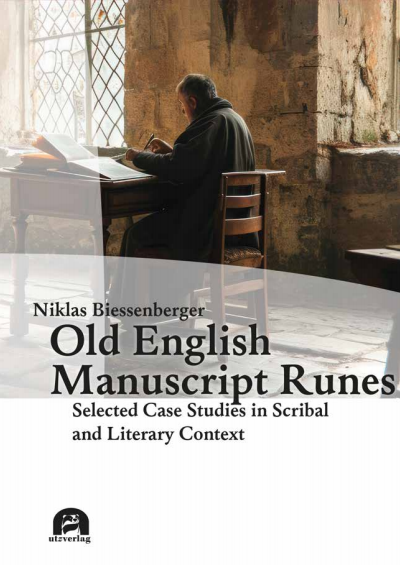
The sporadic appearance of runes in Old English manuscripts has long been a subject of scholarly inquiry. Often regarded as a “learned conceit of a few scribes”, their function is frequently misunderstood. This book moves beyond viewing these characters as simple abbreviations to investigate the impulses that governed their selective use.
Through a meticulous analysis of the logographic runes for ‘homeland’ (œ), ‘man’ (m), and ‘day’ (d) in key manuscripts, including Beowulf (Cotton Vitellius A xv), the Lindisfarne Gospels, and the Old English Orosius, this study aims to uncover a consistent, context-driven system.
The findings reveal an interesting division: where the œ rune functions as a marker in epic and historical texts to evoke an ancestral past, the m and d runes are prevalent in religious works, and highlight the relationship between the human and the divine. This book sheds new light on the sophisticated role of runic abbreviations as literary devices in Old English manuscripts.
Reihe
Sprach- und Literaturwissenschaften - Band 55
Search publication
Bibliographic data
Edition
1/2026
Copyright Year
2026
ISBN-Print
978-3-8316-4750-7
ISBN-Online
978-3-8316-7839-6
Publisher
utzverlag, München
Series
Sprach- und Literaturwissenschaften
Volume
55
Language
English
Pages
195
Product Type
Monograph
Table of contents
ChapterPages
Preface No access Pages i - 2
1. Introduction No access Pages 3 - 9
2. The rune oeþil No access Pages 10 - 52
3. The runes monn and dæg No access Pages 53 - 160
4. Conclusion No access Pages 161 - 168
List of abbreviations No access Pages 169 - 169
List of scribal abbreviations No access Pages 170 - 173
List of Figures No access Pages 174 - 182
List of Tables No access Pages 183 - 183
Sources No access Pages 184 - 187
Similar publications
from the topics "Sprachwissenschaft & Linguistik"
Monograph No access
Mechthild R. von Scheurl-Defersdorf, Theodor von Stockert