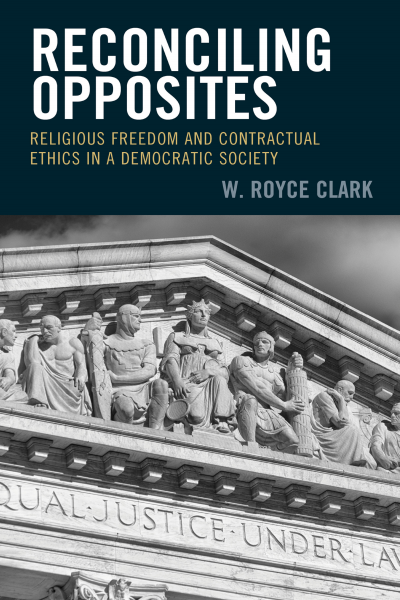
Reconciling Opposites
Religious Freedom and Contractual Ethics in a Democratic Society- Authors:
- Publisher:
- 2022
Summary
The American justice system was founded on the idea of “majority-rule,” but in a democracy this is achievable only if the majority has the interests of the whole at heart. Since the days of America’s founding, white, Christian males created laws from their standpoint as the majority, leading them to exercise power in a largely “majoritarian” way rather than upholding the interests of all citizens. The nation has not realized its stated ideals of equality of liberty, opportunity and justice for all. As a solution, W. Royce Clark formulates a non-majoritarian ethic based not on any majority but on a universal instinct, the combination of Albert Schweitzer’s “will-to-live” and Friedrich Nietzsche’s “will-to-power,” along with democratic principles articulated by John Rawls and James Madison, which would represent all citizens.
Keywords
Search publication
Bibliographic data
- Edition
- 1/2022
- Copyright Year
- 2022
- ISBN-Print
- 978-1-9787-0867-9
- ISBN-Online
- 978-1-9787-0868-6
- Publisher
- Lexington, Lanham
- Language
- English
- Pages
- 566
- Product Type
- Monograph
Table of contents
- Dedication No access
- Contents No access
- Acknowledgments No access
- Introduction No access
- Instinctual Ethics in Nietzsche and Schweitzer No access
- Rawls’s Ethic of Justice as Voluntary Inclusive Agreement No access
- The Empirical Measuring of Both Ethics and Law No access
- The Greatest Freedom: Freedom from Egoistic Morality No access
- Notes No access
- Problems of Majoritarianism in a Democracy No access
- The Problem of Religions’ Absolute Ethics in a Democracy No access
- The Legal Disinterest in Ethics No access
- Notes No access
- The “Aspirational” Intentional Christian Myth about the United States No access
- The Attempt to Identify Christian Ethics with the Ethics of the New Democracy No access
- Desacralization, Demythologization, and Freedom of Conscience No access
- Democracy Articulated with a Freedom of Conscience and Freedom of Worship No access
- National Unity and Social Solidarity No access
- Notes No access
- Three Centuries of Survival and Change for Religion, Ethics, and Law No access
- The Christian Ethic’s Encounter with the Ethnically Different Other No access
- The Secular Nature of the Constitution and “Bill of Rights” No access
- Equality’s Elusiveness despite being the Basic Ethical Presupposition No access
- Notes No access
- The Disestablishment as Real Separation Rather than Accommodation No access
- The “Incorporation” of the Bill of Rights, Including Religious Freedom No access
- “Free Exercise”: The Colonists’ and Founders’ Opposition to Coerced Worship No access
- Notes No access
- “Conscientious Objectors” and Draft Laws Built on Religious Conviction No access
- Jehovah’s Witness, Amish and Krishna Cases: “Incorporation” of the “Free Exercise” Clause No access
- Supreme Court Decisions on “Free Exercise” for Holy Days, Sites, and Sacred Rituals No access
- Notes No access
- The Court’s Boerne Counter to Congress’ RFRA No access
- Congress Doubles Down with the RLUIPA No access
- Unrealistic Expectations of Free Exercise No access
- Legal Antidiscrimination Challenged by Explicit “FE” Discrimination? No access
- Notes No access
- Corporation’s Conscience vs. Rights of the Employees No access
- Moving beyond Hobby Lobby, the RLUIPA Put to the Test No access
- The Discriminating Baker, the Message, and Subsequent “Free Exercise” No access
- More Attacks on the Birth Control Mandate of the ACA No access
- Conclusions about “Free Exercise” of “Religion” No access
- Notes No access
- “Establishment” Standards without Defining “Religion?” No access
- “Incorporation” and the Early Attempts to Define “Establishment” No access
- The Lemon Test Defined, Later Diluted by the “Historical” Test of Marsh No access
- The Origin and Spread of the Elusive Marsh Test No access
- Notes No access
- How Much “Equal Access” May a Religion Have Before It Becomes Establishment? No access
- Challenges of “Neutrality,” “Private Choice,” “Divertibility,” and Historical Longevity No access
- Notes No access
- “Neutrality” and “Private Choice” Competing with Obvious Financial Incentive No access
- The Ten Commandments’ Move: From Mt. Sinai to U.S. States’ Gov’t Property No access
- Executive Orders and Faith-Based Neutrality? No access
- More Religious Symbols or Displays: Which Are “Government” Speech? No access
- When “Private Choice” and “Neutrality” Still Allow Specific Religious Favoritism No access
- Pervasive Indoctrination Authority Yet the Central Symbol Is Only a Symbol of Death? No access
- Pervasive Indoctrination and Absolute Authority in Employment No access
- Notes No access
- Notes No access
- 1. Alphabetical Order No access
- 2. By Year No access
- Bibliography No access Pages 543 - 550
- Index No access Pages 551 - 564
- About the Author No access Pages 565 - 566