, to see if you have full access to this publication.
Edited Book No access
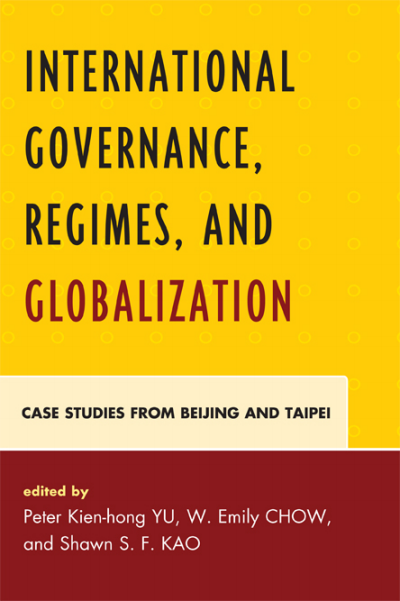
International Governance, Regimes, and Globalization
Case Studies from Beijing and Taipei
Editors:
| |
Publisher:
2010
Summary
In the this collection, International Governance, Regimes, and Globalization, the writers explore international relations and globalization by using specific examples from Beijing and Taipei. In December 1949, when China was politically divided the People's Republic of China (PRC) central government was in control of most resources, tangible and intangible. For that reason, our unit of analysis has to be the state, meaning a government or a politically organized body. With the rise of civil society at both national and international levels, applying the international/global governance theory should be closer to reality, because we have to look at both the state and non-state-sponsored dimensions, which are more complex and complicated. Indeed, international/global governance could become a new school of thought and will continue to expand as academics explore. For example, neo-liberalism primarily focuses on market and contract. When people buy and sell something, they are in a market. In other words, politics is the superstructure of economics or as Karl Marx said what prevails in economy will ultimately prevail in politics. In a sense, subscribers to this school of thought are Marxian. However, the study of international/global governance embraces the non-state sponsored dimension. Hence, it is broader than that of the neo-liberalism school of thought.
Search publication
Bibliographic data
Edition
1/2010
Copyright Year
2010
ISBN-Print
978-0-7391-4319-3
ISBN-Online
978-0-7391-4321-6
Publisher
Lexington, Lanham
Language
English
Pages
212
Product Type
Edited Book
Table of contents
ChapterPages
Contents No access
Preface No access
1 International Governance and International Regimes No access Pages 1 - 8
2 Norms, Power, the Power of Norms, and Community: Essentials of International Governance No access Pages 9 - 24
3 Does Beijing Understand the Term “International Regimes”?: A Content Study No access Pages 25 - 54
4 Beijing’s Hegemony under International Relations and International Regimes No access Pages 55 - 68
5 Adaptation and Strategic Calculation: China’s Participation in International Regimes and Institutions No access Pages 69 - 94
6 The PRC’s Governance Diplomacy in the Asia–Pacific Region No access Pages 95 - 106
7 Governing the Taiwan Strait in a Globalizing World: Using Military and Nonmilitary Adversary Regimes as a Tool No access Pages 107 - 140
8 Globalization, East Asia, and the Future of Global Politics No access Pages 141 - 180
9 Universality Claims and “Failures” across Cultures: Liberalism vs. Asian Values No access Pages 181 - 204