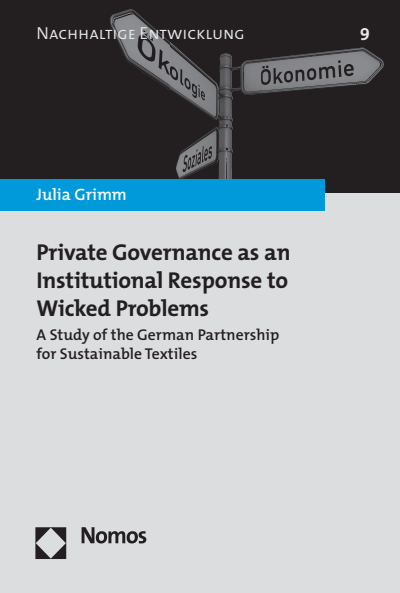
Private Governance as an Institutional Response to Wicked Problems
A Study of the German Partnership for Sustainable Textiles- Authors:
- Series:
- Nachhaltige Entwicklung, Volume 9
- Publisher:
- 2019
Summary
Aufgrund von Kindersklaverei auf Kakaoplantagen, Todesfällen in Textilfabriken oder geschlechterspezifischer Gewalt in Goldminen werden international agierende Unternehmen zunehmend mit unmoralischen Wirtschaftspraktiken in Verbindung gebracht. Während unternehmensinterne und staatliche Lösungsversuche weitestgehend ineffektiv bleiben, rücken branchenweite Zusammenschlüsse vermehrt in den Vordergrund. Hierbei geht es um die kollektive und freiwillige Initiative von Unternehmen, sich selbst zu regulieren, damit die Einhaltung von sozialen und ökologischen Mindeststandards gewährleistet werden kann.
Diese Arbeit diskutiert das Phänomen der freiwilligen Regulierung im Rahmen von Multi-Stakeholder-Initiativen anhand einer umfassenden empirischen Studie des deutschen Bündnisses für nachhaltige Textilien. Die Analyse zeigt auf, dass die Entstehung von kollektiver Selbstregulierung davon abhängt, was als „möglich“ erachtet wird, und dass sich diese Wahrnehmung durch externe Faktoren sowie Adjustierungsmechanismen verändern kann.
Search publication
Bibliographic data
- Edition
- 1/2019
- Copyright Year
- 2019
- ISBN-Print
- 978-3-8487-5949-1
- ISBN-Online
- 978-3-7489-0079-5
- Publisher
- Nomos, Baden-Baden
- Series
- Nachhaltige Entwicklung
- Volume
- 9
- Language
- English
- Pages
- 186
- Product Type
- Monograph
Table of contents
- Titelei/Inhaltsverzeichnis No access Pages 1 - 24
- 1.1 Background and relevance: Human rights violations in global supply chains No access
- 1.2 Problem statement and research object: Second-order free-riding in the context of private governance institutions No access
- 1.3 Purpose statement and research questions: A study to better understand private governance institutions No access
- 2.1 The importance of cooperation No access
- 2.2 Motives for cooperation No access
- 2.3 The importance of institutions No access
- 2.4 Implementation of institutions No access
- 2.5 The problems that institutions may entail No access
- 3.1.1 Conditions inherent in the environment of the firm No access
- 3.1.2 Conditions inherent in the environment of the institution No access
- 3.1.3 Intermediate conclusion: What economics-based literature reveals so far No access
- 3.2.1 Conditions inherent in the environment of the firm No access
- 3.2.2 Conditions describing how firms relate to their environment No access
- 3.2.3 Intermediate conclusion: What sociology-based literature reveals so far No access
- 3.3.1 Additional insights: Reviewing literature on the effectiveness of institutions No access
- 3.3.2 Open questions No access
- 4.1 Research design: An in-depth, longitudinal and single case study No access
- 4.2.1 Case selection criteria No access
- 4.2.2 Industry context: The ready-made garment industry in Bangladesh No access
- 4.2.3 Institutional context: Responses to the Rana Plaza building collapse No access
- 4.2.4 Case description: The German Partnership for Sustainable Textiles No access
- 4.3.1 Data collection process No access
- 4.3.2 Primary data sources No access
- 4.3.3 Secondary data sources No access
- 4.3.4 Challenges and ethical considerations No access
- 4.4 Data analysis No access
- 5.1.1 Phase I (t0): From mid-2001 to early-2014 No access
- 5.1.2 Phase II (t1): From early-2014 to late-2014 No access
- 5.1.3 Phase III (t2): From late-2014 to mid-2015 No access
- 5.1.4 Phase IV (t3): From mid-2015 to mid-2016 No access
- 5.1.5 Phase V (t4): From mid-2016 to mid-2018 No access
- 5.2.1 Initial field frame: Cooperation as an impossible endeavour No access
- 5.2.2 The social construction of a ‘possibility’ frame No access
- 5.2.3 Current field frame: Cooperation as a possible endeavour No access
- 5.3.1 Conditions connected to the pragmatic pillar of legitimacy No access
- 5.3.2 Conditions connected to the moral and cognitive pillars of legitimacy, the role of adjustment mechanisms and time No access
- 5.4 Fragility of frames and stabilising criteria No access
- 5.5 An extended process model No access
- 6.1 Summary and contributions: How the impossible became possible No access
- 6.2 Limitations and outlook: Avenues for future research No access
- 6.3 Practical implications: Lessons learned No access
- References No access Pages 167 - 184
- Index No access Pages 185 - 186
Bibliography (287 entries)
No match found. Try another term.
- Agrawal, A., & Gibson, C. C. (1999). Enchantment and disenchantment: The role of community in natural resource conservation. World Development, 27(4), 629-649. Open Google Scholar DOI: 10.5771/9783748900795
- Aguinis, H., & Glavas, A. (2012). What We Know and Don't Know About Corporate Social Responsibility: A Review and Research Agenda. Journal of Management, 38(4), 932-968. Open Google Scholar DOI: 10.5771/9783748900795
- Ählström, J., & Egels‐Zandén, N. (2008). The processes of defining corporate responsibility: A study of Swedish garment retailers' responsibility. Business Strategy and the Environment, 17(4), 230-244. Open Google Scholar DOI: 10.5771/9783748900795
- Alberini, A., & Segerson, K. (2002). Assessing voluntary programs to improve environmental quality. Environmental & Resource Economics, 22(1-2), 157-184. Open Google Scholar DOI: 10.5771/9783748900795
- Alvesson, M., & Karreman, D. (2007). Constructing mystery: Empirical matters in theory development. Academy of Management Review, 32(4), 1265-1281. Open Google Scholar DOI: 10.5771/9783748900795
- Ansari, S., Wijen, F., & Gray, B. (2013). Constructing a Climate Change Logic: An Institutional Perspective on the “Tragedy of the Commons”. Organization Science, 24(4), 1014–1040. Open Google Scholar DOI: 10.5771/9783748900795
- Arya, B., & Salk, J. E. (2006). Cross-sector alliance learning and effectiveness of voluntary codes of corporate social responsibility. Business Ethics Quarterly, 16(2), 211-234. Open Google Scholar DOI: 10.5771/9783748900795
- Ashby, S., Chuah, S. H., & Hoffmann, R. (2004). Industry Self-Regulation: A Game-Theoretic Typology of Strategic Voluntary Compliance. International Journal of the Economics of Business, 1-21. Open Google Scholar DOI: 10.5771/9783748900795
- Ashforth, B. E., & Gibbs, B. W. (1990). The Double-Edge of Organizational Legitimation. Organization Science, 1(2), 177-194. Open Google Scholar DOI: 10.5771/9783748900795
- Axelrod, R. (1984). The Evolution of Cooperation. New York: Basic Books. Open Google Scholar DOI: 10.5771/9783748900795
- Bäckstrand, K. (2006). Multi-Stakeholder Partnerships for Sustainable Development: Rethinking Legitimacy, Accountability and Effectiveness. European Environment, 16, 290–306. Open Google Scholar DOI: 10.5771/9783748900795
- Barnett, M. L. (2012). One Voice, But Whose Voice? Exploring What Drives Trade Association Activity. Business & Society, 52(2), 213-244. Open Google Scholar DOI: 10.5771/9783748900795
- Barnett, M. L., & Hoffman, A. J. (2008). Beyond Corporate Reputation: Managing Reputational Interdependence. Corporate Reputation Review, 11(1), 1-9. Open Google Scholar DOI: 10.5771/9783748900795
- Barnett, M. L., & King, A. A. (2008). Good Fences Make Good Neighbors: A Longitudinal Analysis of an Industry Self-Regulatory Institution. Academy of Management Journal, 51(6), 1150-1170. Open Google Scholar DOI: 10.5771/9783748900795
- Barrett, P. M., Baumann-Pauly, D., & Gu, A. (2018). Five Years After Rana Plaza: The Way Forward. NYU Stern Center for Business and Human Rights. Open Google Scholar DOI: 10.5771/9783748900795
- Bartley, T. (2005). Corporate Accountability and the Privatization of Labor Standards: Struggles over Codes of Conduct in the Apparel Industry. Politics and the Corporation, 14, 211-244. Open Google Scholar DOI: 10.5771/9783748900795
- Bartley, T. (2007). Institutional emergence in an era of globalization: The rise of transnational private regulation of labor and environmental conditions. American Journal of Sociology, 113(2), 297-351. Open Google Scholar DOI: 10.5771/9783748900795
- Bartley, T. (2018). Rules without Rights: Land, Labor, and Private Authority in the Global Economy: Oxford University Press. Open Google Scholar DOI: 10.5771/9783748900795
- Bartley, T., & Child, C. (2007). Shaming the corporation: Reputation, globalization, and the dynamics of anti-corporate movements. American Sociological Review. Open Google Scholar DOI: 10.5771/9783748900795
- Bartley, T., & Egels-Zandén, N. (2015). Responsibility and neglect in global production networks: the uneven significance of codes of conduct in Indonesian factories. Global Networks-a Journal of Transnational Affairs, 15, 21-44. Open Google Scholar DOI: 10.5771/9783748900795
- Bartley, T., & Smith, S. N. (2010). Communities of practice as cause and consequence of transnational governance: the evolution of social and environmental certification. In M. L. Djelic & S. Quack (Eds.), Transnational communities: Shaping global economic governance (pp. 347-374): Cambridge University Press. Open Google Scholar DOI: 10.5771/9783748900795
- Bates, R. H. (1988). Contra Contractarianism – Some Reflections on the New Institutionalism. Politics & Society, 16(2-3), 387-401. Open Google Scholar DOI: 10.5771/9783748900795
- Battacharya, C. B., Sen, S., & Korschun, D. (2008). Using corporate social responsibility to win the war for talent. MIT Sloan Management Review, 49, 37-44. Open Google Scholar DOI: 10.5771/9783748900795
- Baumann-Pauly, D., Nolan, J., van Heerden, A., & Samway, M. (2017). Industry-Specific Multi-Stakeholder Initiatives That Govern Corporate Human Rights Standards: Legitimacy assessments of the Fair Labor Association and the Global Network Initiative. Journal of Business Ethics, 143(4), 771-787. Open Google Scholar DOI: 10.5771/9783748900795
- Beck, U. (2000). What is Globalization? Cambridge, UK: Polity Press. Open Google Scholar DOI: 10.5771/9783748900795
- Beckmann, M., Hielscher, S., & Pies, I. (2014). Commitment Strategies for Sustainability: How Business Firms Can Transform Trade-Offs Into Win-Win Outcomes. Business Strategy and the Environment, 23(1), 18-37. Open Google Scholar DOI: 10.5771/9783748900795
- Benford, R. D., & Snow, D. A. (2000). Framing processes and social movements: An overview and assessment. Annual Review of Sociology, 26(1), 611-639. Open Google Scholar DOI: 10.5771/9783748900795
- Berger, P. L., & Luckmann, T. (1966). The social construction of reality. A treatise in the sociology of knowledge. New York: Penguin Books. Open Google Scholar DOI: 10.5771/9783748900795
- Berliner, D., & Prakash, A. (2015). “Bluewashing” the Firm? Voluntary Regulations, Program Design, and Member Compliance with the United Nations Global Compact. The Policy Studies Journal, 43(1), 115-138. Open Google Scholar DOI: 10.5771/9783748900795
- BGMEA. (2018). Comparative Statement on Export of RMG and Total Export of Bangladesh. Retrieved from http://www.bgmea.com.bd/home/pages/tradeinformation –.VXHbvM9Viko. Open Google Scholar DOI: 10.5771/9783748900795
- Birkland, T. A. (1998). Focusing events, mobilization, and agenda setting. Journal of public policy, 18(1), 53-74. Open Google Scholar DOI: 10.5771/9783748900795
- Bitzer, V., Francken, M., & Glasbergen, P. (2008). Intersectoral partnerships for a sustainable coffee chain: Really addressing sustainability or just picking (coffee) cherries? Global Environmental Change-Human and Policy Dimensions, 18(2), 271-284. Open Google Scholar DOI: 10.5771/9783748900795
- Bitzer, V., Glasbergen, P., & Leroy, P. (2012). Partnerships of a feather flock together? An analysis of the emergence of networks of partnerships in the global cocoa sector. Global Networks, 12(3), 355-374. Open Google Scholar DOI: 10.5771/9783748900795
- BMZ. (2015). Beitrittswelle zum Textilbündnis – führende Unternehmen erklären Mitgliedschaft. Müller: "Deutschland Vorreiter für faire Standards". Retrieved from http://www.bmz.de/de/presse/aktuelleMeldungen/2015/juni/20150602_Beitrittswelle-zum-Textilbuendnis-fuehrende-Unternehmen-erklaeren-Mitgliedschaft/index.html. Open Google Scholar DOI: 10.5771/9783748900795
- BMZ. (2018). Gesellschaftliche Verantwortung in Unternehmen: Freiwillige Verhaltenskodizes. Retrieved from https://www.bmz.de/de/themen/Unternehmerische_Verantwortung/sozialstandards/verhaltenskodizes/index.html. Open Google Scholar DOI: 10.5771/9783748900795
- Bomsel, O., Börkey, P., Glachant, M., & Lévêque, F. (1996). Is there room for environmental self-regulation in the mining sector? Resources Policy, 22(1-2), 79-86. Open Google Scholar DOI: 10.5771/9783748900795
- Bondy, K., Matten, D., & Moon, J. (2004). The Adoption of Voluntary Codes of Conduct in MNCs: A Three-Country Comparative Study. Business & Society Review, 109(4), 449–477. Open Google Scholar DOI: 10.5771/9783748900795
- Boström, M. (2006). Regulatory credibility and authority through inclusiveness: Standardization organizations in cases of eco-labelling. Organization, 13(3), 345-367. Open Google Scholar DOI: 10.5771/9783748900795
- Bowler, K., Castka, P., & Balzarova, M. (2015). Understanding Firms’ Approaches to Voluntary Certification: Evidence from Multiple Case Studies in FSC Certification. Journal of Business Ethics, 1-16. Open Google Scholar DOI: 10.5771/9783748900795
- Braithwaite, J. (1989). Crime, shame, and reintegration. Cambridge, England: Cambridge University Press. Open Google Scholar DOI: 10.5771/9783748900795
- Braithwaite, J., & Drahos, P. (2000). Global business regulation: Cambridge University Press. Open Google Scholar DOI: 10.5771/9783748900795
- Brammer, S., Jackson, G., & Matten, D. (2012). Corporate Social Responsibility and institutional theory: new perspectives on private governance. Socio-Economic Review, 10(1), 3-28. Open Google Scholar DOI: 10.5771/9783748900795
- Brennan, G., & Buchanan, J. M. (1985). The Reason of Rules—Constitutional Political Economy. Cambridge: Cambridge University Press. Open Google Scholar DOI: 10.5771/9783748900795
- Bromley, D. W. (1989). Economic interests and institutions. New York: Basil Blackwell. Open Google Scholar DOI: 10.5771/9783748900795
- Bromley, P., & Powell, W. W. (2012). From Smoke and Mirrors to Walking the Talk: Decoupling in the Contemporary World. Academy of Management Annals, 6, 483-530. Open Google Scholar DOI: 10.5771/9783748900795
- Buchanan, J. M. (1965). An Economic-Theory of Clubs. Economica, 32(125), 1-14. Open Google Scholar DOI: 10.5771/9783748900795
- Buchanan, J. M., & Tullock, G. (1965). The Calculus of Consent: Logical Foundations of Constitutional Democracy. Ann Arbor, MI: University of Michigan Press. Open Google Scholar DOI: 10.5771/9783748900795
- Cairncross, F. (1993). Costing the Earth. Boston: Harvard Business School Press. Open Google Scholar DOI: 10.5771/9783748900795
- Campbell, J. L. (2004). Institutional Change and Globalization. Princeton, N.J.: Princeton University Press. Open Google Scholar DOI: 10.5771/9783748900795
- Campbell, J. L. (2007). Why Would Corporations Behave in Socially Responsible Ways? An Institutional Theory of Corporate Social Responsibility. The Academy of Management Review, 32(3), 946-967. Open Google Scholar DOI: 10.5771/9783748900795
- Carrington, M. J., Neville, B. A., & Whitwell, G. J. (2010). Why Ethical Consumers Don't Walk Their Talk: Towards a Framework for Understanding the Gap Between the Ethical Purchase Intentions and Actual Buying Behaviour of Ethically Minded Consumers. Journal of Business Ethics, 97(1), 139-158. Open Google Scholar DOI: 10.5771/9783748900795
- Chandler, A. D., & Mazlish, B. (2005). Leviathans: Multinational corporations and the new global history: Cambridge University Press. Open Google Scholar DOI: 10.5771/9783748900795
- Charmaz, K. (2014). Constructing grounded theory (Vol. 2nd edition). London, UK: Sage Publications Ltd. Open Google Scholar DOI: 10.5771/9783748900795
- Chowdhury, R. (2017). Rana Plaza Fieldwork and Academic Anxiety: Some Reflections. Journal of Management Studies, 54(7), 1111-1117. Open Google Scholar DOI: 10.5771/9783748900795
- Christiansen, L. H., & Kroezen, J. J. (2016). Institutional maintenance through business collective action: The alcohol industry’s engagement with the issue of alcohol-related harm. How Institutions Matter! Emerald Group Publishing Limited, 101-143. Open Google Scholar DOI: 10.5771/9783748900795
- Christmann, P., & Taylor, G. (2001). Globalization and the environment: Determinants of firm self-regulation in China. Journal of International Business Studies, 32(3), 439-458. Open Google Scholar DOI: 10.5771/9783748900795
- Coase, R. H. (1974). The lighthouse in economics. Journal of Law and Economics, 17, 357-376. Open Google Scholar DOI: 10.5771/9783748900795
- Corbin, J., & Strauss, A. (2015). Basics of qualitative research: Techniques and procedures for developing grounded theory (Vol. 4th edition). Thousand Oaks, CA: Sage Publications Inc. Open Google Scholar DOI: 10.5771/9783748900795
- Cornelissen, J. P., Durand, R., Fiss, P. C., Lammers, J. C., & Vaara, E. (2015). Putting Communication Front and Center in Institutional Theory and Analysis. Academy of Management Review, 40(1), 10-27. Open Google Scholar DOI: 10.5771/9783748900795
- Creed, W. D., Scully, M. A., & Austin, J. R. (2002). Clothes make the person? The tailoring of legitimating accounts and the social construction of identity. Organization Science, 13(5), 475-496. Open Google Scholar DOI: 10.5771/9783748900795
- Creswell, J. W. (2009). Mapping the Field of Mixed Methods Research. Journal of Mixed Methods Research, 3(2), 95-108. Open Google Scholar DOI: 10.5771/9783748900795
- Creswell, J. W. (2014). Research design: Qualitative, quantitative, and mixed methods approaches. Sage Publications, Inc. Open Google Scholar DOI: 10.5771/9783748900795
- Dacin, M. T., Goodstein, J., & Scott, W. R. (2002). Institutional theory and institutional change: Introduction to the special research forum. Academy of Management Journal, 45(1), 45-56. Open Google Scholar DOI: 10.5771/9783748900795
- Dacin, M. T., Munir, K., & Tracey, P. (2010). Formal Dining at Cambridge Colleges: Linking Ritual Performance and Institutional Maintenance. Academy of Management Journal, 53(6), 1393-1418. Open Google Scholar DOI: 10.5771/9783748900795
- Dashwood, H. S. (2014). Sustainable Development and Industry Self-Regulation: Developments in the Global Mining Sector. Business & Society, 53(4), 551-582. Open Google Scholar DOI: 10.5771/9783748900795
- De Mandeville, B. (2017, [1729]). Free thoughts on religion, the church, and national happiness: Routledge. Open Google Scholar DOI: 10.5771/9783748900795
- Deephouse, D. L., & Suchman, M. (2008). Legitimacy in Organizational Institutionalism. In R. Greenwood, C. Oliver, K. Sahlin, & R. Suddaby (Eds.), The SAGE Handbook of Organizational Institutionalism: SAGE Publications Inc. Open Google Scholar DOI: 10.5771/9783748900795
- Demsetz, H. (1967). Toward a Theory of Property Rights. American Economic Review, 57(2), 347-359. Open Google Scholar DOI: 10.5771/9783748900795
- Diller, J. (1999). A Social Conscience in the Global Marketplace? Labour Dimensions of Codes of Conduct, Social Labelling and Investor Initiatives. International Labour Review, 138(2), 99-129. Open Google Scholar DOI: 10.5771/9783748900795
- DiMaggio, P. J. (1988). Interest and agency in institutional theory. In L. G. Zucker (Ed.), Institutional patterns and organizations: Culture and environment (pp. 3-22). Cambridge, MA: Ballinger. Open Google Scholar DOI: 10.5771/9783748900795
- DiMaggio, P. J. (1991). Constructing an Organizational Field as a Professional Project: U.S. Art Museums, 1920–1940. In W. W. Powell & P. J. DiMaggio (Eds.), The New Institutionalism in Organizational Analysis (pp. 267–292). Chicago: University of Chicago Press. Open Google Scholar DOI: 10.5771/9783748900795
- DiMaggio, P. J., & Powell, W. W. (1983). The Iron Cage Revisited – Institutional Isomorphism and Collective Rationality in Organizational Fields. American Sociological Review, 48(2), 147-160. Open Google Scholar DOI: 10.5771/9783748900795
- DiMaggio, P. J., & Powell, W. W. (1991). Introduction. In W. W. Powell & P. J. DiMaggio (Eds.), The new institutionalism in organizational analysis. Chicago: University of Chicago Press. Open Google Scholar DOI: 10.5771/9783748900795
- Dingwerth, K., & Pattberg, P. (2009). World Politics and Organizational Fields: The Case of Transnational Sustainability Governance. European Journal of International Relations, 15(4), 707-743. Open Google Scholar DOI: 10.5771/9783748900795
- Djelic, M.-L., & Quack, S. (2008). Institutions and transnationalization. In R. Greenwood, C. Oliver, K. Sahlin, & R. Suddaby (Eds.), The Sage Handbook of Organizational Institutionalism (pp. 299-324). London: Sage. Open Google Scholar DOI: 10.5771/9783748900795
- Djelic, M.-L., & Sahlin-Andersson, K. (2006). Transnational Governance: Institutional dynamics of regulation. Cambridge: Cambridge University Press. Open Google Scholar DOI: 10.5771/9783748900795
- Donaghey, J., & Reinecke, J. (2018). When Industrial Democracy Meets Corporate Social Responsibility A Comparison of the Bangladesh Accord and Alliance as Responses to the Rana Plaza Disaster. British Journal of Industrial Relations, 56(1), 14-42. Open Google Scholar DOI: 10.5771/9783748900795
- Donaghey, J., Reinecke, J., Niforou, C., & Lawson, B. (2014). From Employment Relations to Consumption Relations: Balancing Labor Governance in Global Supply Chains. Human Resource Management, 53(2), 229-252. Open Google Scholar DOI: 10.5771/9783748900795
- Dowling, J., & Pfeffer, J. (1975). Organizational Legitimacy – Social Values and Organizational Behavior. Pacific sociological review, 18(1), 122-136. Open Google Scholar DOI: 10.5771/9783748900795
- Doyle, C. (1997). Self Regulation and Statutory Regulation. Business Strategy Review, 8(3), 35-43. Open Google Scholar DOI: 10.5771/9783748900795
- Eckhardt, G. M., Belk, R., & Devinney, T. M. (2010). Why Don’t Consumers Consume Ethically? Journal of Consumer Behaviour, 9(6), 426-436. Open Google Scholar DOI: 10.5771/9783748900795
- Egels-Zandén, N. (2009). TNC motives for signing international framework agreements: A continuous bargaining model of stakeholder pressure. Journal of Business Ethics, 84(4), 529-547. Open Google Scholar DOI: 10.5771/9783748900795
- Egels-Zandén, N. (2007). Suppliers' Compliance with MNCs' Codes of Conduct: Behind the Scenes at Chinese Toy Suppliers. Journal of Business Ethics, 75, 45–62. Open Google Scholar DOI: 10.5771/9783748900795
- Egels-Zandén, N., & Hyllman, P. (2006). Exploring the Effects of Union–NGO Relationships on Corporate Responsibility: The Case of the Swedish Clean Clothes Campaign. Journal of Business Ethics, 64, 303–316. Open Google Scholar DOI: 10.5771/9783748900795
- Egels-Zandén, N., & Kallifatides, M. (2006). The corporate social performance dilemma: Organizing for goal duality in low-income African markets. In W. Vissner, M. McIntosh, & C. Middleton (Eds.), Corporate Citizenship in Africa: Lessons from the Past. Paths to the Future. Sheffield: Greenleaf Publishing. Open Google Scholar DOI: 10.5771/9783748900795
- Egels-Zandén, N., Lindberg, K., & Hyllman, P. (2015). Multiple institutional logics in union–NGO relations: private labor regulation in the Swedish Clean Clothes Campaign. Business Ethics: A European Review, 24(4), 347-360. Open Google Scholar DOI: 10.5771/9783748900795
- Egels-Zandén, N., & Wahlqvist, E. (2007). Post-Partnership Strategies for Defining Corporate Responsibility: The Business Social Compliance Initiative. Journal of Business Ethics, 70(2), 175-189. Open Google Scholar DOI: 10.5771/9783748900795
- Ehrlich, P. R., & Ehrlich, A. H. (2013). Can a collapse of global civilization be avoided? Royal Society. Open Google Scholar DOI: 10.5771/9783748900795
- Eisenhardt, K. M. (1989). Building Theories from Case-Study Research. Academy of Management Review, 14(4), 532-550. Open Google Scholar DOI: 10.5771/9783748900795
- Eisenhardt, K. M., & Graebner, M. E. (2007). Theory building from cases: Opportunities and challenges. Academy of Management Journal, 50(1), 25-32. Open Google Scholar DOI: 10.5771/9783748900795
- Elsbach, K. D., & Sutton, R. I. (1992). Acquiring Organizational Legitimacy through Illegitimate Actions – a Marriage of Institutional and Impression Management Theories. Academy of Management Journal, 35(4), 699-738. Open Google Scholar DOI: 10.5771/9783748900795
- Elster, J. (1989). Social Norms and Economic-Theory. Journal of Economic Perspectives, 3(4), 99-117. Open Google Scholar DOI: 10.5771/9783748900795
- Fasterling, B. (2017). Human Rights Due Diligence as Risk Management: Social Risk Versus Human Rights Risk. Business and Human Rights Journal, 2(2), 225-247. Open Google Scholar DOI: 10.5771/9783748900795
- Fauchart, E., & Cowan, R. (2014). Weak links and the management of reputational interdependencies. Strategic Management Journal, 35(4), 532-549. Open Google Scholar DOI: 10.5771/9783748900795
- Ferraro, F., Etzion, D., & Gehman, J. (2015). Tackling Grand Challenges Pragmatically: Robust Action Revisited. Organization Studies, 36(3), 363-390. Open Google Scholar DOI: 10.5771/9783748900795
- Fligstein, N. (1991). The Structural Transformation of American Industry: An Institutional Account of the Causes of Diversification in the Largest Firms, 1919–1979. In W. W. Powell & P. J. DiMaggio (Eds.), The New Institutionalism in Organizational Analysis (pp. 311–336). Chicago: University of Chicago Press. Open Google Scholar DOI: 10.5771/9783748900795
- Fligstein, N. (1996). Markets as politics: A political-cultural approach to market institutions. American Sociological Review, 61(4), 656-673. Open Google Scholar DOI: 10.5771/9783748900795
- Fligstein, N. (1997). Social skill and institutional theory. American Behavioral Scientist, 40(4), 397-405. Open Google Scholar DOI: 10.5771/9783748900795
- Fligstein, N. (2001). Social skill and the theory of fields. Sociological Theory, 19(2), 105-125. Open Google Scholar DOI: 10.5771/9783748900795
- Fontana, E., & Egels-Zandén, N. (2018). Non Sibi, Sed Omnibus: Influence of Supplier Collective Behaviour on Corporate Social Responsibility in the Bangladeshi Apparel Supply Chain. Journal of Business Ethics, 1-18. Open Google Scholar DOI: 10.5771/9783748900795
- Fransen, L. (2012). Multi-stakeholder governance and voluntary programme interactions: legitimation politics in the institutional design of Corporate Social Responsibility. Socio-Economic Review, 10(1), 163-192. Open Google Scholar DOI: 10.5771/9783748900795
- Fransen, L., & Burgoon, B. (2012). A market for worker rights: Explaining business support for international private labour regulation. Review of International Political Economy, 19(2), 236-266. Open Google Scholar DOI: 10.5771/9783748900795
- Frenkel, S. J., Rahman, K. M., Rahman, S., & Fourie, J. (2017). Between Lead Firms and Institutional Ensembles: Labour and Safety Practices in Bangladeshi Garment Export Factories. Garment Supply Chain Governance Discussion Paper Series, 03. Open Google Scholar DOI: 10.5771/9783748900795
- Friedman, M. (2009). Capitalism and freedom. Chicago: University of Chicago Press. Open Google Scholar DOI: 10.5771/9783748900795
- Gabbioneta, C., Greenwood, R., Mazzola, P., & Minoja, M. (2013). The influence of the institutional context on corporate illegality. Accounting Organizations and Society, 38(6-7), 484-504. Open Google Scholar DOI: 10.5771/9783748900795
- Garud, R., Hardy, C., & Maguire, S. (2007). Institutional entrepreneurship as embedded agency: An introduction to the special issue. Organization Studies, 28(7), 957-969. Open Google Scholar DOI: 10.5771/9783748900795
- Garud, R., Jain, S., & Kumaraswamy, A. (2002). Institutional entrepreneurship in the sponsorship of common technological standards: The case of Sun Microsystems and Java. Academy of Management Journal, 45(1), 196-214. Open Google Scholar DOI: 10.5771/9783748900795
- Garvin, D. A. (1983). Can Industry Self-Regulation Work? California Management Review, 25(4), 37-52. Open Google Scholar DOI: 10.5771/9783748900795
- Gauthier, D. (1985). Morals by Agreement. Oxford: Oxford University Press. Open Google Scholar DOI: 10.5771/9783748900795
- Gereffi, G., Humphrey, J., Kaplinsky, R., & Sturgeon, T. J. (2001). Introduction: Globalisation, value chains and development. Ids Bulletin-Institute of Development Studies, 32(3), 1-8. Open Google Scholar DOI: 10.5771/9783748900795
- Gereffi, G., Humphrey, J., & Sturgeon, T. (2005). The governance of global value chains. Review of International Political Economy, 12(1), 78-104. Open Google Scholar DOI: 10.5771/9783748900795
- Gioia, D. A., Corley, K. G., & Hamilton, A. L. (2012). Seeking Qualitative Rigor in Inductive Research: Notes on the Gioia Methodology. Organizational Research Methods, 16(1), 15-31. Open Google Scholar DOI: 10.5771/9783748900795
- Glaser, B. G., & Strauss, A. (1967). The discovery of grounded theory: Strategies for qualitative research. Chicago, IL: Aldine. Open Google Scholar DOI: 10.5771/9783748900795
- Goodrick, E., & Salancik, G. R. (1996). Organizational discretion in responding to institutional practices: Hospitals and cesarean births. Administrative Science Quarterly, 41(1), 1-28. Open Google Scholar DOI: 10.5771/9783748900795
- Graafland, J. J. (2004). Collusion, Reputation Damage and Interest in Codes of Conduct: The Case of a Dutch Construction Company. Business Ethics: A European Review, 13(2/3), 127–142. Open Google Scholar DOI: 10.5771/9783748900795
- Graham, D., & Woods, N. (2006). Making corporate self-regulation effective in developing countries. World Development, 34(5), 868-883. Open Google Scholar DOI: 10.5771/9783748900795
- Grayson, D., & Nelson, J. (2013). Corporate Responsibility Coalitions: The Past, Present and Future of Alliances for Sustainable Capitalism. Redwood City: Greenleaf Pubishing, Austin and Stanford University Press. Open Google Scholar DOI: 10.5771/9783748900795
- Greenwood, D. J., & Levin, M. (2005). Reform of the social sciences and of universities through action research (Vol. 3): SAGE. Open Google Scholar DOI: 10.5771/9783748900795
- Greenwood, R., & Hinings, C. R. (1996). Understanding radical organizational change: Bringing together the old and the new institutionalism. Academy of Management Review, 21(4), 1022-1054. Open Google Scholar DOI: 10.5771/9783748900795
- Greenwood, R., Suddaby, R., & Hinings, C. R. (2002). Theorizing change: The role of professional associations in the transformation of institutionalized fields. Academy of Management Journal, 45(1), 58-80. Open Google Scholar DOI: 10.5771/9783748900795
- Grief, A. (1997). Microtheory and Recent Developments in the Study of Economic Institutions through Economic History. In D. Kreps & K. Wallis (Eds.), Advances in Economic Theory and Econometrics (pp. 79-113). Cambridge: Cambridge University Press. Open Google Scholar DOI: 10.5771/9783748900795
- Guest, G., MacQueen, K. M., & Namey, E. E. (2012). Applied Thematic Analysis. Thousand Oaks: SAGE Publications, Inc. Open Google Scholar DOI: 10.5771/9783748900795
- Gunningham, N., & Rees, J. (1997). Industry Self-Regulation: An Institutional Perspective. Law and Policy, 19(4), 363-414. Open Google Scholar DOI: 10.5771/9783748900795
- Gupta, A. K., & Lad, L. J. (1983). Industry Self-Regulation – an Economic, Organizational, and Political-Analysis. Academy of Management Review, 8(3), 416-425. Open Google Scholar DOI: 10.5771/9783748900795
- Habermas, J. (1981). Theorie des kommunikativen Handelns. Frankfurt am Main: Suhrkamp. Open Google Scholar DOI: 10.5771/9783748900795
- Habermas, J. (1990). Discourse ethics: notes on a program of philosophical justification. In J. Habermas (Ed.), Moral Consciousness and Communicative Action (pp. 43-115). Cambridge, MA: MIT Press. Open Google Scholar DOI: 10.5771/9783748900795
- Hardin, G. J. (1968). The tragedy of the commons. The population problem has no technical solution; it requires a fundamental extension in morality. Science, 162(3859), 1243-1248. Open Google Scholar DOI: 10.5771/9783748900795
- Hardin, R. (1982). Collective Action. Baltimore, MD: Johns Hopkins University Press. Open Google Scholar DOI: 10.5771/9783748900795
- Haufler, V. (1999). Self-regulation and business norms: Political risk, political activism. In A. C. Cutler, V. Haufler, & T. Porter (Eds.), Private authority and international affairs (pp. 199-222). Albany: State University of New York Press. Open Google Scholar DOI: 10.5771/9783748900795
- Haufler, V. (2001). A public role for the private sector. Washington, DC: Carnegie Endowment for International Peace. Open Google Scholar DOI: 10.5771/9783748900795
- Heckathorn, D. D. (1996). The dynamics and dilemmas of collective action. American Sociological Review, 61(2), 250-277. Open Google Scholar DOI: 10.5771/9783748900795
- Hemphill, T. A. (1992). Self-Regulating Industry Behavior – Antitrust Limitations and Trade Association Codes of Conduct. Journal of Business Ethics, 11(12), 915-920. Open Google Scholar DOI: 10.5771/9783748900795
- Héritier, A., & Eckert, S. (2008). New modes of governance in the shadow of hierarchy: self-regulation by industry in Europe. Journal of public policy, 28(1), 113-138. Open Google Scholar DOI: 10.5771/9783748900795
- Hobbes, T. (1970, [1651]). Leviathan. Erster und zweiter Teil übersetzt von Jacob Peter Mayer. Stuttgart: Reclam. Open Google Scholar DOI: 10.5771/9783748900795
- Hoffman, A. J. (1999). Institutional Evolution and Change: Environmentalism and the U.S. Chemical Industry. The Academy of Management Journal, 42(4), 351-371. Open Google Scholar DOI: 10.5771/9783748900795
- Hollander, S. (2005). Jean-Baptiste Say and the classical canon in economics: The British connection in French classicism: Routledge. Open Google Scholar DOI: 10.5771/9783748900795
- Homann, K. (2014). Sollen und Können: Grenzen und Bedingungen der Individualmoral: Ibera Verlag. Open Google Scholar DOI: 10.5771/9783748900795
- Homann, K., & Blome-Drees, F. (1992). Wirtschafts- und Unternehmensethik. Göttingen: Vandenhoeck and Ruprecht. Open Google Scholar DOI: 10.5771/9783748900795
- Homann, K., & Luetge, C. (2013). Einführung in die Wirtschaftsethik (Vol. 3). Berlin: LIT Verlag Dr. W. Hopf. Open Google Scholar DOI: 10.5771/9783748900795
- Homann, K., & Suchanek, A. (2000). Ökonomik. Eine Einführung. Tübingen: Mohr Siebeck. Open Google Scholar DOI: 10.5771/9783748900795
- Jastram, S. M., & Schneider, A.-M. (2015). Sustainable fashion governance at the example of the partnership for sustainable textiles. uwf, 23, 205-212. Open Google Scholar DOI: 10.5771/9783748900795
- Jennings, P. D., & Zandbergen, P. A. (1995). Ecologically Sustainable Organizations – an Institutional Approach. Academy of Management Review, 20(4), 1015-1052. Open Google Scholar DOI: 10.5771/9783748900795
- Kaul, I., Conceicao, P., Le Goulven, K., & Mendoza, R. U. (2003). Providing global public goods: managing globalization: Oxford University Press. Open Google Scholar DOI: 10.5771/9783748900795
- Keohane, R. O. (2003). Global governance and democratic accountability. Open Google Scholar DOI: 10.5771/9783748900795
- Khan, F. R., Munir, K. A., & Willmott, H. (2007). A dark side of institutional entrepreneurship: Soccer balls, child labour and postcolonial impoverishment. Organization Studies, 28(7), 1055-1077. Open Google Scholar DOI: 10.5771/9783748900795
- King, A. A., & Lenox, M. J. (2000). Industry self-regulation without sanctions: The chemical industry's Responsible Care Program. Academy of Management Journal, 43(4), 698-716. Open Google Scholar DOI: 10.5771/9783748900795
- King, A. A., Lenox, M. J., & Barnett, M. L. (2002). Strategic Responses to the Reputation Commons Problem. In A. J. Hoffman & M. J. Ventresca (Eds.), Organizations, Policy, and the Natural Environment. Institutional and Strategic Perspectives (pp. 393-406). Stanford: Stanford University Press. Open Google Scholar DOI: 10.5771/9783748900795
- King, B. G. (2008). A Political Mediation Model of Corporate Response to Social Movement Activism. Administrative Science Quarterly, 53(3), 395-421. Open Google Scholar DOI: 10.5771/9783748900795
- Klein, N. (2001). No logo: Taking aim at the brand bullies. New York: Picador. Open Google Scholar DOI: 10.5771/9783748900795
- Knight, J. (1992). Institutions and Social Conflict. New York: Cambridge University Press. Open Google Scholar DOI: 10.5771/9783748900795
- Knudsen, J. S., & Moon, J. (2017). Visible hands: Government regulation and international business responsibility: Cambridge University Press. Open Google Scholar DOI: 10.5771/9783748900795
- Kobrin, S. J. (2001). Territoriality and the governance of cyberspace. Journal of International Business Studies, 32(4), 687-704. Open Google Scholar DOI: 10.5771/9783748900795
- Kobrin, S. J. (2008). Globalization, transnational corporations and the future of global governance. In A. G. Scherer & G. Palazzo (Eds.), Handbook of research on global corporate citizenship: Edward Elgar Publishing. Open Google Scholar DOI: 10.5771/9783748900795
- Kraatz, M. S., & Block, E. S. (2008). Organizational Implications of Institutional Pluralism. In R. Greenwood, C. Oliver, K. Sahlin, & R. Suddaby (Eds.), The SAGE Handbook of Organizational Institutionalism: SAGE Publications Inc. Open Google Scholar DOI: 10.5771/9783748900795
- Lamin, A., & Zaheer, S. (2012). Wall Street vs. Main Street: Firm Strategies for Defending Legitimacy and Their Impact on Different Stakeholders. Organization Science, 23(1), 47-66. Open Google Scholar DOI: 10.5771/9783748900795
- Lane, C., & Probert, J. (2009). National capitalisms, global production networks: Fashioning the value chain in the UK, US, and Germany: Oxford University Press. Open Google Scholar DOI: 10.5771/9783748900795
- Langley, A. (1999). Strategies for theorizing from process data. Academy of Management Review, 24(4), 691-710. Open Google Scholar DOI: 10.5771/9783748900795
- Langley, A., Smallman, C., Tsoukas, H., & Van de Ven, A. H. (2013). Process Studies of Change in Organization and Management: Unveiling Temporality, Activity, and Flow. Academy of Management Journal, 56(1), 1-13. Open Google Scholar DOI: 10.5771/9783748900795
- Lawrence, T. B. (2017). High-Stakes Institutional Translation: Establishing North America's First Government-Sanctioned Supervised Injection Site. Academy of Management Journal, 60(5), 1771-1800. Open Google Scholar DOI: 10.5771/9783748900795
- Lawrence, T. B., & Suddaby, R. (2006). lnstitutions and institutional work. In S. R. Clegg, C. Hardy, T. B. Lawrence, & W. R. Nord (Eds.), Handbook of organization studies (Vol. 2nd Edition, pp. 215-254). London: Sage. Open Google Scholar DOI: 10.5771/9783748900795
- Leach, M., Mearns, R., & Scoones, I. (1999). Environment Entitlements: Dynamics and Institutions in Community Based Natural Resource Management. World Development, 27(2), 225-247. Open Google Scholar DOI: 10.5771/9783748900795
- Lee, T. W. (1999). Using qualitative methods in organizational research. Thousand Oaks, CA: Sage. Open Google Scholar DOI: 10.5771/9783748900795
- Leitheiser, E. (2017). A sheep in wolf’s clothing?: How the illusion of hard law makes business more responsible. Academy of Management Proceedings. Open Google Scholar DOI: 10.5771/9783748900795
- Lenox, M. J. (2006). The role of private decentralized institutions in sustaining industry self-regulation. Organization Science, 17(6), 677-690. Open Google Scholar DOI: 10.5771/9783748900795
- Lenox, M. J., & Nash, J. (2003). Industry self‐regulation and adverse selection: A comparison across four trade association programs. Business Strategy and the Environment, 12(6), 343-356. Open Google Scholar DOI: 10.5771/9783748900795
- Lieberman, M., & Asaba, S. (2006). Why do firms imitate each other? Academy of Management Review, 31, 366-385. Open Google Scholar DOI: 10.5771/9783748900795
- Lincoln, Y. S., & Guba, E. G. (1985). Naturalistic inquiry: Sage. Open Google Scholar DOI: 10.5771/9783748900795
- Lohmeyer, N., & Schuessler, E. (2017). Rana Plaza as a threat to the fast fashion model? An analysis of institutional responses to the disaster in Germany. In C. H. Becker-Leifhold, M. (Ed.), Eco Friendly and Fair: Fast Fashion and Consumer Behavior. Sheffield: Greenleaf Publishing. Open Google Scholar DOI: 10.5771/9783748900795
- Lorange, P. M., Scott Morton, S., & Goshal, S. (1986). Strategic Control. St. Paul, MN: West. Open Google Scholar DOI: 10.5771/9783748900795
- Lounsbury, M. (2001). Institutional sources of practice variation: Staffing college and university recycling programs. Administrative Science Quarterly, 46(1), 29-56. Open Google Scholar DOI: 10.5771/9783748900795
- Lounsbury, M., & Crumley, E. T. (2007). New practice creation: An institutional perspective on innovation. Organization Studies, 28(7), 993-1012. Open Google Scholar DOI: 10.5771/9783748900795
- Maguire, S., Hardy, C., & Lawrence, T. B. (2004). Institutional Entrepreneurship in Emerging Fields: HIV/AIDS Treatment Advocacy in Canada. Academy of Management Journal, 47(5), 657-679. Open Google Scholar DOI: 10.5771/9783748900795
- Mair, J., Wolf, M., & Seelos, C. (2016). Scaffolding: A Process of Transforming Patterns of Inequality in Small-Scale Societies. Academy of Management Journal, 59(6), 2021-2044. Open Google Scholar DOI: 10.5771/9783748900795
- Maitland, A. (2005). Industries seek safety in numbers. FT Responsible Business, Special Report. Open Google Scholar DOI: 10.5771/9783748900795
- Maitland, I. (1985). The Limits of Business Self-Regulation. California Management Review, 27(3), 132-147. Open Google Scholar DOI: 10.5771/9783748900795
- Marques, J. C. (2016). Industry Business Associations: Self-Interested or Socially Conscious? Journal of Business Ethics. Open Google Scholar DOI: 10.5771/9783748900795
- Marshall, C., & Rossman, G. B. (1995). Designing Qualitative Research. London: Sage Publications. Open Google Scholar DOI: 10.5771/9783748900795
- Marx, A. (2008). Limits to non‐state market regulation: A qualitative comparative analysis of the international sport footwear industry and the Fair Labor Association. Regulation & Governance, 2(2), 253-273. Open Google Scholar DOI: 10.5771/9783748900795
- Maxwell, J. W., Lyon, T. P., & Hackett, S. C. (2000). Self-regulation and social welfare: The political economy of corporate environmentalism. Journal of Law & Economics, 43(2), 583-617. Open Google Scholar DOI: 10.5771/9783748900795
- McAdam, D., & Scott, W. R. (2005). Organizations and movements. In G. F. Davis, D. McAdam, W. R. Scott, & M. N. Zald (Eds.), Social Movements and Organization Theory (pp. 4-40). New York: Cambridge University Press. Open Google Scholar DOI: 10.5771/9783748900795
- McDonnell, M. H., King, B. G., & Soule, S. A. (2015). A Dynamic Process Model of Private Politics: Activist Targeting and Corporate Receptivity to Social Challenges. American Sociological Review, 80(3), 654-678. Open Google Scholar DOI: 10.5771/9783748900795
- Mena, S., & Palazzo, G. (2012). Input and Output Legitimacy of Multi-Stakeholder Initiatives. Business Ethics Quarterly, 22(3), 527-556. Open Google Scholar DOI: 10.5771/9783748900795
- Meyer, J. W., & Rowan, B. (1977). Institutionalized Organizations – Formal-Structure as Myth and Ceremony. American Journal of Sociology, 83(2), 340-363. Open Google Scholar DOI: 10.5771/9783748900795
- Meyer, J. W., & Scott, W. R. (1983). Organizational environments. Beverly Hills, CA: Sage. Open Google Scholar DOI: 10.5771/9783748900795
- Meyer, M., Narjoud, S., & Granata, J. (2017). When collective action drives corporate social responsibility implementation in small and medium-sized enterprises: the case of a network of French winemaking cooperatives. International Journal of Entrepreneurship and Small Business, 32(1-2), 7-27. Open Google Scholar DOI: 10.5771/9783748900795
- Miles, M. B., Huberman, A. M., & Saldana, J. (2013). Qualitative data analysis: Sage. Open Google Scholar DOI: 10.5771/9783748900795
- Milgrom, P. R., North, D. C., & Weingast, B. R. (1990). The Role of Institutions in the Revival of Trade: The Medieval Law Merchant, Private Judges, and the Champagne Fairs. Economics and Politics, 2, 1-23. Open Google Scholar DOI: 10.5771/9783748900795
- Molinas, J. R. (1998). The impact of inequality, gender, external assistance and social capital on local-level cooperation. World Development, 26(3), 413-431. Open Google Scholar DOI: 10.5771/9783748900795
- Morse, J. M. (2015). Critical Analysis of Strategies for Determining Rigor in Qualitative Inquiry. Qual Health Res, 25(9), 1212-1222. Open Google Scholar DOI: 10.5771/9783748900795
- North, D. C. (1990). Institutions, institutional change, and economic performance. Cambridge, UK: Cambridge University Press. Open Google Scholar DOI: 10.5771/9783748900795
- North, D. C. (1991). Institutions. Journal of Economic Perspectives, 5(1), 97-112. Open Google Scholar DOI: 10.5771/9783748900795
- North, D. C., & Thomas, R. P. (1970). An economic theory of the growth of the Western world. Economic History Review, 23, 1-17. Open Google Scholar DOI: 10.5771/9783748900795
- O’Hare, M. (1982). Information strategies as regulatory surrogates. In E. Bardach & R. Kagan (Eds.), Social regulation: Strategies for reform. San Francisco: Transaction Books. Open Google Scholar DOI: 10.5771/9783748900795
- O’Rourke, D. (2003). Outsourcing Regulation: Analyzing Nongovernmental Systems of Labor Standards and Monitoring. The Policy Study Journal, 31(1), 1-29. Open Google Scholar DOI: 10.5771/9783748900795
- O’Rourke, D. (2005). Market movements: Nongovernmental organization strategies to influence global production and consumption. Journal of Industrial Ecology, 9, 115-128. Open Google Scholar DOI: 10.5771/9783748900795
- O’Rourke, D. (2006). Multi-stakeholder Regulation: Privatizing or Socializing Global Labor Standards? World Development, 34(5), 899–918. Open Google Scholar DOI: 10.5771/9783748900795
- Oliver, C. (1991). Strategic Responses to Institutional Processes. Academy of Management Review, 16(1), 145-179. Open Google Scholar DOI: 10.5771/9783748900795
- Olson, M. (1965). The Logic of Collective Action. Public Goods and the Theory of Groups. (Vol. 5). Cambridge, Massachusetts; London, England: Harvard University Press. Open Google Scholar DOI: 10.5771/9783748900795
- Onwuegbuzie, A. J., & Leech, N. L. (2007). Validity and Qualitative Research: An Oxymoron? Quality & Quantity, 41, 233–249. Open Google Scholar DOI: 10.5771/9783748900795
- Ostrom, E. (1990). Governing the Commons: The Evolution of Institutions for Collective Action. Cambridge: Cambridge University Press. Open Google Scholar DOI: 10.5771/9783748900795
- Ostrom, E. (2000). Collective action and the evolution of social norms. Journal of Economic Perspectives, 14(3), 137-158. Open Google Scholar DOI: 10.5771/9783748900795
- Ostrom, E., & Walker, J. (1997). Neither Markets Nor States: Linking Transformation Processes in Collective Action Arenas. In D. C. Mueller (Ed.), Perspectives on Public Choice: A Handbook (pp. 35-72). Cambridge: Cambridge University Press. Open Google Scholar DOI: 10.5771/9783748900795
- Ostrom, E., Walker, J., & Gardner, R. (1992). Covenants with and without a Sword – Self-Governance Is Possible. American Political Science Review, 86(2), 404-417. Open Google Scholar DOI: 10.5771/9783748900795
- Pacheco, D. F., York, J. G., Dean, T. J., & Sarasvathy, S. D. (2010). The Coevolution of Institutional Entrepreneurship: A Tale of Two Theories. Journal of Management, 36(4), 974-1010. Open Google Scholar DOI: 10.5771/9783748900795
- Palazzo, G., & Richter, U. (2005). CSR business as usual? The case of the tobacco industry. Journal of Business Ethics, 61(4), 387-401. Open Google Scholar DOI: 10.5771/9783748900795
- Palazzo, G., & Scherer, A. G. (2006). Corporate legitimacy as deliberation: A communicative framework. Journal of Business Ethics, 66(1), 71-88. Open Google Scholar DOI: 10.5771/9783748900795
- Papadakis, K. (2011). Shaping global industrial relations: The impact of international framework agreements. Basingstoke, UK: Palgrave Macmillan. Open Google Scholar DOI: 10.5771/9783748900795
- Parsons, T. (1951). The social system. Glencoe, IL: Free Press. Open Google Scholar DOI: 10.5771/9783748900795
- Partnership, f. S. T. (2014). Plan of Action for the Partnership for Sustainable Textiles. Retrieved from https://www.textilbuendnis.com/wp-content/uploads/2017/07/Aktionsplan_Buendnis_fuernachhaltige_Textilien_mit-Annex_Stand_09-10-2014.pdf. Open Google Scholar DOI: 10.5771/9783748900795
- Partnership, f. S. T. (2018). Socially and environmentally – we’re on the right track. Retrieved from https://www.textilbuendnis.com. Open Google Scholar DOI: 10.5771/9783748900795
- Pettigrew, A. M. (1997). What is a processual analysis. Scandinavian journal of management, 13(4). Open Google Scholar DOI: 10.5771/9783748900795
- Powell, W. W., & DiMaggio, P. J. (1991). The new institutionalism in organizational analysis. Chicago: University of Chicago Press. Open Google Scholar DOI: 10.5771/9783748900795
- Pradhan, D., & Ranjan, R. (2016). Achieving Sustainability and Development through Collective Action? An Empirical Analysis of the Impact of the Bore Pool Sharing Program on Farm Incomes and Crop Choices. World Development, 1-23. Open Google Scholar DOI: 10.5771/9783748900795
- Purdy, J., Ansari, S., & Gray, B. (2017). Are Logics Enough? Framing as an Alternative Tool for Understanding Institutional Meaning Making. Journal of Management Inquiry, 1-12. Open Google Scholar DOI: 10.5771/9783748900795
- Rao, H. (1998). Caveat emptor: The construction of nonprofit consumer watchdog organizations. American Journal of Sociology, 103(4), 912-961. Open Google Scholar DOI: 10.5771/9783748900795
- Rees, J. V. (1997). Development of Communitarian Regulation in the Chemical Industry. Law and Policy, 19, 477-528. Open Google Scholar DOI: 10.5771/9783748900795
- Reinecke, J., & Ansari, S. (2015). Taming Wicked Problems: The Role of Framing in the Construction of Corporate Social Responsibility. Journal of Management Studies. Open Google Scholar DOI: 10.5771/9783748900795
- Reinecke, J., & Donaghey, J. (2015). After Rana Plaza: Building coalitional power for labour rights between unions and (consumption-based) social movement organisations. Organization, 22(5), 720-740. Open Google Scholar DOI: 10.5771/9783748900795
- Reinecke, J., & Donaghey, J. (2017). Collective Action and Social Partnership in Global Supply Chains: Lessons from the Bangladesh Accord. Annual Review of Social Partnerships 2017. Open Google Scholar DOI: 10.5771/9783748900795
- Reinecke, J., Manning, S., & von Hagen, O. (2012). The Emergence of a Standards Market: Multiplicity of Sustainability Standards in the Global Coffee Industry. Organization Studies, 33(5-6), 791-814. Open Google Scholar DOI: 10.5771/9783748900795
- Reisman, D. A. (1998). Adam Smith on market and State. Journal of Institutional and Theoretical Economics-Zeitschrift Fur Die Gesamte Staatswissenschaft, 154(2), 357-383. Open Google Scholar DOI: 10.5771/9783748900795
- Riisgaard, L. (2005). International Framework Agreements: A New Model for Securing Workers Rights? Industrial Relations, 44(4), 707–737. Open Google Scholar DOI: 10.5771/9783748900795
- Riisgaard, L. (2009). Global Value Chains, Labor Organization and Private Social Standards: Lessons from East African Cut Flower Industries. World Development, 37(2), 326-340. Open Google Scholar DOI: 10.5771/9783748900795
- Rittel, H. W. J., & Webber, M. M. (1973). Dilemmas in a General Theory of Planning. Policy Sciences, 4(2), 155-169. Open Google Scholar DOI: 10.5771/9783748900795
- Royle, T. (2005). Realism or Idealism? Corporate Social Responsibility and the Employee Stakeholder in the Global Fast-Food Industry. Business Ethics: A European Review, 14(1), 42–55. Open Google Scholar DOI: 10.5771/9783748900795
- Ruggie, J. G. (2002). The Theory and Practice of Learning Networks: Corporate Social Responsibility and the Global Compact. Journal of Corporate Citizenship, 5, 27-36. Open Google Scholar DOI: 10.5771/9783748900795
- Ruttan, V. W. (2006). Social science knowledge and economic development: An institutional design perspective. Journal of Institutional Economics, 2, 249-272. Open Google Scholar DOI: 10.5771/9783748900795
- Saldana, J. (2009). The Coding Manual for Qualitative Researchers: SAGE. Open Google Scholar DOI: 10.5771/9783748900795
- Salvadori, N., & Signorino, R. (2014). Adam Smith on Monopoly Theory. Making good a lacuna. Scottish Journal of Political Economy, 61(2), 178-195. Open Google Scholar DOI: 10.5771/9783748900795
- Scherer, A. G., & Palazzo, G. (2011). The New Political Role of Business in a Globalized World: A Review of a New Perspective on CSR and its Implications for the Firm, Governance, and Democracy. Journal of Management Studies, 48(4), 899-931. Open Google Scholar DOI: 10.5771/9783748900795
- Scherer, A. G., Palazzo, G., & Baumann, D. (2006). Global rules and private actors: Toward a new role of the transnational corporation in global governance. Business Ethics Quarterly, 16(4), 505-532. Open Google Scholar DOI: 10.5771/9783748900795
- Scherer, A. G., Palazzo, G., & Seidl, D. (2013). Managing Legitimacy in Complex and Heterogeneous Environments: Sustainable Development in a Globalized World. Journal of Management Studies, 50(2), 259-284. Open Google Scholar DOI: 10.5771/9783748900795
- Schneiberg, M., & Bartley, T. (2001). Regulating American industries: Markets, politics, and the institutional determinants of fire insurance regulation. American Journal of Sociology, 107(1), 101-146. Open Google Scholar DOI: 10.5771/9783748900795
- Scholtz, J. T. (1984). Cooperation, deterrence, and the ecology of regulation enforcement. Law and Society Review, 18(2), 179-224. Open Google Scholar DOI: 10.5771/9783748900795
- Schrage, E. J., & Ewing, A. P. (2005). The Cocoa Industry and Child Labour. Journal of Corporate Citizenship, 18, 99-112. Open Google Scholar DOI: 10.5771/9783748900795
- Schreck, P., van Aaken, D., & Donaldson, T. (2013). Positive Economics and the Normativistic Fallacy: Bridging the Two Sides of CSR. Business Ethics Quarterly, 23(2), 297-329. Open Google Scholar DOI: 10.5771/9783748900795
- Schuessler, E. (2009). Strategische Prozesse und Persistenzen: Pfadabhängige Organisation der Wertschöpfung in der Bekleidungsindustrie: Kohlhammer. Open Google Scholar DOI: 10.5771/9783748900795
- Schuessler, E., Ashwin, S., Oka, C., Lohmeyer, N., & Alexander, R. (2018). Why do Firms Support Transnational Industrial Relations Arrangements? A Processual Lens. Academy of Management Proceedings. Open Google Scholar DOI: 10.5771/9783748900795
- Schuessler, E., Rueling, C. C., & Wittneben, B. B. F. (2014). On Melting Summits: The Limitations of Field-Configuring Events as Catalysts of Change in Transnational Climate Policy. Academy of Management Journal, 57(1), 140-171. Open Google Scholar DOI: 10.5771/9783748900795
- Scott, C., Cafaggi, F., & Senden, L. (2011). The Conceptual and Constitutional Challenge of Transnational Private Regulation. Journal of Law and Society, 38(1), 1-19. Open Google Scholar DOI: 10.5771/9783748900795
- Scott, W. R. (1983). The organization of environments: Network, cultural and historical elements. In J. W. Meyer & W. R. Scott (Eds.), Organizational Environments: Ritual and Rationality. Beverly Hills: Sage Publications. Open Google Scholar DOI: 10.5771/9783748900795
- Scott, W. R. (1995a). Institutions and Organizations. Thousand Oaks, CA: Sage. Open Google Scholar DOI: 10.5771/9783748900795
- Scott, W. R. (1995b). Introduction: institutional theory and organizations. In W. R. Scott & S. Christensen (Eds.), The institutional construction of organizations: International and longitudinal studies. California: Sage Publications. Open Google Scholar DOI: 10.5771/9783748900795
- Scott, W. R. (2004). Institutional Theory: Contributing to a Theoretical Research Program. In K. G. Smith & M. A. Hitt (Eds.), Great Minds in Management: The Process of Theory Development. Oxford: Oxford University Press. Open Google Scholar DOI: 10.5771/9783748900795
- Scott, W. R., & Meyer, J. W. (1994). Institutional environments and organizations: Structural complexity and individualism: Sage. Open Google Scholar DOI: 10.5771/9783748900795
- Sethi, S. P. (2005). The effectiveness of industry-based codes in serving public interest: the case of the International Council on Mining and Metals. Transnational Corporations, 14(3), 55-100. Open Google Scholar DOI: 10.5771/9783748900795
- Shrivastava, P. (1994). Castrated Environment – Greening Organizational Studies. Organization Studies, 15(5), 705-726. Open Google Scholar DOI: 10.5771/9783748900795
- Siggelkow, N. (2007). Persuasion with case studies. Academy of Management Journal, 50(1), 20-24. Open Google Scholar DOI: 10.5771/9783748900795
- Smets, M., Morris, T., & Greenwood, R. (2012). From Practice to Field: A Multilevel Model of Practice-Driven Institutional Change. Academy of Management Journal, 55(4), 877-904. Open Google Scholar DOI: 10.5771/9783748900795
- Smith, A. (1974, [1789]). Der Wohlstand der Nationen. Eine Untersuchung seiner Natur und seiner Ursachen. München: Beck. Open Google Scholar DOI: 10.5771/9783748900795
- Smith, A. (2010, [1759]). The Theory of Moral Sentiments: Penguin. Open Google Scholar DOI: 10.5771/9783748900795
- Snow, D. A. (2013). Social movements. The Wiley‐Blackwell Encyclopedia of Social and Political Movements. Open Google Scholar DOI: 10.5771/9783748900795
- Snow, D. A., Worden, S. K., Rochford, E. B., & Benford, R. D. (1986). Frame Alignment Processes, Micromobilization, and Movement Participation. American Sociological Review, 51(4), 464-481. Open Google Scholar DOI: 10.5771/9783748900795
- Soundararajan, V., & Brown, J. A. (2016). Voluntary Governance Mechniasms in Global Supply Chains: Beyond CSR to a Stakeholder Utility Perspective. Journal of Business Ethics, 134, 83-102. Open Google Scholar DOI: 10.5771/9783748900795
- Spar, D. L. (1998). The Spotlight and the Bottom Line: How Multinationals Export Human Rights. Foreign Affairs, 77, 7-12. Open Google Scholar DOI: 10.5771/9783748900795
- Stahl, B., & Wötzel, U. (2013). Runder Tisch Verhaltenskodizes–ein Dialogforum ohne Biss. Corporate Social Responsibility-Mythen und Maßnahmen, 93-95. Open Google Scholar DOI: 10.5771/9783748900795
- Stigler, G. J. (1974). Free Riders and Collective Action: An Appendix to Theories of Economic Regulation. Bell Journal of Economics and Management Science, 5(2), 359-365. Open Google Scholar DOI: 10.5771/9783748900795
- Strauss, A., & Corbin, J. M. (1990). Basics of qualitative research: Grounded theory procedures and techniques. Thousand Oaks, CA, US: Sage Publications, Inc. Open Google Scholar DOI: 10.5771/9783748900795
- Suchman, M. C. (1995). Managing Legitimacy – Strategic and Institutional Approaches. Academy of Management Review, 20(3), 571-610. Open Google Scholar DOI: 10.5771/9783748900795
- Thelen, K. (2004). How Institutions Evolve: The Political Economy of Skills in Germany, Britain, the United States, and Japan. New York: Cambridge University Press. Open Google Scholar DOI: 10.5771/9783748900795
- Thornton, P. H., & Ocasio, W. (1999). Institutional logics and the historical contingency of power in organizations: Executive succession in the higher education publishing industry, 1958-1990. American Journal of Sociology, 105(3), 801-843. Open Google Scholar DOI: 10.5771/9783748900795
- Thornton, P. H., & Ocasio, W. (2008). Institutional Logics. In R. Greenwood, C. Oliver, R. Suddaby, & K. Sahlin-Andersson (Eds.), The Sage Handbook of Organizational Institutionalism. Thousand Oaks, CA, US: SAGE Publications Inc. Open Google Scholar DOI: 10.5771/9783748900795
- Thornton, P. H., Ocasio, W., & Lounsbury, M. (2012). The institutional logics perspective: A new approach to culture, structure and process. New York, NY: Oxford University Press. Open Google Scholar DOI: 10.5771/9783748900795
- Tokatli, N. (2014). ‘Made in Italy? Who cares!’ Prada’s new economic geography. Geoforum, 54, 1-9. Open Google Scholar DOI: 10.5771/9783748900795
- Tolbert, P. S., & Zucker, L. G. (1983). Institutional Sources of Change in the Formal-Structure of Organizations – the Diffusion of Civil-Service Reform, 1880-1935. Administrative Science Quarterly, 28(1), 22-39. Open Google Scholar DOI: 10.5771/9783748900795
- Tolbert, P. S., & Zucker, L. G. (1994). Institutional Analyses of Organizations: Legitimate but not Institutionalized. UCLA, 6(5). Open Google Scholar DOI: 10.5771/9783748900795
- Turcotte, M. F., Reinecke, J., & den Hond, F. (2014). Explaining variation in the multiplicity of private social and environmental regulation: a multi-case integration across the coffee, forestry and textile sectors. Business and Politics, 16(1), 151-189. Open Google Scholar DOI: 10.5771/9783748900795
- UN. (1998). Unite Power of Markets with Authority of Universal Values [Press release] Open Google Scholar DOI: 10.5771/9783748900795
- Utting, P. (2001). UN-business partnerships: Whose agenda counts? Transnational Associations-Associations Transnationales, 3, 118-129. Open Google Scholar DOI: 10.5771/9783748900795
- Van Tulder, R., & Kolk, A. (2001). Multinationality and corporate ethics: Codes of conduct in the sporting goods industry. Journal of International Business Studies, 32(2), 267-283. Open Google Scholar DOI: 10.5771/9783748900795
- Vogel, D. (2007). The market for virtue: The potential and limits of corporate social responsibility: Brookings Institution Press. Open Google Scholar DOI: 10.5771/9783748900795
- Vogel, D. (2008). Private global business regulation. Annual Review of Political Science, 11(13), 261-282. Open Google Scholar DOI: 10.5771/9783748900795
- Vogel, D. (2010). The Private Regulation of Global Corporate Conduct Achievements and Limitations. Business & Society, 49(1), 68-87. Open Google Scholar DOI: 10.5771/9783748900795
- von Hayek, F. A. (1944). The road to serfdom. Chicago: University of Chicago Press. Open Google Scholar DOI: 10.5771/9783748900795
- Walgenbach, P., & Meyer, R. (2008). Neoinstitutionalistische Organisationstheorie: W. Kohlhammer Verlag. Open Google Scholar DOI: 10.5771/9783748900795
- Weber, M. (1904). Die "Objektivität" sozialwissenschaftlicher und sozialpolitischer Erkenntnis. Archiv für Sozialwissenschaft und Sozialpolitik, 19(1), 22-87. Open Google Scholar DOI: 10.5771/9783748900795
- Weick, K. E. (1979). The social psychology of organizing. New York, NY: Addison-Wesley. Open Google Scholar DOI: 10.5771/9783748900795
- Wijen, F. (2014). Means Versus Ends in Opaque Institutional Fields: Trading Off Compliance and Achievement in Sustainability Standard Adoption. Academy of Management Review, 39(3), 302-323. Open Google Scholar DOI: 10.5771/9783748900795
- Williamson, Q. E. (2000). The new institutional economics: Taking stock, looking ahead. Journal of Economic Literature, 38(3), 595-613. Open Google Scholar DOI: 10.5771/9783748900795
- Yin, R. K. (2011). Applications of case study research: Sage. Open Google Scholar DOI: 10.5771/9783748900795
- York, J. G., Vedula, S., & Lenox, M. J. (2017). It’s Not Easy Building Green: The Impact of Public Policy, Private Actors, and Regional Logics on Voluntary Standards Adoption. Academy of Management Journal. Open Google Scholar DOI: 10.5771/9783748900795
- Yue, L. Q., Luo, J., & Ingram, P. (2013). The Failure of Private Regulation: Elite Control and Market Crises in the Manhattan Banking Industry. Administrative Science Quarterly, 58(1), 37-68. Open Google Scholar DOI: 10.5771/9783748900795
- Zafarullah, H., & Siddiquee, N. A. (2001). Dissecting public sector corruption in Bangladesh: issues and problems of control. Public Organization Review, 1(4), 465-486. Open Google Scholar DOI: 10.5771/9783748900795
- Zajak, S., Egels-Zandén, N., & Piper, N. (2017). Networks of Labour Activism: Collective Action across Asia and Beyond. An Introduction to the Debate. Development and Change, 48(5), 899-921. Open Google Scholar DOI: 10.5771/9783748900795
- Zalan, T., & Lewis, G. (2004). Writing about methods in qualitative research: Towards a more transparent approach. Open Google Scholar DOI: 10.5771/9783748900795
- Zelger, J., Raich, M., Abfalter, D., & Mueller, J. (2011). Gabek®: Theory and application in management studies. 10th Annual European Academy of Management (EURAM) Conference, 1-4. Open Google Scholar DOI: 10.5771/9783748900795
- Zucker, L. G. (1977). The role of institutionalization in cultural persistence. American Sociological Review, 726-743. Open Google Scholar DOI: 10.5771/9783748900795