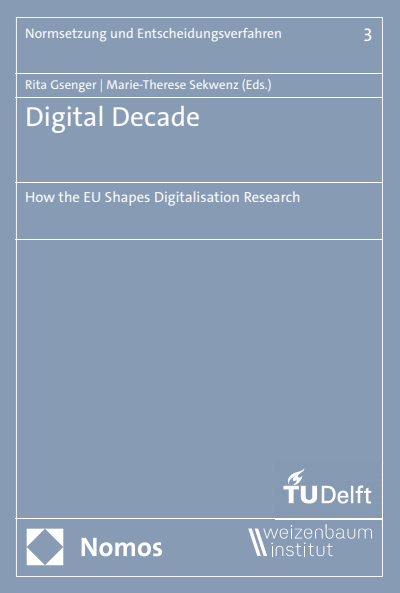
Digital Decade
How the EU Shapes Digitalisation Research- Editors:
- |
- Series:
- Normsetzung und Entscheidungsverfahren – Schriftenreihe des Weizenbaum-Instituts für normative Wissenschaften, Volume 3
- Publisher:
- 2025
Summary
Over the last ten years, numerous pieces of EU legislation have been adopted in the field of digital law, including the AI Act, the Digital Services Act and the Digital Markets Act. These complex but sometimes difficult to understand legal acts play an important role in research and everyday life. In this volume, legal scholars and experts present the key EU legal acts that are relevant to social scientists, students and the general public. The volume also aims to stimulate a greater exchange between the social sciences and law, from which both disciplines can benefit. With contributions byDr. Adelaida Afilipoaie | Valerie Albus | Dr. Lucie Antoine | Lena Auler | Dr. Jascha Bareis, M.A. | Prof. Dr. Catrien Bijleveld, LL.M. | Jorge Constantinos | Dr. Max van Drunen, M.Z. | Rita Gsenger, M.A., M.Sc.| Prisca von Hagen | Liza Herrmann | Julia Krämer | Eyup Kun | Dr. Lucas Lasota | Lisa Markschies | Prof. Dr. Heritiana Ranaivoson | Nik Roeingh | Prof. Dr. Hannah Ruschemeier | Dr. Pascal Schneiders | Marie-Therese Sekwenz | Lisa Völzmann | David Wagner
Keywords
Search publication
Bibliographic data
- Edition
- 1/2025
- Copyright Year
- 2025
- ISBN-Print
- 978-3-7560-1741-6
- ISBN-Online
- 978-3-7489-4399-0
- Publisher
- Nomos, Baden-Baden
- Series
- Normsetzung und Entscheidungsverfahren – Schriftenreihe des Weizenbaum-Instituts für normative Wissenschaften
- Volume
- 3
- Language
- English
- Pages
- 524
- Product Type
- Edited Book
Table of contents
- Titelei/InhaltsverzeichnisPages 1 - 8 Download chapter (PDF)
- Authors: |Download chapter (PDF)
- The principles of the Digital Decade
- Structural aspects of European Regulations and Acts
- The structure of this book
- Authors:Download chapter (PDF)
- 1. What are empirical legal studies
- 2. Doing empirical legal research
- 3. Empirical legal research: qualitative and quantitative methods
- 4.1 Sample representativeness
- 4.2 Sample nonresponse
- 4.3 Testing
- 5. Causality
- 6. Special topic: Systematic case law analysis
- 7. Conclusion
- Authors: |Download chapter (PDF)
- 1. Regulating AI: an introduction
- 2.1 Regulating AI is regulating power
- 2.2 EU taking a stance in the geopolitical AI arena
- 2.3 Coming into being: from ethical guidelines to legal regulation
- 3.1 Regulatory structure
- 3.2.1 Material scope of application
- 3.2.2 High-risk classification as the relevant regulatory definition
- 3.2.3 Exceptions in the material scope
- 3.3 Personal scope of application
- 3.4 Territorial scope of application
- 4.1 Prohibited AI practices
- 4.2 High-risk systems
- 4.3 Systemic risks for general-purpose AI
- 5. Oversight and governance
- 6.1.1 Towards the final AI definition
- 6.1.2 Beyond technical AI: understanding AI as a socio-technical phenomenon
- 6.2.1 Physicality and actors: AI systems are no fixed products
- 6.3 Different understanding of risks and harms depict paradigms that are not compatible
- 6.4 Watered down Fundamental Rights Impact Assessment
- 7.1 Democratically unsupervised private standardisation procedures
- 7.2 Missing participation of affected subjects
- 7.3 The problem of algorithmic discrimination escaping the categories of anti-discrimination
- 7.4 The loophole of addressing recommendation systems on platforms as high-risk systems
- 7.5 Lobbying and the risk of tech-solutionism
- 8. Conclusion and outlook
- Authors:Download chapter (PDF)
- 1. An introduction to AI systems
- 2. AI systems in our societies: good and bad AI?
- 3. The approach of the EU AI Act to accountable AI
- 4. Conclusion
- Authors: |Download chapter (PDF)
- 1. Introducing the DSA: Context and scope
- 2.1 A harmonised form of reporting through DSA transparency reports?
- 2.2 A place for all platform contracts – The terms and conditions database
- 2.3 Quick insights in content moderation decisions through the statement of reason database
- 2.4 Ad library
- 2.5 Data access for researchers
- 3.1 Drop-down of user empowerment? Notice and action mechanisms
- 3.2 Trust me, I am a trusted flagger
- 3.3 The wronged user? Internal complaint-handling systems in the DSA
- 3.4 The right of a judge or the DSA’s answer to it: Out-of-court dispute settlements
- 4. In crisis – Please follow the Commission
- 5.1 That seems pretty risky: Risk assessment under the DSA
- 5.2 Better to avoid it – Risk mitigation under the DSA
- 5.3 Audits
- 5.4 The deluge of delegated regulations
- 6. Conclusion
- Authors: |Download chapter (PDF)
- 1. Introduction
- 2.1 Regulatory approach of the DSA for content moderation
- 2.2 Illegal content and hate speech
- 2.3.1 Notice and action procedure
- 2.3.2 Complaint and redress mechanisms
- 2.3.3 Cooperation with authorities
- 2.4.1 Risk assessment and mitigation
- 2.4.2 Data access
- 2.5 Transparency obligations
- 3.1 Legitimacy and accuracy of content moderation
- 3.2 Involvement of state authorities
- 3.3 Effectiveness of content moderation
- 3.4 Data access
- 4.1 Starting point and the DSA’s approach
- 4.2 Risks and opportunities in relation to the DSA
- 4.3 Implications
- Authors:Download chapter (PDF)
- 1. A fairy-tale introduction
- 2.1 The (complicated) relationship between law and social science: a practical approach
- 2.2 What constitutes the social character of law?
- 3.1 Background considerations on the development of the Regulation
- 3.2 The dual objectives of the DMA
- 3.3 The material and geographical scope
- 3.4 The gatekeeper’s obligations and prohibitions
- 3.5 Enforcement and penalties for non-compliance
- 4.1 Explicit references to the principle of proportionality in the DMA
- 4.2 The recitals
- 4.3 The beneficiaries
- 4.4 The regulatory objectives
- 4.5 The ex ante control approach
- 4.6 Core platform services
- 5. Conclusion & considerations for further (interdisciplinary) research
- Authors:Download chapter (PDF)
- 1. Introduction
- 2.1 Legislative history
- 2.2 Legal basis
- 2.3 Scope of application
- 2.4 Definition of terrorist content
- 3.1 Removal orders
- 3.2 Cross-border removal orders
- 3.3 Specific measures to address the dissemination of terrorist content
- 3.4 Transparency obligations
- 4. Conclusion
- Authors:Download chapter (PDF)
- 1. Introduction
- 2.1 What is political advertising?
- 2.2 Why does the Political Advertising Regulation empower researchers?
- 3.1 Ad libraries
- 3.2.1 From whom can data be requested?
- 3.2.2 Who can request data?
- 4.1 Defining political ads
- 4.2 When should political advertising be prohibited?
- 4.3 Effective labels for political advertisements
- 5. Conclusion
- Authors:Download chapter (PDF)
- 1.1 Objective
- 1.2 Legal Nature
- 2.1 Scope
- 2.2.1 Research Organisations, Cultural Heritage Institutions, and Other Users
- 2.2.2 Rightholders
- 2.3.1 Creating Legal Certainty
- 2.3.2 Enhancing Innovation
- 3.1 Scope
- 3.2.1 Press Publishers
- 3.2.2 Information Society Service Providers
- 3.2.3 Authors and Other Rightholders
- 3.3 Objectives and Perspectives
- 3.3.1 Protecting a Free and Pluralist Press
- 3.3.2 Shifting Power Dynamics
- 4.1 Scope
- 4.2.1 Users
- 4.2.2 Rightholders
- 4.2.3 Online Content-Sharing Service Providers
- 4.3.1 Risking Overblocking
- 4.3.2 Strengthening Copyright Protection
- 5. Conclusion
- Authors: |Download chapter (PDF)
- 1. Introduction
- 2. Safeguarding media pluralism at the EU level
- 3.1 Explaining Section 5 of the EMFA
- 3.2 The EMFA’s approach to media pluralism and the link with the Media Plurality Monitor
- 3.3 Delving into Art. 22 of the EMFA: assessment of media market concentrations
- 4.1.1 Ownership and beyond
- 4.1.2 Diversity and opinion-formation power
- 4.2.1 Editorial independence
- 4.2.2 Editorial independence in practice
- 4.3.1 Economic sustainability
- 4.3.2 Assessment of economic sustainability
- 4.4 Art. 22(2)(d)
- 4.5 Art. 22(2)(e)
- 5. Conclusion
- Authors:Download chapter (PDF)
- 1. The role of trust for data sharing
- 2. Law and trust
- 3.1 The DGA: background, legal nature, and overview
- 3.2.1 Scope and covered data categories
- 3.2.2 General conditions for re-use
- 3.2.3 Additional safeguards
- 3.2.4 Safeguards for the transfer of non-personal data to third countries
- 3.2.5 Transparent and effective framework for re-use requests
- 3.2.6 Summary, guiding principles and perspective
- 3.3.2 Definition of data intermediation service
- 3.3.3 Notification process and public register
- 3.3.4 Conditions for providing data intermediation services
- 3.3.5 Summary, guiding principles, and perspective
- 3.3.7 Definition of data altruism
- 3.3.8 Registration process and public register
- 3.3.9 Further obligations for recognised data altruism organisations
- 3.3.10 Consent and permission
- 3.3.11 Summary, guiding principles, and perspective
- 4. The role of trust in business and consumer decisions?
- 5. Concluding remarks
- Authors: |Download chapter (PDF)
- 1. Introduction
- 2.1 Understanding open government data through its rationale
- 2.2 Understanding open government data as a data state
- 2.3.1 Openness
- 2.3.2 Data
- 2.3.3 Government
- 3.1 A brief history of internal market regulation for open public sector data
- 3.2.1 Standard licences (Art. 8 ODD)
- 3.2.2 Available formats (Art. 5 ODD)
- 3.2.3 Charging (Art. 6 ODD)
- 3.2.4 Non-discrimination (Art. 11 ODD)
- 3.2.5 Exclusivity arrangements (Art. 12 ODD)
- 4.1.1 High value datasets
- 4.1.2 Public sector bodies’ data
- 4.1.3 Public undertakings’ data
- 4.2.1 Dividing lines within Art. 10 ODD
- 4.2.2 Research data
- 4.2.3 Covered data
- 4.2.4 Exclusion: scientific publications
- 5. Overall assessment of the Open Data Directive
- Authors:Download chapter (PDF)
- 1. Introduction
- 2.1 Reasons for the lack of data sharing
- 2.2 Effects of the lack of data sharing
- 2.3.1 The European Data Strategy
- 2.3.2 Basic idea of the DA with regard to IoT data
- 3.1 Scope of application: what data are covered?
- 3.2 Relevant actors
- 3.3.1 Data access of the user
- 3.3.2 Data access for data recipients
- 3.3.3 Restrictions for the use by the data holder
- Legal Basis for Data Processing
- Relationship between the right to data portability and Article 4 (1) and Article 5 (1) DA
- Criticism of the creation of user accounts
- Data as trade secret
- Approaches of the DA with regard to trade secrets
- 4.1.3 Relationship to database protection
- 4.1.4 Relationship to other existing legal instruments
- 4.2 Independent decision by the user?
- 4.3.1 “Ownership-like” position of the user?
- 4.3.2 (Exclusive) de facto position of the data holder?
- 5. Conclusion
- Authors:Download chapter (PDF)
- 1. Introduction
- 2.1.1 Processing
- 2.1.2 Personal data
- 2.1.3 Controllership
- 2.2 Principles of data processing
- 3.1 Art 6 GDPR – lawful grounds for processing
- 3.2 Art. 7 GDPR – conditions for valid consent
- 3.3 Art. 9 GDPR – Data revealing special categories of personal data
- 3.4.1 Privacy policies (Arts. 12, 13, 14 GDPR)
- 3.4.2 Privacy labels and standardised icons (Art. 12(7) GDPR)
- 3.5 Measuring data flows and tracking – transparency and data minimisation
- 3.6 Art. 15 GDPR – right of access
- 3.7 Art. 17 GDPR – right to be forgotten
- 4.1 Challenges for empirical (legal) studies in the context of the GDPR
- 5. Conclusion
- Authors:Download chapter (PDF)
- 1. Introduction
- 2. Legislative history
- 3.1 More control over the individual’s electronic health data
- 3.2 Better treatment through better data
- 3.3 Data access made easy?
- 4.1 Application process
- 4.2 Purposes
- 4.3.1 Categories
- 4.3.2 Patient protection through anonymisation and pseudonymisation
- 4.4 Prohibited secondary uses
- 5. To consent or not to consent
- 6.1 Relation to the GDPR
- 6.2 Differences between the Member States
- 6.3 Garbage in/garbage out?
- 7. Outlook
- Authors:Download chapter (PDF)
- 1. Introduction – making cybersecurity a priority for digital markets
- 2. Cybersecurity is broader than computer security
- 3. Vulnerabilities are inescapable in the digital world
- 4. From safety to security – understanding the EU’s cybersecurity regulatory path
- 5. CRA: setting far-reaching cybersecurity rules for digital products
- 6. The challenge of regulating FOSS cybersecurity
- 7. Conclusion and future research
- Authors:Download chapter (PDF)
- 1. Introduction: evolution from the NIS Directive to NIS 2 Directive
- 2.1.1 Bifurcation of entities under the NIS 2 Directive: Essential and important entities
- 2.1.2 The different supervision and enforcement regime for essential and important entities
- 2.2 Jurisdictional scope of Member States under the NIS 2 Directive
- 2.3 Material scope of the NIS 2 Directive: data and availability of services as proxies to protect individuals and society
- 2.4 Objective of the NIS 2 Directive: solving underinvestment problem in cybersecurity
- 3.1.1 Cybersecurity strategies
- 3.1.2 National cyber crisis management frameworks
- 3.1.3 Establishment of competent authorities and single points of contact for cybersecurity
- 3.1.4 Computer Security Incident Response Teams (CSIRTS)
- 3.1.5 Cooperation at the national level
- 3.2.1 European vulnerability database
- 3.2.2 EU-level cooperation
- 4.1 Responsibilities of managerial boards
- 4.2 Risk management responsibility
- 4.3.1 Notification to CSIRT or competent authorities
- 4.3.3 Notification of the incident to the recipients of services
- 4.3.4 The communication of significant cyber threats to the recipients of services
- 4.3.6 Information sharing on voluntary basis
- 5. Conclusion
- Author BiographiesPages 513 - 520 Download chapter (PDF)
- Abbreviations and AcronymsPages 521 - 524 Download chapter (PDF)