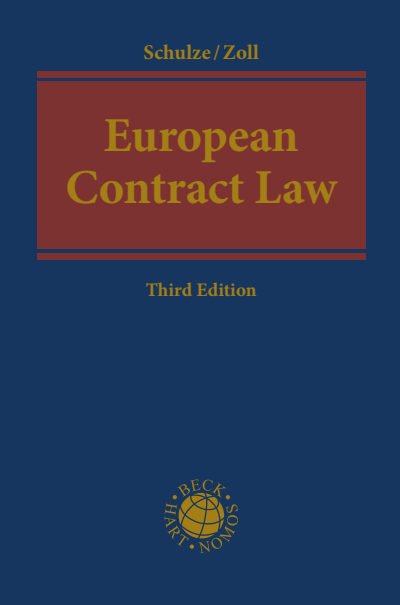
European Contract Law
- Authors:
- |
- Publisher:
- 2021
Summary
This 3rd edition provides information on core EU legislation as well as academic projects in order to unlock the content, approaches and objectives of European contract law.
European contract law is not only a core aspect of European private law but also plays a highly important role in the development of contract law at national level. However, European contract law’s contribution and significance are often overlooked and its content, approaches and objectives not fully understood.
This revised and updated 3rd edition unlocks European contract law by providing fundamental information about core EU legislation, court decisions, and academic projects in order to show how a system arises from the interaction between the different sources. Moreover, this 3rd edition takes into account the recent legislative responses to digitalization and the development of a contract law for the 21st century.
Keywords
Search publication
Bibliographic data
- Edition
- 3/2021
- Copyright Year
- 2021
- ISBN-Print
- 978-3-8487-7764-8
- ISBN-Online
- 978-3-7489-2573-6
- Publisher
- Nomos, Baden-Baden
- Series
- Kooperationswerke Beck - Hart – Nomos
- Language
- English
- Pages
- 312
- Product Type
- Comment
Table of contents
- Titelei/Inhaltsverzeichnis No access Pages I - XXVI
- 1. European contract law No access
- 2. Aim and structure of this book No access
- a) Sources No access
- b) Literature No access
- a) Overview No access
- b) Variations No access
- a) Origins No access
- b) Independence of the supranational legal order No access
- c) Interdependency between national and supranational law No access
- 1. Types of rules No access
- 2. Primary law No access
- a) Development No access
- b) Fragmentation No access
- c) Minimum and full harmonization No access
- a) Consumer protection No access
- b) Small and medium-sized enterprises No access
- c) E-Commerce No access
- d) Payment services No access
- e) Non-discrimination No access
- f) Insurance contracts No access
- g) Others No access
- a) Principles of European Contract Law No access
- b) Pavia Draft No access
- c) General contract law and commercial law No access
- d) Acquis Principles No access
- a) Basic sources No access
- b) Draft Common Frame of Reference No access
- a) Concept No access
- b) Preparation No access
- c) Structure and scope of application No access
- d) Codification character No access
- e) Legislative process and withdrawal No access
- 1. Overview No access
- a) Supply of digital content and digital services No access
- b) Sale of goods No access
- c) Modernization Directive No access
- d) Online intermediaries No access
- 3. Reshaping contract law No access
- a) Requirements for qualified consent No access
- b) Transparency No access
- a) Contract and inertia selling No access
- b) Conclusion of contract as a complex process No access
- 3. Contract and notice No access
- a) Commercial agency No access
- b) Timeshare No access
- c) Goods, digital content and digital services No access
- d) Consumer credit No access
- a) Framework contract No access
- b) Advisory services No access
- c) Service contracts No access
- III. Mixed contracts No access
- 1. Overview No access
- 2. Default and mandatory law No access
- 3. Limitations on contract drafting by controlling contract terms No access
- 4. Good faith No access
- a) Foundation No access
- b) Discrimination due to a personal characteristic No access
- c) Discrimination as a barrier to the internal market No access
- 6. Party status No access
- 1. Overview No access
- 2. Notion of the consumer in the acquis communautaire No access
- 3. Other protected parties No access
- 1. Overview No access
- 2. Comparative perspectives No access
- 3. Pre-contractual duties and good faith in the acquis communautaire No access
- 4. Pre-contractual duties and good faith in the CESL No access
- 5. Pre-contractual duties and good faith in the DCFR No access
- 6. Liability under the Acquis Principles No access
- 7. Information duties in the acquis communautaire No access
- 8. Between pre-contractual information duties and fair trading No access
- 9. Standardized performance No access
- 10. Pre-contractual information duties in the CESL No access
- 11. Pre-contractual information duties in the Acquis Principles and DCFR No access
- 12. Consequences of breach No access
- a) Introduction No access
- b) Acquis communautaire No access
- c) Academic and legislative drafts No access
- a) Principle No access
- b) Requirements No access
- c) Additional requirements? No access
- a) Offer and acceptance No access
- b) Conclusion without offer and acceptance No access
- c) Conclusion via distance means of communication No access
- d) Conclusion of contract with data as counter-performance No access
- a) Statements by a contract party No access
- b) Third parties No access
- a) Binding effect No access
- b) Protecting the offeror No access
- a) Principle No access
- b) Functions No access
- c) Requirements No access
- d) Legal effects No access
- a) An alternative concept for protecting against flawed decisions? No access
- b) Defects in consent in the acquis communautaire No access
- c) Mistake and protection against unfair commercial practices No access
- d) Defects in consent in the CESL No access
- a) Introduction No access
- b) Emergence of a general part No access
- a) Protection No access
- b) Increasing confidence No access
- c) Scope No access
- a) Formative right No access
- b) Distinction from revocation and termination rights No access
- c) Mandatory nature No access
- a) Notice No access
- b) Dispatch principle No access
- c) Information on the right of withdrawal No access
- a) Restitution No access
- b) Termination No access
- c) Obligations of the parties No access
- d) Service contracts and contracts for digital content No access
- e) Ancillary contracts No access
- 1. Unfair terms law as a core area of contract law No access
- a) Structure No access
- b) Standard under the general clause No access
- c) Relationship to German law No access
- d) Approaches to further development No access
- 3. Unfair terms in the Acquis Principles and DCFR No access
- 4. Unfair terms in the CESL No access
- 1. Development in German law No access
- 2. Control of terms under the French system No access
- 3. English and Scandinavian systems No access
- III. Unfair Terms Directive as a compromise No access
- IV. General clause and the list of unfair terms No access
- V. Late Payment Directive No access
- VI. Acquis Principles No access
- VII. DCFR No access
- VIII. Reform No access
- IX. The exclusion of unfair terms from the Consumer Rights Directive No access
- X. CESL No access
- 1. Fragmented regulation No access
- a) Acquis Principles and Common European Sales Law No access
- b) Legislation No access
- 3. Performance obligation and claim for performance No access
- 4. Performance in long-term contracts No access
- 1. Overview No access
- 2. Delivery No access
- 3. Supply No access
- a) Overview No access
- b) Type and place of performance No access
- c) Time No access
- a) Protecting the creditor No access
- b) Protecting the debtor No access
- c) Protecting the provider of personal data No access
- d) Common European Sales Law No access
- 1. Basic features No access
- 2. Subjective criteria No access
- a) Fitness for intended use No access
- b) Reasonable consumer expectations No access
- c) Innovation No access
- 4. Updates No access
- 5. Installation No access
- 6. Integration into the digital environment No access
- 7. Third-party rights No access
- 8. Non-digital services No access
- a) Overview No access
- b) Digital content or digital services No access
- a) Overview No access
- b) Acquis Principles, DCFR and CESL No access
- 1. Innovative approaches in the acquis communautaire No access
- a) Sales law in the acquis communautaire No access
- b) Acquis Principles No access
- c) CESL No access
- d) Services No access
- 1. Overview No access
- a) Competing approaches No access
- b) Classification approach No access
- c) Uniform approach No access
- d) Distinction between non-performance and non-conforming performance No access
- 3. Time No access
- 4. Strict liability No access
- 5. Burden of proof No access
- a) Acquis communautaire No access
- b) Academic drafts and the CESL No access
- a) Limitation and exclusion by agreement No access
- b) Assumption of liability No access
- 1. Overview No access
- a) Foundations No access
- b) Requirements and exclusion No access
- c) Particular types of performance No access
- d) Free of charge and the avoidance of significant inconvenience No access
- e) Consequences No access
- f) Right to cure? No access
- a) Acquis communautaire No access
- b) Academic drafts and the CESL No access
- a) Overview No access
- b) Termination after an additional period No access
- c) Further requirements No access
- d) Partial termination No access
- e) Notice No access
- f) Consequences No access
- a) Overview No access
- b) Requirements and exclusion No access
- c) Consequences No access
- d) CESL No access
- a) Damages in the acquis No access
- b) CESL No access
- c) Interest No access
- a) Regulated aspects No access
- b) Development of the acquis No access
- 2. Sale of Goods Directive No access
- a) Significance No access
- b) Price reimbursement No access
- c) Proportional reimbursement No access
- d) Return of tangible medium No access
- e) Prohibition of use and denied access No access
- f) Restitution of data No access
- g) Starting points for a coherent law of restitution No access
- 4. DCFR and CESL No access
- 5. Redress No access
- I. Acquis communautaire No access
- II. Proposal for comprehensive European rules No access
- III. Conclusions No access
- Chapter 8 Outlook No access Pages 303 - 312