, to see if you have full access to this publication.
Monograph No access
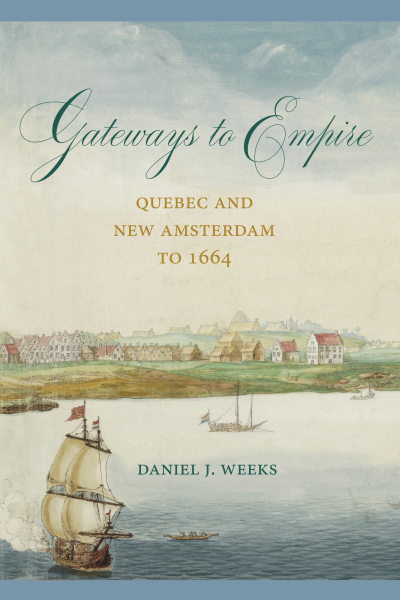
Gateways to Empire
Quebec and New Amsterdam to 1664
Authors:
Publisher:
2019
Summary
In Gateways to Empire: Quebec and New Amsterdam to 1664, historian Daniel Weeks has provided the first comprehensive comparative study of the North-American fur-trading colonies New France and New Netherland. While neither colony profited very much, if at all, from the fur trade (though many individuals fortunes were undoubtedly made), Weeks finds that New France, which far outpaced New Netherland in this trade, grew more slowly and had greater difficulty sustaining itself. As he demonstrates in Gateways to Empire, other factors, including New Netherland’s openness to religious and ethnic diversity and wider connections to the Atlantic World, allowed it to become more economically secure than its rival north of the St. Lawrence. And yet, in both cases, the principal towns of these European colonies—Quebec and New Amsterdam—moved beyond their initial purposes as hubs for trade with the indigenous peoples to become gateways to European settlement. In this, New Amsterdam, by the late 1640s, was singularly successful, so that it rapidly fostered the production of new European towns in its hinterlands, organizing the landscape for settlement and also for trade within the European-dominated Atlantic-World system.
Keywords
Search publication
Bibliographic data
Edition
1/2019
Copyright Year
2019
ISBN-Print
978-1-61146-279-1
ISBN-Online
978-1-61146-280-7
Publisher
University Press Copublishing, Lanham
Language
English
Pages
462
Product Type
Monograph
Table of contents
ChapterPages
Contents No access
Acknowledgments No access
Introduction No access Pages 1 - 20
1. Reconnaissance and the Shaping of Colonial Policy No access Pages 21 - 54
2. First Attempts at Settlement in New France No access Pages 55 - 102
3. Building the Network: Champlain on the St. Lawrence No access Pages 103 - 138
4. Reconnaissance and Staking a Claim—New Netherland No access Pages 139 - 168
5. Building the Network—New Netherland No access Pages 169 - 202
6. The Fur Trade—The Dominant Flow? No access Pages 203 - 256
7. Native American Networks, Flows of Disease, and the Fur Trade No access Pages 257 - 294
8. Flows of People No access Pages 295 - 326
9. Flows of Ideas No access Pages 327 - 380
Conclusion: The Diffuse and Specific Networks of New Amsterdam and Quebec No access Pages 381 - 402