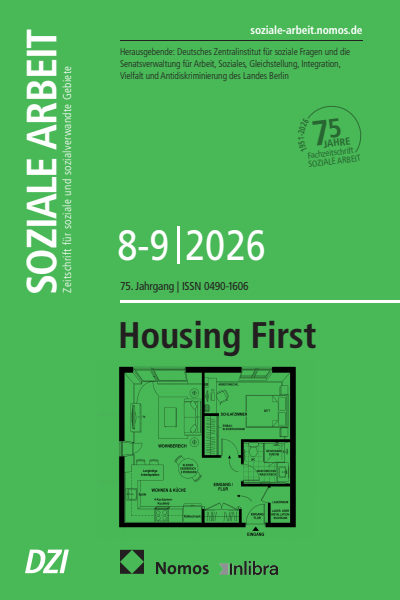
Soziale Arbeit, founded in 1951, is an independent academic journal which addresses developments in the context of social work. It is one of the most important publication media in its field and is read by teachers, students and researchers in social work and social pedagogy as well as by professionals and managers from associations and institutions. The journal’s aim is to promote professional development in social work fields by presenting methods and new concepts, in addition to subject-specific practical reports. In the ‘Rundschau’ (Review) section, information from all social fields is compiled. The ‘Tagungskalender’ (Conference Calendar) refers to important events, and the ‘Zeitschriftenbibliographie’ (Bibliography of Journals) lists current articles from professional journals. Soziale Arbeit is published 11 times a year with an annual focus issue published as a double issue. All scholarly articles submitted for publication in the journal undergo a double-blind peer review process. The editorial board is supported in an advisory capacity by a professional advisory board consisting of individuals from associations, universities, politics and administrative bodies. The journal cooperates with the academic societies of social work from Germany (DGSA) and Austria (OGSA). All social work contributions are indexed in the literature database DZI SoLit.
This article discusses casuistry as a method of teaching and learning in social work and proposes a awarded didactic concept. Casuistic case work systematically relates theory and practice to each other, stimulates theoretical reflection and...
This study examines the relevance of the Housing First (HF) approach for women who have experienced violence and homelessness. Approximately 90% of women experiencing homelessness have a history of violence. However, significant gaps in service...
Impact research and subject-centered research are predominantly practiced separately in social work. At the same time, the methodological literature on impact research calls for the incorporation of users’ perspectives. This article takes up this...
The article discusses impact orientation in development cooperation and humanitarian aid and presents Welthungerhilfe’s differentiated understanding of impact. By placing causality at its core, it enables the planning of transformative impact even...