, to see if you have full access to this publication.
Monograph No access
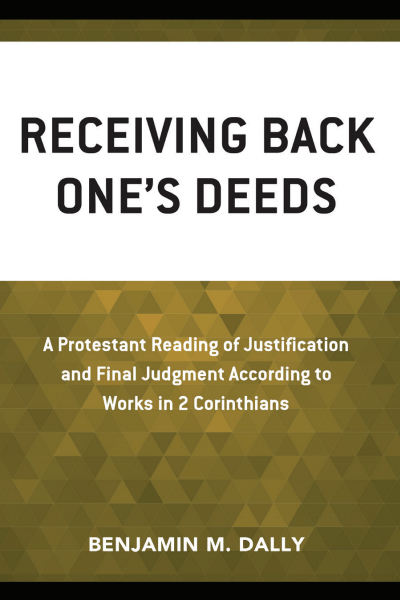
Receiving Back One's Deeds
A Protestant Reading of Justification and Final Judgment According to Works in 2 Corinthians
Authors:
Publisher:
2022
Summary
This book investigates the relationship between justification by faith and final judgment according to works as found in Paul’s second epistle to the Corinthians within a Protestant theological framework. Benjamin M. Dally first demonstrates the diversity and breadth of mainstream Protestant soteriology and eschatology beginning at the time of the Reformation by examining the confessional standards of its four primary ecclesial/theological streams: Lutheran, Reformed, Anabaptist, and Anglican. The soteriological structure of each is assessed (i.e., how each construes the relationship between justification and final judgment), with particular attention given to how each speaks of the place of good works at the final judgment. This initial examination outlines the theological boundaries within which the exegesis of Second Corinthians can legitimately proceed, and illuminates language and conceptual matrices that will be drawn upon throughout the remainder of thebook. Then, drawing upon the narrative logic of Paul’s Early Jewish thought-world, Dally examines the text of Second Corinthians to discern its own soteriological framework, paying particular attention to both the meaning and rhetorical function of the “judgment according to works” motif as it is utilized throughout the letter. The book concludes by offering a Protestant synthesis of the relationship between justification and final judgment according to works in Second Corinthians, giving an explanation of the role of works at the final judgment that arguably alleviates a number of tensions often perceived in other readings devoted to this key aspect of Pauline exegesis and theology.
Dally ultimately argues a three-fold thesis: (1) For the believer one’s earthly conduct, taken as a whole, is best spoken of in the language of inferior/secondary “cause” and/or “basis” as far as its import at the last judgment. (2) One’s earthly conduct, again taken as a whole, is soteriologically necessary (not solely, but secondarily nonetheless) and not simply of importance for the bestowal of non-soteriological, eschatological rewards. (3) There are crucial resources from within mainstream Protestantism to authorize such ways of speaking and to simultaneously affirm these contentions in conjunction with a robust, strictly forensic/imputational, “traditional” Protestant understanding of the doctrine of justification by faith alone.
Keywords
Search publication
Bibliographic data
Edition
1/2022
Copyright Year
2022
ISBN-Print
978-1-9787-0873-0
ISBN-Online
978-1-9787-0874-7
Publisher
Lexington, Lanham
Language
English
Pages
274
Product Type
Monograph
Table of contents
ChapterPages
Contents No access
Introduction No access Pages 1 - 16
Justification and Final Judgment in the Protestant Confessions No access Pages 17 - 72
The Narrative Logic of Early Jewish Restoration Theology No access Pages 73 - 114
The Shape of Justification in Second Corinthians No access Pages 115 - 164
Judgment According to Works in Second Corinthians No access Pages 165 - 208
Conclusion and Synthesis No access Pages 209 - 226
Bibliography No access Pages 227 - 266
Index No access Pages 267 - 272
About the Author No access Pages 273 - 274
Similar publications
from the topics "Religion und Theologie allgemein"