With the digitization of industry, the volume of data is increasing significantly due to growing connectivity. Standardized data structures and interoperability are required for efficient use. This work uses administration shells and...
Operator neural networks open up new possibilities for the efficient modeling and simulation of complex industrial processes. This article provides an overview of common model types such as DeepONet, FNO, GNO, and related variants, and demonstrates...
Predicting temperatures and residual stresses is essential in the glass tempering process. Classical numerical solvers are accurate but slow in large domains. This study develops a variant of a Multi-Input Fourier Neural Operator (MIFNO) as a fast...
Wirebonding as a technology for producing electrical connections is characterized by numerous non-linear and mutually influencing process parameters. The developed random forest model was trained on 690 data points on different substrates and...
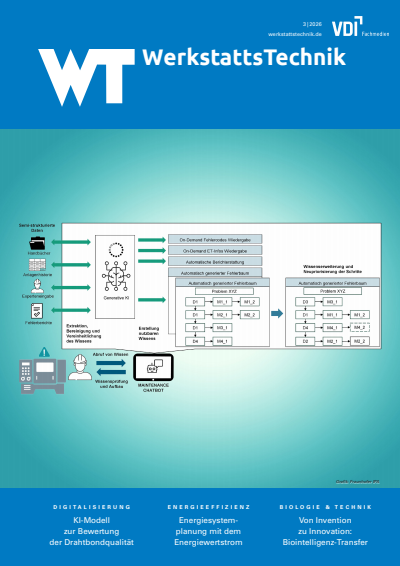
This article presents an LLM-based, adaptive assistance system for the diagnosis and repair of industrial machines. Free texts are cleaned up, categorized and transferred to curated fault trees. The system combines RAG with dialogue, assigns...
The article presents a marker-free track & trace solution for electrodes and other continuous materials. Identification based on the unique surface microstructure enables cross-process recognition and traceability of individual electrode...
Digital B2B platforms hold potential for platform owners and users, but are characterized by uncertainty, investment risks, and complex governance. In the IntWertL project, design principles for operating models for capital-limited, heterogeneous...
Since 2011, Industry 4.0 stands for the vision of fully networked, intelligent production. However, around 15 years later, it is clear that German industry is still a long way from realizing this vision. This article examines the current maturity...
The digitalization of manufacturing processes presents companies with the challenge of identifying and evaluating relevant smart services. Identifying and describing suitable smart services is particularly challenging, as many companies do not know...
This work extends DIN 276 by integrating factory elements and operational costs to enable a comprehensive lifecycle cost calculation. By combining DIN 276 with VDI 5200–4 and VDI 2067–1, a consistent basis for model-based, BIM-supported cost...
Digital factory models offer significant potential for manufacturing. However, SMEs often fail to benefit because the required manual remodeling effort is prohibitive. This paper presents a method for the immediate utilization of point clouds, where...
Factory planning is currently experiencing a major shift, marked by increasing uncertainty. In this context, four trend topics are widely discussed yet lack a clear industrial baseline: systematic risk management, a continuously updated factory...
The paper develops an integrated approach linking the energy value stream method to industrial energy system planning. First, it identifies process-specific opportunities to increase energy efficiency and derives suitable improvement measures. This...
Biointelligent technologies at the interface of biology, engineering, and computer science are considered key to a sustainable industry. Despite strong research, Germany lacks the infrastructure and transfer channels to translate these technologies...
This paper presents a hybrid sensor approach for automated rivet assembly that integrates drilling, sealing, and joining. Using laser triangulation and machine vision, setting depth and sealant wetting are validated in-process, substituting manual...