, to see if you have full access to this publication.
Monograph No access
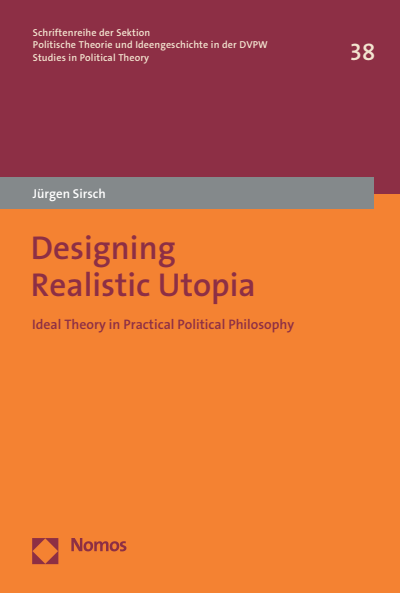
Designing Realistic Utopia
Ideal Theory in Practical Political Philosophy- Authors:
- Series:
- Schriftenreihe der Sektion Politische Theorie und Ideengeschichte in der DVPW | Studies in Political Theory, Volume 38
- Publisher:
- 2020
Summary
Im Anschluss an John Rawls entwickelt der Autor eine praktisch-politisch relevante und kritische Konzeption idealer Theorie. Dies erfolgt auf der Grundlage einer Auseinandersetzung mit der Kritik an idealer Theorie durch Autoren wie Amartya Sen und Raymond Geuss. Als Antwort auf Sen wird eine Konzeption von Machbarkeitsrestriktionen für ideale Theorie entwickelt, insbesondere für die Konstruktion idealer institutioneller Gesellschaftsentwürfe. Als Antwort auf Geuss werden konstruktivistische Ansätze zur Konstruktion normativer Theorien diskutiert und für eine Konzeption idealtheoretischen Denkens argumentiert, die eine kritische Perspektive auf den Status Quo erlaubt.
Search publication
Bibliographic data
- Edition
- 1/2020
- Copyright Year
- 2020
- ISBN-Print
- 978-3-8487-7802-7
- ISBN-Online
- 978-3-7489-2206-3
- Publisher
- Nomos, Baden-Baden
- Series
- Schriftenreihe der Sektion Politische Theorie und Ideengeschichte in der DVPW | Studies in Political Theory
- Volume
- 38
- Language
- English
- Pages
- 274
- Product Type
- Monograph
Table of contents
ChapterPages
- Titelei/Inhaltsverzeichnis No access Pages 1 - 12
- Outline of the course of the argument No access
- 2.1 The output of ideal theory: ideal principles and ideal institutions No access
- The first type: conceptions of the person No access
- The second type: idealized assumptions in thought experiments No access
- The third type: idealization regarding the range of outcomes being considered No access
- The fourth type: idealization in the sense of assuming moral ideals No access
- The fifth type: Idealization as assuming away feasibility restrictions No access
- 3.1.1 “Clinical theory” as an alternative to the ideal guidance approach No access
- The problem of the second-best No access
- The legitimacy critique No access
- 3.2 A reasonable compromise? No access
- 4.1 Institutional design No access
- 4.2.1 Technical feasibility and accessibility No access
- 4.2.2 Modal dimensions of feasibility restrictions No access
- 4.2.3 Ontological dimensions of feasibility restrictions No access
- 4.3 Mapping different approaches to normative theory No access
- 5.1 Principles for designing institutions and the status quo bias No access
- 5.2 The importance of long-term consequences for evaluating incremental reform options No access
- 5.3 Do we need ideal theory? No access
- 5.4 Feasibility in the construction of ideal institutions No access
- 6.1 Geuss’ conception of critical political philosophy No access
- 6.2.1 Recognizing power in ideal theory? No access
- 6.2.2 Ideology and moral intuitions No access
- 7.1 Rawls’ constructivism No access
- 7.2 Justifying moral construction assumptions: the universalist interpretation of Rawls’ theory No access
- 7.3 Problems of Rawls’ approach: Justifying moral construction assumptions No access
- 7.4 The contextualist interpretation of Rawls’ constructivism No access
- 7.5 O’Neill’s minimalist version of constructivism No access
- 8.1 The need for fundamental moral assumptions in constructivism No access
- 8.2 Methodological foundations for moral reasoning? No access
- 8.3 Investigating proceduralism: subjective desires as inputs? No access
- 8.4 Starting from substantive moral reasons: a defense of an objectivist conception of moral reasoning No access
- 9. Conclusion No access
- References No access Pages 263 - 274
Bibliography (204 entries)
No match found. Try another term.
- References: Open Google Scholar DOI: 10.5771/9783748922063
- Acemoglu, Daron / Robinson, James A. (2013): Why Nations Fail: The Origins of Power, Prosperity and Poverty. London: Profile Books. Open Google Scholar DOI: 10.5771/9783748922063
- Alexander, Larry / Moore, Michael (2012): Deontological Ethics. In: Zalta, Edward N. (ed.): The Stanford Encyclopedia of Philosophy, Winter 2012 Edition. URL = <http://plato.stanford.edu/archives/win2012/entries/ethics-deontological/>. Open Google Scholar DOI: 10.5771/9783748922063
- Alexy, Robert (1996): Theorie der Grundrechte. 3. Auflage. Frankfurt a. M: Suhrkamp. Open Google Scholar DOI: 10.5771/9783748922063
- Bagnoli, Carla (2011): Constructivism in Metaethics. In: Zalta, Edward N. (ed.): The Stanford Encyclopedia of Philosophy, Winter 2011 Edition. URL = <http://plato.stanford.edu/archives/win2011/entries/constructivism-ethics/>. Open Google Scholar DOI: 10.5771/9783748922063
- Barry, Brian (1989): Theories of Justice: A Treatise on Social Justice. Volume I. Berkeley and Los Angeles: University of California Press. Open Google Scholar DOI: 10.5771/9783748922063
- Barry, Brian (1995): Justice as Impartiality: A Treatise on Social Justice. Volume II. Oxford: Clarendon Press. Open Google Scholar DOI: 10.5771/9783748922063
- Barry, Brian (2005): Why Social Justice Matters. Cambridge: Polity Press. Open Google Scholar DOI: 10.5771/9783748922063
- Berker, Selim (2009): The Normative Insignificance of Neuroscience. In: Philosophy & Public Affairs 37: 4, 293‒329. Open Google Scholar DOI: 10.5771/9783748922063
- Birnbacher, Dieter (2003): Analytische Einführung in die Ethik. Berlin: Walter de Gruyter. Open Google Scholar DOI: 10.5771/9783748922063
- Birnbaum, Simon (2010): Radical Liberalism, Rawls and the Welfare State: Justifying the Politics of Basic Income. Critical Review of International Social and Political Philosophy 13: 4, 495–516. Open Google Scholar DOI: 10.5771/9783748922063
- Birnbaum, Simon (2011): Should Surfers be Ostracized? Basic Income, Liberal Neutrality, and the Work Ethos. In: Politics Philosophy Economics, DOI: 10.1177/1470594X10386569 Open Google Scholar DOI: 10.5771/9783748922063
- Brendel, Elke (2004): Intuition Pumps and the Proper Use of Thought Experiments. In: Dialectica 58: 1, 89–108. Open Google Scholar DOI: 10.5771/9783748922063
- Brennan, Geoffrey (2013): Feasibility in Optimizing Ethics. In: Social Philosophy & Policy 30: 1–2, 314–329. Open Google Scholar DOI: 10.5771/9783748922063
- Brennan, Geoffrey / Hamlin, Alan (2004): Analytic Conser-vatism. In: British Journal of Political Science 34: 4, 675–691. Open Google Scholar DOI: 10.5771/9783748922063
- Brennan, Geoffrey / Lomasky, Loren (1993): Democracy and Decision: The Pure Theory of Electoral Preference. New York and Cambridge: Cambridge University Press. Open Google Scholar DOI: 10.5771/9783748922063
- Brennan, Geoffrey / Pettit, Philip (2007): The Feasibility Issue. In: Jackson, Frank / Smith, Michael (eds.): The Oxford Handbook of Contemporary Philosophy. Oxford: Oxford Handbooks Online, Oxford University Press, 258–279. Open Google Scholar DOI: 10.5771/9783748922063
- Brennan, Geoffrey / Southwood, Nicholas (2007): Feasibility in Action and Attitude. In: Ronnow-Rasmussen, T. / Petersson, B. / Josefsson, J. / Egonsson, D. (eds.): Hommage a´ Wlodek. Philosophical Papers Dedicated to Wlodek Rabinowicz, URL = <www.fil.lu.se/hommagwawlodek>. (21.07.2014) Open Google Scholar DOI: 10.5771/9783748922063
- Brennan, Jason (2014): Why not Capitalism? New York and London: Routledge. Open Google Scholar DOI: 10.5771/9783748922063
- Brink, David O. (1987): Rawlsian Constructivism in Moral Theory. In: Canadian Journal of Philosophy 17: 1, 71–90. Open Google Scholar DOI: 10.5771/9783748922063
- Buchanan, James M. (1984): Die Grenzen der Freiheit: Zwischen Anarchie und Leviathan. Tübingen: Mohr. Open Google Scholar DOI: 10.5771/9783748922063
- Budde, Kerstin (2009): Constructivism all the Way Down – Can O’Neill Succeed Where Rawls Failed? In: Contemporary Political Theory 8: 2, 199–223. Open Google Scholar DOI: 10.5771/9783748922063
- Bueno de Mesquita, Bruce / Smith, Alastair / Siverson, Randolph M. / Morrow, James (2005): The Logic of Political Survival. Cambridge, (Mass.): MIT Press. Open Google Scholar DOI: 10.5771/9783748922063
- Chambers, Simone (2012): Justice or Legitimacy, Barricades or Public Reason? The Politics of Property-Owning Democracy. In: O’Neill, Martin / Williamson, Thad (eds.): Property-Owning Democracy. Rawls and Beyond. Oxford: Blackwell, 17–31. Open Google Scholar DOI: 10.5771/9783748922063
- Celikates, Robin (2006): From Critical Social Theory to a Social Theory of Critique: On the Critique of Ideology after the Pragmatic Turn. In: Constellations 13, 21‒40. Open Google Scholar DOI: 10.5771/9783748922063
- Ceva, Emmanuela (2012): Beyond Legitimacy: Can Proceduralism Say Anything Relevant About Justice? In: Critical Review of International Social and Political Philosophy 15: 2, 183–200. Open Google Scholar DOI: 10.5771/9783748922063
- Cohen, Gerald A. (2008): Rescuing Justice and Equality. Cambridge (Mass.): Harvard University Press. Open Google Scholar DOI: 10.5771/9783748922063
- Cohen, Gerald A. (2009): Why not Socialism? Princeton: Princeton University Press. Open Google Scholar DOI: 10.5771/9783748922063
- Crouch, Colin (2005): Capitalist Diversity and Change: Recombinant Governance and Institutional Entrepreneurs. Oxford and New York: Oxford University Press. Open Google Scholar DOI: 10.5771/9783748922063
- D'Agostino, Fred / Gaus, Gerald / Thrasher, John (2011): Con-temporary Approaches to the Social Contract. In: Zalta, Edward N. (Hg.): The Stanford Encyclopedia of Philosophy (Winter 2011 Edition), URL = <http://plato.stanford.edu/archives/win2011/entries/contractarianism-contemporary/>. Open Google Scholar DOI: 10.5771/9783748922063
- Downs, Anthony (1957): An Economic Theory of Democracy. New York: Harper. Open Google Scholar DOI: 10.5771/9783748922063
- Dworkin, Ronald (2011): Justice for Hedgehogs. Cambridge (Mass.) and London: The Belknap Press of Harvard University Press. Open Google Scholar DOI: 10.5771/9783748922063
- Edmundson, William A. (2017): John Rawls: Reticent Socialist. Cambridge: Cambridge University Press. Open Google Scholar DOI: 10.5771/9783748922063
- Ebbinghaus, Bernhard (2005): Can Path Dependence Explain Institutional Change? Two Approaches Applied to Welfare State Reform. MPIfG Discussion Paper 05/2, 5–20. Open Google Scholar DOI: 10.5771/9783748922063
- Elster, John (2007): Explaining Social Behavior: More Nuts and Bolts for the Social Sciences. Cambridge (Mass.) and New York: Cambridge University Press. Open Google Scholar DOI: 10.5771/9783748922063
- Esping-Andersen, Gøsta (1990): The Three Worlds of Welfare Capitalism. Cambridge: Polity Press. Open Google Scholar DOI: 10.5771/9783748922063
- Esser, Hartmut (1996): What is Wrong with ‘Variable Sociology’? In: European Sociological Review 12: 2, 159–166. Open Google Scholar DOI: 10.5771/9783748922063
- Esser, Hartmut (1999): Soziologie: Allgemeine Grundlagen. Frankfurt am Main: Campus. Open Google Scholar DOI: 10.5771/9783748922063
- Estlund, David M. (2008): Democratic Authority: A Philo-sophical Framework. Princeton and Oxford: Princeton University Press. Open Google Scholar DOI: 10.5771/9783748922063
- Estlund, David (2011a): Human Nature and the Limits (If Any) of Political Philosophy. In: Philosophy & Public Affairs 39: 3, 207–237. Open Google Scholar DOI: 10.5771/9783748922063
- Estlund, David (2011b): What Good Is It? Unrealistic Political Theory and the Value of Intellectual Work. In: Analyse & Kritik 33: 2, 395–416. Open Google Scholar DOI: 10.5771/9783748922063
- Farrelly, Colin (2007): Justice in Ideal Theory: A Refutation. In: Political Studies 55: 4, 844–864. Open Google Scholar DOI: 10.5771/9783748922063
- Floyd, Jonathan (2009): Is Political Philosophy Too Ahistorical? In: Critical Review of International Social and Political Philosophy 12: 4, 513–533. Open Google Scholar DOI: 10.5771/9783748922063
- Floyd, Jonathan / Stears, Marc (2011): Introduction. In: Floyd, Jonathan/Stears, Marc (ed.): Political Philosophy versus History? Contextualism and Real Politics in Contemporary Political Thought. Cambridge and New York: Cambridge University Press, 1–9. Open Google Scholar DOI: 10.5771/9783748922063
- Forrester, Katrina (2012): Judith Shklar, Bernard Williams and Political Realism. In: European Journal of Political Theory 11 (3): 247–272 Open Google Scholar DOI: 10.5771/9783748922063
- Frazer, Michael L. (2016): Utopophobia as a Vocation: The Professional Ethics of Ideal and Nonideal Political Theory. In: Social Philosophy & Policy 33: 1–2, 175–192. Open Google Scholar DOI: 10.5771/9783748922063
- Freeman, Samuel (2003) (ed.): The Cambridge Companion to Rawls. Cambridge: Cambridge University Press. Open Google Scholar DOI: 10.5771/9783748922063
- Freeman, Samuel (2007): Rawls. London: Routledge. Open Google Scholar DOI: 10.5771/9783748922063
- Freyenhagen, Fabian / Schaub, Jörg, 2010: Hat hier jemand gesagt, der Kaiser sei nackt? Eine Verteidigung der Geussschen Kritik an Rawls’ idealtheoretischem Ansatz. In: Deutsche Zeitschrift für Philosophie 58: 3, 457‒477. Open Google Scholar DOI: 10.5771/9783748922063
- García Gibson, Francisco (2016): Utopias and Comparative Assessments of Justice. In: Metaphilosophy 47, 92–107. Open Google Scholar DOI: 10.5771/9783748922063
- Gaus, Gerald F. (2008): On Philosophy, Politics, and Economics. Belmont: Thomson Wadsworth. Open Google Scholar DOI: 10.5771/9783748922063
- Gaus, Gerald F. (2011): The Order of Public Reason: A Theory of Freedom and Morality in a Diverse and Bounded World. Cambridge: Cambridge University Press. Open Google Scholar DOI: 10.5771/9783748922063
- Gaus, Gerald F. (2016): The Tyranny of the Ideal: Justice in a Diverse Society. Princeton and Oxford: Princeton University Press Open Google Scholar DOI: 10.5771/9783748922063
- Geuss, Raymond (2005): Outside Ethics. Princeton: Princeton University Press. Open Google Scholar DOI: 10.5771/9783748922063
- Geuss, Raymond (2008): Philosophy and Real Politics. Princeton and Oxford: Princeton University Press. Open Google Scholar DOI: 10.5771/9783748922063
- Geuss, Raymond (2010): Realismus, Wunschdenken, Utopie. In: Deutsche Zeitschrift für Philosophie 58, 419‒429. Open Google Scholar DOI: 10.5771/9783748922063
- Geuss, Raymond (2011): Kritik der politischen Philosophie: Eine Streitschrift. Hamburg: Hamburger Edition HIS. Open Google Scholar DOI: 10.5771/9783748922063
- Gilabert, Pablo (2012): Comparative Assessments of Justice, Political Feasibility, and Ideal Theory. In: Ethical Theory and Moral Practice 15: 1, 39–56. Open Google Scholar DOI: 10.5771/9783748922063
- Gilabert, Pablo / Lawford-Smith, Holly (2012): Political Feasibility: A Conceptual Exploration. In: Political Studies 60: 4, 809–825. Open Google Scholar DOI: 10.5771/9783748922063
- Goodin, Robert E. (1995): Political Ideals and Political Practice. In: British Journal of Political Science 25: 1, 37‒56. Open Google Scholar DOI: 10.5771/9783748922063
- Goodin, Robert E. (1996): Institutions and Their Design. In: Goodin, Robert E. (ed.): The Theory of Institutional Design. Cambridge: Cambridge University Press, 1–54. Open Google Scholar DOI: 10.5771/9783748922063
- Goodin, Robert E. (ed.) (1996): The Theory of Institutional Design. Cambridge: Cambridge University Press. Open Google Scholar DOI: 10.5771/9783748922063
- Goodin, Robert E. / Rice, James M. / Parpo, Antti / Eriksson, Lina (2008): Discretionary Time: A New Measure of Freedom. Cambridge: Cambridge University Press. Open Google Scholar DOI: 10.5771/9783748922063
- Hacker, Jacob S. (2010): The Road to Somewhere: Why Health Reform Happened. Or Why Political Scientists Who Write about Public Policy Shouldn’t Assume They Know How to Shape It. In: Reflections 10: 3, 861–876. Open Google Scholar DOI: 10.5771/9783748922063
- Haddock, Bruce (2006): Thin Universalism as Weak Foundationalism. In: Haddock, Bruce / Roberts, Peri / Sutch, Peter (eds.): Principles and Political Order: The Challenge of Diversity. Abingdon: Routledge, 60–76. Open Google Scholar DOI: 10.5771/9783748922063
- Haddock, Bruce (2011): Systemic Evil and the Limits of Pluralism. In: Haddock, Bruce / Roberts, Peri / Sutch, Peter (eds.): Evil in Contemporary Political Theory. Edinburgh: Edinburgh University Press, 62–80. Open Google Scholar DOI: 10.5771/9783748922063
- Hall, Peter A. / Gingerich, Daniel W. (2004): “Spielarten des Kapitalismus” und institutionelle Komplementaritäten in der Makroökonomie – Eine empirische Analyse. In: Berliner Journal für Soziologie 1, 5–32. Open Google Scholar DOI: 10.5771/9783748922063
- Hall, Peter A. / Soskice, David (2001): Introduction. In: Hall, Peter A. / Soskice, David: Varieties of Capitalism: The Institutional Foundations of Comparative Advantage. Oxford and New York: Oxford University Press, 1–68. Open Google Scholar DOI: 10.5771/9783748922063
- Hamlin, Alan / Stemplowska, Zofia (2012): Theory, Ideal Theory and the Theory of Ideals. In: Political Studies Review 10, 48–62 Open Google Scholar DOI: 10.5771/9783748922063
- Hardin, Russell (1996): Institutional Morality. In: Goodin (ed.): The Theory of Institutional Design. Cambridge: Cambridge University Press, 126–154. Open Google Scholar DOI: 10.5771/9783748922063
- Hayek, Friedrich A. (2006): The Constitution of Liberty. London and New York: Routledge. Open Google Scholar DOI: 10.5771/9783748922063
- Hedström, Peter (2008): Anatomie des Sozialen – Prinzipien der Analytischen Soziologie. Wiesbaden: VS-Verlag für Sozialwissenschaften. Open Google Scholar DOI: 10.5771/9783748922063
- Hempel, Carl G. (1942): The Function of General Laws in History. In: The Journal of Philosophy 39: 2, 35–48. Open Google Scholar DOI: 10.5771/9783748922063
- Hempel, Carl G. (1972): Wissenschaftliche und Historische Erklärungen. In: Albert, Hans (ed.): Theorie und Realität. Ausgewählte Aufsätze zur Wissen-schaftslehre der Sozialwissenschaften. Second Edition. Tübingen: Mohr, 237–261. Open Google Scholar DOI: 10.5771/9783748922063
- Hendrix, Burke A. (2013): Where Should We Expect Social Change in Non-Ideal Theory? In: Political Theory 41: 1, 116–143. Open Google Scholar DOI: 10.5771/9783748922063
- Hilmer, Richard / Merz, Stefan (2014): Die Bundestagswahl vom 22. September 2013: Merkels Meisterstück. In: Zeitschrift für Parlamentsfragen 1, 175–206. Open Google Scholar DOI: 10.5771/9783748922063
- Hinsch, Wilfried (2011): Ideal Justice and Rational Dissent. A Critique of Amartya Sen’s ‘The Idea of Justice’. In: Analyse & Kritik 2, 371–36. Open Google Scholar DOI: 10.5771/9783748922063
- Hirschman, Albert O. (1974): Abwanderung und Widerspruch: Reaktionen auf Leistungsabfall bei Unternehmungen, Organisation und Staaten. Tübingen: Mohr. Open Google Scholar DOI: 10.5771/9783748922063
- Jörke, Dirk / Nullmeier, Frank (2012): Realismusstreit und Methodendiskussion: Zur aktuellen Lage der Politischen Theorie. In: Zeitschrift für Politische Theorie 1, 3–8. Open Google Scholar DOI: 10.5771/9783748922063
- Jubb, Robert (2012): Tragedies of Non-Ideal Theory. In: European Journal of Political Theory 11: 3, 229–246. Open Google Scholar DOI: 10.5771/9783748922063
- Kamm, Frances M. (2011): Sen on Justice and Rights: A Review Essay. In: Philosophy & Public Affairs 39: 1, 83–104. Open Google Scholar DOI: 10.5771/9783748922063
- Kelly, Paul (2011): Rescuing Political Theory from the Tyranny of History. In: Jonathan Floyd / Marc Stears (ed.), Political Philosophy versus History? Contextualism and Real Politics in Contemporary Political Though. Cambridge: Cambridge University Press, 13‒38. Open Google Scholar DOI: 10.5771/9783748922063
- Kingdon, John W. (2003): Agendas, Alternatives, and Public Policies. Second Edition, New York: Longman. Open Google Scholar DOI: 10.5771/9783748922063
- Kliemt, Hartmut (1996): Macht und Ohnmacht der Moral in der Demokratie. In: Bayertz, Kurt (ed.): Politik und Ethik. Stuttgart: Reclam, 168–193. Open Google Scholar DOI: 10.5771/9783748922063
- Korpi, Walter (2001): Contentious Institutions: An Augmented Rational-Action Analysis of the Origins and Path-Dependence of Welfare State Institutions in Western Countries. In: Rationality and Society 13: 2, 235–283. Open Google Scholar DOI: 10.5771/9783748922063
- Krupp, Tyler (2008): Genealogy as Critique? In: Journal of the Philosophy of History 2: 3, 315–337. Open Google Scholar DOI: 10.5771/9783748922063
- Kunz, Volker (2004): Rational Choice. Frankfurt am Main & New York: Campus. Open Google Scholar DOI: 10.5771/9783748922063
- Lakatos, Imre (1970): Falsification and the Methodology of Scientific Research Programmes. In: Lakatos, Imre / Musgrave, Alan (eds.): Criticism and the Growth of Knowledge. Cambridge: Cambridge University Press, 91–196. Open Google Scholar DOI: 10.5771/9783748922063
- Landwehr, Claudia (2011): Substantielle und prozedurale Gerechtigkeit in der Verteilung von Gesundheitsgütern. In: Politische Vierteljahresschrift 52: 1, 29–50. Open Google Scholar DOI: 10.5771/9783748922063
- Laurence, Ben (2019): The Question of the Agent of Change. In: The Journal of Political Philosophy 0: 0, DOI: 10.1111/jopp.12204. Open Google Scholar DOI: 10.5771/9783748922063
- Lawford-Smith, Holly (2010): Feasibility Constraints for Political Theories. Thesis submitted for the degree of Doctor of Philosophy of The Australian National University. Open Google Scholar DOI: 10.5771/9783748922063
- Lawford-Smith, Holly (2013): Non-Ideal Accessibility. In: Ethical Theory and Moral Practice 16: 3, 653–669. Open Google Scholar DOI: 10.5771/9783748922063
- Leopold, David / Stears, Marc (eds.): Political Theory: Methods and Approaches. Oxford: Oxford University Press, 11‒29. Open Google Scholar DOI: 10.5771/9783748922063
- Levy, Jacob T. (2016): There is no such Thing as Ideal Theory. In: Social Philosophy & Policy 33: 1–2, 312–333. Open Google Scholar DOI: 10.5771/9783748922063
- List, Christian / Valentini, Laura (2016): The Methodology of Political Theory. In: Cappelen, Herman / Gendler, Tamar S. / Hawthorne, John (Eds.): Oxford Handbook of Philosophical Methodology. Oxford: Oxford University Press, 525–553. Open Google Scholar DOI: 10.5771/9783748922063
- Lovett, Frank (2010): A General Theory of Domination and Justice. Oxford: Oxford University Press. Open Google Scholar DOI: 10.5771/9783748922063
- Lovett, Frank / Pettit, Philip (2009): Neorepublicanism: A Normative and Institutional Research Program. In: The Annual Review of Political Science 12, 11–21. Open Google Scholar DOI: 10.5771/9783748922063
- Lukes, Steven (2005): Power: A Radical View. Second Edition, Houndmills and New York: Palgrave Macmillan. Open Google Scholar DOI: 10.5771/9783748922063
- March, James G. / Olsen, Johan P. (1989): Rediscovering Institutions: The Organizational Basis of Politics. New York: The Free Press. Open Google Scholar DOI: 10.5771/9783748922063
- Markell, Patchen (2010): Philosophy and Real Politics, by Raymond Geuss. In: Political Theory 38: 1, 172–177. Open Google Scholar DOI: 10.5771/9783748922063
- Marx, Johannes (2012): Geistige Eigentumsrechte als Problem der Internationalen Gerechtigkeit: Metatheoretische Anmerkungen zum Rechtfertigungsproblem geistiger Eigentumsrechte. In: Regina Kreide / Claudia Landwehr / Katrin Toens (eds.): Demokratie und Gerechtigkeit in Verteilungskonflikten. Baden-Baden: Nomos, 283–313. Open Google Scholar DOI: 10.5771/9783748922063
- Mason, Andrew (2010): Rawlsian Theory and the Circumstances of Politics. In: Political Theory 38: 5, 658‒683. Open Google Scholar DOI: 10.5771/9783748922063
- Matthew, Dale C. (2019): Rawls’s Ideal Theory: A Clarification and Defense. In: Res Publica 25: 4, 553–570. Open Google Scholar DOI: 10.5771/9783748922063
- McDermott, Daniel (2008): Analytical Political Philosophy. In: Leopold, David / Stears, Marc (eds.): Political Theory: Methods and Approaches. Oxford: Oxford University Press, 11‒29. Open Google Scholar DOI: 10.5771/9783748922063
- McLeod, Owen (2013): Desert. In: Zalta, Edward N. (ed.): The Stanford Encyclopedia of Philosophy, Winter 2013 Edition. URL = <http://plato.stanford.edu/archives/win2013/entries/desert/>. Open Google Scholar DOI: 10.5771/9783748922063
- Menke, Christoph (2010): Neither Rawls Nor Adorno: Raymond Geuss’ Programme for a ‘Realist’ Political Philosophy. In: European Journal of Philosophy 18: 1, 139–147. Open Google Scholar DOI: 10.5771/9783748922063
- Miller, Alexander (2003): An Introduction to Contemporary Metaethics. Cambridge and Malden: Polity Press. Open Google Scholar DOI: 10.5771/9783748922063
- Miller, Clarence H. (2001): Introduction. In: More, Thomas (2001): Utopia. Translated and introduced by Clarence H. Miller. New Haven and London: Yale University Press, vii-xxiii. Open Google Scholar DOI: 10.5771/9783748922063
- Miller, David (2008): Political Philosophy for Earthlings. In: Leopold, David / Stears, Marc (eds.): Political Theory: Methods and Approaches. Oxford: Oxford University Press, 29–47. Open Google Scholar DOI: 10.5771/9783748922063
- Mills, Charles W. (2005): “Ideal Theory” as Ideology. In: Hypatia 20: 3, 165–184. Open Google Scholar DOI: 10.5771/9783748922063
- Mulhall, Stephen / Swift, Adam (2003): Rawls and Communitarianism. In: Freeman, Samuel (ed.): The Cambridge Companion to Rawls. Cambridge: Cambridge University Press, 460‒487. Open Google Scholar DOI: 10.5771/9783748922063
- Norcross, Alistair (1997): Comparing Harms: Headaches and Human Lives. In: Philosophy & Public Affairs 26: 2, 135–167. Open Google Scholar DOI: 10.5771/9783748922063
- North, Douglass C. (1990): Institutions, Institutional Change and Economic Performance. Cambridge: Cambridge University Press. Open Google Scholar DOI: 10.5771/9783748922063
- Nozick, Robert (1974): Anarchy, State and Utopia. New York: Basic Books. Open Google Scholar DOI: 10.5771/9783748922063
- Olson, Mancur (1991): Ein weniger ideologiegebundenes Verfahren der Entscheidung über die Umverteilung zu den Armen. In: Olson, Mancur (ed.): Umfassende Ökonomie. Tübingen: Mohr, 363–390. Open Google Scholar DOI: 10.5771/9783748922063
- Olson, Mancur (2000): Power and Prosperity: Outgrowing Communist and Capitalist Dictatorships. New York: Basic Books. Open Google Scholar DOI: 10.5771/9783748922063
- O’Neill, Onora (1989): Constructions of Reason: Explorations of Kant’s Practical Philosophy. Cambridge and New York: Cambridge University Press. Open Google Scholar DOI: 10.5771/9783748922063
- O’Neill, Onora (1996): Towards Justice and Virtue. Cambridge and New York: Cambridge University Press. Open Google Scholar DOI: 10.5771/9783748922063
- O’Neill, Onora (2000): Bounds of Justice. Cambridge and New York: University Press. Open Google Scholar DOI: 10.5771/9783748922063
- O’Neill, Onora (2003): Constructivism vs. Contractualism. In: Ratio (new series) 16: 4, 319–331. Open Google Scholar DOI: 10.5771/9783748922063
- Parfit, Derek (2011a): On What Matters: Volume One. Oxford: Oxford University Press. Open Google Scholar DOI: 10.5771/9783748922063
- Parfit, Derek (2011b): On What Matters: Volume Two. Oxford: Oxford University Press. Open Google Scholar DOI: 10.5771/9783748922063
- Parfit, Derek (2017): Future People, the Non-Identity Problem, and Person-Affecting Principles. In: Philosophy & Public Affairs 45: 2, 118–157. Open Google Scholar DOI: 10.5771/9783748922063
- Pech, Wesley, J. (2010): Behavioral Economics and the Basic Income Guarantee. In: Basic Income Studies 5: 2, 1–17. Open Google Scholar DOI: 10.5771/9783748922063
- Pettit, Philip (1996): Institutional Design and Rational Choice. In: Goodin, Robert E. (ed.): The Theory of Institutional Design. Cambridge: Cambridge University Press, 54–90. Open Google Scholar DOI: 10.5771/9783748922063
- Pettit, Philip (1997): Republicanism. A Theory of Freedom and Government. Oxford: Oxford University Press. Open Google Scholar DOI: 10.5771/9783748922063
- Pettit, Philip (2012): On the People’s Terms: A Republican Theory and Model of Democracy. New York: Cambridge University Press. Open Google Scholar DOI: 10.5771/9783748922063
- Pierson, Paul (1994) Dismantling the Welfare State? Reagan, Thatcher, and the Politics of Retrenchment. Cambridge: Cambridge University Press. Open Google Scholar DOI: 10.5771/9783748922063
- Pierson, Paul (2000): Increasing Returns, Path Dependence and the Study of Politics. In: American Political Science Review 94, 2, 251–267. Open Google Scholar DOI: 10.5771/9783748922063
- Pogge, Thomas W. (1989): Realizing Rawls. Ithaca and London: Cornell University Press. Open Google Scholar DOI: 10.5771/9783748922063
- Pogge, Thomas W. (2008): Cohen to the Rescue. In: Ratio (new series) 21: 4, 454–475. Open Google Scholar DOI: 10.5771/9783748922063
- Pollack, Mark A. (2005): Theorizing EU Policy-Making. In: Wallace, Helen / Wallace, William / Pollack, Mark A. (eds.): Policy-Making in the European Union. Fifth Edition. Oxford and New York: Oxford University Press, 13–48. Open Google Scholar DOI: 10.5771/9783748922063
- Popper, Karl R. (1994): Logik der Forschung. 10th edition, Tübingen: J.C.B. Mohr. Open Google Scholar DOI: 10.5771/9783748922063
- Popper, Karl R. (2003): Das Elend des Historizismus. 7th edition, Tübingen: Mohr Siebeck. Open Google Scholar DOI: 10.5771/9783748922063
- Räikkä, Juha (1998): The Feasibility Condition in Political Theory. In: The Journal of Political Philosophy 6: 1, 27–40. Open Google Scholar DOI: 10.5771/9783748922063
- Rawls, John (1975): The Independence of Moral Theory. In: Rawls, John (1999): Collected Papers. Edited by Samuel Freeman. Cambridge (Mass.) and London: Harvard University Press, 286–302. Open Google Scholar DOI: 10.5771/9783748922063
- Rawls, John (1980): Kantian Constructivism in Moral Theory. In: Rawls, John (1999): Collected Papers. Edited by Samuel Freeman. Cambridge (Mass.) and London: Harvard University Press, 303–358. Open Google Scholar DOI: 10.5771/9783748922063
- Rawls, John (1982): Social Unity and Primary Goods. In: Rawls, John (1999): Collected Papers. Edited by Samuel Freeman. Cambridge (Mass.) and London: Harvard University Press, 359–387. Open Google Scholar DOI: 10.5771/9783748922063
- Rawls, John (1985): Justice as Fairness: Political not Metaphysical. In: Rawls, John (1999): Collected Papers. Edited by Samuel Freeman. Cambridge and London: Harvard University Press, 388–415. Open Google Scholar DOI: 10.5771/9783748922063
- Rawls, John (1999a): A Theory of Justice. Revised Edition, Cambridge (Mass.): The Belknap Press of Harvard University Press. Open Google Scholar DOI: 10.5771/9783748922063
- Rawls, John (1999b): The Law of Peoples: with ‘The Idea of Public Reason Revisited’. Cambridge (Mass.): Harvard University Press. Open Google Scholar DOI: 10.5771/9783748922063
- Rawls, John (2001): Justice as Fairness: A Restatement. Edited by Erin Kelly. Cambridge (Mass.) and London: The Belknap Press of Harvard University Press. Open Google Scholar DOI: 10.5771/9783748922063
- Rawls, John (2005): Political Liberalism. Expanded Edition, New York: Columbia University Press. Open Google Scholar DOI: 10.5771/9783748922063
- Roberts, Peri (2006): Why Thin Universalism Needs Conceptions of Society and Person. In: Haddock, Bruce / Roberts, Peri / Sutch, Peter (eds.): Principles and Political Order. Abingdon: Routledge, 111–128. Open Google Scholar DOI: 10.5771/9783748922063
- Roberts, Peri (2007): Political Constructivism. Abingdon: Routledge. Open Google Scholar DOI: 10.5771/9783748922063
- Robeyns, Ingrid (2008): Ideal Theory in Theory and Practice. In: Social Theory and Practice 34: 3, 341–362. Open Google Scholar DOI: 10.5771/9783748922063
- Roemer, John E. (1994): A Future for Socialism. Cambridge, Mass.: Harvard University Press. Open Google Scholar DOI: 10.5771/9783748922063
- Ronzoni, Miriam / Valentini, Laura (2008): On the Meta-Ethical Status of Constructivism: Reflections on G.A. Cohen’s ‘Facts and Principles’. In: Politics Philosophy Economics 7: 4, 403–422. Open Google Scholar DOI: 10.5771/9783748922063
- Ross, Michael L. (1999): The Political Economy of the Resource Curse. In: World Politics 51: 2, 297–322. Open Google Scholar DOI: 10.5771/9783748922063
- Rothstein, Bo (2011): Creating a Sustainable Solidaristic Society: A Manual. QoG Working Paper Series 2011:7. Open Google Scholar DOI: 10.5771/9783748922063
- Sandel, Michael J. (1984): The Procedural Republic and the Unencumbered Self. In: Political Theory 12, 81–96. Open Google Scholar DOI: 10.5771/9783748922063
- Sandel, Michael J. (2009): Justice: What’s the Right Thing to Do? New York: Farrar, Straus and Giroux. Open Google Scholar DOI: 10.5771/9783748922063
- Scanlon, Thomas M. (2003): Rawls on Justification. In: Samuel Freeman (ed.): The Cambridge Companion to Rawls. Cambridge: Cambridge University Press, 139‒167. Open Google Scholar DOI: 10.5771/9783748922063
- Scanlon, Tomas M. (2014): Being Realistic about Reasons. Oxford: Oxford University Press. Open Google Scholar DOI: 10.5771/9783748922063
- Scharpf, Fritz W. (2000): Economic Changes, Vulnerabilities, and Institutional Capabilities. In: Scharpf, Fritz W. / Schmidt, Vivien A. (eds.): Welfare and Work in the Open Economy. Volume I: From Vulnerability to Competitiveness in Comparative Perspective. Oxford: Oxford Scholarship Online, 21–124. Open Google Scholar DOI: 10.5771/9783748922063
- Schaub, Jörg (2010): Ideale und/oder nicht-ideale Theorie – oder weder noch? Ein Literaturbericht zum neuesten Methodenstreit in der politischen Philosophie. In: Zeitschrift für philosophische Forschung 64: 3, 393‒409. Open Google Scholar DOI: 10.5771/9783748922063
- Schaub, Jörg (2012): Politische Theorie als angewandte Moralphilosophie? In: Zeitschrift für Politische Theorie 3: 1, 8–25. Open Google Scholar DOI: 10.5771/9783748922063
- Schmidtz, David (2016): A Realistic Political Ideal. In: Social Philosophy & Policy 33: 1–2, 1–10. Open Google Scholar DOI: 10.5771/9783748922063
- Schmitt, Annette (2005): Die Umstände der Gerechtigkeit: Handlungs- und motivationstheoretische Annahmen liberaler Theorien am Beispiel von John Rawls’ A Theory of Justice. Wiesbaden: VS-Verlag für Sozialwissenschaften. Open Google Scholar DOI: 10.5771/9783748922063
- Schnell, Rainer / Hill, Paul B. / Esser, Elke (2013): Methoden der empirischen Sozialforschung. München: Olden-bourg. Open Google Scholar DOI: 10.5771/9783748922063
- Sen, Amartya (1982): Choice, Welfare and Measurement. Cambridge: Harvard University Press. Open Google Scholar DOI: 10.5771/9783748922063
- Sen, Amartya (2006): What Do We Want from a Theory of Justice? In: The Journal of Philosophy 103: 5, 215–238. Open Google Scholar DOI: 10.5771/9783748922063
- Sen, Amartya (2009): The Idea of Justice. Cambridge: The Belknap Press of Harvard University Press. Open Google Scholar DOI: 10.5771/9783748922063
- Silva, Renan (2019): The Two-Dimensional Analysis of Feasibility: A Restatement. In: Moral Philosophy and Politics 6: 2, 357–378. Open Google Scholar DOI: 10.5771/9783748922063
- Simmons, John A. (2010): Ideal and Nonideal Theory. In: Philosophy & Public Affairs 38: 1, 5–36. Open Google Scholar DOI: 10.5771/9783748922063
- Singer, Peter (1972): Famine, Affluence, and Morality. In: Philosophy and Public Affairs 1: 3, 229–243. Open Google Scholar DOI: 10.5771/9783748922063
- Singer, Peter (1974): Sidgwick and Reflective Equilibrium. In: The Monist 58: 3, 490‒517. Open Google Scholar DOI: 10.5771/9783748922063
- Singer, Peter (2005): Ethics and Intuitions. In: The Journal of Ethics 9: 3–4, 331–352. Open Google Scholar DOI: 10.5771/9783748922063
- Singer, Peter (2011a): Practical Ethics. Third Edition, Cambridge: Cambridge University Press. Open Google Scholar DOI: 10.5771/9783748922063
- Singer, Peter (2011b): The Expanding Circle: Ethics, Evolution, and Moral Progress. Princeton and Oxford: Princeton University Press. Open Google Scholar DOI: 10.5771/9783748922063
- Sinnot-Armstrong, Walter (2014): Consequentialism. In: Zalta, Edward N. (ed.): The Stanford Encyclopedia of Philosophy, Spring 2014 Edition. In: Edward N. Zalta (ed.), URL = <http://plato.stanford.edu/archives/spr2014/entries/consequentialism/>. Open Google Scholar DOI: 10.5771/9783748922063
- Sirsch, Jürgen (2012): Die Relevanz idealer Theorie bei der Beurteilung praktischer Probleme. In: Zeitschrift für Politische Theorie 3: 1, 25–41. Open Google Scholar DOI: 10.5771/9783748922063
- Sirsch, Jürgen (2020): Should Liberal-Egalitarians Support a Basic Income? An Examination of the Effectiveness and Stability of Ideal Welfare Regimes. In: Moral Philosophy and Politics 0: 0, DOI: doi.org/10.1515/mopp-2019–0024. Open Google Scholar DOI: 10.5771/9783748922063
- Sirsch, Jürgen / Unger, Doris (2019): The Neorepublican Challenge to Egalitarian-Liberalism: Evaluating Justifications of Redistributive Institutions. In: Critical Review of International Social and Political Philosophy 0: 0, DOI: doi.org/10.1080/13698230.2019.1644580. Open Google Scholar DOI: 10.5771/9783748922063
- Sirsch, Jürgen / Unger, Doris (unpublished): Neorepublicanism as a Public Philosophy: Some Arguments for Freedom as Non-Domination. Open Google Scholar DOI: 10.5771/9783748922063
- Southwood, Nick (2016): Does “Ought” Imply “Feasible”? In: Philosophy & Public Affairs 44: 1, 7–45. Open Google Scholar DOI: 10.5771/9783748922063
- Southwood, Nick / Wiens, David (2016): “Actual” Does not Imply “Feasible”. In: Philosophical Studies 17: 11, 3037–3060. Open Google Scholar DOI: 10.5771/9783748922063
- Stemplowska, Zofia (2008): What’s Ideal about Ideal Theory? In: Social Theory and Practice 34: 3, 319–340. Open Google Scholar DOI: 10.5771/9783748922063
- Stemplowska, Zofia / Swift, Adam (2012): Ideal and Nonideal Theory. In: Estlund, David (ed.): The Oxford Handbook of Political Philosophy. Oxford: Oxford University Press, 373–393. Open Google Scholar DOI: 10.5771/9783748922063
- Stiglitz, Joseph (2012): Der Preis der Ungleichheit: Wie die Spaltung der Gesellschaft unsere Zukunft bedroht. München: Siedler. Open Google Scholar DOI: 10.5771/9783748922063
- Swift, Adam (2008): The Value of Philosophy in Nonideal Circumstances. In: Social Theory and Practice 34: 3, 363–387. Open Google Scholar DOI: 10.5771/9783748922063
- Thelen, Kathleen (1999): Historical Institutionalism in Comparative Perspective. In: Annual Review of Political Science 2, 369–404. Open Google Scholar DOI: 10.5771/9783748922063
- Thomas, Alan (2016): Republic of Equals: Predistribution and Property-Owning Democracy. Oxford: Oxford University Press. Open Google Scholar DOI: 10.5771/9783748922063
- Unger, Doris (2013): Das Recht auf Gleichbehandlung und die (Ir)Relevanz von gruppenspezifischen Merkmalen am Beispiel des Antidiskriminierungsrechts. In: Bonn, Eva / Knöppler, Christian / Souza, Miguel (eds.): Was machen Marker? Logik, Materialität und Politik von Differenzierungsprozessen. Bielefeld: Transcript, 317–342. Open Google Scholar DOI: 10.5771/9783748922063
- Valentini, Laura (2009): On the Apparent Paradox of Ideal Theory. In: The Journal of Political Philosophy 17: 3, 332–350. Open Google Scholar DOI: 10.5771/9783748922063
- Valentini, Laura (2012): Ideal vs. Non-ideal Theory: A Conceptual Map. In: Philosophy Compass 7: 9, 654–664. Open Google Scholar DOI: 10.5771/9783748922063
- Valentini, Laura (2017): On the Messy “Utopophobia vs. Factophobia” Controversy. In: Weber, Michael / Vallier, Kevin (Eds.): Political Utopias: Contemporary Debates. Oxford: Oxford University Press, 11–34. Open Google Scholar DOI: 10.5771/9783748922063
- Valentini, Laura (2018): The Case for Ideal Theory. In: Brown, Chris / Eckersley, Robyn (Eds.): The Oxford Handbook of International Political Theory. Oxford: Oxford University Press, 663–676. Open Google Scholar DOI: 10.5771/9783748922063
- Van Lancker, Wim / Van Mechelen, Natascha (2015) Universalism under Siege? Exploring the Association between Targeting, Child Benefits and Child Poverty Across 26 Countries. Social Science Research 50: 60–75. Open Google Scholar DOI: 10.5771/9783748922063
- Van Parijs, Philippe (1995): Real freedom for all: What (if anything) can justify capitalism? Oxford: Oxford University Press. Open Google Scholar DOI: 10.5771/9783748922063
- Van Parijs, Philippe (2011): Just Democracy: The Rawls-Machiavelli Programme. Colchester: ECPR Press. Open Google Scholar DOI: 10.5771/9783748922063
- Waldron, Jeremy (1999): Law and Disagreement. Oxford and New York: Oxford University Press. Open Google Scholar DOI: 10.5771/9783748922063
- Watkins, Eric / Fitzpatrick, William (2002): O’Neill and Korsgaard on the Construction of Normativity. In: The Journal of Value Inquiry 36: 2–3, 349–367. Open Google Scholar DOI: 10.5771/9783748922063
- Wiens, David (2012): Prescribing Institutions without Ideal Theory. In: The Journal of Political Philosophy 20: 1, 45–70. Open Google Scholar DOI: 10.5771/9783748922063
- Wiens, David (2013): Demands of Justice, Feasible Alternatives, and the Need for Causal Analysis. In: Ethical Theory and Moral Practice 16: 2, 325–338. Open Google Scholar DOI: 10.5771/9783748922063
- Wiens, David (2015): Political Ideals and the Feasibility Frontier. In: Economics and Philosophy 31, 447–477. Open Google Scholar DOI: 10.5771/9783748922063
- Wiens, David (2016): Assessing ideal theories: Lessons from the theory of second best. In: Politics, Philosophy & Economics 15, 2: 132–149. Open Google Scholar DOI: 10.5771/9783748922063
- Williams, Bernard (2007): In the Beginning Was the Deed: Realism and Moralism in Political Argument. Princeton: Princeton University Press. Open Google Scholar DOI: 10.5771/9783748922063
- Williamson, Thad (2009): Who Owns What? An Egalitarian Interpretation of John Rawls’ Idea of a Property-Owning Democracy. Journal of Social Philosophy 40, 3: 434–453. Open Google Scholar DOI: 10.5771/9783748922063
- Wood, Allen (2011): Humanity as an End in Itself. In: Parfit, Derek: On What Matters. Volume Two. Oxford: Oxford University Press, 58–83. Open Google Scholar DOI: 10.5771/9783748922063
- Wright, Erik Olin (2010): Envisioning Real Utopias. London and New York: Verso. Open Google Scholar DOI: 10.5771/9783748922063
- Zahariadis, Nikolaos (2007): The Multiple Streams Framework: Structure, Limitations, Prospects. In: Sabatier, Paul A. (ed): Theories of the Policy Process. Cambridge: Westview Press. Open Google Scholar DOI: 10.5771/9783748922063
- Zimmerling, Ruth (1996): Wissenschaft und Verantwortung: Ist die traditionelle Gegenüberstellung von empirischer und normativer Wissenschaft haltbar? In: Zeitschrift für Politikwissenschaft 6, 51‒82. Open Google Scholar DOI: 10.5771/9783748922063
- Zimmerling, Ruth (2005): Influence and Power: Variations on a Messy Theme. Dordrecht: Springer. Open Google Scholar DOI: 10.5771/9783748922063