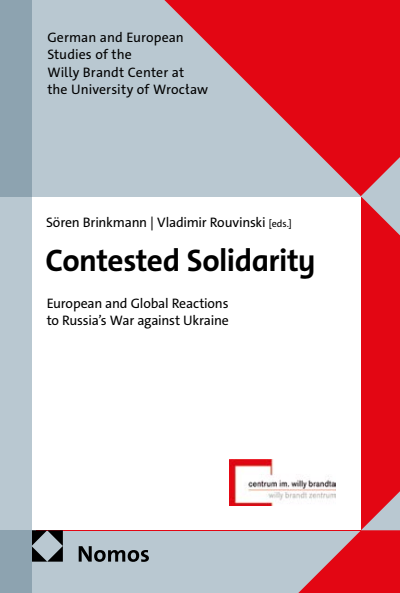
Contested Solidarity
European and Global Reactions to Russia's War against Ukraine- Editors:
- |
- Series:
- German and European Studies of the Willy Brandt Center at the University of Wrocław, Volume 11
- Publisher:
- 2026
Summary
In February 2022, the world was outraged by Russia's criminal war of aggression against Ukraine and prom-ised solidarity with the attacked country. But what did this solidarity mean in political practice? How did civil society actors and the public react and influence political decision-making processes in European countries and beyond? In 15 country chapters by different authors, this volume provides insight into the reactions, perceptions and public debates put forward by different social and political actors, while painting a complex picture of ‘contested solidarity’ that helps to understand why, even in the fourth year of the war, Ukraine seems far from achieving a just peace.
With contributions by Sebastien Marcel Albert Adins| Mustafa Berkay Aydın | Sören Brinkmann | Alberto Bueno | Emidio Diodato | Sebastian Hoppe | Andrii Hrubinko | Akihiro Iwashita | João H. S. Jung | Linda Kaljundi | Suzanne Loftus | Justin Massie | Raili Nugin | Maciej Olejnik | Marçal de Menezes Paredes | Nicolas-François Perron | Luis Rosenfield | Tamilla Sahin | Cecilia Emma Sottilotta | Karol Szulc | Oscar Vidarte Arévalo
Search publication
Bibliographic data
- Edition
- 1/2026
- Copyright Year
- 2026
- ISBN-Print
- 978-3-7560-3656-1
- ISBN-Online
- 978-3-7489-6717-0
- Publisher
- Nomos, Baden-Baden
- Series
- German and European Studies of the Willy Brandt Center at the University of Wrocław
- Volume
- 11
- Language
- English
- Pages
- 390
- Product Type
- Edited Book
Table of contents
- Preface No access Pages 1 - 6
- Authors: |
- 1. From the dissolution of the USSR to Ukrainian independence (1991–1994) No access
- 2. From rapprochement to rupture: Ukraine–Russia relations from Kuchma to Donbas (1994–2015) No access
- 3. From escalation to a large-scale invasion: Ukraine under fire (2021–February 2022) No access
- 4. From a failed blitzkrieg to a war of attrition: (2022–2025) No access
- 5. About this book No access
- Authors:
- 1. Introduction No access
- 2. Prerequisites for strategic partnership No access
- 3. Great Britain’s position and role in the Russian-Ukrainian war (2014-2022) No access
- 4. Partnership in times of the Russian full-scale invasion No access
- 5. Political and public opinion on support for Ukraine No access
- 6. Why does the UK support Ukraine? No access
- 7. Instead of conclusions No access
- Authors:
- 1. Dimensions of the “Zeitenwende” No access
- 2. Between solidarity and pacifism: the debate on arms deliveries No access
- 3. Social attitudes and the role of the mass media No access
- 4. Longing for peace, election campaigns, and crumbling solidarity No access
- 5. Concluding remarks No access
- Authors:
- 1. Belgium’s foreign policy and international role No access
- 2. Bilateral links between Belgium and Russia before 2022 No access
- 3.1 Belgian military and civilian aid to Ukraine No access
- 3.2 Belgium’s diplomatic support for Ukraine No access
- 3.3 Sanctions against Russia No access
- 4. The stance of Belgium’s political parties and society No access
- 5. Final remarks No access
- Authors: |
- 1. Introduction No access
- 2. The “special relationship” between Italy and Russia before February 2022 No access
- 3. The Draghi cabinet is facing the February 2022 invasion No access
- 4. Continuity amidst change: The Meloni government’s position No access
- 5. Conclusions: current challenges and future perspectives No access
- Authors:
- 1. Introduction No access
- 2. Spain’s official political position: Russia, from “strategic partner” to a threat to Europe No access
- 3. The academic community’s perspective: a focus on hybrid strategy No access
- 4. Spanish society: between concern over Russia and war fatigue No access
- 5. Conclusion No access
- Authors:
- 1. Introduction No access
- 2. Political response No access
- 3. Media narrative No access
- 4. Public opinion No access
- 5. Cultural responses No access
- 6. Conclusions No access
- Authors: |
- 1. Introduction No access
- 2. Background to the Estonian case No access
- 3. Monuments and public spaces No access
- 4. Russian Cultural House and Russian Theatre No access
- 5. Conclusions No access
- Authors:
- 1. Introduction No access
- 2. Hungarian-Russian relations from 2010 to the 2022 invasion No access
- 3. Hungarian policy following the onset of the 2022 war No access
- 4. State-controlled media and public opinion after the outbreak of the 2022 war No access
- 5. Conclusions No access
- Authors:
- 1. Introduction No access
- 2. Domestic support and U.S. media No access
- 3. Understanding the nature of the Russian threat No access
- 4. Implications of U.S. support for Ukraine amidst a changing world No access
- 5. Conclusion No access
- Authors: |
- 1. Introduction No access
- 2. Russo-Ukrainian war, February 2014 to November 2021 No access
- 3. Russo-Ukrainian war, November 2021 to February 2022 No access
- 4. Russo-Ukrainian war, February 2022 to October 2024 No access
- 5. Societal attitudes and public debates No access
- 6. Conclusion No access
- Authors: | |
- 1. Introduction No access
- 2. Understanding the Brazilian position on Russia’s invasion of Ukraine No access
- 3. Explaining the Bolsonaro-Putin friendship No access
- 4. A biased equidistance: the Brazilian internationalist mindset No access
- 5. Conclusions No access
- Authors:
- 1. Introduction No access
- 2. Peru’s relations with Ukraine No access
- 3. Peru at the beginning of the crisis in Ukraine (2014) No access
- 4. Peru in the Security Council and the Ukrainian crisis (2018–2019) No access
- 5. Peru and the full-scale Russian invasion of Ukraine No access
- 6. Conclusions No access
- Authors:
- 1. Introduction No access
- 2. Distanced war diplomacy No access
- 3. Revealed preferences in foreign economic strategy No access
- 4. Counter-hegemony versus export-led growth No access
- 5. Man versus state: Xi’s personalism and the Russia risk No access
- 6. Conclusions No access
- Authors:
- 1. Introduction No access
- 2.1 The driving forces behind Japan–Russia relations: the Northern territories, China, and the United States? No access
- 2.2 Post-Abe Japan and the impact of Russia’s war against Ukraine No access
- 2.3 Challenges and hope on the border regions No access
- 3.1.1 Higher interests in Russia in the borderlands No access
- 3.1.2 Impact of the war on borderlands No access
- 3.1.3 Northern territories and peace treaty negotiation No access
- 3.1.4 War responsibility and support for Japan’s policy against Russia No access
- 3.1.5 Role of Japan No access
- 3.2 Cross-references and other findings No access
- 3.3 Other findings No access
- 4. Conclusion No access
- Authors: |
- 1. Introduction No access
- 2. The Montreux Straits Convention and the start of mediation No access
- 3. Ongoing commercial relations with both actors of the war No access
- 4. Negotiations No access
- 5. The global implications of Türkiye’s mediation No access
- 6. Prisoner exchanges, humanitarian assistance, and migration management No access
- 7. Academic research on the Russia-Ukraine war No access
- 8. Media and perception of Turkish society towards the war No access
- 9. Empathy and emotional reaction No access
- 10. Skepticism and disinformation No access
- 11. Sexism and tabloidization No access
- 12. Shifting agendas No access
- 13. Perception of discrimination No access
- 14. Conclusion No access
- About the authors No access Pages 383 - 390