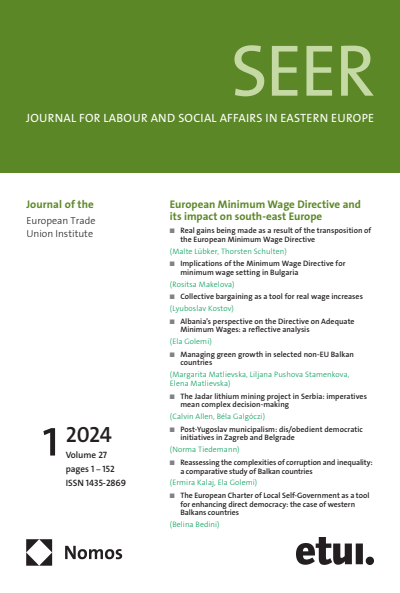
SEER tries to stimulate the exchange of information among researchers, trade unionists and people who have a special interest in the political, social and economic development of the region of south-east Europe. The journal tries to draw attention to new research results and the latest analyses about the ongoing process of political and social changes in the south-east of Europe. It tries to create more understanding for the importance of the elaboration of democratic structures in industrial relations. The SEER combines contributions from different disciplines and »political schools« into an information package of interest for policy makers, researchers, academics and trade unionists from various backgrounds. Website: www.seer.nomos.de
This article constitutes the formal paper presented by the author to the SEER Journal symposium ‘The European integration of the western Balkans’ which took place in Belgrade on 19 May 2025. The article seeks to centralise a revised Central...
This article analyses the effects of the European integration process on the labour market in Albania. It provides a summary analysis of a much deeper body of research examining the processes of European integration which have brought with them a...
The EU’s ‘From Farm to Fork’ Strategy, a central pillar of the European Green Deal, seeks to reshape the EU food system into one that is fair, healthy and environmentally sustainable. Spanning the entire food chain, it incorporates...
This article reports on a study examining the impact of remittances on economic development and the labour market structure in Albania, focusing on both short-term and long-term effects. The methodology follows a quantitative approach, utilising...
Social insurance in the Republic of Serbia consists of three main components: pension and disability insurance; health insurance; and unemployment insurance. Pension and disability insurance includes both mandatory and voluntary schemes. Mandatory...
According to the Labour Force Survey, in 2023, there were around 9,000 domestic workers (i.e. less than 1% of all workers) across the country. Administrative data on domestic work arrangements are scarce and, while anecdotal evidence suggests that...
2023 LFS data suggest that there are around 30,000 domestic workers in Albania. There is no available estimate of the extent of informality in the sector, but this is assumed to be extremely high. The labour code does not provide any reference to...
2023 Labour Force Survey data suggests that there are about 3,000 domestic workers in Montenegro, of whom three-quarters are women, while 55% are employees and 80% are employed outside the care sector. There is no legal definition of domestic...
This article reviews the current situation in Georgia through the specific lens of trade unionism and the role of new independent unions in the street protests that took place during 2024 in relation to the country’s controversial ‘foreign...