, to see if you have full access to this publication.
Monograph No access
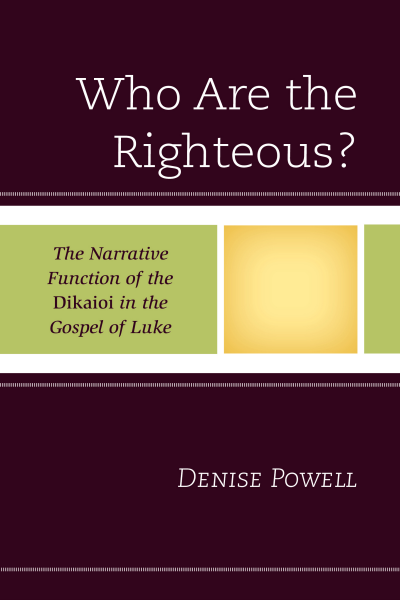
Who Are the Righteous?
The Narrative Function of the Dikaioi in the Gospel of Luke
Authors:
Publisher:
2021
Summary
Who is righteous and how one becomes righteous is a question often debated in Pauline studies but rarely explored in the Gospels. In this book, Denise Powell investigates Luke’s answer to the question by tracing his “righteous” characters sequentially through the Gospel narrative. By portraying Zechariah and Elizabeth, Mary, Simeon, and Anna as righteous at the beginning of the narrative, Luke establishes the characteristics of the righteous. As a result of the primacy effect, these birth narrative characters become the standard against which the righteous nature of subsequent characters is measured. This leads to uncertainty over who belongs in the category of the righteous when later stories contrast an ostensibly righteous character with a “sinner.” The increasing uncertainty over who belongs in which category functions as the backdrop for the centurion’s declaration that Jesus is “righteous.” By way of the “sword discourse” of 22:35-38 and the subsequent arrest scene, Jesus intentionally places himself in the “sinner” category in fulfilment of Scripture. Since Jesus has placed himself in solidarity with sinners, and they with him, the centurion’s declaration that Jesus is righteous has implications for all the sinners in the Lukan story.
Keywords
Search publication
Bibliographic data
Edition
1/2021
Copyright Year
2021
ISBN-Print
978-1-9787-1257-7
ISBN-Online
978-1-9787-1258-4
Publisher
Lexington, Lanham
Language
English
Pages
156
Product Type
Monograph
Table of contents
ChapterPages
Dedication No access
Contents No access
List of Table No access
Abbreviations No access
Acknowledgments No access
Outline of the Study No access
Limits of This Study No access
Notes No access
Frequency and Uniqueness of Occurrences No access
Location of Occurrences No access
Characters Described as Falsely Δίκαι* No access
Δίκαι*: A Leitwort in the Lukan Narrative No access
Conclusion No access
Notes No access
Introducing the Δίκαι* Characters in the Birth Narrative No access
Establishing the Characteristics of the Δίκαι* No access
Establishing the Δίκαι* as Reliable Characters No access
The Δίκαι* as Those Who “Believe That What Was Spoken Will Be Fulfilled.” No access
Conclusion No access
Notes No access
Levi’s Banquet No access
Simon and the Woman No access
The Parable of the “Lost” No access
The Parable of the Pharisee and the Tax Collector No access
The Sinful People of 24:7 No access
The Special Case of the Pharisees No access
Conclusion No access
Notes No access
The Continuation of the Righteous-Sinner Theme in the Passion Narrative No access
Jesus the Sinner No access
Jesus the Righteous One No access
Sinner or Righteous: A Matter of Perspective No access
Sinners Become Righteous No access
Conclusion No access
Notes No access
Chapter 6: Conclusion No access Pages 123 - 128
Bibliography No access Pages 129 - 140
Author Index No access Pages 141 - 144
Reference Index No access Pages 145 - 154
About the Author No access Pages 155 - 156
Similar publications
from the topics "Religion und Theologie allgemein"
Edited Book No access
Jan Hermelink, Alexander Deeg, Michael Domsgen, Kristin Merle, Marcell Saß