, to see if you have full access to this publication.
Monograph No access
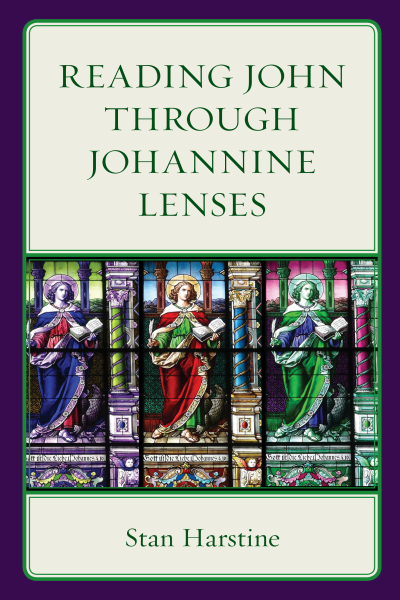
Reading John through Johannine Lenses
Authors:
Publisher:
2022
Summary
Reading John through Johannine Lenses demonstrates that the model an interpreter chooses for examining the Gospel of John significantly impacts the resulting interpretation. The Fourth Evangelist uses key words in the prologue in order to guide the reader toward key moments in the gospel. Stan Harstine shows how four words— life, word, receive, and believe— converge at transition points in John 5, 12, and 17. Their close relationship is not random; rather, it guides the reader to recall what the Gospel has presented in the preceding section, providing a road map for understanding the narrative. By using interpretive models from both diachronic and synchronic methodologies, Harstine’s comparison of traditional historical methods with more recent narrative and rhetorical methods demonstrates the wide disparity of results from prior approaches, thus accentuating the importance of reading the Fourth Gospel through the lenses it provides its readers.
Keywords
Search publication
Bibliographic data
Edition
1/2022
Copyright Year
2022
ISBN-Print
978-1-9787-1293-5
ISBN-Online
978-1-9787-1294-2
Publisher
Lexington, Lanham
Language
English
Pages
130
Product Type
Monograph
Table of contents
ChapterPages
Contents No access
Table No access
Acknowledgments No access
Abbreviations No access
Various Approaches to the Prologue No access
Relationship to the “Gospel Proper” No access
Another Approach to the Question of Unity No access
Notes No access
Light as a Theme in the Gospel No access
Life as a Theme in the Gospel No access
What Is the Alternative? No access
Notes No access
Diachronic Approach: Historical Criticism No access
Synchronic Approach: Narrative Criticism No access
Synchronic Approach: Rhetorical Criticism No access
Reading John 5 through Themes from the Prologue No access
Conclusion No access
Notes No access
Diachronic Approach: Historical Criticism No access
Synchronic Approach: Narrative Criticism No access
Synchronic Approach: Rhetorical Criticism No access
Reading John 12 through Themes from the Prologue No access
Conclusion No access
Notes No access
Diachronic Approach: Historical Criticism No access
Synchronic Approach: Narrative Criticism No access
Synchronic Approach: Rhetorical Criticism No access
Reading John 17 through Themes from the Prologue No access
Conclusion No access
Notes No access
Review of the Four Themes No access
Analysis No access
Unity of the Gospel No access
Final Propositions No access
Notes No access
Bibliography No access Pages 113 - 122
Author Index No access Pages 123 - 124
Scripture Index No access Pages 125 - 128
About the Author No access Pages 129 - 130
Similar publications
from the topics "Religion und Theologie allgemein"
Edited Book No access
Jan Hermelink, Alexander Deeg, Michael Domsgen, Kristin Merle, Marcell Saß