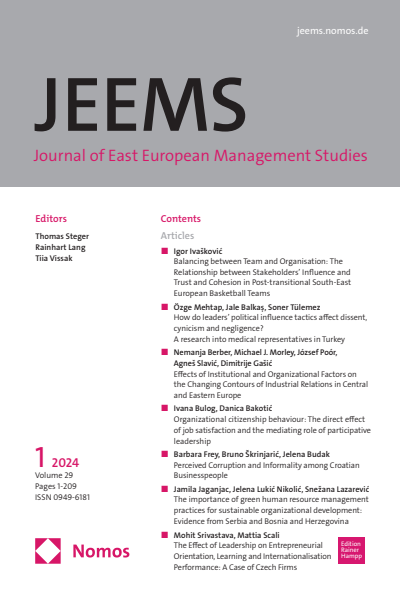
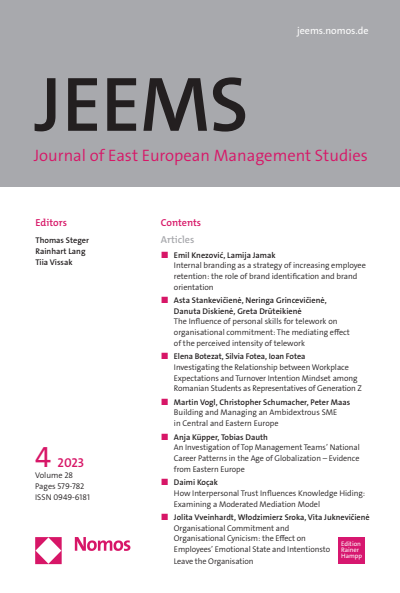
The Journal of East European Management Studies aims to promote dialogue and cooperation among scholars seeking to examine,explore and explain the behaviour and practices of management within the transforming societies of Central and Eastern Europe.The theoretical interests of the journal areorganisational and management change,Central and East European societies (including those on the fringes of Europe) undergoing processes of transition or transformation, andscientific issues of business, management and organisation that arise in such contexts.The JEEMS aims to attract social scientific contributions from scholars of any nation and region, but particularly wishes to encourageauthors from those countries directly experiencing transformational change. Its potential readership is international, comprising academicsand practitioners with an involvement or interest in the management of change in transforming societies in Central and Eastern Europe.
The current study applies content analysis to scrutinize the relationship between Twitter messaging tactics employed by 186 Public Benefit Organizations (PBO) and public reactions in the form of liking, retweeting and commenting behaviour. The...
This paper aims to study the effects of using strategic alliances by Czech SMEs. It reviews available literature and provides an analytical framework to employ for analysing the propensity of SMEs to engage in strategic alliances and its...
This research explores the relationships between the networking of firms and their innovativeness and internationalisation, with the distinction between their outward and inward types. It adopts a holistic approach to firms’ innovativeness and...
This study focused on demonstrating that the psychological contract influences employees’ intention to leave the organization. Both factors in the context of work satisfaction. It also examined: (1) whether there is a relationship between the...
Scholars and managers have been discussing and investigating assets that could offer superior performance for decades, and they found that human resources are the most important asset that enables organizations to improve their organizational...
This study explores the ethical ideology of students in order to find if ethical ideology is influenced by their academic studies. We use an ethical ideology concept that distinguishes between idealism and relativism, and we surveyed 228 Ukrainian...
Strategic responses of organizations can be triggered by both environmental and organizational antecedents. Even though environments impose some constraints on organizations, they still have a range of response. We find that newspapers, in Turkey,...