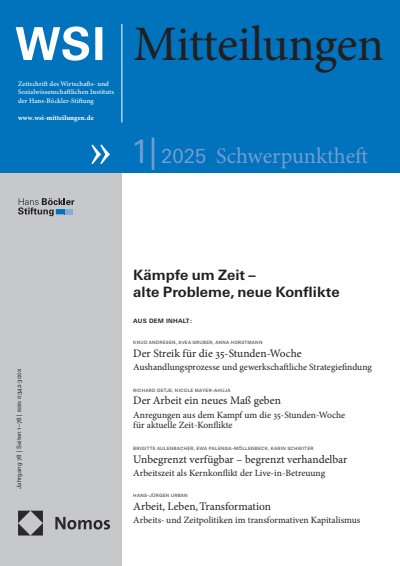
The 1984 strike for the 35-hour week is a milestone in the history of German trade union working time struggles. On the one hand, this is due to the fierceness of the struggle and its long-term consequences in terms of labour law. On the other hand,...
40 years after the struggle for a 35-hour workweek in the Western German metal, electrical, and printing industries, the quest for reduced work hours is once more at the centre of discussions. Although just like in 1984, it’s all about securing...
Several trade unions in Germany have pushed through flexible working time arrangements recently, giving employees the choice between more time and more money. With this choice, employees can adapt their working hours to different stages of life in a...
Stationary care for the elderly is considered to be problematic not only in terms of poor working conditions and the resulting turnover, but also with regard to possibilities for union representation. But why does it seem so difficult to...
This article addresses the issue of live-in care in Germany, Austria and Switzerland and shows how working time is a key conflict in the regulation and the everyday organisation and practice of this type of work. First, the authors tie the concept...
Based on analyses of the 2023 working time survey by the Federal Institute for Occupational Safety and Health (Bundesanstalt für Arbeitsschutz und Arbeitsmedizin), this article shows that the working time of men and women with and without children...