, to see if you have full access to this publication.
Monograph No access
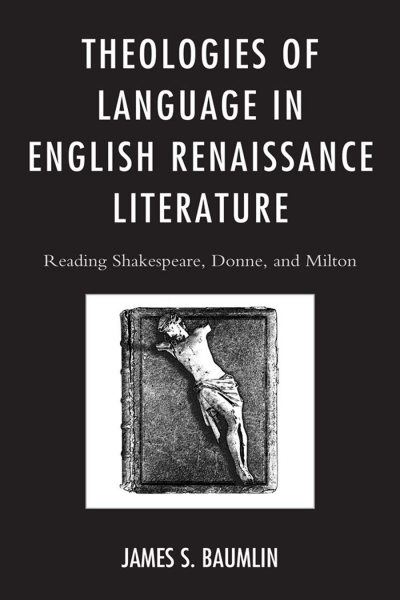
Theologies of Language in English Renaissance Literature
Reading Shakespeare, Donne, and Milton
Authors:
Publisher:
2012
Summary
James S. Baumlin’s Theologies of Language in English Renaissance Literature offers a revisionist history of discourse, taking Shakespeare, Donne, and Milton as its touchstones. Their works mark stages in dieEntzauberung or “disenchantment,” as Max Weber has termed it: that is, in the “elimination of magic from the world.” Shakespeare’s Hamlet questions the word-magic associated with medieval Catholicism; Donne’s love lyrics ironize the sacramental gestures of their poetic-priestly speakers; more radical still, Milton’s major poems and polemical prose empty language of sacral power, repudiating human persuasion entirely over matters of “saving faith.”
Baumlin describes four archetypes of historical rhetoric: sophism, skepticism, incarnationism, and transcendence. Undergirding the age’s competing theologies, each makes unique assumptions regarding the powers of language (both communicative and performative); the nature of being (including transcendent being or deity); the structure of the psyche (whether sin-weakened or self-sufficient); and the capacities of human knowing (whether certain knowledge is communicable—or even possible). Working within divergent theologies of language, the poets here studied take theological controversies as explicit themes.
The crisis of Hamlet begins not in a king’s murder simply, but in his dying without benefit of the sacraments. As if compensating for their loss, young Hamlet “minister[s]” to Gertrude while acting as “scourge” to Claudius. Alternating between soul-cursing and soul-curing, Hamlet plays sorcerer and priest indiscriminately.
Appropriating the speech-acts of Catholic sacramentalism, Donne’s lyrics describe a private “religion of Love,” over which the poet-lover presides as officiant. Or rather, some lyrics present him as Love’s Priest, there being as many personae as there are theologies of language. Beyond Love’s Priest, Baumlin describes three such personae: Love’s Apostate, Love’s Atheist, and Love’s Reformer.
Focusing on “Lycidas” and De Doctrina Christiana, Baumlin outlines Milton’s plerophoristic “rhetoric of certitude.” Such texts as these explore the problematic status of preaching. (Can human eloquencecontribute to salvation?) They explore competing definitions (Aristotelian vs. Pauline) of pistis—meaningalternatively (religious) “faith” and (rhetorical) “persuasion.” And they invoke conflicting typologies (classical vs. Hebraic) of authorial ethos.
Baumlin’s study ends with a glance at the Restoration and Royal Society’s final “disenchantment” or secularization of discourse.
Search publication
Bibliographic data
Edition
1/2012
Copyright Year
2012
ISBN-Print
978-0-7391-6960-5
ISBN-Online
978-0-7391-6961-2
Publisher
Lexington, Lanham
Language
English
Pages
259
Product Type
Monograph
Table of contents
ChapterPages
Contents No access
Abbreviations No access
List of Figures No access
Prelude: On Reading Rhetorically No access
Acknowledgments No access
1. “Resistless Eloquence” No access Pages 1 - 32
2. Hamlet’s Sorcery No access Pages 33 - 51
3. “Scourge” or “Minister”? No access Pages 52 - 76
4. The Donnean Doubting-Game No access Pages 77 - 90