, to see if you have full access to this publication.
Edited Book No access
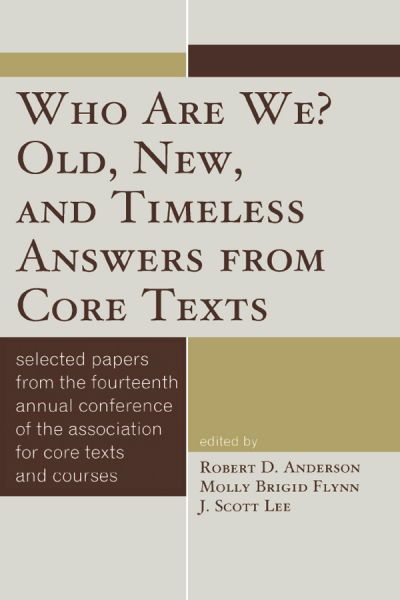
Who Are We? Old, New, and Timeless Answers from Core Texts
Editors:
| |
Publisher:
2011
Summary
In this volume, the Association for Core Texts and Courses has gathered essays of literary and philosophical accounts that explain who we are simply as persons. Further, essays are included that highlight the person as entwined with other persons and examine who we are in light of communal ties. The essays reflect both the Western experience of democracy and how community informs who we are more generally. Our historical position in a modern or post-modern, urbanized or disenchanted world is explored by yet other papers. And, finally, ACTC educators model the intellectual life for students and colleagues by showing how to read texts carefully and with sophistication —- as an example of who we can be.
Search publication
Bibliographic data
Edition
1/2011
Copyright Year
2011
ISBN-Print
978-0-7618-5371-8
ISBN-Online
978-0-7618-5372-5
Publisher
Hamilton Books, Lanham
Language
English
Pages
232
Product Type
Edited Book
Table of contents
ChapterPages
Table of Contents No access
Introduction No access
Paideia in a Post-Darwinian World: Reconnecting Education and Biology No access
The Great "Civilized" Conversation: A Case in Point No access
Who We Were, Are, and Will Be, Seen Through a Darwinian Lens No access
Georg Simmers "The Metropolis and Mental Life": An Anchor for the First-Year Core No access
The Woman in the Dunes as a Core Text: Abe Kobo's Search for a New Modern Identity No access
Descartes and the Existentialists: The Continuing Fruitfulness of the Cogito No access
Dark Night of Our Souls' Democratic Vistas No access
Old Maps, New Worlds: A Case of Culture and Core No access
Freedom, Democracy, and Empire: Are We Imperial Athens? No access
Boiling Down the People: Democratic Reform in Aristophanes' The Knights No access
Tocquevillian Reflections on Liberal Education and Civic Engagement No access
Good Cop, Bad Cop: Interrogating Human Nature with Xunzi and Mencius No access
Aristotle (versus Kant) on Autonomy and Moral Maturity No access
Two Meditations on the Nature of Self No access
Montaigne and the Limits of Human Reason No access
Othello in Context: Who Are We? Who Do We Think We Are? Who Are They? How Do We Know? No access
Dock - Alles, was dazu mich trieb / Gott! war so gut! ach war so lieb: Pleasure and Obligation in Faust No access
Who Are We, Whose Are We? Women as God's Agents of Change in the Hebrew Bible No access
Who We Are Through Family and Friends No access
Rethinking Rites-Music Relations in Confucian Tradition No access
Politics, Principles, and Death in Antigone No access
Self-Cultivation and the Chinese Epic: Confucian, Taoist, and Buddhist Themes in Journey to the West No access
The Morality of Makola in Conrad's An Outpost of Progress No access
H.G. Wells on Being an Engineer No access
Who We Are and the Case for Economics in the Core Curriculum No access
Core Texts, Introspection, and the Recovery of the Renaissance Ideal in Twenty-First-Century Higher Education No access
Adverbial Play in Plato's Ion No access
Remembering Ancient Truths: The Four Roots of Plato's Recollection No access
Dante Is from Mars No access
Art and Revolution in the Images of Francisco Goya No access
Incorporating Eastern Texts into a Western Core: Teaching the Tao Te Ching in Conversation with Wallace Stevens No access