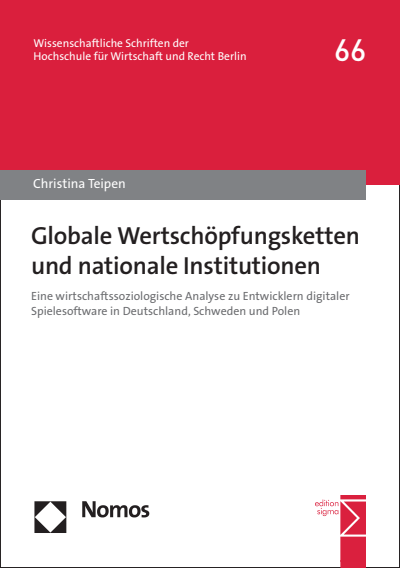
Globale Wertschöpfungsketten und nationale Institutionen
Eine wirtschaftssoziologische Analyse zu Entwicklern digitaler Spielesoftware in Deutschland, Schweden und Polen- Authors:
- Series:
- HWR Berlin Forschung, Volume 66
- Publisher:
- 2019
Summary
Along with only a small handful of European industries, video game development typifies creative knowledge work under high-risk employment conditions. Data on the global video game market indicate that the industry is expanding worldwide and will only continue to gain in relevance for European economies in the future. In this context, the author of this study analyses the interaction between macro-institutional and industry-specific conditions as well as work and employment systems at company level in three countries. At the micro-level, the author focuses on interest representation, employment flexibility and the role of worker qualifications and skills. At the macro-institutional level, she focuses on analysing labour regulation as well as on educational and financial systems. The author, Christina Teipen, conducts research and teaches in the areas of comparative institutional analysis and global value chains.
Keywords
Search publication
Bibliographic data
- Copyright Year
- 2019
- ISBN-Print
- 978-3-8487-5910-1
- ISBN-Online
- 978-3-7489-0037-5
- Publisher
- Nomos, Baden-Baden
- Series
- HWR Berlin Forschung
- Volume
- 66
- Language
- German
- Pages
- 407
- Product Type
- Monograph
Table of contents
- Titelei/InhaltsverzeichnisPages 1 - 18 Download chapter (PDF)
- EinleitungPages 19 - 26 Download chapter (PDF)
- Das Finanzsystem:
- Die interne Unternehmensstruktur:
- Die industriellen Beziehungen:
- Das Ausbildungssystem:
- Zwischenbetriebliche Beziehungen:
- Inkrementelle versus radikale Innovation
- Unzulänglichkeiten des Komplementaritätsarguments
- Der „Varieties-of-Capitalism“-Ansatz und der Kreativsektor
- Schlussfolgerungen aus der Kritik des „Varieties-of-Capitalism-Ansatzes“
- „Social systems of innovation and production“ von Amable und Petit
- Produktionsmodelle nach Boyer/Freyssenet
- „Industrial Order“ und „soziales System der Produktion“
- Der evolutionsökonomische Ansatz der Lebenszyklen von Branchen
- „Sectoral Systems of Innovation“
- Der Prozesskettenansatz
- Verbindungen zwischen dem „Global Value Chain“- Ansatz und der „Labour Process“-Theorie
- Institutionelle, branchen- sowie unternehmensspezifische oder Prozessketten-Faktoren?
- Deutschland
- Schweden
- Polen
- Zwischenfazit
- Deutschland
- Schweden
- Polen
- Zwischenfazit
- Die VoC-Perspektive auf Finanzsysteme
- Die besondere Rolle der KMUs
- Übergreifende Veränderungsdynamiken im Bereich von Finanzsystemen
- Transnationale Standards im Bereich von Finanzsystemen
- Fragestellung des internationalen Vergleichs
- Das Finanzregime Deutschlands
- Das schwedische Finanzsystem
- Das polnische Finanzsystem
- Zusammenfassung und erwartbare Konsequenzen im Hinblick auf junge Entwicklerstudios
- Gesamtresümee zu den drei institutionellen Bereichen
- Auswahl der Länder und der Segmente der Wertschöpfungskette
- Datengrundlage
- Analyse und Aussagekraft der Ergebnisse
- Einleitung
- Die Vorgeschichte:
- Die 1970er Jahre:
- Die 1980er Jahre:
- Die 1990er Jahre:
- Die Entwicklung seit dem Jahr 2000:
- Zwischenfazit zur Struktur der Wertschöpfungskette in der Computerspielebranche
- Computerbasierte Spiele
- Konsolenspiele
- Mobilfunkspiele
- Onlinespiele
- „Social Games“
- Die Bedeutung der Spielekategorien im Vergleich
- Der Wandel von Distributionskanälen und Profitstrategien
- Die Positionierung der schwedischen, polnischen und deutschen Entwicklerstudios auf dem Produktmarkt
- Die Finanzierung über den Finanzmarkt
- Die Finanzierungspraxis entlang der Prozesskette
- Staatliche und überregionale Förderpolitik sowie die Verbändestruktur in den drei Ländern
- Crowdfunding
- Flexible Beschäftigungsverhältnisse
- Mehrarbeit als Flexibilitätspuffer
- Outsourcing
- Offshoring
- Zwischenfazit
- „Intrinsische“ Motivation und Steuerung über sog. Meilensteine: Leidenschaft für Spiele und getaktete Selbstorganisation
- Lohndifferenzierung und variable Entgeltbestandteile
- Zwischenfazit
- Diskussion der arbeitssoziologischen Ergebnisse vor dem Hintergrund von Analysen in vergleichbaren Arbeitsmarktsegmenten
- Schweden
- Deutschland und Polen
- Der Qualifikationsbedarf der Publishing-Unternehmen
- Rekrutierung aus der Perspektive der Entwicklungsfirmen
- Reaktionen der Ausbildungssysteme
- Die Gamesbranche in Deutschland
- Die Gamesbranche in Schweden
- Die polnische Gamesbranche
- Zwischenfazit
- Fazit der empirischen Ergebnisse und Ausblick auf gegenwärtige Veränderungstendenzen
- Bildungstheoretische Schlussfolgerungen
- Arbeits- und beschäftigungstheoretische Implikationen
- Interaktion zwischen nationalen Finanzierungssystemen und Akteuren entlang der Wertschöpfungskette
- Theoretische Schlussfolgerungen
- LiteraturverzeichnisPages 381 - 407 Download chapter (PDF)
Bibliography (392 entries)
No match found. Try another term.
- Abel, Jörg; Ittermann, Peter; Wannöffel, Manfred (2001): Alte und neue Arenen der industriellen Beziehungen - Resümee und Ausblick. In: Walther Müller-Jentsch, Jörg Abel und Hans Joachim Sperling (Hg.): Umbrüche und Kontinuitäten. Perspektiven nationaler und internationaler Arbeitsbeziehungen: Walther Müller-Jentsch zum 65. Geburtstag. München: R. Hampp, S. 383–405. Open Google Scholar DOI: 10.5771/9783748900375
- Abel, Jörg; Pries, Ludger (2005): Von der Stellvertretung zur Selbstvertretung? Interessenvertretung bei hochqualifizierter Wissensarbeit in Neue-Medien-Unternehmen. In: Nicole Mayer-Ahuja und Harald Wolf (Hg.): Entfesselte Arbeit - neue Bindungen. Grenzen der Entgrenzung in der Medien- und Kulturindustrie. Berlin: edition sigma, S. 109–152. Open Google Scholar DOI: 10.5771/9783748900375
- Abel, Jörg; Peter Ittermann (2006): Strukturen und Wirksamkeit von Beschäftigtenpartizipation in Neue-Medien-Unternehmen. In: Ingrid Artus (Hg.): Betriebe ohne Betriebsrat. Informelle Interessenvertretung in Unternehmen. Frankfurt/Main, New York: Campus, S. 197–221. Open Google Scholar DOI: 10.5771/9783748900375
- Agarwal, Ratshree; Sarkar, M. B.; Echambadi, Raj (2002): The conditioning effect of time on firm survival: An industry life cycle approach. In: Academy of Management Journal 45 (5), S. 971–994. Open Google Scholar DOI: 10.5771/9783748900375
- Aguilera, Ruth V.; Jackson, Gregory (2010): Comparative and International Corporate Governance. In: The Academy of Management Annals 4 (1), S. 485–556. DOI: 10.1080/19416520.2010.495525. Open Google Scholar DOI: 10.5771/9783748900375
- Ahmad, Shakeel u.a. (2011): ICT-248175. Deliverable D2.10. Online verfügbar unter www.cng-project.eu, zuletzt geprüft am 21.02.2014. Open Google Scholar DOI: 10.5771/9783748900375
- Allen, Matthew (2004): The varieties of capitalism paradigm: not enough variety? In: Socio-Economic Review 2 (1), S. 87–108. DOI: 10.1093/soceco/2.1.87. Open Google Scholar DOI: 10.5771/9783748900375
- Allen, Matthew M. C. (2013): Comparative capitalisms and the institutional embeddedness of innovative capabilities. In: Socio-Economic Review 11 (4), S. 771–794. DOI: 10.1093/ser/mwt018. Open Google Scholar DOI: 10.5771/9783748900375
- Allmendinger, Jutta; Christian Ebner; Rita Nikolai (2010): Bildung in Europa 2010 – Ziele erreicht oder verfehlt? In: WSI Mitteilungen 63 (4), S. 171–177. Open Google Scholar DOI: 10.5771/9783748900375
- Allmendinger, Jutta; Ebner, Christian (2007): Kommentar: Erst- und Weiterbildung und die europäische Bildungspolitik. In: WSI-Mitteilungen (11), S. 578. Open Google Scholar DOI: 10.5771/9783748900375
- Allmendinger, Jutta; Rita Nikolai (2010): Bildungs- und Sozialpolitik: Die zwei Seiten des Sozialstaats im internationalen Vergleich. In: Soziale Welt 61, S. 105–119. Open Google Scholar DOI: 10.5771/9783748900375
- Aluchna, Maria (2006): Ownership Concentration and Corporate Performance: Evidence from Poland. In: Tomasz Mickiewicz (Hg.): Corporate governance and finance in Poland and Russia. Basingstoke, [England], New York, N.Y.: Palgrave Macmillan (Studies in economic transition), S. 194–214. Open Google Scholar DOI: 10.5771/9783748900375
- Amable, Bruno (2003): The diversity of modern capitalism. Oxford, New York: Oxford University Press. Open Google Scholar DOI: 10.5771/9783748900375
- Amable, Bruno; Petit, Pascal (impr. 2002): La diversité des systèmes sociaux d'innovation et de production dans les années 90. In: Robert M. Solow und Jean-Philippe Touffut (Hg.): Institutions et innovation. De la recherche aux systèmes sociaux d'innovation. Paris: Albin Michel (Bibliothèque Albin Michel. Économie). Open Google Scholar DOI: 10.5771/9783748900375
- Amable, Bruno; Petit, Pascal (2003): The Diversity of Social Systems of Innovation and Production during the 1990s. In: Jean-Philippe Touffut (Hg.): Institutions, innovations and growth. Selected economic papers, 207-244. Cheltenham, Northampton MA: Edward Elgar. Open Google Scholar DOI: 10.5771/9783748900375
- Andersen, Robert; van de Werfhorst, Herman G (2010): Education and occupational status in 14 countries: the role of educational institutions and labour market coordination. In: The British journal of sociology 61 (2), S. 336–355. DOI: 10.1111/j.1468-4446.2010.01315.x. Open Google Scholar DOI: 10.5771/9783748900375
- Anxo, Dominque; Harald, Niklasson (2009): The Swedish Model: Revival after the Turbulant 1990s? In: Gerhard Bosch, Steffen Lehndorff und Jill Rubery (Hg.): European Employment Models in Flux. Basingstoke: Palgrave Macmillan, S. 81–104. Open Google Scholar DOI: 10.5771/9783748900375
- Apergis, Nicholas; Lyroudi, Katerina; Vamvakidis, Athanasios (2008): The relationship between foreign direct investment and economic growth: evidence from transition countries. In: Transition Studies Review 15 (1), S. 37–51. DOI: 10.1007/s11300-008-0177-0. Open Google Scholar DOI: 10.5771/9783748900375
- Apitzsch, Birgit (2015): Flexibilität und Inklusion: Die Integrationskraft informeller Kooperationsstrukturen. In: Victoria von Groddeck und Sylvia Marlene Wilz (Hg.): Formalität und Informalität in Organisationen. Wiesbaden: Springer Fachmedien, S. 261-276. Open Google Scholar DOI: 10.5771/9783748900375
- Arrowsmith, James (2006): Temporary agency work in an enlarged European Union. Luxembourg: Office for Official Publications of the European Communities. Open Google Scholar DOI: 10.5771/9783748900375
- Arrowsmith, James (2009): Temporary agency work and collective bargaining in the EU. Hg. v. European Foundation for the Improvement of Living and Working Conditions. Dublin. Online verfügbar unter http://eurofound.europa.eu/sites/default/files/ef_files/docs/eiro/tn0807019s/tn0807019s.pdf, zuletzt geprüft am 10.03.2015. Open Google Scholar DOI: 10.5771/9783748900375
- Artus, Ingrid (Hg.) (2006): Betriebe ohne Betriebsrat. Informelle Interessenvertretung in Unternehmen. Frankfurt/Main, New York: Campus. Open Google Scholar DOI: 10.5771/9783748900375
- Audretsch, David B. (1986): The Effect of Technology and the Industry Life-Cycle on the Concentration-Profits Relationship. Hg. v. Wissenschaftszentrum Berlin für Sozialforschung. Berlin (discussion paper IIM/IP 86 5). Open Google Scholar DOI: 10.5771/9783748900375
- Baethge, Martin (2003): Das berufliche Bildungswesen in Deutschland am Beginn des 21. Jahrhunderts. In: Jürgen Baumert und Kai S. Cortina (Hg.): Das Bildungswesen in der Bundesrepublik Deutschland. Strukturen und Entwicklungen im Überblick. Unter Mitarbeit von Martin Baethge. Vollständig überarbeitete und erweiterete Neuausg. Reinbek bei Hamburg: Rowohlt, S. 525–580. Open Google Scholar DOI: 10.5771/9783748900375
- Baethge, Martin; Bartelheimer, Peter (2002): Berichterstattung zur sozio-ökonomischen Leistungsfähigkeit in Deutschland. In: SOFI-Mitteilungen 30, S. 27–45. Open Google Scholar DOI: 10.5771/9783748900375
- Baethge, Martin; Solga, Heike; Wieck, Markus (2007): Berufsbildung im Umbruch. Signale eines überfälligen Aufbruchs; [Studie]. 1. Aufl. Berlin: Friedrich-Ebert-Stiftung (Netzwerk - Bildung). Open Google Scholar DOI: 10.5771/9783748900375
- Bair, Jennifer (2008): Analysing global economic organization: embedded networks and global chains compared. In: Economy and Society 37 (3), S. 339–364. DOI: 10.1080/03085140802172664. Open Google Scholar DOI: 10.5771/9783748900375
- Baltowski, Maciej; Mickiewicz, Tomasz (2006): State Corporate Governance in Poland. In: Tomasz Mickiewicz (Hg.): Corporate Governance and Finance in Poland and Russia. Houndsmills, Basingstoke: Palgrave Macmillan, S. 72–87. Open Google Scholar DOI: 10.5771/9783748900375
- Bandau, Frank (2018): Nordische Gewerkschaften unter Druck. Der Angriff rechter Parteien auf das Gent-System in Schweden und Dänemark. In: WSI-Mitteilungen 71 (2), S. 96-104. Open Google Scholar DOI: 10.5771/9783748900375
- Bandelj, Nina (2009): The Global Economy as Instituted Process: The Case of Central and Eastern Europe. In: American Sociological Review 74 (1), S. 128–149. DOI: 10.1177/000312240907400107. Open Google Scholar DOI: 10.5771/9783748900375
- Baron, Sonja Corinna (2007): Das duale System der Berufsausbildung unter dem Einfluss der europäischen Berufsbildungspolitik. Entwicklungsprozesse und Herausforderungen. Dissertation am Fachbereich Bildungswissenschaften, Duisburg-Essen. Open Google Scholar DOI: 10.5771/9783748900375
- Batchelor, James (2012): International Factfile: Poland. Mcvuk.com, 13.03.2012. Online verfügbar unter http://www.mcvuk.com/news/read/international-factfile-poland/092675, zuletzt geprüft am 16.10.2016. Open Google Scholar DOI: 10.5771/9783748900375
- Baukrowitz, Andrea (2006): Informatisierung der Arbeit - Gesellschaft im Umbruch. Berlin: edition sigma. Open Google Scholar DOI: 10.5771/9783748900375
- Baumert, Jürgen; Cortina, Kai S. (Hg.) (2003): Das Bildungswesen in der Bundesrepublik Deutschland. Strukturen und Entwicklungen im Überblick. Unter Mitarbeit von Martin Baethge. Vollständig überarbeitete und erweiterte Neuausg. Reinbek bei Hamburg: Rowohlt. Open Google Scholar DOI: 10.5771/9783748900375
- Becker, Karina (2009): Die Bühne der Bonität. Wie mittelständische Unternehmen auf die neuen Anforderungen des Finanzmarkts reagieren. 1. Aufl. Berlin: edition sigma. Open Google Scholar DOI: 10.5771/9783748900375
- Becker, Uwe (2008): Was ist dran am skandinavischen Modell? In: Leviathan 36 (2), S. 229–248. DOI: 10.1007/s11578-008-0013-2. Open Google Scholar DOI: 10.5771/9783748900375
- Beckert, Jens; Ebbinghaus, Bernhard; Hassel, Anke; Manow, Philip (Hg.) (1999): Transformationen des Kapitalismus. Festschrift für Wolfgang Streeck zum sechzigsten Geburtstag. Frankfurt/New York: Campus Verlag (57). Open Google Scholar DOI: 10.5771/9783748900375
- Beckert, Jens; Ebbinghaus, Bernhard; Hassel, Anke (Hg.) (2006): Transformationen des Kapitalismus. 1. Aufl. [S.l.]: Campus Verlag. Open Google Scholar DOI: 10.5771/9783748900375
- Bedu, Nicolas; Montalban, Matthieu (2014): Analysing the uneven development of private equity in Europe: legal origins and diversity of capitalism. In: Socio-Economic Review 12 (1), S. 33–70. DOI: 10.1093/ser/mwt011. Open Google Scholar DOI: 10.5771/9783748900375
- Behrmann, Malte (2011): EGDF-Policy-papers-2nd-edition-Game-Development-and-Digital-Growth-web. Online verfügbar unter http://www.b105.fi/egdf/wp-content/uploads/2011/06/EGDF-Policy-papers-2nd-edition-Game-Development-and-Digital-Growth-web.pdf, zuletzt geprüft am 24.02.2014. Open Google Scholar DOI: 10.5771/9783748900375
- Behrmann, Malte; Freeman, Jonathan (2012): European Online Game Survey 2012. Online verfügbar unter http://www.cng-project.eu/wp-content/uploads/2012/11/CNG-Brochure-Final.pdf, zuletzt geprüft am 24.02.2014. Open Google Scholar DOI: 10.5771/9783748900375
- Bell, Daniel (1985): Die nachindustrielle Gesellschaft. Frankfurt/Main, New York: Campus (Reihe Campus, 1001). Open Google Scholar DOI: 10.5771/9783748900375
- Bellini, Andrea u.a. (2018): Industrial relations and creative workers. Overall report. Florenz, Mailand: Universitäten (IR-CREA – Strategic but vulnerable. Project funded by the DG Employment, Social Affairs & Inclusion of the EC). Open Google Scholar DOI: 10.5771/9783748900375
- Benner, Chris (2002): Work in the new economy. Flexible labor markets in Silicon Valley. Oxford, UK: Malden, MA; Blackwell Publishers (Information Age series). Open Google Scholar DOI: 10.5771/9783748900375
- Berghahn, Volker R.; Vitols, Sigurt (Hg.) (2006): Gibt es einen deutschen Kapitalismus? Tradition und globale Perspektiven der sozialen Marktwirtschaft. Frankfurt am Main, New York: Campus. Open Google Scholar DOI: 10.5771/9783748900375
- Berntson, Erik; Näswall, Katharina.; Sverke, Magnus (2010): The moderating role of employability in the association between job insecurity and exit, voice, loyalty and neglect. In: Economic and Industrial Democracy 31 (2), S. 215–230. DOI: 10.1177/0143831X09358374. Open Google Scholar DOI: 10.5771/9783748900375
- Beyer, Jürgen; Höpner, Martin (2004): The Disintegration of Organized Capitalism: German Corporate Governance in the 1990s. In: Herbert Kitschelt und Wolfgang Streeck (Hg.): Germany. Beyond the stable state. London, Portland, OR: Frank Cass. Open Google Scholar DOI: 10.5771/9783748900375
- Bezmalinovic, Tomislav (2017): Der Nachfolger von Second Life öffnet diesen Frühling seine Tore. In: RODO. Magazin für virtuelle Realität. 7.3.2017. Online verfügbar unter https://vrodo.de/der-nachfolger-von-second-life-oeffnet-diesen-fruehling-sein-tore/, zuletzt geprüft am 8.3.2017. Open Google Scholar DOI: 10.5771/9783748900375
- Bitard, Pierre; Edquist, Charles; Hommen, Leif; Rickne, Annika (2008): Reconsidering the paradox of high R&D input and low innovation: Sweden. In: Charles Edquist und Leif Hommen (Hg.): Small country innovation systems. Globalization, change and policy in Asia and Europe. Cheltenham, UK, Northampton, MA: Edward Elgar, S. 237–280. Open Google Scholar DOI: 10.5771/9783748900375
- Blanchflower, David G. (2007): International Patterns of Union Membership. In: British Journal of Industrial Relations 45 (1), S. 1–28. DOI: 10.1111/j.1467-8543.2007.00600.x. Open Google Scholar DOI: 10.5771/9783748900375
- Blanck, Dag; Börjesson, Mikael (2008): Transnationale Strategies in Higher Education and Cultural Fields. The Case of the United States and Sweden in the 20th Century. In: American Studies in Scandinavia 40 (1-2), S. 80–89. Open Google Scholar DOI: 10.5771/9783748900375
- Bluhm, Katharina (2007): Experimentierfeld Ostmitteleuropa? Deutsche Unternehmen in Polen und der Tschechischen Republik. 1. Aufl. Wiesbaden: VS Verlag für Sozialwissenschaften (Forschung Gesellschaft). Open Google Scholar DOI: 10.5771/9783748900375
- Bluhm, Katharina; Schmidt, Rudi (Hg.) (2008): Change in SMEs. Towards a new European capitalism? Houndmills, Basingstoke, Hampshire [England], New York: Palgrave Macmillan. Open Google Scholar DOI: 10.5771/9783748900375
- Bluhm, Katharina; Schmidt, Rudi (2008): Why should the Varieties Literature Grant Smaller Firms More Attention? In: Katharina Bluhm und Rudi Schmidt (Hg.): Change in SMEs. Towards a new European capitalism? Houndmills, Basingstoke, Hampshire [England], New York: Palgrave Macmillan, S. 1–14. Open Google Scholar DOI: 10.5771/9783748900375
- Boes, Andreas; Baukrowitz, Andrea (2002): Arbeitsbeziehungen in der IT-Industrie. Erosion oder Innovation der Mitbestimmung? Berlin: edition sigma (Forschung aus der Hans-Böckler-Stiftung, 37). Open Google Scholar DOI: 10.5771/9783748900375
- Boes, Andreas; Bultemeier, Anja (2008): Informatisierung - Unsicherheit - Kontrolle. In: Kai Dröge, Kira Marrs und Wolfgang Menz (Hg.): Rückkehr der Leistungsfrage. Leistung in Arbeit, Unternehmen und Gesellschaft. Berlin: edition sigma, S. 59–90. Open Google Scholar DOI: 10.5771/9783748900375
- Boes, Andreas; Trinks, Katrin (2006): "Theoretisch bin ich frei". Interessenhandeln und Mitbestimmung in der IT-Industrie. Berlin: edition sigma (Forschung aus der Hans- Böckler-Stiftung, 67). Open Google Scholar DOI: 10.5771/9783748900375
- Boes, Andreas; Baukrowitz, Andrea (2002): Arbeitsbeziehungen in der IT-Industrie. Erosion oder Innovation der Mitbestimmung? Berlin: edition sigma. Open Google Scholar DOI: 10.5771/9783748900375
- Bogner, Alexander; Littig, Beate; Menz, Wolfgang (Hg.) (2002): Das Experteninterview. Wiesbaden: VS Verlag für Sozialwissenschaften. Open Google Scholar DOI: 10.5771/9783748900375
- Bohle, Dorothee (2002): Europas neue Peripherie. Polens Transformation und transnationale Integration. Münster: Westfälisches Dampfboot. Open Google Scholar DOI: 10.5771/9783748900375
- Bohle, Dorothee; Greskovits, Béla (2007): The State, Internationalization, and Capitalist Diversity in Eastern Europe. In: Competition & Change 11 (2), S. 89–115. DOI: 10.1179/102452907X181929. Open Google Scholar DOI: 10.5771/9783748900375
- Borkowski, Tadeusz; Marcinkowski, Aleksander (2008): From the "Wild West" Towards Europe. Change and Challenges in SMEs in Poland. In: Katharina Bluhm und Rudi Schmidt (Hg.): Change in SMEs. Towards a new European capitalism? Houndmills, Basingstoke, Hampshire [England], New York: Palgrave Macmillan, S. 185–200. Open Google Scholar DOI: 10.5771/9783748900375
- Borrás, Susana; Seabrooke, Leonard (Hg.) (2015): Sources of national institutional competitiveness. Sense-making in institutional change. Oxford: Oxford University Press. Open Google Scholar DOI: 10.5771/9783748900375
- Borrás, Susana; Seabrooke, Leonard; Schmidt, Vivien (2015): Conclusion. Sensemaking, Politics, Ideas, and Discourses in Institutional Change. In: Susana Borrás und Leonard Seabrooke (Hg.): Sources of national institutional competitiveness. Sense-making in institutional change. Oxford: Oxford University Press, S. 148–161. Open Google Scholar DOI: 10.5771/9783748900375
- Bosch, Gerhard; Lehndorff, Steffen; Rubery, Jill (Hg.) (2009): European Employment Models in Flux. Basingstoke: Palgrave Macmillan. Open Google Scholar DOI: 10.5771/9783748900375
- Botzem, Sebastian (2010): Standards der Globalisierung. Die grenzüberschreitende Regulierung der Unternehmensrechnungslegung als Pfadgestaltung. Dissertation. Freie Universität Berlin, Berlin. Open Google Scholar DOI: 10.5771/9783748900375
- Boyer, Robert (1999): What is the Future for Codetermination and Corporate Governance in Germany? In: Jens Beckert, Bernhard Ebbinghaus, Anke Hassel und Philip Manow (Hg.): Transformationen des Kapitalismus. Festschrift für Wolfgang Streeck zum sechzigsten Geburtstag. Frankfurt/New York: Campus Verlag (57), S. 135–157. Open Google Scholar DOI: 10.5771/9783748900375
- Boyer, Robert (2006): How Do Institutions Cohere and Change? The Institutional Complementarity Hypothesis and Its Explanation. In: Geoffrey Edward Wood und Philip James (Hg.): Institutions, production, and working life. Oxford, New York: Oxford University Press, S. 13–61. Open Google Scholar DOI: 10.5771/9783748900375
- Boyer, Robert (2015): How Institutional Competitiveness Emerged from Complementarities between Nordic Welfare and Innovation Systems. In: Susana Borrás und Leonard Seabrooke (Hg.): Sources of national institutional competitiveness. Sense-making in institutional change. Oxford: Oxford University Press, S. 129–147. Open Google Scholar DOI: 10.5771/9783748900375
- Boyer, Robert; Freyssenet, Michel (2003): Produktionsmodelle. Eine Typologie am Beispiel der Automobilindustrie. Berlin: ed. sigma. Open Google Scholar DOI: 10.5771/9783748900375
- Braczyk, Hans-Joachim (Hg.) (1997): Innovationsstrategien im deutschen Maschinen- und Anlagenbau. Akademie für Technikfolgenabschätzung in Baden-Württemberg (Arbeitsbericht Nr. 83). Stuttgart (Arbeitsbericht Nr. 83). Open Google Scholar DOI: 10.5771/9783748900375
- Braczyk, Hans-Joachim; Schienstock, Gerd (1996): Im "Lean-Express" zu einem neuen Produktionsmodell? In: Hans-Joachim Braczyk und Gerd Schienstock (Hg.): Kurswechsel in der Industrie. Lean production in Baden-Württemberg. Stuttgart: Kohlhammer (Veröffentlichungen der Akademie für Technikfolgenabschätzung in Baden-Württemberg), S. 269–329. Open Google Scholar DOI: 10.5771/9783748900375
- Braczyk, Hans-Joachim; Schienstock, Gerd (Hg.) (1996): Kurswechsel in der Industrie. Lean production in Baden-Württemberg. Stuttgart: Kohlhammer (Veröffentlichungen der Akademie für Technikfolgenabschätzung in Baden-Württemberg). Open Google Scholar DOI: 10.5771/9783748900375
- Brater, Michael; Beck, Ulrich (1983): Berufe als Organisationsformen menschlichen Arbeitsvermögens. In: Wolfgang Littek, W. Rammert und G. Wachtler (Hg.): Einführung in die Arbeits- und Industriesoziologie. 2. Aufl. Frankfurt/Main, New York: Campus-Verlag (Campus Studium. Kritische Sozialwissenschaft, Bd. 548), S. 208–224. Open Google Scholar DOI: 10.5771/9783748900375
- Brousseau, Eric; Curien, Nicolas (Hg.) (2006): Internet and digital economics. Cambridge, UK, New York: Cambridge University Press. Open Google Scholar DOI: 10.5771/9783748900375
- Bundesministerium für Bildung und Forschung: Berufsbildungsbericht 2009. Online verfügbar unter http://www.bmbf.de/pub/bbb_09.pdf, zuletzt geprüft am 21.09.2009. Open Google Scholar DOI: 10.5771/9783748900375
- Bundesministerium für Forschung und Bildung (2014): Berufsbildungsbericht 2014. Online verfügbar unter http://www.bmbf.de/pub/bbb_2014.pdf, Zugriff, zuletzt geprüft am 18.03.2015. Open Google Scholar DOI: 10.5771/9783748900375
- Burns, Natasha; McTier, Brian C.; Minnick, Kristina (2015): Equity-incentive compensation and payout policy in Europe. In: Journal of Corporate Finance 30, S. 85–97. DOI: 10.1016/j.jcorpfin.2014.10.019. Open Google Scholar DOI: 10.5771/9783748900375
- Busemeyer, Marius R. (2015): Skills and inequality. Partisan politics and the political economy of education reforms in western welfare states. Cambridge: Cambridge University Press. Open Google Scholar DOI: 10.5771/9783748900375
- Campbell, John L.; Hollingsworth, J. Rogers; Lindberg, Leon N. (Hg.) (1991): Governance of the American economy. Cambridge [England], New York: Cambridge University Press (Structural analysis in the social sciences, 5). Open Google Scholar DOI: 10.5771/9783748900375
- Casper, Steven (2007): Creating Silicon Valley in Europe. Public policy towards new technology industries. Oxford, New York: Oxford University Press. Open Google Scholar DOI: 10.5771/9783748900375
- Casper, Steven; Soskice, David (2004): Sectoral Systems of Innovation and Varieties of Capitalism: Explaining the Development of High-Technology Entrepreneurship in Europe. In: Franco Malerba (Hg.): Sectoral systems of innovation. Concepts, issues and analyses of six major sectors in Europe. New York, N.Y.: Cambridge University Press, S. 348–387. Open Google Scholar DOI: 10.5771/9783748900375
- Casper, Steven; Whitley, Richard (2004): Managing Competences in Entrepreneurial Technology Firms: A Comparative Institutional Analysis of Germany, Sweden and the UK. In: Research Policy 33, S. 89–106. Open Google Scholar DOI: 10.5771/9783748900375
- Caves, Richard E. (2000): Creative industries. Contracts between art and commerce. Cambridge, Mass., London: Harvard University Press. Open Google Scholar DOI: 10.5771/9783748900375
- Chung, Heejung; Thewissen, Stefan (2011): Falling Back on Old Habits? A Comparison of the Social and Unemployment Crisis Reactive Policy Strategies in Germany, the UK and Sweden. In: Social Policy & Administration 45 (4), S. 354–370. DOI: 10.1111/j.1467-9515.2011.00779.x. Open Google Scholar DOI: 10.5771/9783748900375
- Cohendet, Patrick u.a. (2018): The local, the global and the industry common: the case of the video game industry. In: Journal of Economic Geography 18, S. 1045-1068. Open Google Scholar DOI: 10.5771/9783748900375
- Comi, Simona; Grasseni, Mara (2012): Are Temporary Workers discriminated against? Evidence from Europe. In: The Manchester School 80 (1), S. 28–50. DOI: 10.1111/j.1467-9957.2011.02231.x. Open Google Scholar DOI: 10.5771/9783748900375
- Crouch, Colin; Streeck, Wolfgang (1997): Political economy and modern capitalism. Mapping convergence and diversity. London: Sage Publications. Open Google Scholar DOI: 10.5771/9783748900375
- Crouch, Colin (2005): Capitalist diversity and change. Recombinant governance and institutional entrepreneurs. Oxford, New York: Oxford University Press. Open Google Scholar DOI: 10.5771/9783748900375
- Crouch, Colin; Schröder, Martin; Voelzkow, Helmut (2007): Regional and Sectoral Varieties of Capitalism. Draft version for special issue on Capitalist Diversity and Diversity within Capitalism. In: Economy and Society 38 (4), S. 654–678. Open Google Scholar DOI: 10.5771/9783748900375
- Crowley, Stephen (2004): Explaining Labor Weakness in Post-Communist Europe: Historical Legacies and Comparative Perspective. In: east eur polit soc 18 (3), S. 394–429. DOI: 10.1177/0888325404267395. Open Google Scholar DOI: 10.5771/9783748900375
- Cumbers, Andrew (2015): Understanding Labour’s Agency under Globalization: Embedding GPN’s within an Open Political Economy. In: Newsome, Kirsty; Phil Taylor; Jennifer Bair; Al Rainnie, (Hg.): Putting Labour in its Place: Labour Process Analysis and Global Value Chains. London: Palgrave, S. 135-151. Open Google Scholar DOI: 10.5771/9783748900375
- Dataspelsbranschen (2012): Game Developer Index 2011. Swedish Games Industry’s Reports 2012. Swedish Games Industry. Stockholm. Online verfügbar unter http://www.dataspelsbranschen.se/media/130988/game_developer_index_2011.pdf, zuletzt geprüft am 14.02.2014. Open Google Scholar DOI: 10.5771/9783748900375
- Dataspelsbranschen (2013): Game Developer Index 2012. Swedish Games Industry’s Reports 2012. Swedish Games Industry. Stockholm. Online verfügbar unter http://www.dataspelsbranschen.se/media/134723/gamedeveloperindex_2012.pdf, zuletzt geprüft am 03.03.2014. Open Google Scholar DOI: 10.5771/9783748900375
- Deeg, Richard (1999): Finance capitalism unveiled. Banks and the German political economy. Ann Arbor: University of Michigan Press. Open Google Scholar DOI: 10.5771/9783748900375
- Deeg, Richard (2006): Path Dependency, Institutional Complementarity, and Change in National Business Systems. In: Glenn Morgan, Richard Whitley und Eli Moen (Hg.): Changing capitalisms? Internationalism, institutional change, and systems of economic organization. Oxford: Oxford University Press, S. 21–52. Open Google Scholar DOI: 10.5771/9783748900375
- Deeg, Richard (2009): The rise of internal capitalist diversity? Changing patterns of finance and corporate governance in Europe. In: Economy and Society 38 (4), S. 552–579. DOI: 10.1080/03085140903190359. Open Google Scholar DOI: 10.5771/9783748900375
- Deeg, Richard; O'Sullivan, Mary A. (2009): The Political Economy of Global Finance Capital. In: World Pol. 61 (04), S. 731–763. DOI: 10.1017/S0043887109990116. Open Google Scholar DOI: 10.5771/9783748900375
- Deppe, Rainer; Tatur, Melanie (2002): Rekonstitution und Marginalisierung. Transformationsprozesse und Gewerkschaften in Polen und Ungarn. Frankfurt/Main, New York: Campus-Verl. (Studienreihe des Instituts für Sozialforschung Frankfurt am Main). Open Google Scholar DOI: 10.5771/9783748900375
- DePrato, Giuditta; Bogdanowicz, Marc; Nepelski, Daniel; Simon, Jean-Paul; Lusoli, Wainer (2010): Born Digital / Grown Digital. Assessing the Future Competitiveness of the EU Video Games Software Industry. Hg. v. European Union. Institute for Prospective Technology Studies. Luxemburg. Open Google Scholar DOI: 10.5771/9783748900375
- Detzer, Daniel; Dodig, Nina; Evans, Trevor; Hein, Eckhard; Herr, Hansjörg (2013): The German Financial System. Hg. v. FESSUD (Studies in Financial Systems, No 3). Open Google Scholar DOI: 10.5771/9783748900375
- Dicken, Peter (1998): Global shift. Transforming the world economy. 3rd ed. London: Paul Chapman. Open Google Scholar DOI: 10.5771/9783748900375
- Dobbin, Frank; Boychuk, Terry (1999): National Employment Systems and Job Autonomy: Why Job Autonomy is High in the Nordic Countries and Low in the United States, Canada, and Australia. In: Organization Studies 20 (2), S. 257–291. DOI: 10.1177/0170840699202004. Open Google Scholar DOI: 10.5771/9783748900375
- Dobischat, Rolf; Fischell, Marcel; Rosendahl, Anna: Rechtliche Grundlagen der Weiterbildung auf europäischer Ebene und die Auswirkungen auf Deutschland, S. 11–27. Open Google Scholar DOI: 10.5771/9783748900375
- Dolata, Ulrich (2008): Technologische Innovationen und sektoraler Wandel. Eingriffstiefe, Adaptionsfähigkeit, Transformationsmuster: Ein analytischer Ansatz. In: Zeitschrift für Soziologie 37 (1), S. 42–59. Open Google Scholar DOI: 10.5771/9783748900375
- Dølvik, Jon Erik (2009): Nordeuropäische Muster der Arbeitsmarktanpassung. In: WSI Mitteilungen 62 (1), S. 10–16. Open Google Scholar DOI: 10.5771/9783748900375
- Dörre, Klaus; Brinkmann, Ulrich (2005): Finanzmarkt-Kapitalismus. Triebkraft eines flexiblen Produk¬tionsmodells? Finanzmarkt-Kapitalismus. In: Kölner Zeitschrift für Soziologie und Sozialpsychologie 45 (1), S. 85–116. Open Google Scholar DOI: 10.5771/9783748900375
- Dörre, Klaus (2006): Prekäre Arbeit. Unsichere Beschäftigungsverhältnisse und ihre sozialen Folgen. In: Arbeit 15 (3), S. 183–191. Open Google Scholar DOI: 10.5771/9783748900375
- Dröge, Kai; Marrs, Kira; Menz, Wolfgang (Hg.) (2008): Rückkehr der Leistungsfrage. Leistung in Arbeit, Unternehmen und Gesellschaft. Berlin: edition sigma. Open Google Scholar DOI: 10.5771/9783748900375
- Dunin-Wasowicz, Stefan; Pradelle, Perceval (2014): Private Equity and Labour in a Transition Economy: The Case of Poland. In: Howard F. Gospel, Andrew Pendleton und Sigurt Vitols (Hg.): Financialization, new investment funds, and labour. An international comparison. Oxford: Oxford University Press, S. 261–289. Open Google Scholar DOI: 10.5771/9783748900375
- Edlund, Jonas; Grönlund, Anne (2008): Protection of Mutual Interests? Employment Protection and Skill Formation in Different Labour Market Regimes. In: European Journal of Industrial Relations, 14 (3), S. 245-264. Open Google Scholar DOI: 10.5771/9783748900375
- Edquist, Charles; Hommen, Leif (Hg.) (2008): Small country innovation systems. Globalization, change and policy in Asia and Europe. Cheltenham, UK, Northampton, MA: Edward Elgar. Open Google Scholar DOI: 10.5771/9783748900375
- Edwards, Richard (1979): Contested terrain: The transformation of the workplace in the twentieth century, New York: Basic Books. Open Google Scholar DOI: 10.5771/9783748900375
- Ellguth, Peter (2003): Quantitative Reichweite der betrieblichen Mitbestimmung. In: WSI Mitteilungen 56 (3), S. 194–199. Open Google Scholar DOI: 10.5771/9783748900375
- Ellguth, Peter; Kohaut, Susanne (2008): Tarifbindung und betriebliche Interessenvertretung. Aktuelle Ergebnisse aus dem IAB-Betriebspanel 2007. In: WSI Mitteilungen 61 (9), S. 515–519. Open Google Scholar DOI: 10.5771/9783748900375
- Ellguth, Peter; Gerner, Hans-Dieter; Stegmaier, Jens (2012): Wage bargaining in Germany: The role of works councils and opening clauses. Institut für Arbeitsmarkt- und Berufsforschung. Nürnberg (IAB Discussion Paper No. 5/2012). Open Google Scholar DOI: 10.5771/9783748900375
- Ellguth, Peter; Kohaut, Susanne (2012): Arbeitsbeziehungen und Personalpolitik im Dienstleistungsbereich. In: Industrielle Beziehungen 19 (3), S. 257–289. Open Google Scholar DOI: 10.5771/9783748900375
- Ellguth, Peter; Gerner, Hans-Dieter; Stegmaier, Jens (2014): Wage effects of works councils and opening clauses: The German case. In: Economic and Industrial Democracy 35 (1), S. 95–113. DOI: 10.1177/0143831X12463171. Open Google Scholar DOI: 10.5771/9783748900375
- Engblom, Samuel (2008): Fixed-Term-at-Will. The New Regulation of Fixed-term Work in Sweden. In: The International Journal of Comparative Labour Law and Industrial Relations 24 (1), S. 133–149. Open Google Scholar DOI: 10.5771/9783748900375
- Engelhardt, Lutz (2007): Arbeits- und Kapitalmarktstruktur als Determinanten von Frühphasen-Wagniskapitalinvestitionen. Hg. v. WZB. Berlin (Discussion Paper SP II 2007 – 08). Open Google Scholar DOI: 10.5771/9783748900375
- Esping-Andersen, Gøsta (1998): Die drei Welten des Wohlfahrtskapitalismus. Zur politischen Ökonomie des Wohlfahrtsstaates. In: Stephan Lessenich und Ilona Ostner (Hg.): Welten des Wohlfahrtskapitalismus. Der Sozialstaat in vergleichender Perspektive. Frankfurt, New York: Campus (Theorie und Gesellschaft, Bd. 40), S. 19–56. Open Google Scholar DOI: 10.5771/9783748900375
- Estévez-Abe, Margarita; Iversen, Torben; Soskice, David (2001): Social Protection and the Formation of Skills. A Reinterpretation of the Welfare State. In: Peter A. Hall und David W. Soskice (Hg.): Varieties of capitalism. The institutional foundations of comparative advantage. Oxford [England], New York: Oxford University Press, S. 145–183. Open Google Scholar DOI: 10.5771/9783748900375
- Eurofound (2013): Eurofound Yearbook 2013. Living and working in Europe. Hg. v. The European Foundation for the Improvement of Living and Working Conditions. Publications Office of the European Union Luxembourg. Dublin. Open Google Scholar DOI: 10.5771/9783748900375
- Eurofound (2013): Third European company survey. First findings : résumé. Luxembourg: Publications Office. Open Google Scholar DOI: 10.5771/9783748900375
- European Commission (2008): Structures of Education, Voacational Training and Adult Education Systems in Europe. Sweden. Ministry of Education and Research. Online verfügbar unter http://eacea.ec.europa.eu/education/eurydice/documents/eurybase/structures/041_SE_EN.pdf, zuletzt geprüft am 23.10.2009. Open Google Scholar DOI: 10.5771/9783748900375
- EURYDICE Unit (2008): Structures of education, vocational training and adult education systems in Europe. Hg. v. Foundation for the Development of the Education System. Warschau. Online verfügbar unter http://www.eurydice.org, zuletzt geprüft am 03.01.2011. Open Google Scholar DOI: 10.5771/9783748900375
- EVCA (2014): Central and Eastern Europe Statistics 2013. Hg. v. European Private and Equity and Venture Capital Association (EVCA). Brüssel. Open Google Scholar DOI: 10.5771/9783748900375
- Faust, Michael; Fisecker, Christiane; Bahnmüller, Reinhard (2007): Was interessiert Analysten? Versuch über ein erklärungsbedürftiges Desinteresse an Personalpolitik. Berliner Debatte Initial, 18 (4/5). Open Google Scholar DOI: 10.5771/9783748900375
- Ferner, Anthony; Hyman, Richard (Hg.) (1993): Industrial relations in the new Europe. Oxford, UK, Cambridge, Mass., USA: Blackwell Business (Industrial relations in context). Open Google Scholar DOI: 10.5771/9783748900375
- Filatotchev, Igor; Mickiewicz, Tomasz (2006): ‚Private Benefits of Control’ and Debt Financing. In: Tomasz Mickiewicz (Hg.): Corporate Governance and Finance in Poland and Russia. Houndsmills, Basingstoke: Palgrave Macmillan, S. 159–175. Open Google Scholar DOI: 10.5771/9783748900375
- Florida, Richard (2002): The Rise of the Creative Class. New York: Basic Books. Open Google Scholar DOI: 10.5771/9783748900375
- Förster, Christian; Schmid, Josef; Trick, Nicolas (2014): Die nordischen Länder. Wiesbaden: Springer Fachmedien Wiesbaden. Open Google Scholar DOI: 10.5771/9783748900375
- Fulton, Lionel (2007): Worker representation in Europe. Labour Research Department and ETUI-REHS. Online verfügbar unter http://www.worker-participation.eu/national_industrial_relations/across_europe/collective_bargaining__1, zuletzt geprüft am 27.02.2009. Open Google Scholar DOI: 10.5771/9783748900375
- Games Wirtschaft (2016): Die 25 größten Spielhersteller in Deutschland. Online verfügbar unter http://www.gameswirtschaft.de/wirtschaft/top-25-games-studios-deutschland/, zuletzt geprüft am 21.02.2017. Open Google Scholar DOI: 10.5771/9783748900375
- Ganssmann, Heiner; Haas, Michael (2001): Arbeitsmärkte im Vergleich II. Flexibilität und Rigidität der Arbeitsmärkte in den Niederlanden, Dänemark und Schweden. Marburg: Schüren (Standortdebatte). Open Google Scholar DOI: 10.5771/9783748900375
- Gereffi, Gary; Humphrey, John; Sturgeon, Timothy (2005): The governance of global value chains. In: Review of International Political Economy 12 (1), S. 78–104. DOI: 10.1080/09692290500049805. Open Google Scholar DOI: 10.5771/9783748900375
- Gerlach, Knut; Stephan, Gesine (2008): A Note on Job Tenure and Collective Contracts. In: Labour 22 (1), S. 167–183. DOI: 10.1111/j.1467-9914.2008.00380.x. Open Google Scholar DOI: 10.5771/9783748900375
- Geyer, Robert R. (2003): Globalization, Europeanization, Complexity, and the Future of Scandinavian Exceptionalism. In: Governance 16 (4), S. 559–576. DOI: 10.1111/1468-0491.00228. Open Google Scholar DOI: 10.5771/9783748900375
- Giancola, Frank L. (2011): Examining the Job Itself as a Source of Employee Motivation. In: Compensation & Benefits Review (43, 1), S. 23–29. Open Google Scholar DOI: 10.5771/9783748900375
- Gibbon, Peter; Bair, Jennifer; Ponte, Stefano (2008): Governing global value chains: an introduction. In: Economy and Society 37 (3), S. 315–338. DOI: 10.1080/03085140802172656. Open Google Scholar DOI: 10.5771/9783748900375
- Glaeser, Edward ; Johnson, Simon ; Shleifer, Andrei (2001): Coase Versus the Coasians. In: The Quarterly Journal of Economics 116 (3), S. 853–899. DOI: 10.1162/00335530152466250. Open Google Scholar DOI: 10.5771/9783748900375
- Glimstedt, Henrik; Lazonick, William; Xie, Hao (2006): The evolution and allocation of employee stock options. adapting US-style compensation to the Swedish business model. In: European Management Review (3), S. 156–176. Open Google Scholar DOI: 10.5771/9783748900375
- Gonäs, Lena; Larsson, Patrik (2014): Employment Regimes and Personnel Work in Sweden. In: Bruce Kaufman (Hg.): The Development of Human Resource Management across Nations. Unity and Diversity. Cheltenham, Northampton: Edward Elgar, S. 410–436. Open Google Scholar DOI: 10.5771/9783748900375
- Gospel, Howard F. (1992): Markets, firms, and the management of labour in modern Britain. Cambridge, New York: Cambridge University Press (Cambridge studies in management, 17). Open Google Scholar DOI: 10.5771/9783748900375
- Gospel, Howard F.; Pendleton, Andrew; Vitols, Sigurt (Hg.) (2014): Financialization, new investment funds, and labour. An international comparison. Oxford: Oxford University Press. Open Google Scholar DOI: 10.5771/9783748900375
- Graf, Lukas (2009): Applying the Varieties of Capitalism Approach to Higher Education: comparing the internationalisation of German and British universities. In: European Journal of Education 44 (4), S. 569–585. DOI: 10.1111/j.1465-3435.2009.01401.x. Open Google Scholar DOI: 10.5771/9783748900375
- Haddon, Leslie (1999): The development of interactive games. In: Hugh Mackay und Tim O'Sullivan (Hg.): The media reader. London, Thousand Oaks, Calif.: Sage Publications, S. 305–327. Open Google Scholar DOI: 10.5771/9783748900375
- Haipeter, Thomas (2009): Tarifabweichungen und Flächentarifverträge. Eine Analyse der Regulierungspraxis in der Metall- und Elektroindustrie. 1. Aufl. Wiesbaden: VS Verlag für Sozialwissenschaften / GWV Fachverlage, Wiesbaden. Open Google Scholar DOI: 10.5771/9783748900375
- Hall, Peter (2007): The Evolution of Varieties of Capitalism in Europe. In: Bob Hancké, Martin Rhodes und Mark Thatcher (Hg.): Beyond varieties of capitalism. Conflict, contradiction, and complementarities in the European economy. Oxford, New York: Oxford University Press, S. 39–85. Open Google Scholar DOI: 10.5771/9783748900375
- Hall, Peter A.; Soskice, David (2001): An Introduction to Varieties of Capitalism. In: Peter A. Hall und David W. Soskice (Hg.): Varieties of capitalism. The institutional foundations of comparative advantage. Oxford [England], New York: Oxford University Press, S. 1–70. Open Google Scholar DOI: 10.5771/9783748900375
- Hall, Peter A.; Soskice, David W. (Hg.) (2001): Varieties of capitalism. The institutional foundations of comparative advantage. Oxford [England], New York: Oxford University Press. Open Google Scholar DOI: 10.5771/9783748900375
- Hällsten, Martin; Korpi, Tomas; Tåhlin, Michael (2010): Globalization and Uncertainty: Earnings Volatility in Sweden, 1985-2003. In: Industrial Relations: A Journal of Economy and Society 49 (2), S. 165–189. DOI: 10.1111/j.1468-232X.2009.00594.x. Open Google Scholar DOI: 10.5771/9783748900375
- Hammer, Nikolaus; Riisgaard, Lone (2015): Labour and Segmentation in Value Chains. In: Newsome, Kirsty; Phil Taylor; Jennifer Bair; Al Rainnie, (Hg.): Putting Labour in its Place: Labour Process Analysis and Global Value Chains. London: Palgrave, S. 83-99. Open Google Scholar DOI: 10.5771/9783748900375
- Hancké, Bob; Goyer, Michel (2005): Degrees of Freedom: Rethinking the Institutional Analysis of Economic Change. In: Glenn Morgan, Richard Whitley und Eli Moen (Hg.): Changing capitalisms? Internationalism, institutional change, and systems of economic organization. Oxford: Oxford University Press, S. 53–77. Open Google Scholar DOI: 10.5771/9783748900375
- Hancké, Bob; Rhodes, Martin; Thatcher, Mark (2007): Introduction: Beyond Varieties of Capitalism. In: Bob Hancké, Martin Rhodes und Mark Thatcher (Hg.): Beyond varieties of capitalism. Conflict, contradiction, and complementarities in the European economy. Oxford, New York: Oxford University Press, S. 3–38. Open Google Scholar DOI: 10.5771/9783748900375
- Hardy, Jane; Fitzgerald, Ian (2010): Negotiating ‘solidarity’ and internationalism: the response of Polish trade unions to migration. In: Industrial Relations Journal 41 (4), S. 367–381. DOI: 10.1111/j.1468-2338.2010.00574.x. Open Google Scholar DOI: 10.5771/9783748900375
- Hassel Anke (2007): What Does Business Want? Labour Market Reforms in CMEs and Its Problems. In: Bob Hancké, Martin Rhodes und Mark Thatcher (Hg.): Beyond varieties of capitalism. Conflict, contradiction, and complementarities in the European economy. Oxford, New York: Oxford University Press, S. 253–277. Open Google Scholar DOI: 10.5771/9783748900375
- Hassel, Anke (2008): Liberalizing a coordinated market economy: The transformation of the German welfare and employment regime. Center for European Studies at Harvard University. Online verfügbar unter http://people.fas.harvard.edu/~ces/conferences/nordic/papers/Hassel.pdf. Open Google Scholar DOI: 10.5771/9783748900375
- Haves, Jacob; Vitols, Sigurt; Wilke, Peter (2014): Financialization and Ownership Change: Challenges for the German Model of Labour Relations. In: Howard F. Gospel, Andrew Pendleton und Sigurt Vitols (Hg.): Financialization, new investment funds, and labour. An international comparison. Oxford: Oxford University Press, S. 148–175. Open Google Scholar DOI: 10.5771/9783748900375
- Heidenreich, Martin; Kerst, Christian; Munder, Irmtraud (1997): Innovationsstrategien im deutschen Maschinenbau. Bestandsaufnahme und neue Herausforderungen. In: Hans-Joachim Braczyk (Hg.): Innovationsstrategien im deutschen Maschinen- und Anlagenbau. Stuttgart (Arbeitsbericht Nr. 83), S. 106–195. Open Google Scholar DOI: 10.5771/9783748900375
- Heidenreich, Martin (1998): Die duale Berufsausbildung zwischen industrieller Prägung und wissensgesellschaftlichen Herausforderungen. In: Zeitschrift für Soziologie 27 (5), S. 321–340. Open Google Scholar DOI: 10.5771/9783748900375
- Helfen, Markus (2007): Digitale Wirtschaft, direkte Partizipation und die Verankerung von Unternehmen in arbeitspolitischen Institutionen. Eine empirische Untersuchung der Tarifautonomie und der repräsentativen Mitbestimmung zu Beginn des 21. Jahrhunderts. 1. Aufl. München, Mering: Hampp (International vergleichende Schriften zur Personalökonomie und Arbeitspolitik, 19). Open Google Scholar DOI: 10.5771/9783748900375
- Helfen, Markus; Nicklich, Manuel (2016): Interorganisationale Wertschöpfung, Personalpolitik und Arbeitsbeziehungen: Ein Fallstudienansatz qualitativer Netzwerkforschung. In: Wenzel Matiaske; Axel Czaya (Hg.): Periphere Arbeit im Zentrum. Baden-Baden: Nomos, S. 49-70. Open Google Scholar DOI: 10.5771/9783748900375
- Henderson, Jeffrey; Dicken, Peter; Hess, Martin; Coe, Neil M.; Yeung, Henry W.-C. (2002): Global Production Networks and the analysis of economic development’. In: Review of International Political Economy 9 (3), S. 436–464. Open Google Scholar DOI: 10.5771/9783748900375
- Herrmann, Andrea M. (2010): How macro-level sampling affects micro-level arguments: a rejoinder to Steven Casper. In: Socio-Economic Review 8 (2), S. 333–339. DOI: 10.1093/ser/mwp036. Open Google Scholar DOI: 10.5771/9783748900375
- Hertwig, Markus (2013): Zur Logik kollektiver Partizipation in Betrieben ohne Betriebsrat. In: Industrielle Beziehungen 20 (3), S. 199–220. Open Google Scholar DOI: 10.5771/9783748900375
- Hildebrandt, Eckart; Jürgens, Ulrich; Oppen, Maria; Teipen, Christina (2007): Arbeitspolitik im Wandel. Entwicklungen und Perspektiven der Arbeitspolitik. Berlin: edition sigma. Open Google Scholar DOI: 10.5771/9783748900375
- Hildebrandt, Swen (2000): Jenseits globaler Managementkonzepte. Betriebliche Reorganisationen von Banken und Sparkassen im deutsch-französischen Vergleich. Berlin: edition sigma. Open Google Scholar DOI: 10.5771/9783748900375
- Hodgson, Damian; Briand, Louise (2013): Controlling the uncontrollable: ‘Agile’ teams and illusions of autonomy in creative work. In: Work, employment and society 27 (2), S. 308-325. Open Google Scholar DOI: 10.5771/9783748900375
- Hoffmann, Reiner (Hg.) (1995): German Industrial Relations under the Impact of Structural Change. Unification and European Integration. Hans-Böckler-Stiftung. Düsseldorf. Open Google Scholar DOI: 10.5771/9783748900375
- Hollingsworth, J. Rogers; Streeck, Wolfgang (1994): Countries and Sectors. Concluding Remarks on Performance, Convergence, and Competitiveness. In: J. Rogers Hollingsworth, Philippe C. Schmitter und Wolfgang Streeck (Hg.): Governing capitalist economies. Performance and control of economic sectors. New York: Oxford University Press, S. 270–300. Open Google Scholar DOI: 10.5771/9783748900375
- Hollingsworth, J. Rogers; Boyer, Robert (1997): Coordination of Economic Actors and Social Systems of Production. In: J. Rogers Hollingsworth und Robert Boyer (Hg.): Contemporary capitalism. The embeddedness of institutions. Cambridge, New York: Cambridge University Press (Cambridge studies in comparative politics), S. 1–47. Open Google Scholar DOI: 10.5771/9783748900375
- Hollingsworth, J. Rogers (2002): On Institutional Embeddedness. In: J. Rogers Hollingsworth, Karl H. Müller und Ellen Jane Hollingsworth (Hg.): Advancing socio-economics. An institutionalist perspective. Lanham: Rowman & Littlefield, S. 87–108. Open Google Scholar DOI: 10.5771/9783748900375
- Holmlund, Bertil; Storrie, Donald (2002): Temporary Work in Turbulent Times: The Swedish Experience. In: Economic Journal 112 (480), S. F245. DOI: 10.1111/1468-0297.00042. Open Google Scholar DOI: 10.5771/9783748900375
- Höpner, Martin (2003): Wer beherrscht die Unternehmen? Shareholder Value, Managerherrschaft und Mitbestimmung in Deutschland. Frankfurt, New York: Campus Verlag (Schriften aus dem Max-Planck-Institut für Gesellschaftsforschung, Köln, Bd. 46). Open Google Scholar DOI: 10.5771/9783748900375
- Höpner, Martin; Lutter, Mark (2014): One Currency and Many Modes of Wage Formation. Why the Eurozone is too heterogeneous for the Euro. Hg. v. Max-Planck-Institut für Gesellschaftsforschung. Köln (MPIfG Discussion Paper 14/14). Open Google Scholar DOI: 10.5771/9783748900375
- House of Research (2014): Medienindex Berlin-Brandenburg. Die Entwicklungder audiovisuellen Medienwirtschaft. Berlin. Online verfügbar unter http://www.house-of-research.de/uploads/media/20141118_Medienindex_Berlin-Brandenburg_2014.pdf, zuletzt geprüft am 08.12.2014. Open Google Scholar DOI: 10.5771/9783748900375
- Howkins, John (2001): The creative economy. How people make money from ideas. Second edition. New York: The Penguin Press. Open Google Scholar DOI: 10.5771/9783748900375
- Hubler, Olaf; Jirjahn, Uwe (2003): Works Councils and Collective Bargaining in Germany: The Impact on Productivity and Wages. In: Scottish J Political Economy 50 (4), S. 471–491. DOI: 10.1111/1467-9485.5004006. Open Google Scholar DOI: 10.5771/9783748900375
- Humphrey, John; Lecler, Yveline; Salerno, Mario Sergio (2000): Global strategies and local realities. The auto industry in emerging markets. Houndmills, Basingstoke, Hampshire, New York: Macmillan Press; St. Martin's Press. Open Google Scholar DOI: 10.5771/9783748900375
- Humphrey, John; Schmitz, Hubert (2001): Governance in Global Value Chains. In: IDS Bulletin 32 (3), S. 19–29. DOI: 10.1111/j.1759-5436.2001.mp32003003.x. Open Google Scholar DOI: 10.5771/9783748900375
- Ibsen, Christian Lyhne (2015): Three approaches to coordinated bargaining: A case for power-based explanations. In: European Journal of Industrial Relations 21 (1), S. 39–56. DOI: 10.1177/0959680114527032. Open Google Scholar DOI: 10.5771/9783748900375
- IMF Congress (2001): Enterprise Restructuring and Work Organisation. Research Paper. FES. Online verfügbar unter http://library.fes.de/pdf-files/gurn/00252.pdf, zuletzt geprüft am 13.03.2015. Open Google Scholar DOI: 10.5771/9783748900375
- Jackson, Gregory; Deeg, Richard (2006): How Many Varieties of Capitalism? Hg. v. Max-Planck-Institut für Gesellschaftsforschung. Köln (MPIfG Discussion Paper 06/2). Open Google Scholar DOI: 10.5771/9783748900375
- Jackson, Gregory; Sorge, Arndt (2012): The trajectory of institutional change in Germany, 1979–2009. In: Journal of European Public Policy, 19 (8), S. 1146-1167. Open Google Scholar DOI: 10.5771/9783748900375
- Janc, Alfred; Jurek, Michał; Marszałek, Paweł (2013): Financial System in Poland. Hg. v. FESSUD. The Poznan University of Economics (Studies in Financial Systems, No 7). Open Google Scholar DOI: 10.5771/9783748900375
- Jochem, Sven (2010): Wandel und Zukunftsaussichten des schwedisch-sozialdemokratischen Modells. In: Leviathan 38 (2), S. 227–249. DOI: 10.1007/s11578-010-0083-9. Open Google Scholar DOI: 10.5771/9783748900375
- Jürgens, Ulrich; Naschold, Frieder (1982): Arbeitspolitik – Entwicklungstendenzen und Politikformen. In: Joachim Jens Hesse (Hg.): Politikwissenschaft und Verwaltungswissenschaft. PVS-Sonderheft 23 (13). Opladen: Westdeutscher Verlag, S. 327–343. Open Google Scholar DOI: 10.5771/9783748900375
- Jürgens, Ulrich; Lippert, Inge (1997): Schnittstellen des deutschen Produktionsregimes. Innovationshemmnisse im Produktentstehungsprozess? In: Frieder Naschold (Hg.): Ökonomische Leistungsfähigkeit und institutionelle Innovation. Das deutsche Produktions- und Politikregime im globalen Wettbewerb. Berlin: ed. sigma, S. 65–94. Open Google Scholar DOI: 10.5771/9783748900375
- Jürgens, Ulrich; Lippert, Inge (1998): Schnittstellen. In: Die Mitbestimmung 44 (3), S. 10-15. Open Google Scholar DOI: 10.5771/9783748900375
- Jürgens, Ulrich; Meißner, Heinz-Rudolf; Renneke, Leo; Sablowski, Thomas; Teipen, Christina (2002): Zukünfte der Industriegovernance – Befunde und Schlussfolgerungen. Abschlußbericht an die DFG. 19.12.2002, unveröffentlichtes Manuskript. Wissenschaftszentrum Berlin für Sozialforschung. Berlin. Open Google Scholar DOI: 10.5771/9783748900375
- Jürgens, Ulrich; Meissner, Heinz-Rudolf; Renneke, Leo; Thomas Sablowski; Teipen, Christina (2003): Paradigmenkonkurrenz der Industriegovernance zwischen neuer und alter Ökonomie. In: Industrielle Beziehungen 10 (3), S. 393–417. Open Google Scholar DOI: 10.5771/9783748900375
- Jürgens, Ulrich; Krzywdzinski, Martin (2006): Globalisierungsdruck und Beschäftigungssicherung - Standortsicherungsvereinbarungen in der deutschen Automobilindustrie zwischen 1993 und 2006. Hg. v. Wissenschaftszentrum Berlin für Sozialforschung. Discussion Paper SP III 2006-303. Berlin. Open Google Scholar DOI: 10.5771/9783748900375
- Jürgens, Ulrich; Krzywdzinski, Martin; Teipen, Christina (2006): Changing Employment Relations in German Companies – Breaking Away from the German Model? Hg. v. WZB Discussion Paper. Berlin. Open Google Scholar DOI: 10.5771/9783748900375
- Jürgens, Ulrich; Krzywdzinski, Martin (2007): Zukunft der Arbeitsmodelle in Polen. Institutionelle Entwicklungen und Strategien transnationaler Unternehmen der Automobilindustrie. Hg. v. Wissenschaftszentrum Berlin für Sozialforschung. Berlin (Discussion Paper SP III 2007-301). Open Google Scholar DOI: 10.5771/9783748900375
- Jürgens, Ulrich (2008): Corporate Governance: Eine kritische Rekonstruktion der Grundlagen, Anwendungen und Entwicklungen aus soziologischer Sicht. In: Andrea Maurer und Uwe Schimank (Hg.): Die Gesellschaft der Unternehmen — Die Unternehmen der Gesellschaft. Wiesbaden: VS Verlag für Sozialwissenschaften, S. 105–123. Open Google Scholar DOI: 10.5771/9783748900375
- Jürgens, Ulrich; Krzywdzinski, Martin (2009): Verlagerung nach Mittelosteuropa und Wandel der Arbeitsmodelle in der Automobilindustrie. Hg. v. OBS-Arbeitshefte. Otto Brenner Stiftung. Frankfurt am Main (Arbeitsheft 57). Online verfügbar unter https://www.otto-brenner-shop.de/publikationen/obs-arbeitshefte/shop/verlagerung-nach-mittelosteuropa-und-wandel-der-arbeitsmodelle-in-der-automobilindustrie-ah57.html, zuletzt geprüft am 13.03.2015. Open Google Scholar DOI: 10.5771/9783748900375
- Kädtler, Jürgen; Faust, Michael (2008): The Power of Financial Markets. What does that mean and how does it work for different categories of companies? In: Katharina Bluhm und Rudi Schmidt (Hg.): Change in SMEs. Towards a new European capitalism? Houndmills, Basingstoke, Hampshire [England], New York: Palgrave Macmillan, S. 17–38. Open Google Scholar DOI: 10.5771/9783748900375
- Kalinowski, Thomas (2013): Regulating international finance and the diversity of capitalism. In: Socio-Economic Review 11 (3), S. 471–496. DOI: 10.1093/ser/mws023. Open Google Scholar DOI: 10.5771/9783748900375
- Karsai, Judit (2009): "The End of the Golden Age". The Developments of the Venture Capital and Private Equity Industry in Central and Eastern Europe. Hg. v. HUNGARIAN ACADEMY OF SCIENCES. INSTITUTE OF ECONOMICS. Budapest. Open Google Scholar DOI: 10.5771/9783748900375
- Kaufman, Bruce (Hg.) (2014): The Development of Human Resource Management across Nations. Unity and Diversity. Cheltenham, Northampton: Edward Elgar. Open Google Scholar DOI: 10.5771/9783748900375
- Kazandziska, Milka (2015): Macroeconomic policy regime in Poland. Institute of Economic Research. Berlin, Oldenburg (Institute of Economic Research Working Papers No. 59). Open Google Scholar DOI: 10.5771/9783748900375
- Keller, Berndt; Seifert, Hartmut (2007): Atypische Beschäftigung - Flexibilisierung und soziale Risiken. Berlin: edition sigma (Forschung aus der Hans-Böckler-Stiftung, 81). Open Google Scholar DOI: 10.5771/9783748900375
- Keller, Berndt (2008): Einführung in die Arbeitspolitik. Arbeitsbeziehungen und Arbeitsmarkt in sozialwissenschaftlicher Perspektive. 7., völlig überarb. Aufl. München: Oldenbourg (Lehrbuch). Open Google Scholar DOI: 10.5771/9783748900375
- Keller, Berndt; Seifert, Hartmut (2008). Atypische Beschäftigungsverhältnisse: Flexibilität, soziale Sicherheit und Prekarität. In: Rehberg, Karl-Siegbert (Hg.): Die Natur der Gesellschaft: Verhandlungen des 33. Kongresses der Deutschen Gesellschaft für Soziologie in Kassel 2006. Teilbd. 1 u. 2 (S. 4390-4405). Frankfurt am Main: Campus Verl. Open Google Scholar DOI: 10.5771/9783748900375
- KfW (2006): Unternehmensfinanzierung: Immer noch schwierig, aber erste Anzeichen einer Besserung. Hg. v. KfW. Frankfurt am Main. Online verfügbar unter https://www.kfw.de/Download-Center/Konzernthemen/Research/WirtschaftsObserver-online/2006/WirtschaftsObserver-online-Nr.7-2006.pdf. Open Google Scholar DOI: 10.5771/9783748900375
- KfW (2009): Unternehmensbefragung 2009. Auswertung zu den Themen Finanzierungsbedingungen und Investitionen. Hg. v. KfW. Online verfügbar unter https://www.kfw.de/Download-Center/Konzernthemen/Research/PDF-Dokumente-Unternehmensbefragung/Unternehmensbefragung-2009.pdf, zuletzt geprüft am 13.03.2015. Open Google Scholar DOI: 10.5771/9783748900375
- King, Lawrence (2002): Postcommunist divergence: A comparative analysis of the transition to capitalism in Poland and Russia. In: St Comp Int Dev 37 (3), S. 3–34. DOI: 10.1007/BF02686229. Open Google Scholar DOI: 10.5771/9783748900375
- Kitschelt, Herbert (1991): Industrial governance structures, innovation strategies, and the case of Japan: sectoral or cross-national comparative analysis? In: Int. Org. 45 (04), S. 453–493. DOI: 10.1017/S002081830003318X. Open Google Scholar DOI: 10.5771/9783748900375
- Kitschelt, Herbert; Streeck, Wolfgang (Hg.) (2004): Germany. Beyond the stable state. London, Portland, OR: Frank Cass. Open Google Scholar DOI: 10.5771/9783748900375
- Kjellberg, Anders (1993): Sweden. Can the model survive? In: Anthony Ferner und Richard Hyman (Hg.): Industrial relations in the new Europe. Oxford, UK, Cambridge, Mass., USA: Blackwell Business (Industrial relations in context), S. 88–142. Open Google Scholar DOI: 10.5771/9783748900375
- Klepper, Steven (1996): Entry, Exit, Growth, and Innovation over the Product Life Cycle. In: The American Economic Review 86 (3), S. 562–583. Open Google Scholar DOI: 10.5771/9783748900375
- Knell, Mark; Srholec, Martin (2006): Diverging Pathways in Central and Eastern Europe. In: David Stuart Lane und M. R. Myant (Hg.): Varieties of capitalism in post-communist countries. Basingstoke [England], New York: Palgrave Macmillan (Studies in economic transition), S. 40–64. Open Google Scholar DOI: 10.5771/9783748900375
- Kochan, Thomas A. (1996): Changing Employment Relations and Governance in the International Auto Industry. paper prepared for meeting of the IMVP. Sao Paolo/Brazil. Online verfügbar unter http://dspace.mit.edu/bitstream/handle/1721.1/1618/Kochan.pdf?sequence=1. Open Google Scholar DOI: 10.5771/9783748900375
- Kocka, Jürgen (Hg.) (2007): Zukunftsfähigkeit Deutschlands. Sozialwissenschaftliche Essays. Berlin: ed. sigma (WZB-Jahrbuch, 2006). Open Google Scholar DOI: 10.5771/9783748900375
- Köke, Jens; Schröder, Michael (2006): The Contribution of CEE Capital Markets to Corporate Finance. In: Mickiewicz, Tomasz (Hg.): Corporate Governance and Finance in Poland and Russia. Houndmills, Basingstoke: Palgrave macmillan, S. 243-258. Open Google Scholar DOI: 10.5771/9783748900375
- Kohaut, Susanne; Ellguth, Peter (2008): Branchentarifvertrag - Neu gegründete Betriebe sind seltener tarifgebunden. In: IAB-Kurzbericht (16), S. 1-8. Open Google Scholar DOI: 10.5771/9783748900375
- Kohl, Heribert (2003): Interessenvertretung der Arbeitnehmer in den EU-Beitrittsländern Mittelosteuropas. In: Arbeitsrecht im Betrieb 6, S. 363–373. Open Google Scholar DOI: 10.5771/9783748900375
- Kohl, Heribert; Platzer, Wolfgang (2003a): EU-Erweiterung und Arbeitsbeziehungen in Mittelosteuropa. In: Gewerkschaftliche Monatshefte 54 (8-9), S. 460–471. Open Google Scholar DOI: 10.5771/9783748900375
- Kohl, Heribert; Platzer, Hans-Wolfgang (2003b): Arbeitsbeziehungen in Mittelosteuropa. Transformation und Integration ; die acht EU-Beitrittsländer im Vergleich. 1. Aufl. Baden-Baden: Nomos. Open Google Scholar DOI: 10.5771/9783748900375
- Kohl, Heribert; Platzer, Hans-Wolfgang (2007): The role of the state in Central and Eastern European industrial relations: the case of minimum wages. In: Industrial Relations Journal 38 (6), S. 614–635. DOI: 10.1111/j.1468-2338.2007.00466.x. Open Google Scholar DOI: 10.5771/9783748900375
- Kohl, Heribert (2008): Wo stehen die Gewerkschaften in Osteuropa heute? Eine Zwischenbilanz nach der EU-Osterweiterung. Hg. v. Friedrich-Ebert-Stiftung. Bonn (Kurzbericht N° 5). Open Google Scholar DOI: 10.5771/9783748900375
- Köhler, Christoph; Loudovici, Kai; Struck, Olaf (2007): Generalisierung von Beschäftigungsrisiken oder anhaltende Arbeitsmarktsegmentation? In: Berliner Journal für Soziologie 17 (3), S. 387–406. Open Google Scholar DOI: 10.5771/9783748900375
- Korpi, Tomas (2014): A Capital-Labour Accord on Financialization? The Growth and Impact on New Investment Funds in Sweden. In: Howard F. Gospel, Andrew Pendleton und Sigurt Vitols (Hg.): Financialization, new investment funds, and labour. An international comparison. Oxford: Oxford University Press, S. 200–230. Open Google Scholar DOI: 10.5771/9783748900375
- Korpi, Walter (1983): The democratic class struggle. London, Boston: Routledge & K. Paul. Open Google Scholar DOI: 10.5771/9783748900375
- Kowalewski, Oskar (2014): Financial System Development. In: Marzenna Weresa (Hg.): A decade in the European Union. Warsaw: Warsaw School of Economics Press (Competitiveness Report : Poland, 2014), S. 215–228. Open Google Scholar DOI: 10.5771/9783748900375
- Kraus, Katrin (2007): Die "berufliche Ordnung" im Spannungsfeld von nationaler Tradition und europäischer Integration. In: Zeitschrift für Pädagogik 53 (3), S. 382–398. Open Google Scholar DOI: 10.5771/9783748900375
- Krzywdzinski, Martin (2008): Arbeits- und Sozialpolitik in Polen. Interessenvermittlung und politischer Tausch in einem umkämpften Politikfeld. 1. Aufl. Wiesbaden: VS Verl. für Sozialwiss. Open Google Scholar DOI: 10.5771/9783748900375
- Kuhlmann, Martin: Reorganisation der Produktionsarbeit in der Automobilindustrie: Entwicklungslinien und Arbeitsfolgen. In: BeitrAB (240), S. 47–79. Open Google Scholar DOI: 10.5771/9783748900375
- Lakhani, Tashlin; Kuruvilla, Sarosh; Avgar, Ariel (2013): From the Firm to the Network: Global Value Chains and Employment Relations Theory. In: Br J Industrial Relations 51 (3), S. 440–472. DOI: 10.1111/bjir.12015. Open Google Scholar DOI: 10.5771/9783748900375
- Lampel, Joseph; Shamsie, Jamal (2003): Capabilities in Motion: New Organizational Forms and the Reshaping of the Hollywood Movie Industry. In: Journal of Management Studies 40 (8), S. 2189–2210. DOI: 10.1046/j.1467-6486.2003.00417.x. Open Google Scholar DOI: 10.5771/9783748900375
- Lane, Christel (1995): Industry and society in Europe. Stability and change in Britain, Germany, and France. Aldershot, UK, Brookfield, Vt., US: E. Elgar. Open Google Scholar DOI: 10.5771/9783748900375
- Lane, Christel (2006): Institutional Transformation and System Change. Changes in Corporate Governance of German Corporations. In: Glenn Morgan, Richard Whitley und Eli Moen (Hg.): Changing capitalisms? Internationalism, institutional change, and systems of economic organization. Oxford: Oxford University Press, S. 78–109. Open Google Scholar DOI: 10.5771/9783748900375
- Lane, Christel (2007): National capitalisms and global production networks: an analysis of their interaction in two global industries. In: Socio-Economic Review 6 (2), S. 227–260. DOI: 10.1093/ser/mwm010. Open Google Scholar DOI: 10.5771/9783748900375
- Lane, Christel; Probert, Jocelyn (2009): National capitalisms, global production networks. Fashioning the value chain in the UK, USA, and Germany. Oxford, New York: Oxford University Press. Open Google Scholar DOI: 10.5771/9783748900375
- Lane, Christel; Wood, Geoffrey (Hg.) (2012): Capitalist diversity and diversity within capitalism. London, New York: Routledge (Routledge frontiers of political economy, 151). Open Google Scholar DOI: 10.5771/9783748900375
- Lane, David Stuart; Myant, Martin R. (Hg.) (2006): Varieties of capitalism in post-communist countries. Basingstoke [England], New York: Palgrave Macmillan (Studies in economic transition). Open Google Scholar DOI: 10.5771/9783748900375
- Lange, Knut (2008): Institutional embeddedness and the strategic leeway of actors: the case of the German therapeutical biotech industry. In: Socio-Economic Review 7 (2), S. 181–207. DOI: 10.1093/ser/mwn029. Open Google Scholar DOI: 10.5771/9783748900375
- Laramée, François Dominic (Hg.) (2003): Secrets of the game business. 1st ed. Hingham, Mass.: Charles River Media (Game development series). Open Google Scholar DOI: 10.5771/9783748900375
- Larrue, Philippe; Lazonick, William; O’Sullivan, Mary (2003): The European Challenge in Videogame Soft¬ware: The French ‘Touch’ and the ‘Britsoft Paradox’. In: François Dominic Laramée (Hg.): Secrets of the game business. 1st ed. Hingham, Mass.: Charles River Media (Game development series), S. 65–77. Open Google Scholar DOI: 10.5771/9783748900375
- Lazonick, William (2006): Evolution of the New Economy Business Model. In: Eric Brousseau und Nicolas Curien (Hg.): Internet and digital economics. Cambridge, UK, New York: Cambridge University Press, S. 59–113. Open Google Scholar DOI: 10.5771/9783748900375
- Lechevalier, Arnaud; Wielgohs, Jan (2010): Europäische Integration und EU-Kritik. EU-Sozialpolitik und die Debatte um das Europäische Sozialmodell. In: Berliner Debatte Initial 21.2010,2, S. 29–44. Open Google Scholar DOI: 10.5771/9783748900375
- Leopold, Julia (2006): The Role of International Organisations in Central and Eastern Europe. In: Transition Studies Review 13, S. 311–316. Open Google Scholar DOI: 10.5771/9783748900375
- Lessenich, Stephan; Ostner, Ilona (Hg.) (1998): Welten des Wohlfahrtskapitalismus. Der Sozialstaat in vergleichender Perspektive. Frankfurt, New York: Campus (Theorie und Gesellschaft, Bd. 40). Open Google Scholar DOI: 10.5771/9783748900375
- Liebe, Michael (2014): Analyse der Games Branche in Berlin und Polen. Hg. v. Senatsverwaltung für Wirtschaft, Technologie und Forschung. Berlin. Online verfügbar unter http://www.berlin.de/imperia/md/content/sen-wirtschaft/int_kooperation/2014_01_29_potenzialanalyse_berlin_meets_poland_extern.pdf?start&ts=1391430369&file=2014_01_29_potenzialanalyse_berlin_meets_poland_extern.pdf, zuletzt geprüft am 06.05.2014. Open Google Scholar DOI: 10.5771/9783748900375
- Lieberman, Marvin B.; Montgomery, David B. (1988): First-mover advantages. In: Strategic Management Journal 9, S. 41–58. Open Google Scholar DOI: 10.5771/9783748900375
- Lindberg, Leon N.; Campbell, John L.; Rogers Hollingsworth, J. (1991): Economic Governance and the Analysis of Structural Change in the American Economy. In: John L. Campbell, J. Rogers Hollingsworth und Leon N. Lindberg (Hg.): Governance of the American economy. Cambridge [England], New York: Cambridge University Press (Structural analysis in the social sciences, 5), S. 4–34. Open Google Scholar DOI: 10.5771/9783748900375
- Lippert, Inge; Jürgens, Ulrich (2012): Corporate Governance und Arbeitnehmerbeteiligung in den Spielarten des Kapitalismus. Pfade der Unternehmensentwicklung in der Automobilzulieferindustrie in Deutschland, Schweden und den USA. 1., Aufl. Berlin: edition sigma (Forschung aus der Hans-Böckler-Stiftung, 143). Open Google Scholar DOI: 10.5771/9783748900375
- Littek, Wolfgang; Rammert, W.; Wachtler, G. (Hg.) (1983): Einführung in die Arbeits- und Industriesoziologie. 2. Aufl. Frankfurt/Main, New York: Campus-Verlag (Campus Studium. Kritische Sozialwissenschaft, Bd. 548). Open Google Scholar DOI: 10.5771/9783748900375
- Locke, Richard M.; Kochan, Thomas A.; Piore, Michael J. (1995): Employment relations in a changing world economy. Cambridge, MA: MIT Press. Open Google Scholar DOI: 10.5771/9783748900375
- Lubatkin, Michael H.; Lane, Peter J.; Collin, Sven-Olaf; Very, Philippe (2005): Origins of Corporate Governance in the USA, Sweden and France. In: Organization Studies 26 (6), S. 867–888. DOI: 10.1177/0170840605054602. Open Google Scholar DOI: 10.5771/9783748900375
- Lungwitz, Ralph-Elmar; Wannöffel, Manfred; Rückert, Yvonne (2008): Polish SMEs at a Crossroads: Market Strategies and Labour Relations in Global Competition. In: Bluhm, Katharina; Schmidt, Rudi (Hg.): Change in SMEs. Towards a New European Capitalism? Houndmills, Basingstoke: Palgrave macmillan, S. 228-242. Open Google Scholar DOI: 10.5771/9783748900375
- Lutz, Burkart (2008): Wohlfahrtskapitalismus und die Ausbreitung und Verfestigung interner Arbeitsmärkte nach dem Zweiten Weltkrieg. Zentrum für Sozialforschung Halle e.V. an der Martin-Luther-Universität Halle-Wittenberg. Halle. Open Google Scholar DOI: 10.5771/9783748900375
- Lütz, Susanne (2002): Der Staat und die Globalisierung von Finanzmärkten. Regulative Politik in Deutschland, Grossbritannien und den USA. Frankfurt/Main: Campus (Schriften des Max-Planck-Instituts für Gesellschaftsforschung, Köln, Bd. 43). Open Google Scholar DOI: 10.5771/9783748900375
- Mackay, Hugh; O'Sullivan, Tim (Hg.) (1999): The media reader. London, Thousand Oaks, Calif.: Sage Publications. Open Google Scholar DOI: 10.5771/9783748900375
- Majchrowska, Aleksandra; Zólkiewski, Zbigniew (2012): The Impact Of Minimum Wage On Employment In Poland. In: Investigaciones Regionales 24, S. 211–239. Open Google Scholar DOI: 10.5771/9783748900375
- Malerba, Franco (Hg.) (2004): Sectoral systems of innovation. Concepts, issues and analyses of six major sectors in Europe. New York, N.Y.: Cambridge University Press. Open Google Scholar DOI: 10.5771/9783748900375
- Malerba, Franco (2004): Sectoral systems of innovation. Concepts, issues and analyses of six major sectors in Europe. New York, N.Y.: Cambridge University Press. Open Google Scholar DOI: 10.5771/9783748900375
- Malerba, Franco (2007): Innovation and the dynamics and evolution of industries: Progress and challenges. In: International Journal of Industrial Organization 25 (4), S. 675–699. DOI: 10.1016/j.ijindorg.2006.07.005. Open Google Scholar DOI: 10.5771/9783748900375
- Marsden, David (1999): A theory of employment systems. Micro-foundations of diversity. Oxford, New York: Oxford University Press. Open Google Scholar DOI: 10.5771/9783748900375
- Matzner, Egon; Streeck, Wolfgang (Hg.) (1991): Beyond Keynesianism. The socio-economics of production and full employment. Conference 'No Way to Full Employment'. Aldershot, Hants, England, Brookfield, Vt., USA: Elgar. Open Google Scholar DOI: 10.5771/9783748900375
- Maurer, Andrea; Schimank, Uwe (Hg.) (2008): Die Gesellschaft der Unternehmen — Die Unternehmen der Gesellschaft. Wiesbaden: VS Verlag für Sozialwissenschaften. Open Google Scholar DOI: 10.5771/9783748900375
- Max-Planck-Institut für Gesellschaftsforschung (2002): Arbeitsbeziehungen in Deutschland: Wandel durch Internationalisierung. Bericht über Forschung am MPIfG. Köln. Open Google Scholar DOI: 10.5771/9783748900375
- Mayer-Ahuja, Nicole; Wolf, Harald (Hg.) (2005): Entfesselte Arbeit - neue Bindungen. Grenzen der Entgrenzung in der Medien- und Kulturindustrie. Berlin: edition sigma. Open Google Scholar DOI: 10.5771/9783748900375
- Mazzucato, Mariana (2002): The PC Industry: New Economy or Early Life-Cycle? In: Review of Economic Dynamics 5 (2), S. 318–345. DOI: 10.1006/redy.2002.0164. Open Google Scholar DOI: 10.5771/9783748900375
- McGee, Robert W. (2006): A comparative Study of corporate governance in the Czech Republic, Hungary and Poland. In: Tomasz Mickiewicz (Hg.): Corporate governance and finance in Poland and Russia. Basingstoke, [England], New York, N.Y.: Palgrave Macmillan (Studies in economic transition), S. 259–277. Open Google Scholar DOI: 10.5771/9783748900375
- McGuinness, Seamus (2006): Overeducation in the Labour Market. In: J Economic Surveys 20 (3), S. 387–418. DOI: 10.1111/j.0950-0804.2006.00284.x. Open Google Scholar DOI: 10.5771/9783748900375
- McKinlay, Alan; Smith, Chris (Hg.) (2009): Creative labour. Working in the creative industries. Basingstoke: Palgrave Macmillan (Critical perspectives on work and employment). Open Google Scholar DOI: 10.5771/9783748900375
- Meller, Janusz (1996): Changes within Pay Systems. In: Zenon Wiśniewski (Hg.): The adjustment of Polish companies to the market economy. Toruń: Wydawn. Uniwersytetu Mikołaja Kopernika, S. 21–29. Open Google Scholar DOI: 10.5771/9783748900375
- Meske, Werner (2000): Changes in the innovation system in economies in transition: basic patterns, sectoral and national particularities. In: Sci. and Pub. Pol. 27 (4), S. 253–264. DOI: 10.3152/147154300781781887. Open Google Scholar DOI: 10.5771/9783748900375
- Meuser, Michael; Nagel, Ulrike (2002): ExpertInneninterviews — vielfach erprobt, wenig bedacht. In: Alexander Bogner, Beate Littig und Wolfgang Menz (Hg.): Das Experteninterview. Wiesbaden: VS Verlag für Sozialwissenschaften, S. 71–93. Open Google Scholar DOI: 10.5771/9783748900375
- Miani, Stefano; Sagan, Kasia (2006): The Role of Foreign Banks in Poland. In: Transition Studies Review 13 (2), S. 255–269. DOI: 10.1007/s11300-006-0114-z. Open Google Scholar DOI: 10.5771/9783748900375
- Mickiewicz, Tomasz (2006): Coporate Governance in Russia and Poland in Comparative Perspective. An Introduction. In: Tomasz Mickiewicz (Hg.): Corporate governance and finance in Poland and Russia. Basingstoke, [England], New York, N.Y.: Palgrave Macmillan (Studies in economic transition), S. 3–22. Open Google Scholar DOI: 10.5771/9783748900375
- Ministry of Economy (Hg.) (2008): Entrepreneurship in Poland 2008. Warschau. Online verfügbar unter http://www.mg.gov.pl/NR/rdonlyres/79EAA081-13A4-4FF9-BDBA-49BB45A188A2/49683/raport_en_cor.pdf, zuletzt geprüft am 18.03.2015. Open Google Scholar DOI: 10.5771/9783748900375
- Ministry of Economy and Labour (Hg.) (2005): Entrepreneurship in Poland 2005. Warschau. Open Google Scholar DOI: 10.5771/9783748900375
- Ministry of Treasury (2014): Polish video games market against the background of global industry. Warschau. Online verfügbar unter http://msp.gov.pl/en/polish-economy/economic-news/5240,Polish-video-games-market-against-the-background-of-global-industry.html, zuletzt aktualisiert am 21.12.2011, zuletzt geprüft am 20.03.2014. Open Google Scholar DOI: 10.5771/9783748900375
- Morley, John (2007): Labour market developments in the new EU Member States. In: Industrial Relations Journal 38 (6), S. 458–479. DOI: 10.1111/j.1468-2338.2007.00459.x. Open Google Scholar DOI: 10.5771/9783748900375
- Movitz, Frederik (2013): The New Economy Rhetoric and Interactive Media Workers. In: Ǻke Sandberg (Hg.): Nordic Lights. Work, Management and Welfare in Scandinavia. Stockholm: SNS Förlag, S. 436–448. Open Google Scholar DOI: 10.5771/9783748900375
- Mrozowicki, Adam; van Hootegem, Geert (2008): Unionism and Workers' Strategies in Capitalist Transformation: The Polish Case Reconsidered. In: European Journal of Industrial Relations 14 (2), S. 197–216. DOI: 10.1177/0959680108089191. Open Google Scholar DOI: 10.5771/9783748900375
- Muffels, Ruud; Crouch, Colin; Wilthagen, Ton (2014): Flexibility and security: national social models in transitional labour markets. In: Transfer: European Review of Labour and Research 20 (1), S. 99–114. DOI: 10.1177/1024258913514361. Open Google Scholar DOI: 10.5771/9783748900375
- Müller, Walter; Klein, Markus (2008): Schein oder Sein: Bildungsdisparitäten in der europäischen Statistik. Eine Illustration am Beispiel Deutschlands. In: Schmollers Jahrbuch 128 (4), S. 511–543. DOI: 10.3790/schm.128.4.511. Open Google Scholar DOI: 10.5771/9783748900375
- Müller-Jentsch, Walther (1995): Das deutsche Modell der industriellen Beziehungen auf dem Prüfstand. Studien zur industriellen Demokratie. Ruhr-Univ., Lehrstuhl Mitbestimmung und Organisation. Bochum (Arbeits- und Diskussionspapier Januar 1995). Open Google Scholar DOI: 10.5771/9783748900375
- Müller-Jentsch, Walther; Sperling, Hans-Joachim (1995): Towards a Flexible Triple System? Continuity and Structural Changes in German Industrial Relations. In: Reiner Hoffmann (Hg.): German Industrial Relations under the Impact of Structural Change. Unification and European Integration. Düsseldorf, S. 9–29. Open Google Scholar DOI: 10.5771/9783748900375
- Müller-Jentsch, Walther; Abel, Jörg; Sperling, Hans Joachim (Hg.) (2001): Umbrüche und Kontinuitäten. Perspektiven nationaler und internationaler Arbeitsbeziehungen: Walther Müller-Jentsch zum 65. Geburtstag. München: R. Hampp. Open Google Scholar DOI: 10.5771/9783748900375
- Müller-Jentsch, Walther (2008): Arbeit und Bürgerstatus. Studien zur industriellen und wirtschaftlichen Demokratie. 1. Aufl. Wiesbaden: VS Verlag für Sozialwissenschaften. Open Google Scholar DOI: 10.5771/9783748900375
- Munk, Martin D. (2009): Transnational Investments in Informational Capital: A Comparative Study of Denmark, France and Sweden. In: Acta Sociologica 52 (1), S. 5–23. DOI: 10.1177/0001699308100631. Open Google Scholar DOI: 10.5771/9783748900375
- Musiolek, Bettina; Amin, Amirul Haque (1999): Gezähmte Modemultis. Verhaltenskodizes: ein Modell zur Durchsetzung von Arbeitsrechten? Eine kritische Bilanz. 1. Aufl. Frankfurt a.M., Wien: Brandes und Apsel; Südwind. Open Google Scholar DOI: 10.5771/9783748900375
- Naschold, Frieder (Hg.) (1997): Ökonomische Leistungsfähigkeit und institutionelle Innovation. Das deutsche Produktions- und Politikregime im globalen Wettbewerb. Berlin: ed. sigma. Open Google Scholar DOI: 10.5771/9783748900375
- Nelson, Richard R.; Winter, Sidney G. (1982): An evolutionary theory of economic change. Cambridge, Mass.: Belknap Press of Harvard University Press. Open Google Scholar DOI: 10.5771/9783748900375
- Nölke, Andreas (2009): Finanzkrise, Finanzialisierung und Vergleichende Kapitalismusforschung. In: Zeitschrift für Internationale Beziehungen 16 (1), S. 123–139. Open Google Scholar DOI: 10.5771/9783748900375
- Nölke, Andreas; Vliegenthart, Arjan (2009): Enlarging the Varieties of Capitalism: The Emergence of Dependent Market Economies in East Central Europe. In: World Pol. 61 (04), S. 670–702. DOI: 10.1017/S0043887109990098. Open Google Scholar DOI: 10.5771/9783748900375
- North, Douglass C. (1990): Institutions, institutional change, and economic performance. Cambridge, New York: Cambridge University Press (The Political economy of institutions and decisions). Open Google Scholar DOI: 10.5771/9783748900375
- North, Douglass C. (1992): Institutionen, institutioneller Wandel und Wirtschaftsleistung. Tübingen: Mohr (Einheit der Gesellschaftswissenschaften, Bd. 76). Open Google Scholar DOI: 10.5771/9783748900375
- OECD (1996): Assessing and Certifying Occupational Skills and Competences in Vocational Education and Training. Paris. Open Google Scholar DOI: 10.5771/9783748900375
- OECD (2009): Bildung auf einen Blick. Hg. v. OECD-Indikatoren. OECD. Paris. Open Google Scholar DOI: 10.5771/9783748900375
- OECD (2013): OECD Employment Outlook 2013. OECD. Open Google Scholar DOI: 10.5771/9783748900375
- Oechsler, Walter A. (2011): Personal und Arbeit. Grundlagen des Human-Resource-Management und der Arbeitgeber-Arbeitnehmer-Beziehungen. 9., aktualisierte und überarb. Aufl. München: Oldenbourg (Oldenbourgs Lehr- und Handbücher der Wirtschafts- und Sozialwissenschaften). Open Google Scholar DOI: 10.5771/9783748900375
- Offe, Claus; Fuchs, Susanne (2007): Welfare State Formation in the Enlarged European Union. Patterns of Reform in the Post-Communist New Member States. Hg. v. Wissenschaftszentrum Berlin für Sozialforschung. Berlin (SP IV 2007-306). Open Google Scholar DOI: 10.5771/9783748900375
- Oschmiansky, Heidi; Oschmiansky, Frank (2003): Erwerbsformen im Wandel: Integration oder Ausgrenzung durch atypische Beschäftigung. Hg. v. Wissenschaftszentrum Berlin für Sozialforschung ((Dp SP I 2003–106)). Open Google Scholar DOI: 10.5771/9783748900375
- O'Sullivan, Mary A. (2006): Acting out institutional change: understanding the recent transformation of the French financial system. In: Socio-Economic Review 5 (3), S. 389–436. DOI: 10.1093/ser/mwm005. Open Google Scholar DOI: 10.5771/9783748900375
- Paoli, Pascal; Parent-Thirion, Agnès (2003): Working conditions in the acceding and candidate countries. Dublin: European Foundation for the Improvement of Living and Working Conditions. Open Google Scholar DOI: 10.5771/9783748900375
- Pastore, Jose (2007): Industrial Relocation and Labour Relations. The Case of Central and Eastern Europe. In: The International Journal of Comparative Labour Law and Industrial Relations 23 (1), S. 35–59. Open Google Scholar DOI: 10.5771/9783748900375
- Pavlínek, Petr (2002): Restructuring the Central and Eastern European Automobile Industry. Legacies, Trends and Effects of Foreign Direct Investment. In: Post-Soviet Geography and Economics 43 (1), S. 41–77. Open Google Scholar DOI: 10.5771/9783748900375
- Piore, Michael (2003): The Neo-Liberal Ideal and the Reality of Workplace Practice: Shifting Axes of Political Mobilization and New Regimes of Workplace Governance in the United States. Worlds of Capitalism: Globalization, Governance and Democracy. Hamburg, Mai 2003. Open Google Scholar DOI: 10.5771/9783748900375
- Pleines, Heiko (2008): In Brüssel angekommen? Die gewerkschaftliche Interessenvertretung der neuen Mitgliedsländer auf der EU-Ebene. Hg. v. OBS-Arbeitsheft 54. Otto-Brenner-Stiftung. Frankfurt am Main. Open Google Scholar DOI: 10.5771/9783748900375
- Pongratz, Hans J.; Voß, G. Günther (2003): Arbeitskraftunternehmer. Erwerbsorientierungen in entgrenzten Arbeitsformen., Berlin: edition sigma. Open Google Scholar DOI: 10.5771/9783748900375
- Porter, Michael (1992): Capital Disadvantage: America’s Failing Capital Investment System. In: Harvard Business Review 70, S. 65–82. Open Google Scholar DOI: 10.5771/9783748900375
- Pries, Ludger (2001): Industrielle Beziehungen im globalen Wandel. In: Walther Müller-Jentsch, Jörg Abel und Hans Joachim Sperling (Hg.): Umbrüche und Kontinuitäten. Perspektiven nationaler und internationaler Arbeitsbeziehungen: Walther Müller-Jentsch zum 65. Geburtstag. München: R. Hampp, S. 295–313. Open Google Scholar DOI: 10.5771/9783748900375
- Pries, Ludger (2010): Erwerbsregulierung in einer globalisierten Welt. Wiesbaden: VS Verlag für Sozialwissenschaften / GWV Fachverlage GmbH, Wiesbaden. Open Google Scholar DOI: 10.5771/9783748900375
- Quack, Sigrid; Morgan, Glenn; Whitley, Richard (2000): National capitalisms, global competition, and economic performance. Amsterdam, [Great Britain]: John Benjamins (Advances in organization studies, v. 3). Open Google Scholar DOI: 10.5771/9783748900375
- Ramirez, Matias (2007): Redefining Firm Competencies, Innovation and Labour Mobility: A Case Study in Telecommunication Services. In: Industry and Innovation 14 (3), S. 325–347. DOI: 10.1080/13662710701369288. Open Google Scholar DOI: 10.5771/9783748900375
- Randle, Keith; Culkin, Nigel (2009): Getting In and Getting On in Hollywood. In: Alan McKinlay und Chris Smith (Hg.): Creative labour. Working in the creative industries. Basingstoke: Palgrave Macmillan (Critical perspectives on work and employment), S. 93–115. Open Google Scholar DOI: 10.5771/9783748900375
- Redek, Tjaša; Sušjan, Andrej (2007): Foreign direct investment and institutional environment in transition economies. In: Transition Studies Review 14 (1), S. 40–54. Open Google Scholar DOI: 10.5771/9783748900375
- Reich, Robert (1992): The Work of Nations. Preparing Ourselves for the 21st Century Capitalism. New York: Vintage Books. Open Google Scholar DOI: 10.5771/9783748900375
- Reisse, Wilfried (1996): Germany. The Institutional Framework and Certification in the Dual System. In: Assessing and Certifying Occupational Skills and Competences in Vocational Education and Training. Paris, S. 157–171. Open Google Scholar DOI: 10.5771/9783748900375
- Rogers, Joel; Streeck, Wolfgang (Hg.) (1995): Works councils. Consultation, representation, and cooperation in industrial relations. Chicago, Ill.: University of Chicago Press (NBER Comparative labor markets series). Open Google Scholar DOI: 10.5771/9783748900375
- Sandberg, Ǻke (Hg.) (2013): Nordic Lights. Work, Management and Welfare in Scandinavia. Stockholm: SNS Förlag. Open Google Scholar DOI: 10.5771/9783748900375
- Sandqvist, Ulf (2012): The Development of the Swedish Game Industry. A True Success Story? In: Peter Zackariasson und Tomothy Wilson (Hg.): The Video Game Industry. Formation, Present State, and Future. New York, London: Routledge, S. 134-153. Open Google Scholar DOI: 10.5771/9783748900375
- Schettkat, Ronald (1998): Arbeitsmarktinstitutionen und Beschäftigung. In: Stephan Lessenich und Ilona Ostner (Hg.): Welten des Wohlfahrtskapitalismus. Der Sozialstaat in vergleichender Perspektive. Frankfurt, New York: Campus (Theorie und Gesellschaft, Bd. 40), S. 201–223. Open Google Scholar DOI: 10.5771/9783748900375
- Schleifer, Andrei; Vishny, Robert W. (1997): A Survey of Corporate Governance. In: Journal of Finance 52, S. 737–783. Open Google Scholar DOI: 10.5771/9783748900375
- Schmidt, Manfred G. (1998): Politische Grundlagen und politisch-ökonomisches Leistungsvermögen. In: Stephan Lessenich und Ilona Ostner (Hg.): Welten des Wohlfahrtskapitalismus. Der Sozialstaat in vergleichender Perspektive. Frankfurt, New York: Campus (Theorie und Gesellschaft, Bd. 40), S. 179–200. Open Google Scholar DOI: 10.5771/9783748900375
- Schmidt, Rudi (2001): Erosion der Tarifsetzungsmacht. In: Walther Müller-Jentsch, Jörg Abel und Hans Joachim Sperling (Hg.): Umbrüche und Kontinuitäten. Perspektiven nationaler und internationaler Arbeitsbeziehungen: Walther Müller-Jentsch zum 65. Geburtstag. München: R. Hampp, S. 201–219. Open Google Scholar DOI: 10.5771/9783748900375
- Schneiberg, Marc (2007): What's on the path? Path dependence, organizational diversity and the problem of institutional change in the US economy, 1900-1950. In: Socio-Economic Review 5 (1), S. 47–80. DOI: 10.1093/ser/mwl006. Open Google Scholar DOI: 10.5771/9783748900375
- Schneider, Martin R.; Paunescu, Mihai (2012): Changing varieties of capitalism and revealed comparative advantages from 1990 to 2005: a test of the Hall and Soskice claims. In: Socio-Economic Review 10 (4), S. 731–753. DOI: 10.1093/ser/mwr038. Open Google Scholar DOI: 10.5771/9783748900375
- Schneider, Silke (2008): The international standard classification of education (ISCED-97). An evaluation of content and criterion validity for 15 European countries. Mannheim: Mannheimer Zentrum fur Europaische Sozialforschung (MZES). Open Google Scholar DOI: 10.5771/9783748900375
- Schröder, Martin (2014): Varianten des Kapitalismus. Die Unterschiede liberaler und koordinierter Marktwirtschaften. Wiesbaden: Springer VS. Open Google Scholar DOI: 10.5771/9783748900375
- Sengenberger, Werner (1987): Struktur und Funktionsweise von Arbeitsmärkten. Die Bundesrepublik Deutschland im internationalen Vergleich. Frankfurt, New York: Campus Verlag (Arbeiten aus dem Institut für Sozialwissenschaftliche Forschung e.V. ISF München). Open Google Scholar DOI: 10.5771/9783748900375
- Serrano-Velarde, Kathia (2009): Der Bolognaprozess und die europäische Wissensgesellschaft. In: Soziale Welt 60 (4), S. 339–352. Open Google Scholar DOI: 10.5771/9783748900375
- Siwek, Stephen E. (2010): Video Games in the 21st Century. Hg. v. Entertainment Software Association (esa). Online verfügbar unter http://www.theesa.com/wp-content/uploads/2014/11/VideoGames21stCentury_2014.pdf, zuletzt geprüft am 09.03.2015. Open Google Scholar DOI: 10.5771/9783748900375
- Solomon, George; Fuchs, Kathrin; Werner, Arndt; Wallau, Frank (2008): Entrepreneurship education in Germany and Sweden: what role do different school systems play? In: Jrnl of Small Bus Ente Dev 15 (2), S. 365–381. DOI: 10.1108/14626000810871736. Open Google Scholar DOI: 10.5771/9783748900375
- Sorge, Arndt (2005): The global and the local. Understanding the dialectics of business systems. Oxford, New York: Oxford University Press. Open Google Scholar DOI: 10.5771/9783748900375
- Sorge, Arndt (2007): Was ist von einer produktiven Wissensgesellschaft durch nachhaltige Innovation und Berufsbildung zu erwarten? In: Jürgen Kocka (Hg.): Zukunftsfähigkeit Deutschlands. Sozialwissenschaftliche Essays. Berlin: ed. sigma (WZB-Jahrbuch, 2006), S. 229–249. Open Google Scholar DOI: 10.5771/9783748900375
- Sorge, Arndt (Hg.) (2009): Internationalisierung: Gestaltungschancen statt Globalisierungsschicksal. 1. Aufl. Berlin: edition sigma. Open Google Scholar DOI: 10.5771/9783748900375
- Spiegel Online (2006): Erster Lehrstuhl für Computerspiele. Spiegel.de, 13.02.2006. Online verfügbar unter http://www.spiegel.de/netzwelt/web/game-forschung-erster-lehrstuhl-fuer-computerspiele-a-400192.html, zuletzt geprüft am 16.10.2016. Open Google Scholar DOI: 10.5771/9783748900375
- Steier-Jordan, Sonja (1999): Bildungssystem und Bildungsreform in Polen: Wandel und Kontinuität. In: Osteuropa 2, S. 130–142. Open Google Scholar DOI: 10.5771/9783748900375
- Steinmueller, W. Edward (2004): The European software sectoral system of innovation. In: Franco Malerba (Hg.): Sectoral systems of innovation. Concepts, issues and analyses of six major sectors in Europe. New York, N.Y.: Cambridge University Press, S. 193–242. Open Google Scholar DOI: 10.5771/9783748900375
- Stenfors, Alexis (2014): The Swedish Financial System. Unter Mitarbeit von Eric Clark, Ilia Farahani, Anders Lund Hansen und Marco Passarella. Hg. v. FESSUD (Studies in Financial Systems, No 13). Open Google Scholar DOI: 10.5771/9783748900375
- Stokke, T. Aarvaag (2008): The Anatomy of Two-tier Bargaining Models. In: European Journal of Industrial Relations 14 (1), S. 7–24. DOI: 10.1177/0959680107086109. Open Google Scholar DOI: 10.5771/9783748900375
- Storz, Cornelia (2008): Dynamics in innovation systems: Evidence from Japan's game software industry. In: Research Policy 37 (9), S. 1480–1491. DOI: 10.1016/j.respol.2008.05.007. Open Google Scholar DOI: 10.5771/9783748900375
- Streeck, Wolfgang (1991): On the Social and Political Conditions of Diversified Qualify Production. In: Egon Matzner und Wolfgang Streeck (Hg.): Beyond Keynesianism. The socio-economics of production and full employment. Aldershot, Hants, England, Brookfield, Vt., USA: Elgar, S. 21–61. Open Google Scholar DOI: 10.5771/9783748900375
- Streeck, Wolfgang (1995): Works Councils in Western Europe: From Consultation to Participation. In: Joel Rogers und Wolfgang Streeck (Hg.): Works councils. Consultation, representation, and cooperation in industrial relations. Chicago, Ill.: University of Chicago Press (NBER Comparative labor markets series), S. 313–317. Open Google Scholar DOI: 10.5771/9783748900375
- Streeck, Wolfgang; Thelen, Kathrin (2005): Introduction. In: Wolfgang Streeck und Kathleen Ann Thelen (Hg.): Beyond continuity. Institutional change in advanced political economies. Oxford, New York: Oxford University Press, S. 1–39. Open Google Scholar DOI: 10.5771/9783748900375
- Streeck, Wolfgang (2011): Taking capitalism seriously: towards an institutionalist approach to contemporary political economy. In: Socio-Economic Review, 9 (1), S. 137-167. Open Google Scholar DOI: 10.5771/9783748900375
- Stringham, Edward; Boettke, Peter; Clark, J. R. (2008): Are regulations the answer for emerging stock markets? Evidence from the Czech Republic and Poland. In: The Quarterly Review of Economics and Finance 48 (3), S. 541–566. DOI: 10.1016/j.qref.2007.11.003. Open Google Scholar DOI: 10.5771/9783748900375
- Struck, Olaf; Köhler, Christoph; Goetzelt, Ina; Grotheer, Michael; Schröder, Tim (2006): ): Die Ausweitung von Instabilität? Beschäftigungsdauern und betriebliche Beschäftigungssysteme (BBSS). In: Arbeit. Zeitschrift für Arbeitsforschung, Arbeitsgestaltung und Arbeitspolitik 15 (3), S. 167–180. Open Google Scholar DOI: 10.5771/9783748900375
- Sturgeon, Timothy J. (2001): How Do We Define Value Chains and Production Networks?. In: IDS Bulletin 32 (3), S. 9–18. DOI: 10.1111/j.1759-5436.2001.mp32003002.x. Open Google Scholar DOI: 10.5771/9783748900375
- Svallfors, Stefan (2015): Politics as Organized Combat. New Players and New Rules of the Game in Sweden. Max-Planck-Institut für Gesellschaftsforschung. Köln (MPIfG Discussion Paper, 15/2). Open Google Scholar DOI: 10.5771/9783748900375
- Széll, György (Hg.) (2001): European labour relations. Aldershot, Hampshire, England, Burlington, VT: Gower. Open Google Scholar DOI: 10.5771/9783748900375
- Talkowski, Peter (2001): Zwischen Beteiligung und Entmündigung. In: Mitbestimmung 11, S. 38–41. Open Google Scholar DOI: 10.5771/9783748900375
- Taylor, Mark Zachary (2004): Empirical Evidence Against Varieties of Capitalism's Theory of Technological Innovation. In: Int. Org. 58 (03), S. 601–631. DOI: 10.1017/S0020818304583066. Open Google Scholar DOI: 10.5771/9783748900375
- Taylor, Phil; Newsome, Kirsty; Bair, Jennifer; Rainnie, Al (2015): Putting Labour in Its Place: Labour Process Analysis and Global Value Chains. In: Newsome, Kirsty; Phil Taylor; Jennifer Bair; Al Rainnie, (Hg.): Putting Labour in its Place: Labour Process Analysis and Global Value Chains. London: Palgrave, S. 1-26. Open Google Scholar DOI: 10.5771/9783748900375
- Teipen, Christina (2003): Die Frühverrentung im Wandel betrieblicher Strategien. 1. Aufl. München: Hampp. Open Google Scholar DOI: 10.5771/9783748900375
- Teipen, Christina (2008a): Hochtechnologische Unternehmen im Spiegel des „Varieties-of-Capitalism“-Ansatzes: Arbeit und Beschäftigung in der Computerspieleindustrie. In: Kölner Zeitschrift für Soziologie und Sozialpsychologie 60 (4), S. 765–787. Open Google Scholar DOI: 10.5771/9783748900375
- Teipen, Christina (2008b): Work and Employment in Creative Industries: The Video Games Industry in Germany, Sweden and Poland. In: Economic and Industrial Democracy 29 (3), S. 309–335. DOI: 10.1177/0143831X08092459. Open Google Scholar DOI: 10.5771/9783748900375
- Teipen, Christina (2009): Zwischennationalen Institutionen und internationalen Prozessketten. Die Computerspielebranche in Deutschland, Schweden und Polen. In: Arndt Sorge (Hg.): Internationalisierung: Gestaltungschancen statt Globalisierungsschicksal. 1. Aufl. Berlin: edition sigma, S. 105–133. Open Google Scholar DOI: 10.5771/9783748900375
- The National Agency for Education (2007): Children, Pupils, and Staff – National Level. Stockholm (Report 298). Online verfügbar unter http://www.skolverket.se/sb/d/193/url/0068007400740070003a002f002f0077007700770034002e0073006b006f006c007600650072006b00650074002e00730065003a0038003000380030002f00770074007000750062002f00770073002f0073006b006f006c0062006f006b002f0077007000750062006500780074002f0074007200790063006b00730061006b002f005200650063006f00720064003f006b003d0032003100340039/target/Record%3Fk%3D2149, zuletzt geprüft am 26.10.2009. Open Google Scholar DOI: 10.5771/9783748900375
- The World Bank (2001): Poland’s Labor Market. The Challenge of Job Creation. Hg. v. The World Bank. Washington D. C. (a World Bank country study). Open Google Scholar DOI: 10.5771/9783748900375
- Thelen, Kathleen (2006): Institutionen und sozialer Wandel. Die Entwicklung der beruflichen Bildung in Deutschland. In: Jens Beckert, Bernhard Ebbinghaus und Anke Hassel (Hg.): Transformationen des Kapitalismus. 1. Aufl. [S.l.]: Campus Verlag, S. 399–422. Open Google Scholar DOI: 10.5771/9783748900375
- Thelen, Kathleen; Busemeyer, Marius R. (2008): From Collectivism towards Segmentalism. Institutional Change in German Vocational Training. Hg. v. MPIfG Discussion Paper 08/13. Max-Planck-Institut für Gesellschaftsforschung. Köln. Open Google Scholar DOI: 10.5771/9783748900375
- Theobald, Hildegard (1999): Geschlecht, Qualifikation und Wohlfahrtsstaat. Deutschland und Schweden im Vergleich. Berlin: edition sigma. Open Google Scholar DOI: 10.5771/9783748900375
- Thomas, Gary (2011): A Typology for the Case Study in Social Science Following a Review of Definition, Discourse, and Structure. In: Qualitative Inquiry 17 (6), S. 511–521. DOI: 10.1177/1077800411409884. Open Google Scholar DOI: 10.5771/9783748900375
- Thompson, Paul (2013): Financialization and the workplace: extending and applying the disconnected capitalism thesis. In: Work, Employment & Society, 27 (3), S. 472-488. Open Google Scholar DOI: 10.5771/9783748900375
- Trappmann, Vera; Draheim, Susanne (2009): Lebenslanges Lernen: Gewerkschaften und Kompetenzentwicklung im aktivierenden Sozialstaat 62 (10), S. 533–539. Open Google Scholar DOI: 10.5771/9783748900375
- Traxler, Franz; Blaschke, Sabine; Kittel, Bernhard (2001): National labour relations in internationalized markets. A comparative study of institutions, change, and performance. Oxford, New York: Oxford University Press. Open Google Scholar DOI: 10.5771/9783748900375
- Tsang, Eric W.K. (2013): Case study methodology: causal explanation, contextualization, and theorizing. In: Journal of International Management 19 (2), S. 195–202. DOI: 10.1016/j.intman.2012.08.004. Open Google Scholar DOI: 10.5771/9783748900375
- Vanderhoef, John (2013): Warsaw’s Gaming Sector Gains Global Standing. Hg. v. Carsey-Wolf Center. Santa Barbara. Online verfügbar unter http://www.carseywolf.ucsb.edu/mip/article/warsaws-gaming-sector-gains-global-standing, zuletzt geprüft am 21.03.2014. Open Google Scholar DOI: 10.5771/9783748900375
- Verhaest, Dieter; Omey, Eddy (2006): Measuring the Incidence of Over- and Undereducation. In: Qual Quant 40 (5), S. 783–803. DOI: 10.1007/s11135-005-3955-3. Open Google Scholar DOI: 10.5771/9783748900375
- Vitols, Sigurt (2006): Das “deutsche Modell” in der politischen Ökonomie. In: Volker R. Berghahn und Sigurt Vitols (Hg.): Gibt es einen deutschen Kapitalismus? Tradition und globale Perspektiven der sozialen Marktwirtschaft. Frankfurt am Main, New York: Campus, S. 44–59. Open Google Scholar DOI: 10.5771/9783748900375
- Vliegenthart, Arjan; Nölke, Andreas (2008): Enlarging the Varieties of Capitalism: The Emergence of Dependent Market Economies in East Central Europe. Johann Wolfgang Goethe-Universität. Frankfurt am Main (unveröffentlichtes Manuskript). Open Google Scholar DOI: 10.5771/9783748900375
- Voß, Eckhard (2003): Entwicklung der industriellen Beziehungen und Unternehmenskulturen in Polen. Hg. v. Wilke, Maack und Partner. Hamburg (Länderstudie im Rahmen des Projekts „Arbeitsbeziehungen und Unternehmenskulturen in Polen, Tschechien und Ungarn“.). Open Google Scholar DOI: 10.5771/9783748900375
- Voß, Eckhard; Wilke, Peter (2003): Modelltransfer oder Anpassung an lokale Verhältnisse? Managementstile, Führungsmodelle und betriebliche Arbeitsbeziehungen bei ausländischen Unternehmen in Tschechien, Ungarn und Polen. Hg. v. Bertelsmann und HBS. Wilke, Maack und Partner. Hamburg (Auswertungsbericht des Projekts „Arbeitsbeziehungen und Unternehmenskulturen in Tschechien, Ungarn und Polen“). Open Google Scholar DOI: 10.5771/9783748900375
- Voß, G. Günther; Pongratz, Hans (1998): Der Arbeitskraftunternehmer. Eine neue Grundform der Ware Arbeitskraft? In: Kölner Zeitschrift für Soziologie und Sozialpsychologie 50, S. 131-158. Open Google Scholar DOI: 10.5771/9783748900375
- Waldow, Florian (2008): Economic Cycles or International Reform Models? Explaining Transformations of the Educational Policy‐making Discourse in Sweden, 1930–2000. In: Scandinavian Journal of Educational Research 52 (3), S. 243–258. DOI: 10.1080/00313830802025041. Open Google Scholar DOI: 10.5771/9783748900375
- Waldow, Florian (2009): Undeclared imports: silent borrowing in educational policy‐making and research in Sweden. In: Comparative Education 45 (4), S. 477–494. DOI: 10.1080/03050060903391628. Open Google Scholar DOI: 10.5771/9783748900375
- Weinert, Rainer (2010): Berufliche Weiterbildung in Europa. Was Deutschland von nordeuropäischen Ländern lernen kann. Hg. v. Otto-Brenner-Stiftung. Frankfurt am Main (OBS-Arbeitsheft, 66). Open Google Scholar DOI: 10.5771/9783748900375
- Weresa, Marzenna Anna; Gomulka, Marcin (2006): Transformation of the National Innovation System in Poland. In: IJFIP 2 (2), S. 159–174. DOI: 10.1504/IJFIP.2006.009313. Open Google Scholar DOI: 10.5771/9783748900375
- Weresa, Marzenna (Hg.) (2014): A decade in the European Union. Warsaw: Warsaw School of Economics Press (Competitiveness Report: Poland, 2014). Open Google Scholar DOI: 10.5771/9783748900375
- Wigblad, Rune (2001): Industrial Relations and Productivity in Decline. In: György Széll (Hg.): European labour relations. Aldershot, Hampshire, England, Burlington, VT: Gower, S. 97–130. Open Google Scholar DOI: 10.5771/9783748900375
- Wikinvest (2012): Video Games – Wiki Analysis. Online verfügbar unter http://www.wikinvest.com/industry/Video_Games, zuletzt geprüft am 16.10.2016.Willa, Rafał (2015): 10 Years of Polish Membership in the European Union Structures. Was It Worth It? In: HiP 12 (19), S. 41-56. DOI: 10.12775/HiP.2014.017. Open Google Scholar DOI: 10.5771/9783748900375
- Wimmer, Jeffrey; Sitnikova, Tatiana (2012) The Professional Identity of Gameworkers Revisited. A Qualitative Inquiry on the Case Example of German Professionals. In: eludamos. Journal for Computer Game Culture 6 (1), S. 153-169. Open Google Scholar DOI: 10.5771/9783748900375
- Windolf, Paul (2005): Was ist Finanzmarkt-Kapitalismus? In: Paul Windolf (Hg.): Finanzmarkt-Kapitalismus. Analysen zum Wandel von Produktionsregimen. 2. Aufl. Wiesbaden: VS Verlag für Sozialwissenschaften (Kölner Zeitschrift für Soziologie und Sozialpsychologie. Sonderhefte, 45), S. 20–57. Open Google Scholar DOI: 10.5771/9783748900375
- Windolf, Paul (2008): Eigentümer ohne Risiko. Die Dienstklasse des Finanzmarkt-Kapitalismus. In: Zeitschrift für Soziologie 37 (6), S. 516–535. Open Google Scholar DOI: 10.5771/9783748900375
- Wiśniewski, Zenon (Hg.) (1996): The adjustment of Polish companies to the market economy. Toruń: Wydawn. Uniwersytetu Mikołaja Kopernika. Open Google Scholar DOI: 10.5771/9783748900375
- Witte, Johanna Katharina (2006): Change of degrees and degrees of change. Comparing adaptations of European higher education systems in the context of the Bologna process. Enschede: CHEPS/UT. Open Google Scholar DOI: 10.5771/9783748900375
- Wood, Geoffrey Edward; James, Philip (Hg.) (2006): Institutions, production, and working life. Oxford, New York: Oxford University Press. Open Google Scholar DOI: 10.5771/9783748900375
- Wood, Geoffrey T.; Lane, Christel (2012): Institutions, change and diversity. In: Christel Lane und G. Wood (Hg.): Capitalist diversity and diversity within capitalism. London, New York: Routledge (Routledge frontiers of political economy, 151), S. 1–31. Open Google Scholar DOI: 10.5771/9783748900375
- Wright, Adrian (2015) It's all about games: enterprise and entrepreneurialism in digital games. In: New Technology, Work and Employment 30(1), S. 32-46. Open Google Scholar DOI: 10.5771/9783748900375
- Yin, Robert K. (2009): Case study research. Design and methods. Fourth edition. Los Angeles: Sage. Open Google Scholar DOI: 10.5771/9783748900375
- Zackariasson, Peter; Wilson, Timothy (2010): Paradigm shifts in the video game industry. In: Competitiveness Review 20, S. 139-151. Open Google Scholar DOI: 10.5771/9783748900375
- Zalewska, Anna (2006): Home Bias and Stock Market Development. The Polish Experience. In: Tomasz Mickiewicz (Hg.): Corporate governance and finance in Poland and Russia. Basingstoke, [England], New York, N.Y.: Palgrave Macmillan (Studies in economic transition), S. 217–242. Open Google Scholar DOI: 10.5771/9783748900375
- Zientara, Piotr (2008): A Report on the Polish Labor Market: An Insider-Outsider System. In: Industrial Relations 47 (3), S. 419–429. DOI: 10.1111/j.1468-232X.2008.00527.x. Open Google Scholar DOI: 10.5771/9783748900375
- Zysman, John (1983): Governments, markets, and growth. Financial systems and the politics of industrial change. Ithaca [N.Y.]: Cornell University Press (Cornell studies in political economy). Open Google Scholar DOI: 10.5771/9783748900375