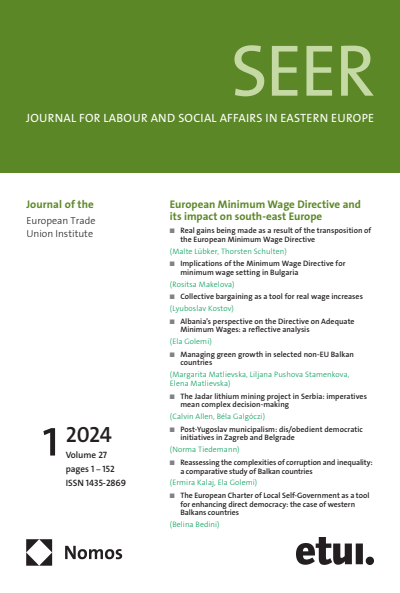
SEER tries to stimulate the exchange of information among researchers, trade unionists and people who have a special interest in the political, social and economic development of the region of south-east Europe. The journal tries to draw attention to new research results and the latest analyses about the ongoing process of political and social changes in the south-east of Europe. It tries to create more understanding for the importance of the elaboration of democratic structures in industrial relations. The SEER combines contributions from different disciplines and »political schools« into an information package of interest for policy makers, researchers, academics and trade unionists from various backgrounds. Website: www.seer.nomos.de
This article, prepared by economists from the Southeast Europe Trade Union Economic Experts network, analyses the main economic and social developments within south-east Europe over the past decade, focusing on macroeconomic stability, income...
This article reviews Bulgaria’s long and politically burdensome path towards the adoption of the euro, finally achieved on 1 January 2026 after almost twenty years of membership of the EU. It commences with a broad introduction to the key events...
This article examines demographic change, both globally and in the context of the wider region of Europe, paying specific attention to the situation in Bulgaria which has been experiencing a deteriorating demographic situation. Uneven economic...
This article outlines the empowerment of base-level trade union leaders in the agricultural sector in Bulgaria as an innovative strategy towards attracting new members and retaining existing ones. The approach has been adopted by the Federation of...
Organisations require effective human resource (HR) management policies to address the diversity of a workforce which varies by age, ethnicity, educational background and professional experience. Multigenerational or cultural perspectives should be...
This article uses desk-based research to explore the issues raised by artificial intelligence in the labour market concerning its potential impact on vulnerable groups already experiencing discrimination such as women, older workers and disabled...
From the perspective of Albania, a country currently outside the EU but which is taking steps to join it, this article reviews the current legislative framework introduced within the EU on artificial intelligence, workplace applications of which are...
The digital transformation of tourism is reshaping labour markets and regional economies. Northern Albania, rich in natural and cultural resources but limited by infrastructure and workforce challenges, has adopted online platforms such as...