, to see if you have full access to this publication.
Monograph No access
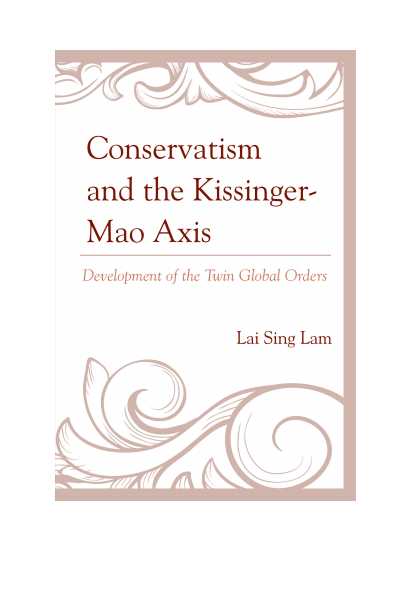
Conservatism and the Kissinger-Mao Axis
Development of the Twin Global Orders
Authors:
Publisher:
2015
Summary
Kissinger’s dual-purpose instrument of the US-China and US-Soviet détente was devised to achieve a stable balance of power in the contemporary world in the second half of the 1960s. Stimulated by both Kissinger’s doctrine and the historical novel, the Romance of the Three Kingdoms, Mao’s global order of tripolarity was created to feature the new US-China relations in the early 1970s with his initiative of the ping-pong diplomacy through this Kissinger-Mao axis. This made his quest for a modernization revolution possible with the Western market oriented approach.
Strengthening Mao’s modernization program, Xiaoping’s “good-neighborhood” policy was designed to induce the world to help modernize China. Vitally including Russia with the collapse of the Soviet Union, Deng’s policy helped maintain a peaceful and stable international environment, though it also marked the end of Mao’s global order.
Perceiving the PRC’s rise as a threat to its dominance in the Asia Pacific region, the US containment effort was enhanced with US-Japanese collusion and siding with the Philippines and Vietnam in relevant maritime disputes with the PRC. The US united with the Republic of Korea, nations in Southeast Asia, and Australia in establishing a wide-range alliance to go against the “China threat.”
The post-Cold War, eastward expansion of the US-led NATO and the Russian determination to be a great power again, contributed to tension with the United States. The Russian desire to maintain its nuclear deterrent capability was at odds with the US missile defense plans. Thus, the US deployment of its missile shield in Eastern Europe as part of its strategic configuration in Alaska and the Far East was to contain Russia from both the Far East and Europe.
Keywords
Search publication
Bibliographic data
Edition
1/2015
Copyright Year
2015
ISBN-Print
978-1-4985-1139-1
ISBN-Online
978-1-4985-1140-7
Publisher
Lexington, Lanham
Language
English
Pages
203
Product Type
Monograph
Table of contents
ChapterPages
Contents No access
Preface No access
Prologue No access
Introduction No access Pages 1 - 10
1 The Postwar International Environment No access
2 Conservatism and the Materialization of the Kissinger-Mao Axis No access
3 The Kissinger-Mao Axis I: The Integration of Kissinger’s Balance of Power and Mao’s Global Order of Tripolarity No access
4 The Kissinger-Mao Axis II No access
5 The Kissinger-Mao Axis III: The Post-Deng Economic Development No access
6 The New American Containment of China No access
7 The New US-Led NATO Containment of the Rising Russia No access
8 The SCO Counter-containment of the West No access