, to see if you have full access to this publication.
Monograph No access
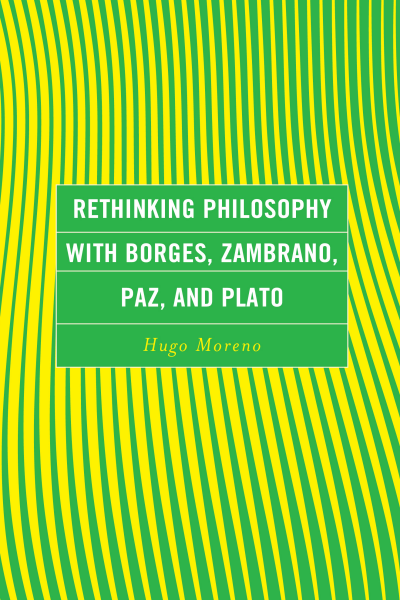
Rethinking Philosophy with Borges, Zambrano, Paz, and Plato
Authors:
Publisher:
2022
Summary
In Rethinking Philosophy with Borges, Zambrano, Paz, and Plato, Hugo Moreno argues that in Ficciones, Claros del bosque, and El mono gramático, Jorge Luis Borges, María Zambrano, and Octavio Paz practice a literary way of philosophizing—a way of seeking and communicating knowledge of reality that takes up analogical procedures. They deploy analogy as an indispensable and irreplaceable heuristic tool and literary device to convey their insight and perplexities on the nature of existence. Borges’ ironic approach involves reading and writing philosophy as fiction. Zambrano’s poetic reason is a mode of writing and thinking based on an imaginative sort of recollection that is ultimately a visionary’s poetizing technique. Paz’s poetic thinking relies on analogy to correlate and harmonize an array of worldviews, ideas, and discourses.
In the appendix, Moreno shows that Plato's Republic is a forerunner of this way of philosophizing in literature. Moreno suggests that in the Republic, Plato reconciles philosophy and poetry and creates a rational prose poetry that fuses argumentation and narration, dialectical and analogical reasoning, and abstract concepts and poetic images.
Search publication
Bibliographic data
Edition
1/2022
Copyright Year
2022
ISBN-Print
978-1-7936-3928-8
ISBN-Online
978-1-7936-3929-5
Publisher
Lexington, Lanham
Language
English
Pages
232
Product Type
Monograph
Table of contents
ChapterPages
Contents No access
Acknowledgments No access
Analogy in Philosophy and Metaphysics No access
Analogical Metaphysics and Philosophy No access
Contemporary Hispanic Literary Philosophy No access
Organization No access
Notes No access
A Historical Introduction to the Didactic, Classical, Romantic, and Analogical Schemas No access
The Essentialistic Approach No access
The Nonessentialistic Approach No access
Censorious Didacticism No access
Conciliatory Didacticism No access
Borges as an Existentialist No access
Borges as a Mystical Thinker No access
A Deconstructionist Avant la Lettre No access
The Transcendentalist Approach No access
The Immanentist Approach No access
Reading Borges Using the Analogical Schema No access
Notes No access
The Symbol and Conceptual Persona of Borges’ Ironic Philosophy No access
The Metaphysics of Immanence in Borges’ Ficciones, or the Way of the Same No access
Borges’ Modal Ironism, or the Way of Ts’ui Pên No access
Notes No access
The Genesis of Poetic Reason No access
The Metaphysics of the Soul No access
Poetic Reason in Claros del Bosque No access
Notes No access
Paz’s The Bow and the Lyre and the Epic of Being No access
El mono gramático as a Thinking Experience with Language No access
The Path of Memory and the Epiphany of Being No access
The Path of Reading and the Strife between Monism and Variabilism No access
The Path of Poetic Writing and the Analogical Sense of Being No access
The Path of Poetic Writing and Analogy among Beings No access
The Path of Poetic Writing and the Mystical Character of Language No access
The Allegory of the Forest in El mono gramático No access