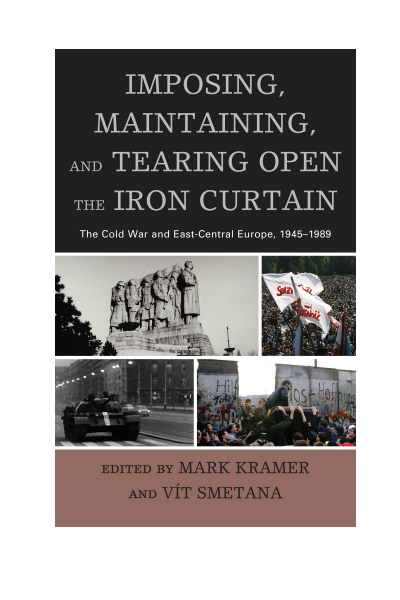
Imposing, Maintaining, and Tearing Open the Iron Curtain
The Cold War and East-Central Europe, 1945–1989- Editors:
- |
- Publisher:
- 2013
Summary
The Cold War began in Europe in the mid-1940s and ended there in 1989. Notions of a “global Cold War” are useful in describing the wide impact and scope of the East-West divide after World War II, but first and foremost the Cold War was about the standoff in Europe. The Soviet Union established a sphere of influence in Eastern Europe in the mid-1940s that later became institutionalized in the Warsaw Pact, an organization that was offset by the North Atlantic Treaty Organization (NATO) led by the United States. The fundamental division of Europe persisted for forty years, coming to an end only when Soviet hegemony in Eastern Europe dissolved. Imposing, Maintaining, and Tearing Open the Iron Curtain: The Cold War and East-Central Europe, 1945–1989, edited by Mark Kramer and Vít Smetana, consists of cutting-edge essays by distinguished experts who discuss the Cold War in Europe from beginning to end, with a particular focus on the countries that were behind the iron curtain. The contributors take account of structural conditions that helped generate the Cold War schism in Europe, but they also ascribe agency to local actors as well as to the superpowers. The chapters dealing with the end of the Cold War in Europe explain not only why it ended but also why the events leading to that outcome occurred almost entirely peacefully.
Keywords
Search publication
Bibliographic data
- Edition
- 1/2013
- Copyright Year
- 2013
- ISBN-Print
- 978-0-7391-8185-0
- ISBN-Online
- 978-0-7391-8186-7
- Publisher
- Lexington, Lanham
- Language
- English
- Pages
- 563
- Product Type
- Edited Book
Table of contents
- Contents No access
- Acknowledgments No access
- Introduction No access
- Chapter One: Stalin, Soviet Policy, and the Establishment of a Communist Bloc in Eastern Europe, 1941-1949 No access
- Chapter Two: The United States and Eastern Europe, 1943-1948 No access
- Chapter Three: Concessions or Conviction? Czechoslovakia’s Road to the Cold War and the Soviet Bloc No access
- Chapter Four: Hungary’s Role in the Soviet Bloc, 1945-1956 No access
- Chapter Five: Stalin, the Split with Yugoslavia, and Soviet-East European Efforts to Reassert Control, 1948-1953 No access
- Chapter Six: Austria, Germany, and the Cold War, 1945-1955 No access
- Chapter Seven: Neutrality for Germany or Stabilization of the Eastern Bloc? New Evidence on the Decision-Making Process of the Stalin Note No access
- Chapter Eight: The Berlin Wall: Looking Back on the History of the Wall Twenty Years After Its Fall No access
- Chapter Nine: The German Problem and Security in Europe: Hindrance or Catalyst on the Path to 1989-1990? No access
- Chapter Ten: Germany and East-Central Europe, 1945-1990: The View from London No access
- Chapter Eleven: The German Question as Seen from Paris No access
- Chapter Twelve: Cold War, Détente, and the Soviet Bloc: The Evolution of Intra-Bloc Foreign Policy Coordination, 1953-1975 No access
- Chapter Thirteen: Ronald Reagan, George H. W. Bush, and the Revolutions of 1989: American Myths Versus the Primary Sources No access
- Chapter Fourteen: Moscow and Eastern Europe, 1988-1989: A Policy of Optimism and Caution No access
- Chapter Fifteen: The Fall of the Wall, Eastern Europe, and Gorbachev’s Vision of Europe after the Cold War No access
- Chapter Sixteen: Pulling the Rug: East-Central Europe and the Implosion of East Germany No access
- Chapter Seventeen: The Demise of the Soviet Bloc No access
- Chapter Eighteen: Nuclear Weapons and the Cold War in Europe No access
- Chapter Nineteen: Why Did the Cold War Last So Long? No access
- Chapter Twenty: The End of Cold War as a Non-Linear Confluence No access
- Chapter Twenty-one: Conspicuous Connections, 1968 and 1989 No access
- Chapter Twenty-two: 1989 in Historical Perspective: The Problem of Legitimation No access
- Chapter Twenty-three: November 1989: From a Velvet Opening of Regime Change to a Revolutionary Outcome No access
- Chapter Twenty-four: The End of the Cold War and the Transformation of Cold War History: A Tale of Two Conferences, 1988-1989 No access
- About the Editors No access Pages 551 - 552
- About the Contributors No access Pages 553 - 554
- Index No access Pages 555 - 563