Monograph Open Access Full access
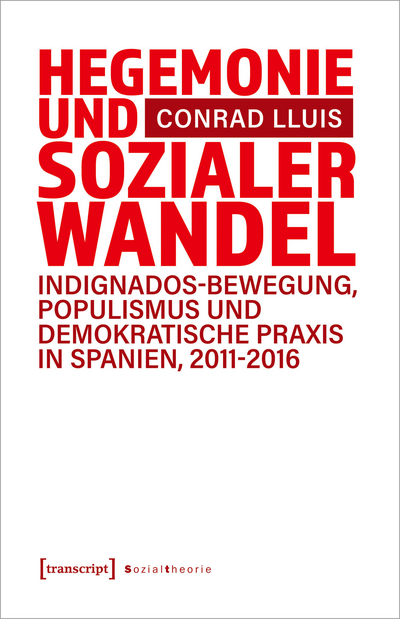
Hegemonie und sozialer Wandel
Indignados-Bewegung, Populismus und demokratische Praxis in Spanien, 2011-2016- Authors:
- Series:
- Sozialtheorie
- Publisher:
- 2023
Keywords
Search publication
Bibliographic data
- Edition
- 1/2023
- Copyright Year
- 2023
- ISBN-Print
- 978-3-8376-6625-0
- ISBN-Online
- 978-3-8394-6625-4
- Publisher
- transcript, Bielefeld
- Series
- Sozialtheorie
- Volume
- 0
- Language
- German
- Pages
- 578
- Product Type
- Monograph
Table of contents
ChapterPages
- FrontmatterPages 1 - 1 Download chapter (PDF)
- EditorialPages 2 - 6 Download chapter (PDF)
- InhaltPages 7 - 10 Download chapter (PDF)
- EinleitungPages 11 - 24 Download chapter (PDF)
- EinleitungPages 25 - 28 Download chapter (PDF)
- EinleitungPages 28 - 28 Download chapter (PDF)
- 1.1 Diskurs zwischen Struktur und PraxisPages 28 - 38 Download chapter (PDF)
- 1.2 Artikulation als DiskursproduktionPages 39 - 46 Download chapter (PDF)
- 1.3 Grenze und Grund: der AntagonismusPages 46 - 52 Download chapter (PDF)
- 1.4 Vom Sozialen zum Politischen? Zur Hegemonie!Pages 53 - 61 Download chapter (PDF)
- EinleitungPages 62 - 62 Download chapter (PDF)
- 2.1 Was ist Postfundamentalismus?Pages 62 - 69 Download chapter (PDF)
- 2.2 Gramscis Spuren: Hegemonie als KulturPages 69 - 75 Download chapter (PDF)
- EinleitungPages 75 - 78 Download chapter (PDF)
- 3.1 Der tradierte Pfad: politische DiskursanalysePages 78 - 84 Download chapter (PDF)
- 3.2 Der neue Pfad: praxeologische UntersuchungPages 84 - 91 Download chapter (PDF)
- 3.3 Der reaktivierte Pfad: historische RekonstruktionPages 92 - 98 Download chapter (PDF)
- EinleitungPages 99 - 102 Download chapter (PDF)
- 1 Genealogie einer hegemonialen KulturPages 102 - 107 Download chapter (PDF)
- 2.1 Die Transition (1975–1978) als GründungsmythosPages 107 - 115 Download chapter (PDF)
- 2.2 Modernisierung unter sozialistischem Vorzeichen?Pages 115 - 124 Download chapter (PDF)
- 2.3 Der neue Konservatismus, ein freiheitliches ProjektPages 124 - 129 Download chapter (PDF)
- 2.4 Verdrängt: das Proletariat und der KonfliktPages 129 - 136 Download chapter (PDF)
- EinleitungPages 137 - 138 Download chapter (PDF)
- 3.1 Neue GesellschaftPages 138 - 141 Download chapter (PDF)
- 3.2 Beruhigte PolitikPages 141 - 146 Download chapter (PDF)
- 3.3 Die Kultur der Transition – eine diskursive KartographiePages 146 - 152 Download chapter (PDF)
- EinleitungPages 153 - 154 Download chapter (PDF)
- 1 Acampadas – Protestchronologie mit Fokus auf Barcelona, Mai/Juni 2011Pages 155 - 162 Download chapter (PDF)
- EinleitungPages 162 - 163 Download chapter (PDF)
- 2.1 Echte Demokratie Jetzt – der Bruch entstehtPages 163 - 168 Download chapter (PDF)
- 2.2 Antagonismus und Identität (I): Der Feind ist das SystemPages 168 - 172 Download chapter (PDF)
- 2.3 Antagonismus und Identität (II): die Demokratie und ihre RepräsentantenPages 172 - 176 Download chapter (PDF)
- 2.4 Unten gegen oben, Demokratie gegen DespotiePages 176 - 178 Download chapter (PDF)
- 2.5 Eine reformierte oder eine neue, direkte Demokratie?Pages 179 - 190 Download chapter (PDF)
- EinleitungPages 190 - 192 Download chapter (PDF)
- 3.1 Zündphase der Empörung (16. bis 19. Mai 2011)Pages 192 - 201 Download chapter (PDF)
- 3.2 Hochphase der Empörung (21. bis 25. Mai 2011)Pages 201 - 216 Download chapter (PDF)
- 3.3 Die Gewalt erdet die Empörung (27. Mai bis 3. Juni 2011)Pages 216 - 229 Download chapter (PDF)
- 4.1 Der populare Bruch und das neue VolkPages 229 - 232 Download chapter (PDF)
- 4.2 Plaça Catalunya, Passagenpunkt des BruchesPages 232 - 235 Download chapter (PDF)
- 4.3 Antagonismus: Eliten und OrdnungsgewaltPages 235 - 238 Download chapter (PDF)
- 4.4 Demokratie – ein strittiger und vorzeichnender SignifikantPages 238 - 242 Download chapter (PDF)
- EinleitungPages 243 - 246 Download chapter (PDF)
- 1 Eine Ethnographie von Protestgruppen in Barcelona (2014–2016)Pages 246 - 251 Download chapter (PDF)
- 2 Versammlungen, erste AnnäherungPages 252 - 255 Download chapter (PDF)
- EinleitungPages 256 - 257 Download chapter (PDF)
- 3.1 Zitierung und normierende MachtPages 257 - 268 Download chapter (PDF)
- 3.2 Wiederholung, Erfahrung und RaumPages 268 - 278 Download chapter (PDF)
- 3.3 Fokussierung, die geordnete PerformativitätPages 278 - 296 Download chapter (PDF)
- 4 Vorder- und Rückseite – Artikulation revisitedPages 297 - 309 Download chapter (PDF)
- 5 Subjektivierung, oder: gemeinsam ermächtigtPages 309 - 322 Download chapter (PDF)
- 6 Kollektivität: Versammlungen als Passagenpunkte von DemokratiePages 322 - 330 Download chapter (PDF)
- 7 RekapitulationPages 330 - 334 Download chapter (PDF)
- EinleitungPages 335 - 338 Download chapter (PDF)
- EinleitungPages 338 - 341 Download chapter (PDF)
- 1.1 Der Empörungsdiskurs – verbreitet, aber erschöpftPages 341 - 347 Download chapter (PDF)
- 1.2 Die Kultur der Transition – von der Krise zur Reform?Pages 347 - 354 Download chapter (PDF)
- 2 Populismus als Hypothese und GelegenheitPages 355 - 366 Download chapter (PDF)
- EinleitungPages 367 - 367 Download chapter (PDF)
- 3.1 Geburt einer Volkspartei? (Januar 2014)Pages 368 - 375 Download chapter (PDF)
- 3.2 Böses Europa, gutes Europa (Mai/Juli 2014)Pages 375 - 383 Download chapter (PDF)
- 3.3 Wir können Volk werden (Januar 2015)Pages 383 - 396 Download chapter (PDF)
- 3.4 Ein Land vor der Wahl (Dezember 2015)Pages 396 - 407 Download chapter (PDF)
- 4 Spanischer Linkspopulismus, eine GesamtschauPages 407 - 420 Download chapter (PDF)
- 5 Populismus als demokratische PraxisPages 420 - 440 Download chapter (PDF)
- EinleitungPages 441 - 442 Download chapter (PDF)
- 1 Entformalisierung im Zeichen der PraxisPages 442 - 453 Download chapter (PDF)
- 2 Die Artikulation der Zeichen, Praktiken und DingePages 453 - 463 Download chapter (PDF)
- 3 Eine sinnliche, mehr als antagonistische KollektivitätPages 463 - 477 Download chapter (PDF)
- 4 Hegemonie in (und von) Raum und ZeitPages 477 - 491 Download chapter (PDF)
- 5 RekapitulationPages 491 - 494 Download chapter (PDF)
- EinleitungPages 495 - 496 Download chapter (PDF)
- EinleitungPages 496 - 496 Download chapter (PDF)
- 1.1 Diskurs der Empörung überallPages 496 - 502 Download chapter (PDF)
- 1.2 Kollektivität im Wandel, Empörte als SozialfigurPages 502 - 508 Download chapter (PDF)
- 1.3 Versammelt zu einer neuen KulturPages 508 - 518 Download chapter (PDF)
- EinleitungPages 518 - 519 Download chapter (PDF)
- 2.1 Erste Bewegung: Verdrängung durch staatliche GewaltPages 519 - 521 Download chapter (PDF)
- 2.2 Zweite Bewegung: rechtspopulistische NeutralisierungPages 522 - 524 Download chapter (PDF)
- 2.3 Dritte Bewegung: »progressive« IntegrationPages 525 - 530 Download chapter (PDF)
- Ein postfundamentalistischer AusblickPages 531 - 534 Download chapter (PDF)
- QuellenPages 535 - 544 Download chapter (PDF)
- LiteraturPages 545 - 570 Download chapter (PDF)
- AbbildungsverzeichnisPages 571 - 572 Download chapter (PDF)
- TabellenverzeichnisPages 573 - 574 Download chapter (PDF)
- DankPages 575 - 578 Download chapter (PDF)