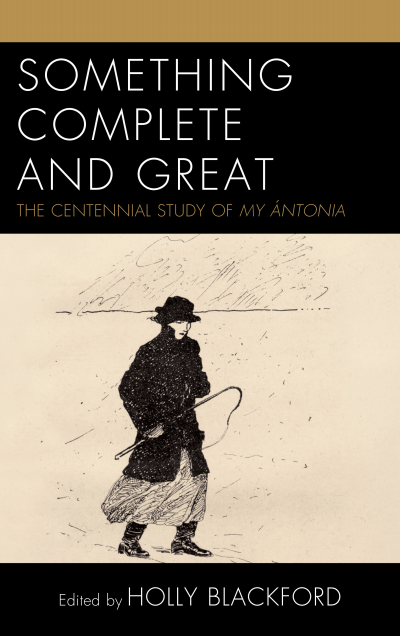
Something Complete and Great
The Centennial Study of My Ántonia- Editors:
- Publisher:
- 2017
Summary
This volume situates My Ántonia as a novel that stands the test of time by including in its pages an extraordinarily wide range of historical, cultural, literary, psychological, thematic, perceptual, and stylistic issues. The volume provides an analysis and assessment of complexities in the novel as well as its reception and legacy. The essays as a whole situate the novel at the cusp of the modern period, marking in myriad ways the novel’s transitional role between nineteenth and twentieth-century literature and culture. The first section “Translation” features writers that reflect on Cather’s curious devaluation of My Ántonia’s reception over time; translation issues in Germany, Italty, France, and Russia; and linguistic issues in the novel’s vision of Ántonia’s acculturation. The second section “Tradition” defines Cather’s relationship to modernism and regionalism through her career shifts and changes to the Introduction as well as her narrative technique in marginalizing violence and darkness to the edges of Jim’s consicousness. The third section “Transgender” analyzes Cather’s relationship to Hamlin Garland’s Life on the Prairie, J. M. Barrie’s Peter Pan and the Neverland, and the work of Truman Capote, especially his gay protagoanist Joel Knox in Other Voices, Other Rooms. The fourth section “Transhuman” deploys work on hysteria to situate Cather’s vision of genderless desire and ecocritical lenses to understand Jim and nature. Finally the last section “Transition” discusses Lena Lingard’s presence as a New Woman and gift economies in the novel that underscore the community’s uneasy transition to twentieth-century capitalism. Gathered in the volume are an international group of scholars who demonstrate the novel’s centrality to women’s studies, American studies, queer studies, childhood studies, psychoanalysis, ecology, translation and reception, Marxism, narratology, and intertextuality.
Keywords
Search publication
Bibliographic data
- Edition
- 1/2017
- Copyright Year
- 2017
- ISBN-Print
- 978-1-68393-125-6
- ISBN-Online
- 978-1-68393-126-3
- Publisher
- Lexington, Lanham
- Language
- English
- Pages
- 312
- Product Type
- Edited Book
Table of contents
- Contents No access
- Introduction. Cather’s Sod House of Fiction: Introduction to the Centennial Study of My Ántonia No access Pages 1 - 16
- Chapter One. What Willa Cather’s Letters Tell Us about the Reception of My Ántonia No access
- Chapter Two. “People in countries who read it in the strangest languages”: The International Reception of My Ántonia No access
- Chapter Three. Ántonia’s Mother Tongue: Reading and Translating (in) My Ántonia No access
- Chapter Four. “Live Property”: Cather’s 1926 Revisions to the Introduction of My Ántonia and the Specter of Nineteenth-Century Women’s Regionalism No access
- Chapter Five. Violence in the Pastoral: Darkness in the Narrative Structure of My Ántonia No access
- Chapter Six. Boyhood and the Frontier: Nostalgia and Play in My Ántonia No access
- Chapter Seven. The Nebraskan Neverland: The Archeology of Children’s Fantasy Fiction in My Ántonia No access
- Chapter Eight. “Obliterating Strangeness”: Willa Cather, Truman Capote, and the Influence of My Ántonia No access
- Chapter Nine. Hysterical Resistance: Desire and Narrative in My Ántonia No access
- Chapter Ten. The Image of Nature in the Past in My Ántonia No access
- Chapter Eleven. My Ántonia: Keatsian Negative Capability and the Dissolution of Boundaries No access
- Chapter Twelve. A Portrait of a Self-Made Woman: Lena Lingard in My Ántonia No access
- Chapter Thirteen. The Gift Economies of My Ántonia No access
- Bibliography No access Pages 285 - 298
- Index No access Pages 299 - 308
- About the Contributors No access Pages 309 - 312