, to see if you have full access to this publication.
Edited Book No access
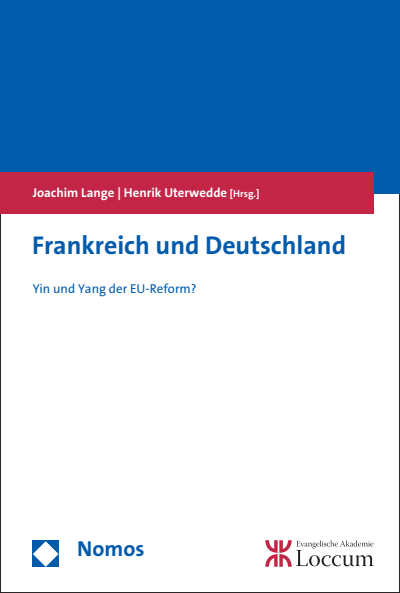
Frankreich und Deutschland
Yin und Yang der EU-Reform?- Editors:
- |
- Publisher:
- 2019
Keywords
Search publication
Bibliographic data
- Edition
- 1/2019
- Copyright Year
- 2019
- ISBN-Print
- 978-3-8487-6397-9
- ISBN-Online
- 978-3-7489-0488-5
- Publisher
- Nomos, Baden-Baden
- Language
- German
- Pages
- 187
- Product Type
- Edited Book
Table of contents
ChapterPages
- Titelei/Inhaltsverzeichnis No access Pages 1 - 6
- Vorwort No access Pages 7 - 8Authors: |
- Frankreich, Deutschland und die EU-Reform. Eine Hinführung No access Pages 9 - 16Authors:
- Erneuerung Frankreichs – und der Europäischen Union? Macrons Politik im Härtetest No access Pages 17 - 38Authors:
- Deutschland nach dem Wahljahr: Sind die außenwirtschaftlichen Herausforderungen ein Thema? No access Pages 39 - 58Authors:
- Die Währungsunion auf dem Prüfstand. Zehn Jahre nach Ausbruch der Krise: Welche Lehren ergeben sich für den französisch-deutschen Dialog? No access Pages 59 - 130Authors:
- Mit verschiedenen Geschwindigkeiten unterwegs: Gemeinsamkeiten und Unterschiede der deutschen und französischen Volkswirtschaften No access Pages 131 - 154Authors:
- Der Finanzrahmen für eine vielgestaltige Europäische Union No access Pages 155 - 164Authors:
- Angesichts der dramatischen globalen Herausforderungen ist ein starkes und souveränes Europa das Gebot der Stunde No access Pages 165 - 172Authors:
- Frankreich nach dem Wahljahr: Erfolgsperspektiven von Reformen mit Augenmaß? No access Pages 173 - 178Authors:
- Welche Reformen braucht Europa? Beitrag aus dem Kamingespräch der Tagung No access Pages 179 - 186Authors:
- Verzeichnis der Autorinnen und Autoren No access Pages 187 - 187
Bibliography (125 entries)
No match found. Try another term.
- Afonso A., Checherita C., Trabandt M., Warmedinger T. (2010): Euro area fiscal policies: Response to the economic crisis, in: van Riet A. [Hg.]: Euro area fiscal policies and the crisis, European Central Bank Occasional Papers n° 109, April, S. 22-34. Open Google Scholar DOI: 10.5771/9783748904885
- Aghion P. (2018): Le gouvernement devrait mettre sur pied un «Grenelle» de la fiscalité, Le Monde, 4. Dezember 2018, S. 23. Open Google Scholar DOI: 10.5771/9783748904885
- Arnold N.G., Barkbu B.B., Ture H.E., Wang H., Yao J. (2018): A central fiscal stabilization capacity f/or the euro area, IMF Staff Discussion Note 18/03, Fonds monétaire international, Washington, DC., March 2018. Open Google Scholar DOI: 10.5771/9783748904885
- Artus P. (2018): La politique économique de la zone euro est-elle condamnée à devenir procyclique ?, Flash Economie, n° 793, 5 juillet 2018. Open Google Scholar DOI: 10.5771/9783748904885
- Aubourg A. (2018): L’industrie manufacturière en 2017, Etudes économiques de la DGE, Paris. Open Google Scholar DOI: 10.5771/9783748904885
- Aussilloux V., Le Hir B., Leclerc H. (2017): The Spinelli Fund: a European compact for skills, France Stratégie, Note d’analyse n° 63, novembre. Open Google Scholar DOI: 10.5771/9783748904885
- Banque de France (2019): Taux d’endettement des agents non financiers – Comparaisons internationales 2018T3, online gestellt am 8 Februar 2019. Open Google Scholar DOI: 10.5771/9783748904885
- Bardt H., Grömling M., Hentze, T., Puls T. (2017): Investieren Staat und Unternehmen in Deutschland zu wenig?, IW-Analysen 118, Institut der deutschen Wirtschaft, Köln. Open Google Scholar DOI: 10.5771/9783748904885
- Bechetoille M., Blaize T., Campagne B., de Waziers D. (2018): How to explain Germany’s strong current account surplus?, Trésor-economics, No.°209, November. Open Google Scholar DOI: 10.5771/9783748904885
- Beck T., Kotz H.-H. (2017): „Banking union: Rules versus discretion?“, in: Beck T., Kotz H.-H. [Hg.]: Ordoliberalism: A German oddity?, Vox eBook, CEPR Press, London, S. 107-119. Open Google Scholar DOI: 10.5771/9783748904885
- Behringer J, van Treeck T. (2018): Income distribution and the current account, Journal of International Economics, vol. 114, september, S. 238-254. Open Google Scholar DOI: 10.5771/9783748904885
- Bénassy-Quéré A., Brunnermeier M., Enderlein H., Farhi E., Fratzscher M., Fuest C., Gourinchas P.-O., Martin P., Pisani F., Rey H., Schnabel I., Véron N., Weder di Mauro B., Zettelmeyer J. (2018): Reconciling risk sharing with market discipline: A constructive approach to euro area reform, CEPR Policy Insight No 91, January. Open Google Scholar DOI: 10.5771/9783748904885
- Berger B., Wolff G. (2017): The global decline in the labour income share: is capital the answer to Germany’s current account surplus?, Bruegel, Policy Contribution, n° 12, April 2017 Open Google Scholar DOI: 10.5771/9783748904885
- Bernanke B. (2018): The Real Effects of the Financial Crisis, Brookings Papers on Economic Activity Conference Draft, September 13-14. Open Google Scholar DOI: 10.5771/9783748904885
- Blanchard O., Dornbusch R., Layard R. (1986): Restoring Europe’s Prosperity, MIT Press, Cambridge, Mass. Open Google Scholar DOI: 10.5771/9783748904885
- Blanchard O., Leigh D. (2013): Growth Forecast Errors and Fiscal Multipliers, IMF Working Paper Nr. 2013/1, janvier. Open Google Scholar DOI: 10.5771/9783748904885
- Blot C., Antonin C., Falah A., Le Bayon S., Mathieu C., Rifflart C., Villemot S. (2018): La fin d’un cycle? Perspectives 2018-2019 pour l’économie mondiale et la zone euro, Revue de l’OFCE, n° 155, S. 17-179. Open Google Scholar DOI: 10.5771/9783748904885
- Boeri T, Ichino A., Moretti E., Posch J. (2019): Wage Equalization and Regional Misallocation: Evidence from Italian and German Provinces, CEPR discussion paper 13545, february. Open Google Scholar DOI: 10.5771/9783748904885
- Boone L., Kuhanathan A. (2016): Brexit the French way: Regulation, tax, and politics, in: Wyplosz C. [Hg.] (2016): What To Do With the UK? EU Perspectives on Brexit, A VoxEU.org Book, CEPR Press, october, S. 37-44. Open Google Scholar DOI: 10.5771/9783748904885
- Boyer R. (2015): The Success of Germany from a French Perspective: What Consequences for the Future of the European Union?, in: Brigitte Unger [Hg.]: The German Model – Seen by its Neighbours, SE Publishing, S. 201-236. Open Google Scholar DOI: 10.5771/9783748904885
- Boysen-Hogrefe J., Gern K.-J., Groll D., Hauber P., Jannsen N., Kooths S. (2017): Wirtschafts-, Finanz- und Geldpolitik: Wirkungen auf die deutsche Leistungsbilanz, Institut für Weltwirtschaft, Kieler Beiträge zur Wirtschaftspolitik, n° 11, November. Open Google Scholar DOI: 10.5771/9783748904885
- Brand S., Steinbrecher J., Wächter L. (2018): Bundesrepublik en marche?! Kommunale Investitionsrückstände in Frankreich und Deutschland, Fokus Volkswirtschaft Nr. 217, Juli. Open Google Scholar DOI: 10.5771/9783748904885
- Brankovic M. (2017): Nöte des Exportmeisters, Frankfurter Allgemeine Zeitung, 13 Juni 2017 Open Google Scholar DOI: 10.5771/9783748904885
- Breidenbach P., Mitze T., Schmidt C. (2016): EU Structural Funds and Regional Income Convergence – A Sobering Experience, Technische Universität Dortmund, Ruhr-Universität Bochum (RUB) und Rheinisch-Westfälisches Institut für Wirtschaftsforschung (RWI), Ruhr Economic Paper, 03/2016. Open Google Scholar DOI: 10.5771/9783748904885
- Brunnermayer, M. K. et al. (2018): Euro: Der Kampf der Wirtschaftskulturen, München: Beck Open Google Scholar DOI: 10.5771/9783748904885
- Brunnermeier M., James H., Landau J.-P. (2016): The Euro Crisis and the Battle of Economic Ideas, Princeton University Press, Princeton. Open Google Scholar DOI: 10.5771/9783748904885
- Burda M. (2017): Ordnungsökonomik or Teutonomik?, in: Beck T., Kotz H.-H. [Hg.]: Ordoliberalism: A German oddity?, Vox eBook, CEPR Press, London, p. 53-61. Open Google Scholar DOI: 10.5771/9783748904885
- Cette, G.(2018): La loi PACTE: une avancée utile et bienvenue, www.telos-eu.com, 6.9.2018 Open Google Scholar DOI: 10.5771/9783748904885
- Challe É., Ragot X. (2018): France-Allemagne: retour au travail, Revue de OFCE, n° 158, décembre 2018, p. 149-169. Open Google Scholar DOI: 10.5771/9783748904885
- Cléaud G., F. de Castro Fernández, J. Durán Laguna, L. Granelli, M. Hallet, A. Jaubertie, C. Maravall Rodriguez, D. Ognyanova, B. Palvolgyi, T. Tsalinski, K.-Y. Weißschädel and J. Ziemendorff (2019): Cruising at different speeds: Similarities and divergences between the German and the French economies; ECFIN Discussion Paper No. 103, Brussels. Open Google Scholar DOI: 10.5771/9783748904885
- Clemens M., Hart J. (2018): EU-Zuwanderung hat das Wirtschaftswachstum in Deutschland erhöht, DIW Wochenbericht, vol. 85, n° 44, S. 955-963. Open Google Scholar DOI: 10.5771/9783748904885
- Cœuré B. (2014): Structural reforms: learning the right lessons from the crisis, Keynote speech at the Bank of Latvia Economic Conference 2014, Riga, 17 october 2014. Open Google Scholar DOI: 10.5771/9783748904885
- Cohen, E. (2018): La fin de l‘état de grâce, in: www.telos-eu.com, 17.9.2018 Open Google Scholar DOI: 10.5771/9783748904885
- Comité de suivi du CICE (2018): Rapport 2018 du Comité de suivi du Crédit d’impôt pour la compétitivité et l’emploi, France Stratégie, octobre Open Google Scholar DOI: 10.5771/9783748904885
- Cooper R. (2017): Germany and the world economy, in: Beck T., Kotz H.-H. [Hg.]: Ordoliberalism: A German oddity?, Vox eBook, CEPR Press, London, p. 181-186. Open Google Scholar DOI: 10.5771/9783748904885
- Cribb J., Johnson P. (2018): 10 years on – have we recovered from the financial crisis?, Institute for Fiscal Studies. Open Google Scholar DOI: 10.5771/9783748904885
- Darvas Z., Martin P., Ragot X. (2018): European Fiscal Rules Require a Major Overhaul, Conseil d’analyse économique, Note du CAE n° 47, september Open Google Scholar DOI: 10.5771/9783748904885
- De Waziers D., Kerdrain D., Osman Y. (2019): L’évolution de la part du travail dans la valeur ajoutée dans les pays avancés, Trésor-Éco n° 234, janvier. Open Google Scholar DOI: 10.5771/9783748904885
- Dena: Deutsche Energie-Agentur (2017): Alternativen zur Finanzierung des EEG, Berlin, November. Open Google Scholar DOI: 10.5771/9783748904885
- Deutsche Bundesbank (2018): Die deutsche Zahlungsbilanz für das Jahr 2017, Monatsbericht, März 2018, S. 15-36. Open Google Scholar DOI: 10.5771/9783748904885
- Deutsche Bundesbank (2019): Die deutsche Zahlungsbilanz für das Jahr 2018, Monatsbericht, März 2019, S. 17-42. Open Google Scholar DOI: 10.5771/9783748904885
- DG Trésor (2018): Perspectives économiques et des finances publiques, Rapport économique, social et financier, dans le cadre du Projet de loi de finances pour 2019, Paris. Open Google Scholar DOI: 10.5771/9783748904885
- DG Trésor (2019): Le programme de stabilité 2019-2022, veröffentlicht am 10 April 2019. Open Google Scholar DOI: 10.5771/9783748904885
- Dolls M. (2018): An Unemployment Re-Insurance Scheme for the Eurozone? Stabilizing and Redistributive Effects, Studie hg. von der Bertelsmann Stiftung. Open Google Scholar DOI: 10.5771/9783748904885
- Dorn F., Gäbler S., Kauder B., Krause M., Lorenz L., Mosler M., Potrafke N. (2018): Eine Reform der Eurozone – Diskussion und Bewertung der Vorschläge, ifo Schnelldienst, vol. 71, n° 11, 14 Juni, S. 48-52. Open Google Scholar DOI: 10.5771/9783748904885
- Emerson M., Gros D., Italianer A., Pisani-Ferry J., Reichenbach H. (1992): One Market, One Money: An Evaluation of the Potential Benefits and Costs of Forming an Economic and Monetary Union, Oxford University Press, Oxford. Open Google Scholar DOI: 10.5771/9783748904885
- Enderlein H., Guttenberg L. (2018): De l’importance de la déclaration de Meseberg – Une brève explication, Institut Delors, Blog post vom 22 Juni 2018. Open Google Scholar DOI: 10.5771/9783748904885
- Enderlein, H. and Pisani-Ferry, J. (2014). Reforms, Investment and Growth – An agenda for France, Germany and Europe. 27 November 2014. Open Google Scholar DOI: 10.5771/9783748904885
- Europäische Kommission (2019). Länderbericht Deutschland 2019 – mit eingehender Überprüfung der Vermeidung und Korrektur makroökonomischer Ungleichgewichte. Arbeitsunterlage der Kommissionsdienststellen SWD(2019) 1004, Brüssel, 27.2.2019. Open Google Scholar DOI: 10.5771/9783748904885
- European Commission (2016): Towards a positive fiscal stance for the euro area, Communication from the Commission to the European Parliament, the Council, the European Economic and Social Committee and the Committee of the Regions, COM(2016) 727 final, Brussels, 16 november. Open Google Scholar DOI: 10.5771/9783748904885
- European Commission (2017): Recommendation for a Council Recommendation on the 2017 National Reform Programme of Germany and delivering a Council opinion on the 2017 Stability Programme of Germany, COM(2017) 505 final, Brussels, 22 may. Open Google Scholar DOI: 10.5771/9783748904885
- European Commission (2017). The 2018 Ageing Report – Underlying Assumptions & Projection Methodologies. DG ECFIN Institutional Paper 065, November 2017. Open Google Scholar DOI: 10.5771/9783748904885
- European Commission (2018a): Proposal for a regulation of the European Parliament and of the Council on the establishment of a European Investment Stabilisation Function, COM(2018) 387 final, Brussels, 31 May. Open Google Scholar DOI: 10.5771/9783748904885
- European Commission (2018b): Public opinion in the European Union – First results, Standard Eurobarometer 89 – Spring 2018. Open Google Scholar DOI: 10.5771/9783748904885
- Felbermayr G., Fuest C., Wollmershäuser T. (2017): The German current-account surplus: Causes and consequences, in: Beck T., Kotz H.-H. [Hg.]: Ordoliberalism: A German oddity?, Vox eBook, CEPR Press, London, S. 187-199. Open Google Scholar DOI: 10.5771/9783748904885
- Fiedler S., Görg H., Hornok C., Jannsen N., Kooths S., Marchal L., Potjagailo G. (2018): Direktinvestitionen im Ausland – Effekte auf die deutsche Leistungsbilanz und Spillovers in den Empfängerländern, Institut für Weltwirtschaft, Kieler Beiträge zur Wirtschaftspolitik, Nr. 16, November Open Google Scholar DOI: 10.5771/9783748904885
- Frankel J. (2017): German ordoliberals vs American pragmatists: What did they get right or wrong in the euro crisis?, in: Beck T., Kotz H.-H. [Hg.]: Ordoliberalism: A German oddity?, Vox eBook, CEPR Press, London, S. 135-143. Open Google Scholar DOI: 10.5771/9783748904885
- Franks J., Barkbu B., Blavy R., Oman W., Schoelermann H. (2018): Economic convergence in the euro area: coming together or drifting apart?, IMF Working Paper, January 23. Open Google Scholar DOI: 10.5771/9783748904885
- Fratzscher M., Gornig M., Schiersch A. (2016): Investitionsschwäche der Unternehmen schafft Handlungsbedarf, DIW Wochenbericht, n° 15.2016, S. 175-180. Open Google Scholar DOI: 10.5771/9783748904885
- Gouardo C. (2019): Où baisser la dépense publique ?, Note d’analyse, France Stratégie, Paris, janvier. Open Google Scholar DOI: 10.5771/9783748904885
- Grillmayer, D. et al (2018): Ein Jahr Macron – Reformen, Regierungsstil, Herausforderungen. Aktuelle Frankreich-Analysen, Ludwigsburg: Deutsch-Französisches Institut (www.dfi.de/pdf-Dateien/Veroeffentlichungen/afa/afa32.pdf) Open Google Scholar DOI: 10.5771/9783748904885
- Guillou S., Mini C., Lallement R. (2018): L’investissement des entreprises françaises est-il efficace?, La Fabrique de l’Industrie et France Stratégie, Presses des Mines, Paris. Open Google Scholar DOI: 10.5771/9783748904885
- Hazouard, S. et al. (2015) (Hg.): France-Allemagne: cultures monétaires et budgétaires. Vers une nouvelle gouvernance européenne? Cergy-Pontoise: Cirac 2015 Open Google Scholar DOI: 10.5771/9783748904885
- Hochmuth B, Moyen S., Stähler N. (2019): Labor market reforms, precautionary savings, and global imbalances, Bundesbank Research Centre, Discussion Paper 13/2019. Open Google Scholar DOI: 10.5771/9783748904885
- Horn G., Watzka S. (2018): Ist Frankreich ein Sanierungsfall oder Deutschland?, IMK Policy Brief, n° 10, November. Open Google Scholar DOI: 10.5771/9783748904885
- IMF (2018b): Greece: 2018 Article IV Consultation and Proposal for Post-Program Monitoring-Press Release; Staff Report; and Statement by the Executive Director for Greece, Country Report No. 18/248, July 31, Open Google Scholar DOI: 10.5771/9783748904885
- IMF: International Monetary Fund (2018a): Germany: 2018 Article IV Consultation-Staff Report, IMF Country Report No. 18/208, Washington D.C., July. Open Google Scholar DOI: 10.5771/9783748904885
- Kaldi M., de Lapasse B. (2018): L’industrie dans les territoires français: après l’érosion, quel rebond ?, Fiche d’analyse de l’Observatoire des territoires 2018, Commissariat général à l’égalité des territoires. Open Google Scholar DOI: 10.5771/9783748904885
- Kauffmann, S. (2018): Le malheur franco-allemand, c‘est que Paris et Berlin ne sont plus au même tempo depuis longtemps, Le Monde, 3.10.2018 Open Google Scholar DOI: 10.5771/9783748904885
- Keller E. (2018): De Meseberg à nulle part ? Des impulsions franco-allemandes pour la zone euro, Visions franco-allemandes, n° 29, Ifri, novembre. Open Google Scholar DOI: 10.5771/9783748904885
- Koalitionsvertrag (2018): Ein neuer Aufbruch für Europa. Eine neue Dynamik für Deutschland. Ein neuer Zusammenhalt für unser Land. Koalitionsvertrag zwischen CDU, CSU und SPD, Berlin Open Google Scholar DOI: 10.5771/9783748904885
- Krotz, U./Schild, J. (2013): Shaping Europe. France, Germany and Embedded Bilateralism from the Elysee Treaty to Twenty-First Century Politics, Oxford: OUP Open Google Scholar DOI: 10.5771/9783748904885
- Krotz, U./Schild, J. (2018): Frankreich – unverzichtbarer Partner deutscher Europapolitik, in: Handbuch zur deutschen Europapolitik, Berlin: Institut für europäische Politik, S. 435-448 (https://tinyurl.com/yyghedl7) Open Google Scholar DOI: 10.5771/9783748904885
- Lallement R. (2010): Das deutsche exportorientierte Wachstumsregime: zwischen Erfolg und Zweifel, in: Lange J. [Hg.]: Aus dem Gleichgewicht? Außenwirtschaftliche Ungleichgewichte und die Lehren der Krise für die deutsche Wirtschaftspolitik, Loccumer Protokolle 9/10, Rehburg-Loccum, S. 15-87. Open Google Scholar DOI: 10.5771/9783748904885
- Lallement R. (2012): La «culture de stabilité» en France – Quelle soutenabilité du régime de croissance?, document de travail du Centre d’analyse stratégique, n°2012-05, juillet. Open Google Scholar DOI: 10.5771/9783748904885
- Lallement R. (2013): France’s culture of stability, in: Konrad-Adenauer-Stiftung [Hg.]: Perspectives for a common stability culture in Europe, Berlin, p. 31-66. Open Google Scholar DOI: 10.5771/9783748904885
- Lallement R. (2016a): L’Europe selon le Conseil allemand des „Sages“, mis en ligne sur le site Telos le 20 décembre 2016. Open Google Scholar DOI: 10.5771/9783748904885
- Lallement R. (2016b): Das Modell und seine Kehrseite: eine Bilanz des wirtschaftlichen und gesellschaftlichen Wandels in Deutschland, in: Koopmann M., Kunz B. [Hg.]: Deutschland 25 Jahre nach der Einheit – Partner, Führungsmacht, Modell? Perspektiven aus dem Weimarer Dreieck, Reihe Genshagener Schriften – Europa politisch denken, Band 3, Nomos / Stiftung Genshagen, S. 99-114. Open Google Scholar DOI: 10.5771/9783748904885
- Lallement R. (2017): – Les mutations socioéconomiques en Allemagne: bilan et perspectives, France Stratégie, document de travail n°2017-04, mars. Open Google Scholar DOI: 10.5771/9783748904885
- Lallement, R. (2017): Les mutations socioéconomiques en Allemagne: bilan et perspectives. France Stratégie document de travail No. 2017-04. Open Google Scholar DOI: 10.5771/9783748904885
- Landmann O. (2017): What’s wrong with EZ: Conflicting narratives, in: Beck T., Kotz H.-H. [Hg.]: Ordoliberalism: A German oddity?, Vox eBook, CEPR Press, London, p. 123-133. Open Google Scholar DOI: 10.5771/9783748904885
- Macron, E (2017): Initiative für Europa. Rede an der Sorbonne-Universität, Paris, 26.9.2917 (deutscher Text: https://de.ambafrance.org/Initiative-fur-Europa-Die-Rede-von-Staatsprasident-Macron-im-Wortlaut) Open Google Scholar DOI: 10.5771/9783748904885
- Macron, E. (2016): Révolution, Paris: XO Éditions Open Google Scholar DOI: 10.5771/9783748904885
- Manifesto (2019): Bundesministerium für Wirtschaft und Energie/Ministère de l‘économie et des finances: A Franco-German Manifesto for a European industrial policy fit for the 21st century. (https://tinyurl.com/yy69plw3) Open Google Scholar DOI: 10.5771/9783748904885
- Marini P. (2008): Le système fiscal français à l’épreuve de la crise, Rapport d’information du Sénat n° 75 (2008-2009), Commission des finances, du contrôle budgétaire et des comptes économiques de la nation, Paris. Open Google Scholar DOI: 10.5771/9783748904885
- MEF (2018): Quel effet macroéconomique du PACTE? Premiers éléments de réponse, Ministère de l‘économie et des finances, Direction du Trésor, Paris, 5.9.2018 Open Google Scholar DOI: 10.5771/9783748904885
- Mion G., Ponattu D. (2019): Estimating economic benefits of the Single Market for European countries and regions, Policy paper der Bertelsmann Stiftung, Mai. Open Google Scholar DOI: 10.5771/9783748904885
- Mion G., Ponattu, D.:Ökonomische Effekte des EU-Binnenmarktes, Bertelsmann-Stiftung (Hg.), Gütersloh, 2019 Open Google Scholar DOI: 10.5771/9783748904885
- Neuhoff K., Bach S., Diekmann J., Beznoska M., El-Laboudy T. (2012): Steigende EEG-Umlage: unerwünschte Verteilungseffekte können vermindert werden, DIW Wochenbericht, n° 41/2012, S. 3-12. Open Google Scholar DOI: 10.5771/9783748904885
- OCDE (2017): Panorama des administrations publiques 2017 / Government at a Glance 2017, Paris. Open Google Scholar DOI: 10.5771/9783748904885
- OCDE (2018b): Études économiques de l’OCDE – Zone Euro, Paris, juin. Open Google Scholar DOI: 10.5771/9783748904885
- OCDE (2018c): Statistiques des recettes publiques 2018, Paris, décembre. Open Google Scholar DOI: 10.5771/9783748904885
- OECD (2018a): OECD Employment outlook 2018, Paris, July. Open Google Scholar DOI: 10.5771/9783748904885
- Piketty, T. (2017): Of productivity in France and in Germany. Le blog de Thomas Piketty (http://piketty.blog.lemonde.fr), 9 January 2017. Open Google Scholar DOI: 10.5771/9783748904885
- Pisani-Ferry J. (2018): Euro area reform: An anatomy of the debate, CEPR Policy insight No. 95, October. Open Google Scholar DOI: 10.5771/9783748904885
- Pouget J., Tallet F., Bour R., Rousset C. (2018): Note de conjoncture, Insee, décembre. Open Google Scholar DOI: 10.5771/9783748904885
- Praet, P. (2018): Improving the functioning of Economic and Monetary Union: lessons and challenges for economic policies. Speech at the NABE Symposium, Madrid, 16 April 2018, www.ecb.europa.eu/press/key/date/2018/html/ecb.sp180416.en.html Open Google Scholar DOI: 10.5771/9783748904885
- Projektgruppe Gemeinschaftsdiagnose (2019): Gemeinschaftsdiagnose Frühjahr 2019: Konjunktur deutlich abgekühlt – Politische Risiken hoch, Halle, 2. April. Open Google Scholar DOI: 10.5771/9783748904885
- Schäfer, T. (2017): Der Energiesoli – Alternative Finanzierungsmodelle für die Energiewende, Institut der deutschen Wirtschaft, IW policy paper 9/2017. Open Google Scholar DOI: 10.5771/9783748904885
- Schild, J. (2017): Französische Europapolitik unter Emmanuel Macron. Ambitionen, Strategien, Erfolgsbedingungen, in: integration, Nr. 3/2017, S. 117-192 Open Google Scholar DOI: 10.5771/9783748904885
- Schild, J./Uterwedde, H., Hrsg. (2009): Die verunsicherte Französische Republik. Wandel der Politik – und der Leitbilder? Baden-Baden: Nomos Open Google Scholar DOI: 10.5771/9783748904885
- Schmidt C. (2017): How to Renew the European Project, Project Syndicate, Sept. 1, 2017. Open Google Scholar DOI: 10.5771/9783748904885
- Schreiber, B. (2018): Kampf gegen Windmühlen? Frankreichs Gewerkschaften verzweifeln an Macron, Paris: Friedrich Ebert Stiftung Open Google Scholar DOI: 10.5771/9783748904885
- Sode A. (2016): Dette, déficit et dépenses publiques: quelles orientations ?, France Stratégie, juillet. Open Google Scholar DOI: 10.5771/9783748904885
- Steinberg P. (2017): Global imbalances – coordinating with different script books, in: Beck T., Kotz H.-H. [Hg.]: Ordoliberalism: A German oddity?, Vox eBook, CEPR Press, London, S. 167-180. Open Google Scholar DOI: 10.5771/9783748904885
- Stiglitz J. (2016): The Euro: How a Common Currency Threatens the Future of Europe, New York: W. W. Norton & Co. Open Google Scholar DOI: 10.5771/9783748904885
- Südekum J. (2018): The China shock and the rise of robots: Why Germany is different, in: Marin D. [Hg.]: Explaining Germany’s Exceptional Recovery, A VoxEU.org Book, CEPR Press, S. 47-53. Open Google Scholar DOI: 10.5771/9783748904885
- SVR (2011): Verantwortung für Europa wahrnehmen, Jahresgutachten 2011/12, Wiesbaden, November. Open Google Scholar DOI: 10.5771/9783748904885
- SVR (2016): Zeit für Reformen, Jahresgutachten 2016/17, Wiesbaden, November. Open Google Scholar DOI: 10.5771/9783748904885
- SVR (2017): Für eine zukunftsorientierte Wirtschaftspolitik, Jahresgutachten 2017/18, Wiesbaden, November. Open Google Scholar DOI: 10.5771/9783748904885
- SVR Sachverständigenrat für Wirtschaft (2018): Vor wichtigen wirtschaftspolitischen Weichenstellungen, Jahresgutachten 2018/19, Wiesbaden, November. Open Google Scholar DOI: 10.5771/9783748904885
- Sy M. (2012): European Economic Convergence: Twenty Years Later, Centre d’analyse stratégique, Policy Brief 286 Open Google Scholar DOI: 10.5771/9783748904885
- Tan Z., Yao Y., Wei S.-J. (2015): Financial structure, corporate savings and current account imbalances, Journal of International Money and Finance, Vol. 54, S. 142–167. Open Google Scholar DOI: 10.5771/9783748904885
- Tooze A. (2019): Output gap nonsense – How misleading statistics have led to terrible economic policy-making in the EU since 2008, auf der Website von International Politics and Society am 7. Mai veröffentlicht. Open Google Scholar DOI: 10.5771/9783748904885
- Uterwedde H., Kauffmann P. (2010): Verlorene Konvergenz? Deutschland, Frankreich und die Euro-Krise, Aus Politik und Zeitgeschichte, n° 43, 25 Oktober, S. 13-19. Open Google Scholar DOI: 10.5771/9783748904885
- Uterwedde, H. (2012): Ein Europa, zwei Visionen? Deutsche und französische Leitbilder der europäischen Wirtschafts- und Währungsunion, in: Osnabrücker Jahrbuch Frieden und Wissenschaft, Göttingen/Osnabrück: V&R Unipress Osnabrück, S.153-167 Open Google Scholar DOI: 10.5771/9783748904885
- Uterwedde, H. (2017): Frankreich – eine Länderkunde, Opladen: Barbara Budrich Open Google Scholar DOI: 10.5771/9783748904885
- Uterwedde, H. (2018): Neuer Aufbruch für Europa? Macrons Initiative, Deutschlands Antworten, in: Gesellschaft, Wirtschaft, Politik (GWP) Nr. 2/2018, S. 211-220 Open Google Scholar DOI: 10.5771/9783748904885
- Uterwedde, H. (2019): Die deutsch-französischen Beziehungen – eine Einführung, Opladen: Barbara Budrich Open Google Scholar DOI: 10.5771/9783748904885
- Uterwedde, H. (2019a): Wirtschaftsreformen: Inhalte, Erfolge und Grenzen Macron-Methode, in: Deutsch-Französisches Institut (Hrsg.): Frankreich-Jahrbuch 2018, Wiesbaden: Springer VS 2019. S. 73-89 Open Google Scholar DOI: 10.5771/9783748904885
- Van Rompuy, H., Barroso, J.-M., Juncker, J.-C., Draghi M. (2012): Towards a Genuine Economic and Monetary Union (Vier-Präsidenten-Bericht): Brussels, december. Open Google Scholar DOI: 10.5771/9783748904885
- Whyte P. (2010): Why Germany is not a model for the eurozone, Centre for European reform (Essays), London, October. Open Google Scholar DOI: 10.5771/9783748904885
- Wolff G. (2018): Germany‘s current account surplus and corporate investment, in: Marin D. [Hg.]: Explaining Germany’s Exceptional Recovery, A VoxEU.org Book, CEPR Press, S. 67-75. Open Google Scholar DOI: 10.5771/9783748904885
- Wyplosz C. (2017): The euro and ordoliberalism, in: Beck T., Kotz H.-H. [Hg..], Ordoliberalism: A German oddity?, Vox eBook, CEPR Press, London, S. 145-153. Open Google Scholar DOI: 10.5771/9783748904885
- Zettelmeyer J. (2017): German ordo and Eurozone reform: a view from the trenches, in: Beck T., Kotz H.-H. [Hg.]: Ordoliberalism: A German oddity?, Vox eBook, CEPR Press, London, S. 155-164. Open Google Scholar DOI: 10.5771/9783748904885