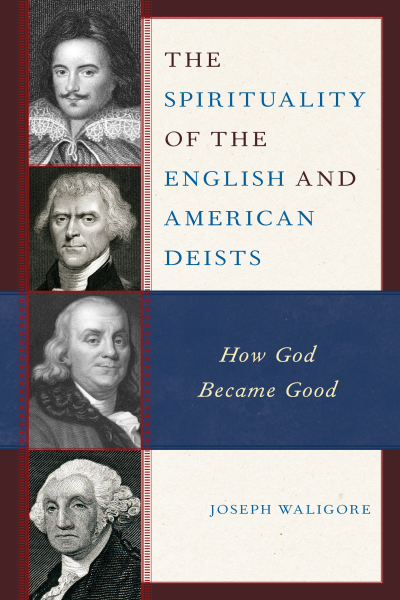
The Spirituality of the English and American Deists
How God Became Good- Authors:
- Publisher:
- 2022
Summary
The deists have been misunderstood as Enlightenment thinkers who believed in an inactive deity. Instead, the deists were spiritually oriented people who believed God treated all his children fairly. Unlike the biblical God, the deist God did not punish entire nations with plagues, curse innocent people, or order the extermination of whole nations. In deism, for the first time in modern Western history, God “became” good.
The Spirituality of the English and American Deists: How God Became Good explores how the English deists were especially important because they formulated the arguments that most of the later deists accepted. Half of the English deists claimed they were advocating the Christianity Jesus taught before his later followers perverted his teachings. Joseph Waligore call these deists Jesus-centered deists.
Ben Franklin, Thomas Jefferson, and John Adams studied these Jesus-centered deists and had similar beliefs. While some of the most prominent American Founders were deists, deism had little or no influence on the religious parts of the Constitution and the First Amendment.
Deism did not die out at the end of the Enlightenment. Instead, under different names and forms it has continued to be a significant religious force. Informed observers even think a deistic spiritual outlook is the most popular religious or spiritual outlook in contemporary America.
Keywords
Search publication
Bibliographic data
- Edition
- 1/2022
- Copyright Year
- 2022
- ISBN-Print
- 978-1-6669-2063-5
- ISBN-Online
- 978-1-6669-2064-2
- Publisher
- Lexington, Lanham
- Language
- English
- Pages
- 338
- Product Type
- Monograph
Table of contents
- Contents No access
- Acknowledgments No access
- The Deists Emphasized God’s Goodness and Fairness No access
- The Definition of Deism No access
- The Deists Did Not Champion the Modern, Scientific Worldview No access
- The French Revolutionary Deists Believed God Worked Miracles No access
- Most Deists Could Be Characterized as Spiritual but Not Religious No access
- The English Deists and the Socratic Spiritual Tradition No access
- Deism Had Little Influence on the Constitution and First Amendment No access
- Chapter Summaries No access
- Notes No access
- Newtonian Scientists Believed God Worked Miracles No access
- Most English Deists Believed in Miracles No access
- Many English Deists Believed God or Angels Still Communicated with People No access
- Conclusion No access
- Notes No access
- Seventeenth-Century Christians Emphasized the Old Testament Deity No access
- Calvinists Emphasized God’s Wrathfulness No access
- The Arminians Disagreed with the Calvinists’ Emphasis on God’s Wrathfulness No access
- The First English Deist, Herbert of Cherbury, Emphasized God’s Goodness No access
- Most of the Later English Deists Shared Herbert’s Basic Ideas No access
- Conclusion No access
- Notes No access
- The Cambridge Platonists Developed a New Kind of Protestantism That Emphasized God’s Goodness No access
- The Latitudinarians Accepted the New Protestantism No access
- The Unitarians and Other Dissenters Adopted the New Protestantism No access
- The New Protestantism Gave Rise to Eighteenth-Century English Deism No access
- Conclusion No access
- Notes No access
- The English Deists Denied a Fair God Sent Plagues to Punish Whole Nations No access
- The English Deists Denied a Fair God Cursed Entire Ethnic Groups to Slavery No access
- The English Deists Denied a Fair God Commanded Genocide No access
- The English Deists Denied a Fair God Subjected All of Humanity to Original Sin No access
- The English Deists’ Emphasis on God’s Fairness Shaped Their Views about Revelations No access
- One Deist’s Sadness on Rejecting Christianity Because of Its Immoral Teachings No access
- Conclusion No access
- Notes No access
- The Philosophers of the Socratic Spiritual Tradition No access
- The English Deists Shared the Socratic Spiritual Tradition’s View of God’s Nature No access
- The English Deists Shared the Socratic Spiritual Tradition’s View of Reason No access
- The English Deists Shared the Main Elements of Socratic Spirituality No access
- Conclusion No access
- Notes No access
- The Distinctiveness of Jesus-Centered Deism No access
- The Basic Beliefs of the Jesus-Centered Deists No access
- The Sincerity of the Jesus-Centered Deists No access
- The Influence of the Jesus-Centered Deists on the American Founders No access
- Conclusion No access
- Notes No access
- Franklin’s Connection to Two English Deists Who Were Pythagoreans No access
- Pythagoreanism and the Young Franklin No access
- Franklin’s Longest and Most Passionate Religious Writings No access
- Franklin’s Advocacy of Jesus-Centered Deism No access
- Franklin’s Later Religious Beliefs No access
- Conclusion No access
- Notes No access
- Jefferson and Adams Did Not Share the Beliefs of the Eighteenth-Century Unitarians No access
- The Unitarians Stressed the Bible’s Authority No access
- Jefferson and Adams Rejected the Bible’s Authority No access
- The Unitarians, Unlike Jefferson and Adams, Emphasized the Entire Bible No access
- The Unitarians, Unlike Jefferson and Adams, Believed God Ordered Genocide No access
- The Unitarians, Unlike Jefferson and Adams, Believed God Cursed Entire Ethnic Groups No access
- The Unitarians, Unlike Jefferson and Adams, Believed God Punished Sinful Nations No access
- Conclusion No access
- Notes No access
- Washington’s Belief in Providence and Prayer Do Not Show He Was a Christian No access
- Washington’s Church Attendance Does Not Show He Was a Christian No access
- Washington’s Statements about Christianity Do Not Show He Was a Christian No access
- Washington Was Not a Latitudinarian Christian No access
- Washington Was Probably a Stoic Deist, Not a Stoic Christian No access
- Conclusion No access
- Notes No access
- Christian Nationalists Mistakenly Claim That None of the Major Founders Were Deists No access
- Christian Nationalists Mistakenly Claim All the Major Founders Were Christians No access
- Some Christian Nationalists Mistakenly Claim the Constitution Was a Divine Covenant No access
- Secularists Mistakenly Focus on Only the Most Prominent Founders No access
- Secularists Misunderstand the Enlightenment and So Misunderstand the Founders No access
- Very Few Founders Were Deists No access
- The Constitution Was Not “Godless” No access
- The First Amendment Did Not Create a Wall of Separation between Church and State No access
- The Supreme Court Used Faulty Historical Reasoning to Create a Wall of Separation No access
- Conclusion No access
- Notes No access
- The Two Distinguishing Features of Thomas Paine’s Kind of Deism No access
- Why Paine’s Kind of Deism Was Popular No access
- Why Paine’s Kind of Deism Lost Its Popularity No access
- Young Abraham Lincoln Embraced Paine’s Kind of Deism No access
- Scientific Advances Undermined the Scientific Basis of Paine’s Kind of Deism No access
- Mark Twain and Thomas Edison’s Life Show How Scientific Advances Undercut Paine’s Kind of Deism No access
- Conclusion No access
- Notes No access
- Early Nineteenth-Century Unitarians Rejected Liberal Protestantism No access
- Jesus-Centered Deism Influenced the Rise of German Liberal Protestantism No access
- Theodore Parker Brought Liberal Protestantism to America in the 1840s No access
- The Popularity of Deistic Christianity in Nineteenth-Century America No access
- President Abraham Lincoln Probably Accepted the Deistic Christianity of Liberal Protestantism No access
- Many Contemporary Christians Accept the Deistic Christianity of Liberal Protestantism No access
- Conclusion No access
- Notes No access
- Moralistic Therapeutic Deism No access
- Moralistic Therapeutic Deism Is Similar to Enlightenment Deism No access
- Moralistic Therapeutic Deism’s Widespread Popularity in Contemporary America No access
- Contemporary Deism Does Not Suffer from the Problems of Paine’s Kind of Deism No access
- The Values of Contemporary Spirituality versus the Values of Socratic Spirituality No access
- The Resurgence of Stoicism, One Branch of the Socratic Spiritual Tradition No access
- Final Thoughts No access
- Notes No access
- References for the English Deists in the Table No access
- The French Revolutionary Deists and Miracles No access
- A List of the French Revolutionary Deists Who Wrote Prayers or Hymns to God No access
- Probable Deists, Former Deists, and People Investigated to See If They Were Deists No access
- A List of the French Revolutionary Deists No access
- French Deists Mentioned in the Archives Parlementaires No access
- Bibliography No access Pages 301 - 326
- Index No access Pages 327 - 336
- About the Author No access Pages 337 - 338