, to see if you have full access to this publication.
Monograph No access
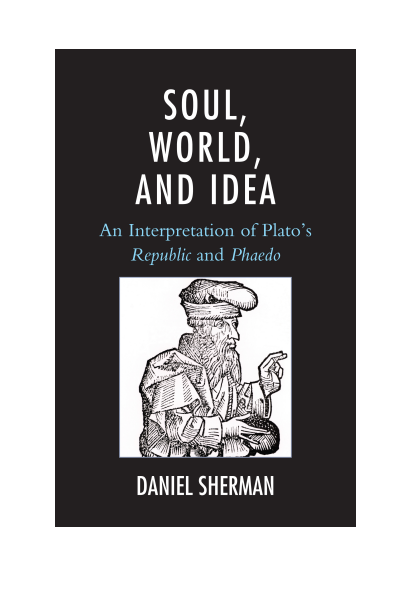
Soul, World, and Idea
An Interpretation of Plato's "Republic" and "Phaedo"
Authors:
Publisher:
2013
Summary
In its examination of two of Plato's key works, Soul, World, and Idea: An Interpretation of Plato's Republic and Phaedo reveals the key role that images and our capacity for image-making play in the relationship among soul, world, and Idea. This bookbegins and ends with a reading of the Republic. Daniel Sherman turns midway to the Phaedo to further analyze the nature of the soul and its relation to the nature of the Ideas, then returns to apply the conclusions to the rest of the Republic. Sherman's focus is on the ontological and epistemological argument, including attention to the dramatic detail. He argues that the ontology of the Ideas in the Republic and the Phaedo is inseparable from the ontology of human being, that is, from the structure and life of the soul. On this interpretation, the Ideas are seen as indeed objective but as in a sense also a product of a permanent dialectical relationship. The Ideas, though something more than concepts, do not have any real independent existence outside of this human dialectical triad of world, soul and Idea. The stability of the Ideas need not be grounded in a static otherworldliness, and the condition of meaning is not temporally prior to human existence in general. The result is a new interpretation concerning the realm of the Ideas, the immortality of the soul, and the lived in world of their interaction in the production of interpretive images.
Sherman argues that the platonic soul is immortaland the Ideas eternal wholly and solely in human (dialogical) activity--the rest is muthologia--and that the world of our experience is a product of an ongoing act of interpretation or dianoetic dialegesthai. This reinterpretation of the platonic Ideas will be especially interesting to students and scholars of classics, ancient philosophy, and continental philosophy.
Keywords
Search publication
Bibliographic data
Edition
1/2013
Copyright Year
2013
ISBN-Print
978-0-7391-7232-2
ISBN-Online
978-0-7391-7233-9
Publisher
Lexington, Lanham
Language
English
Pages
410
Product Type
Monograph
Table of contents
ChapterPages
Contents No access
Preface No access
Introduction No access Pages 1 - 18
Chapter One: The Interlocutors’ Request No access Pages 19 - 50
Chapter Two: Discourse No access Pages 51 - 84
Chapter Three: The Cave: Education and the Lack of It No access Pages 85 - 120
Chapter Four: The Divided Line and the Dynamic of Ascent No access Pages 121 - 172
Chapter Five: Education and the Mind’s Eye No access Pages 173 - 218
Chapter Six: The Phaedo’s Arguments for Immortality No access Pages 219 - 264
Chapter Seven: The Problem of Wrong Beginnings No access Pages 265 - 292
Chapter Eight: From Logos to Idea No access Pages 293 - 332
Chapter Nine: Closing the Circle No access Pages 333 - 384