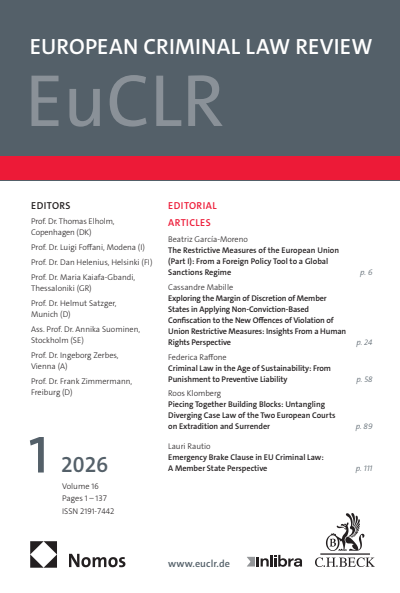
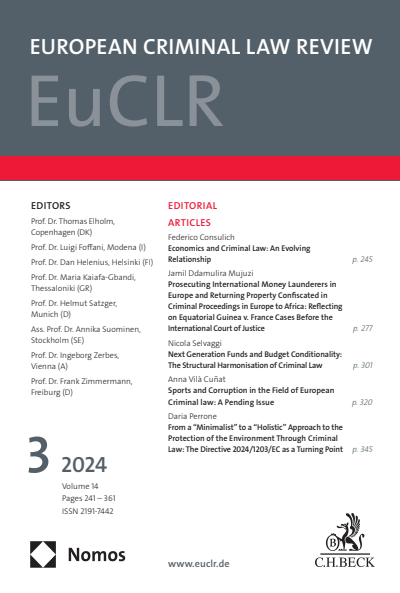
The European Criminal Law Review (EuCLR) is a journal dedicated to the development of European Criminal Law and the cooperation in criminal matters within the European Union. In these areas the Lisbon Treaty has supposedly brought about the most important changes and also the greatest challenges for the future. It is the journal’s ambition to provide a primary forum for comprehensive discussion and critical analysis of all questions arising in relation to European Criminal Law. It will include articles and relevant material on topics such as - the harmonisation of national criminal law in consideration of European legal instruments, - the implementation of the principle of mutual recognition in the area of cooperation in criminal matters and the development towards the creation of a European Public Prosecutor, - the emergence of a balanced European Criminal Policy based on fundamental rights, freedom and democracy with particular reference to the Charter of Fundamental Rights of the European Union and the European Convention on Human Rights.
Originally conceived as exceptional instruments of foreign policy under the Common Foreign and Security Policy (CFSP), the European Union’s restrictive measures have evolved into a structural and autonomous system of sanctions. This study examines...
In its quest to increase the effectiveness of restrictive measures, the Union has adopted Directive (EU) 2024/1224 defining the offences and penalties applicable in the event of a breach of these measures. At the same time, new rules on asset...
The development of a criminal law of sustainability is still in its infancy, but fundamental issues that deserve attention are already emerging. This contribution aims to offer some initial reflections on a topic that is destined to occupy legal...
The protection of fundamental rights in surrender and extradition cases is a complex issue. Both the ECtHR and the CJEU created a line of case law which addresses the so-called fundamental rights exception, a test which allows the executing or...
This article analyses the emergency brake mechanism of the EU criminal law, focusing on both its content and circumstances in which it might be invoked. The analysis adopts the perspective of Member States as the decision to use the mechanism...