, to see if you have full access to this publication.
Monograph No access
Morality, Not Mortality
Moral Psychology and the Language of Death in Romans 5–8
Authors:
Publisher:
2022
Summary
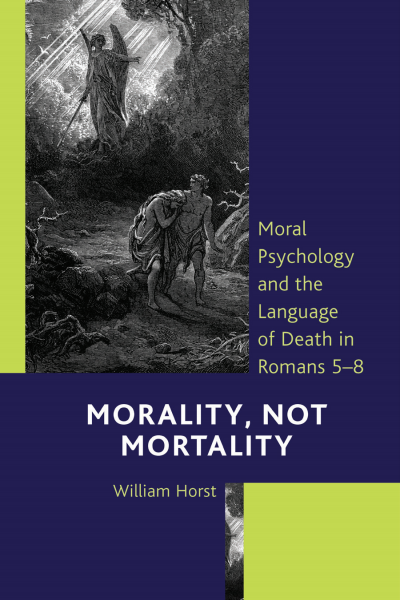
This study argues that the language of “death” as a present human plight in Romans 5–8 is best understood against the background of Hellenistic moral-psychological discourse, in which “death” refers to a state of moral bondage in which a person’s rational will is dominated by passions associated with the body. It is death of this sort, rather than human mortality or a cosmic power called “Death,” that entered the world through the transgression of Adam and Eve in Eden. Moral death was imposed on humanity as a judgment against this initial transgression, in order to increase sinful behavior, which ultimately serves to increase the magnitude of the glorious revelation of God’s grace through Jesus Christ. Likewise, creation’s subjection to “corruption” and “futility” in Romans 8 involves the detrimental effects of human moral corruption, not the physical corruption of death and decay. Ultimately, the plight on which Paul focuses much of his attention throughout Rom 5–8 is a matter of morality, not mortality.
Keywords
Search publication
Bibliographic data
Edition
1/2022
Copyright Year
2022
ISBN-Print
978-1-6669-0028-6
ISBN-Online
978-1-6669-0029-3
Publisher
Lexington, Lanham
Language
English
Pages
238
Product Type
Monograph
Table of contents
ChapterPages
Contents No access
Acknowledgments No access
Abbreviations No access
Introduction No access Pages 1 - 30
Moral Metaphorical Death as a Background to Romans 5–8 No access Pages 31 - 62
The Language of Death in Romans 6:1–8:13 No access Pages 63 - 118
The Inception of Death through Adam in Romans 5:12–21 No access Pages 119 - 144
The Glory of God in the Early Chapters of Romans No access Pages 145 - 170
The Subjection of Creation to Corruption in Romans 8:18–23 No access Pages 171 - 192
Conclusion No access Pages 193 - 198
Bibliography No access Pages 199 - 210
Ancient Sources Index No access Pages 211 - 228
Topical Index No access Pages 229 - 236
About the Author No access Pages 237 - 238
Similar publications
from the topics "Religion und Theologie allgemein"
Edited Book No access
Jan Hermelink, Alexander Deeg, Michael Domsgen, Kristin Merle, Marcell Saß