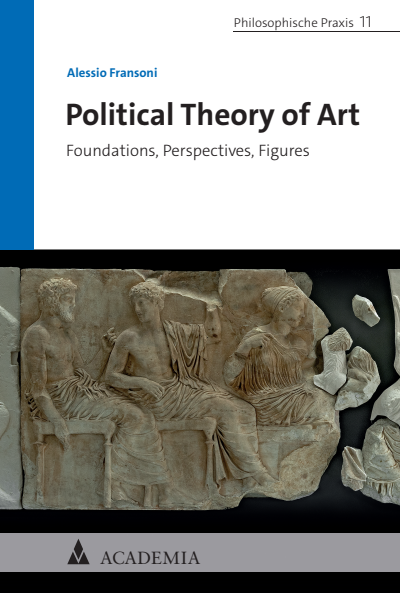
The book enters the debate on the relationship between aesthetics and politics with an original and comprehensive theory. As Fransoni makes clear, a political theory is not a theory of politics, but a theory that deals with things, in this case art, in order to read them in the light of the political, i.e. in relation to human plurality. In the light of the political, the work of art and other common notions of art criticism find new and surprising definitions. At the same time, it is revealed how the work of art manifests some of the crucial relationships of politics, such as that between freedom and world. A political theory ultimately looks at art from the same perspective of plurality that art, together with other concepts of the political, helps to define.
Keywords
Search publication
Bibliographic data
Copyright Year
2024
ISBN-Print
978-3-98572-161-0
ISBN-Online
978-3-98572-162-7
Publisher
Academia, Baden-Baden
Series
Philosophische Praxis
Volume
11
Language
English
Pages
103
Product Type
Monograph
Table of contents
ChapterPages
Titelei/Inhaltsverzeichnis No access Pages 1 - 12
1) A theory as a system of differences No access
2) The dimensions of the human condition as coordinates No access
3) Phenomenology of the activities and the place of art No access
4) Difference in movement and as movement No access
5.1) Political vs. social No access
5.2) The art world beyond sociology and institutional analysis No access
5.3) Freedom and beginning No access
6.1) Kant and plurality No access
6.2) Circumstances and examples No access
6.3) Art space between excellence and equality No access
6.4) Art and political judgement No access
7.1) Appearance of the world No access
7.2) Lasting like the action No access
7.3) Revolution, beginning and duration No access
8) Proximity and support No access
9) Speaking and seeing in the dative case No access