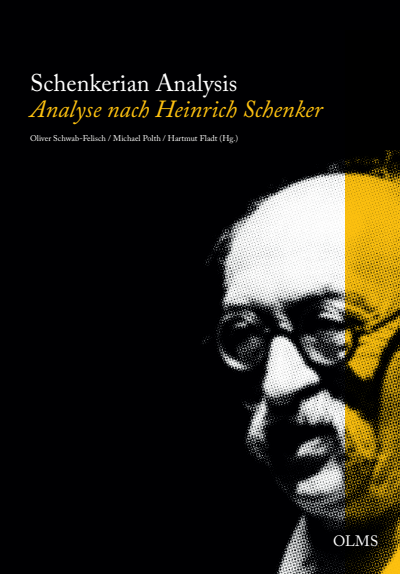
Schenkerian Analysis - Analyse nach Heinrich Schenker
- Editors:
- | |
- Series:
- Studien und Materialien zur Musikwissenschaft, Volume 112
- Publisher:
- 2021
Summary
There are two main reasons why Heinrich Schenker became one of the most discussed music theorists of the 20th century: Firstly, his theory enables descriptions of the voice leading, harmony and syntax of tonal works that are as multi-layered as they are consistent. And secondly, Schenker's 'theory of layers' found ideal conditions in the USA, where most of Schenker's students had emigrated after 1933 - conditions that quickly allowed it to rise to become the leading theory of tonal music. In Austria, Germany and Switzerland, Schenker's reception initially took a different path: until the turn of the millennium, Schenker's theory remained the preserve of a few specialists. Since then, however, it has also met with growing interest in the German-speaking world. This German-English anthology contributes to Schenker research in both language areas and academic cultures. It examines questions of theoretical history, illuminates unexplored aspects of Schenker theory and opens up numerous of its implications for the theory of science, the history of reception and music aesthetics. In doing so, he often goes beyond Schenker - through new ideas of rhythm and metrics, references to Niklas Luhmann's systems theory or pluralistic theoretical concepts. The separate music volume contains analytical graphics as well as original musical texts. Online audio examples illustrate how different analytical interpretations can affect musical performances. Finally, a glossary and index facilitate in-depth readings along the lines of specific questions. A fundamental study book that shows music theorists and performers numerous possibilities for being inspired by Schenker's thinking.
Keywords
Search publication
Bibliographic data
- Copyright Year
- 2021
- ISBN-Print
- 978-3-487-14726-0
- ISBN-Online
- 978-3-487-42479-8
- Publisher
- Georg Olms Verlag, Baden-Baden
- Series
- Studien und Materialien zur Musikwissenschaft
- Volume
- 112
- Language
- English
- Pages
- i132
- Product Type
- Edited Book
Table of contents
- Titelei/Inhaltsverzeichnis No access Pages I - xiv
- Schenker-Analyse und Wissenschaft. Eine Einführung No access Pages 1 - 20Authors:
- The Curious Incident of the Dog in the Night-Time: The Importance of Non-Events No access Pages 21 - 30Authors:
- Effects, Alternative Analytical Solutions, and Interpretation No access Pages 31 - 40Authors:
- Structure and Design in Chopin’s Mazurka, Op. 56, No. 3: Voice Leading and Cadential Gestures No access Pages 41 - 50Authors:
- Triebleben oder Logik der Klänge? Über Chopins Nocturnes op. 62 No access Pages 51 - 66Authors:
- Das Präludium als Abriss der Harmonielehre – Eine Interpretation von Chopins Opus 28, Nr. 9 No access Pages 67 - 88Authors:
- Bach, Praeludium C-Dur BWV 939 No access Pages 89 - 102Authors: |
- Klangisolation und -projektion im späten Klavierwerk Franz Liszts No access Pages 103 - 112Authors:
- Die Logik der Schenkerschen Musikanalyse und ihre Bedeutung für die allgemeine Ästhetik No access Pages 113 - 134Authors:
- ›Sonatenform‹ als Funktionalität. Formbildung um 1775 aus post-Schenkerscher Perspektive No access Pages 135 - 162Authors:
- Rationale Rekonstruktion der Schichtenlehre Heinrich Schenkers No access Pages 163 - 182Authors:
- Zum Problem des Motivischen bei Schenker No access Pages 183 - 192Authors:
- Schenker, Luhmann und das Problem der ›steigenden Urlinie‹ No access Pages 193 - 226Authors:
- Fundamental Line(s) No access Pages 227 - 234Authors:
- Diminution and Harmonic Counterpoint in Late-Eighteenth-Century Naples: Vincenzo Lavigna’s Studies with Fedele Fenaroli No access Pages 235 - 254Authors:
- Die ornamentale Struktur des Tonsatzes. Ornamentik als Grenzbereich zwischen Analyse und Vortragslehre No access Pages 255 - 272Authors:
- Schenker und Bach – ein Zwiegespräch zwischen einem Interpreten und einem Musiktheoretiker No access Pages 273 - 288Authors: |
- Schenker in Böhmen. Ein Beitrag zur Rezeption von Schenkers Musiktheorie No access Pages 289 - 296Authors:
- Glossar No access Pages 297 - 314Authors:
- Sachregister Deutsch No access Pages 315 - 323
- Sachregister Englisch No access Pages 324 - 327
- Personenregister No access Pages 328 - 331
- The Curious Incident of the Dog in the Night-Time: The Importance of Non-Events No access Pages i1 - i14Authors:
- Effects, Alternative Analytical Solutions, and Interpretation No access Pages i15 - i26Authors:
- Structure and Design in Chopin’s Mazurka, Op. 56, No. 3: Voice Leading and Cadential Gestures No access Pages i27 - i40Authors:
- Triebleben oder Logik der Klänge? Über Chopins Nocturnes op. 62 No access Pages i41 - i48Authors:
- Das Präludium als Abriss der Harmonielehre – Eine Interpretation von Chopins Opus 28, Nr. 9 No access Pages i49 - i52Authors:
- Bach, Praeludium C-Dur BWV 939 No access Pages i53 - i58Authors: |
- Klangisolation und -projektion im späten Klavierwerk Franz Liszts No access Pages i59 - i62Authors:
- ›Sonatenform‹ als Funktionalität. Formbildung um 1775 aus post-Schenkerscher Perspektive No access Pages i63 - i72Authors:
- Zum Problem des Motivischen bei Schenker No access Pages i73 - i84Authors:
- Schenker, Luhmann und das Problem der ›steigenden Urlinie‹ No access Pages i85 - i88Authors:
- Fundamental Line(s) No access Pages i89 - i92Authors:
- Diminution and Harmonic Counterpoint in Late-Eighteenth-Century Naples: Vincenzo Lavigna’s Studies with Fedele Fenaroli No access Pages i93 - i108Authors:
- Die ornamentale Struktur des Tonsatzes. Ornamentik als Grenzbereich zwischen Analyse und Vortragslehre No access Pages i109 - i110Authors:
- Schenker und Bach – ein Zwiegespräch No access Pages i111 - i132Authors: |