, to see if you have full access to this publication.
Monograph No access
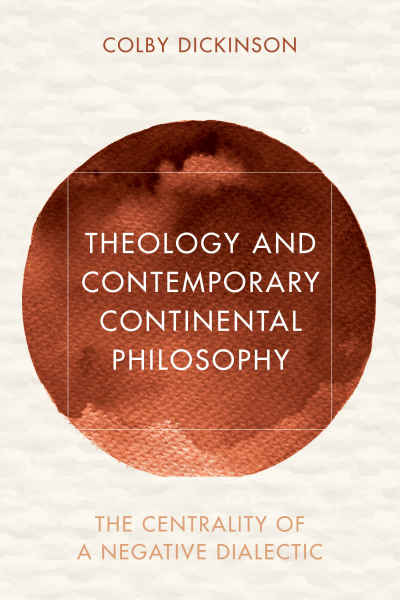
Theology and Contemporary Continental Philosophy
The Centrality of a Negative Dialectic
Authors:
Publisher:
2018
Summary
This book aims to put modern continental philosophy, specifically the sub-fields of phenomenology, existentialism, hermeneutics, deconstruction, critical theory and genealogy, into conversation with the field of contemporary theology. Colby Dickinson demonstrates the way in which negative dialectics, or the negation of negation, may help us to grasp the thin (or non-existent) borders between continental philosophy and theology as the leading thinkers of both fields wrestle with their entrance into a new era. With the declining place of “the sacred” in the public sphere, we need to pay more attention than ever to how continental philosophy seems to be returning to distinctly theological roots.
Through a genealogical mapping of 20th-century continental philosophers, Dickinson highlights the ever-present Judeo-Christian roots of modern Western philosophical thought. Opposing categories such as immanence/transcendence, finitude/infinitude, universal/particular, subject/object, are at the center of works by thinkers such as Agamben, Marion, Vattimo, Levinas, Latour, Caputo and Adorno. This book argues that utilizing a negative dialectic allows us to move beyond the apparent fixation with dichotomies present within those fields and begin to perform both philosophy and theology anew.
Keywords
Search publication
Bibliographic data
Edition
1/2018
Copyright Year
2018
ISBN-Print
978-1-78661-059-1
ISBN-Online
978-1-78661-061-4
Publisher
Rowman & Littlefield, Lanham
Language
English
Pages
160
Product Type
Monograph
Table of contents
ChapterPages
Contents No access
Acknowledgments No access
Introduction No access Pages 1 - 8
1 On the Relationship of Continental Philosophy to Theology No access Pages 9 - 32
2 Toward a Negative Dialectic No access Pages 33 - 68
3 The Gap within Existence as Theological Motif No access Pages 69 - 106
4 The Phenomenological (Re)turn No access Pages 107 - 128