, to see if you have full access to this publication.
Monograph No access
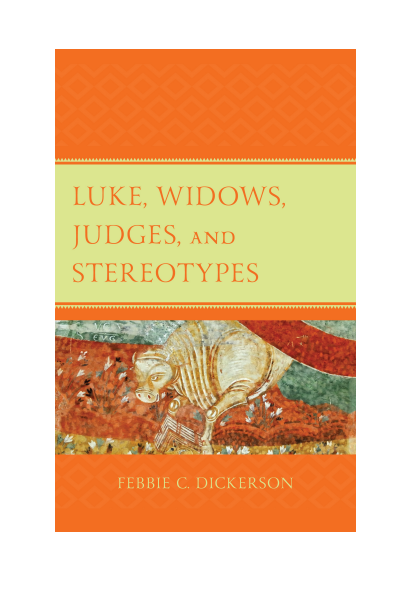
Luke, Widows, Judges, and Stereotypes
Authors:
Publisher:
2019
Summary
Biblical narratives are not simply sacred stories for religious communities: They are stories that provide transformative insight into cultural biases. By putting historical criticism and reception history into dialogue with womanist biblical hermeneutics, Luke, Widows, Judges, and Stereotypes offers a provocative reading of Jesus’ parable about a widow who confronts a judge and obtains what she seeks by means of physical threat. Rather than simply reading the widow as the model for “one who prays always and does not lose heart” (Luke 18:1), Dickerson shows that read in the context of Luke’s wider narrative, the widow, domesticated and robbed both of her agency and moral ambiguity, is more likely demanding vengeance instead of justice. Likewise, rather than simply reading the judge as one "who neither feared God nor had respect for people" (Luke 18:2), Dickerson argues that the judge is both an ideal man and one who compromises standards of ancient masculinity. Then, reading both the widow and judge through African American stereotypes (Mammy, Jezebel, Sapphire, Cool Black Male, Master-Pastor, and Foolish Judge) that are used to degrade, debase, and control, and reading them into and in light of the parable, Dickerson demonstrates how the parable calls into question these stereotypes thereby producing new liberative readings.
Keywords
Search publication
Bibliographic data
Edition
1/2019
Copyright Year
2019
ISBN-Print
978-1-9787-0123-6
ISBN-Online
978-1-9787-0124-3
Publisher
Lexington, Lanham
Language
English
Pages
225
Product Type
Monograph
Table of contents
ChapterPages
Contents No access
Acknowledgments No access
Abbreviations No access
1 The Price of Stereotypes No access Pages 1 - 16
2 Parable of the Widow and the Judge (Luke 18:2–5) No access Pages 17 - 44
3 A History of Allegory, Stereotypes, and Challenge No access Pages 45 - 68
4 Luke, Widows, Judges, and Gender No access Pages 69 - 92
5 Mammy, Jezebel, and Sapphire in Conversation with Luke No access Pages 93 - 160
6 Luke, the Judge, and African American Male Stereotypes No access Pages 161 - 194
7 Conclusion No access Pages 195 - 202
Bibliography No access Pages 203 - 220
Index No access Pages 221 - 224
About the Author No access Pages 225 - 225
Similar publications
from the topics "Religion und Theologie allgemein"