, to see if you have full access to this publication.
Monograph No access
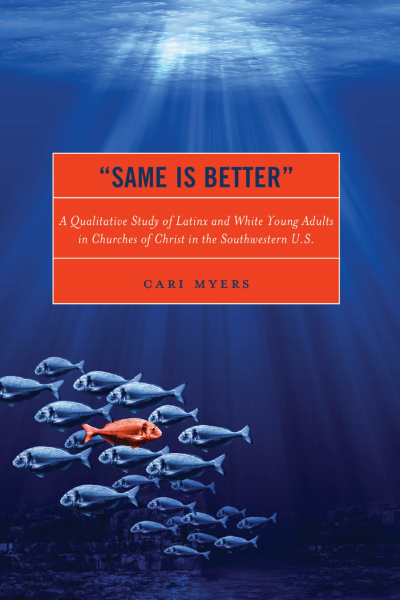
Same Is Better
A Qualitative Study of Latinx and White Young Adults in Churches of Christ in the Southwestern U.S.
Authors:
Publisher:
2022
Summary
As younger generations drift away from evangelical churches, the number of religiously unaffiliated young adults grows. Is the drift because of politics, personal morality, rebelliousness, culture wars, or something else? In this project, 16 young adults from the Churches of Christ participate in qualitative interviews over a five-year span. They describe messages they learned about success and survival from their faith communities as children, and how they have embraced and reinterpreted those messages into helpful life principles as adults. The resulting study explores issues of ethnicity in evangelical borderland communities and contrasts Latinx narratives with white narratives in religious and educative contexts. Findings also revealed gendered narratives, class-based narratives, and the glaring absence of helpful narratives around sexuality, filtered through the lenses of religion and education. The central finding of the interviews is this: participants experienced the Church of Christ as rewarding conformity with community, a strategy (when it works) which secures the future of the denomination and cements a conservative doctrine in the next generation of leadership. However, the study concludes that true survival narratives were the narratives participants constructed in response to the narratives provided by Churches of Christ.
Keywords
Search publication
Bibliographic data
Edition
1/2022
Copyright Year
2022
ISBN-Print
978-1-7936-5512-7
ISBN-Online
978-1-7936-5513-4
Publisher
Lexington, Lanham
Language
English
Pages
190
Product Type
Monograph
Table of contents
ChapterPages
Contents No access
Acknowledgments No access
Introduction No access Pages 1 - 8
Constructing the Survival Narrative No access Pages 9 - 32
The Hermeneutical Circle of Ethics as Qualitative Methodology No access Pages 33 - 52
Religion No access Pages 53 - 68
Identity No access Pages 69 - 110
Education No access Pages 111 - 132
Mechanism beneath the Message No access Pages 133 - 162
Conclusion No access Pages 163 - 174
Appendix No access Pages 175 - 176
Bibliography No access Pages 177 - 184
Index No access Pages 185 - 188
About the Author No access Pages 189 - 190
Similar publications
from the topics "Religion und Theologie allgemein"
Edited Book No access
Jan Hermelink, Alexander Deeg, Michael Domsgen, Kristin Merle, Marcell Saß