, to see if you have full access to this publication.
Monograph No access
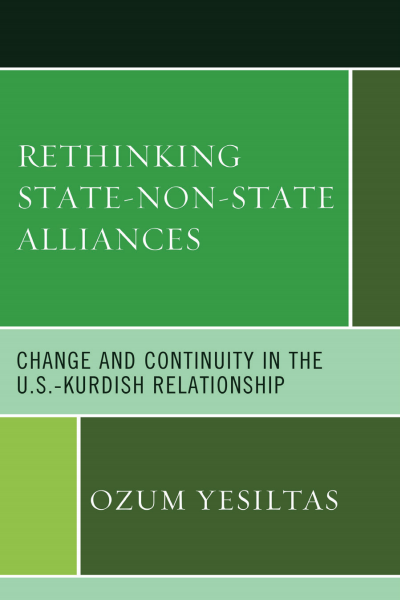
Rethinking State-Non-State Alliances
Change and Continuity in the U.S.-Kurdish Relationship
Authors:
Publisher:
2022
Summary
Thriving in the context of political vacuums created by state weakness, the armed non-state actors in the Middle East, such as Hamas, Hezbollah, and the Kurds increasingly demonstrate features of both state and non-state actors and act autonomously in their foreign policy. Rethinking State-Non-State Alliances: Change and Continuity in the U.S.-Kurdish Relationship investigates the growing influence of Middle Eastern non-state actors as agents of foreign policy through an analysis of the U.S.-Kurdish relationship. Ozum Yesiltas analyzes the underlying causes of increased U.S.-Kurdish cooperation since the early 1990s and addresses the extent to which existing approaches in international relations are adequate in explaining the changing political landscape in the Middle East that brought the U.S. and Kurds together in new ways. Yesiltas draws attention to the ways in which U.S-Kurdish interactions contributed to the escalation of Kurdish nationalism as a transnational phenomenon, and how the growing saliency of Kurdish transnational politics reshapes U.S. foreign policy and broader regional order.
Keywords
Search publication
Bibliographic data
Edition
1/2022
Copyright Year
2022
ISBN-Print
978-1-7936-4591-3
ISBN-Online
978-1-7936-4592-0
Publisher
Lexington, Lanham
Language
English
Pages
170
Product Type
Monograph
Table of contents
ChapterPages
Contents No access
Acknowledgments No access
Introduction No access Pages 1 - 14
Weak States and Strong Non-States No access Pages 15 - 36
The Kurds and the U.S. during the Cold War No access Pages 37 - 60
The Kurds and the U.S. in the Post–Cold War Era No access Pages 61 - 88
The Kurds and the U.S. in the Twenty-First Century No access Pages 89 - 126