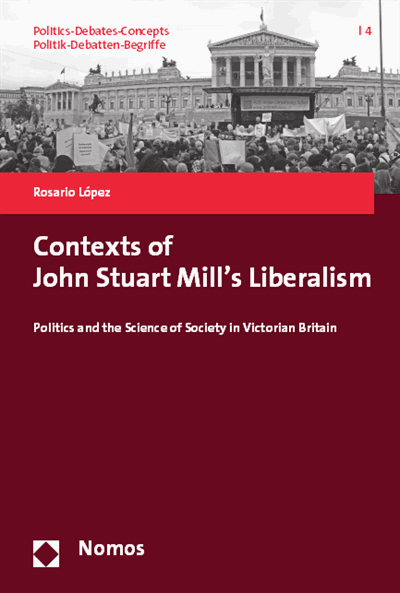
Contexts of John Stuart Mill's Liberalism
Politics and the Science of Society in Victorian Britain- Authors:
- Series:
- Politics-Debates-Concepts. Politik-Debatten-Begriffe, Volume 4
- Publisher:
- 2016
Summary
Das Buch enthält sieben miteinander verbundene Aufsätze, die dem Leser John Stuart Mills' Denken und seinen Politischen Liberalismus im Sinne eines historisch determinierten Narrativs näherbringen sollen – mittels aktueller historiografischer Debatten, der theoretischen Annahmen der „Neuen Politischen Ideengeschichte“ und der Begriffsgeschichte. Ausgehend von einer gemeinsamen methodologischen Basis untersuchen die verschiedenen Kapitel die Relevanz der historischen Texte für unser gegenwärtiges Verständnis von Mills politischem Denken und wie es in seinen sozialen und politischen Kontext eingebettet werden kann. Der Leser lernt hierdurch nicht nur Mills politisches Denken aus historischer Perspektive kennen, sondern erhält auch eine Idee des intellektuellen Milieus viktorianischer Zeit.
Search publication
Bibliographic data
- Copyright year
- 2016
- ISBN-Print
- 978-3-8487-3695-9
- ISBN-Online
- 978-3-8452-7994-7
- Publisher
- Nomos, Baden-Baden
- Series
- Politics-Debates-Concepts. Politik-Debatten-Begriffe
- Volume
- 4
- Language
- English
- Pages
- 201
- Product type
- Book Titles
Table of contents
- Titelei/Inhaltsverzeichnis No access Pages 1 - 12
- Purpose of the Study No access
- The Argument No access
- Mill in Context: The Approach No access
- Debates on Method: The Study of the History of Political Thought No access
- Antagonistic Forces in the History of Modern Civilisation: Guizot and Coleridge No access
- The Place of Dissenters in On Liberty No access
- Developing a Method: The Science of Society, Political Economy and Political Science No access
- Hearing Both Sides of the Subject: Mill’s Personal Experience of Antagonism and his Intellectual Development No access
- Parliament and the Value of Debate No access
- Concluding Remarks No access
- History as the ‘Great Things’ Achieved by Mankind No access
- Mill and the Coleridgeans on History No access
- France and French Historians No access
- Concluding Remarks No access
- Coleridge (1840) No access
- A System of Logic (1843) and The Principles of Political Economy (1848) No access
- Guizot’s Essays and Lectures on History (1845) No access
- On Liberty (1859) and Thoughts on Parliamentary Reform (1859) No access
- Considerations on Representative Government (1861) No access
- Auguste Comte and Positivism (1865) and Inaugural Address Delivered to the University of St. Andrews (1867) No access
- Concluding Remarks No access
- Samuel Taylor Coleridge and John Stuart Mill No access
- Herbert Spencer (1820-1903) No access
- Auguste Comte’s Positivism, Frederic Harrison and Samuel Alexander No access
- Walter Bagehot (1836-1877) No access
- Political Ideologies Encapsulated No access
- Explaining Social and Political Unrest No access
- Summarising Ideological Positions No access
- Exploring Everyday Language: Pamphlets No access
- Concluding Remarks No access
- What is it to be Interpreted? On Multiple Versions of Political Texts No access
- The Peculiarities of Mill’s A System of Logic No access
- The Relevance of Textual Instability for Understanding Authorial Revisions No access
- Mill’s Revision Process: Recasting Comte’s Role in A System of Logic No access
- Concluding Remarks No access
- Social Organism, Social Body and Body Politic No access
- Consensus No access
- Statics and Dynamics No access
- Astronomy and the Progress of History No access
- Cohesion and Mathematics No access
- The Task of Understanding Mill’s Use of Figurative Language No access
- The Controversies on the Cognitive Value of Metaphors No access
- Concluding Remarks No access
- Present-day Interpretations of Mill’s Concept of Nationality and Considerations on Representative Government No access
- The ‘Vulgar Sense’ of Nationality: Recasting its Meaning as a Principle of Cohesion No access
- Textual Revision and Quentin Skinner’s Insights No access
- The Meaning of ‘Cohesion’ and the Argumentative Context No access
- Concluding Remarks No access
- Conclusions No access Pages 171 - 178
- Note on chapters No access Pages 179 - 180
- Bibliography No access Pages 181 - 201