, to see if you have full access to this publication.
Edited Book No access
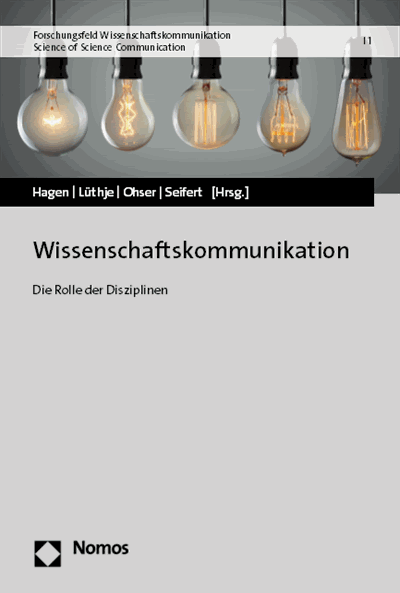
Wissenschaftskommunikation
Die Rolle der Disziplinen- Editors:
- | | |
- Series:
- Forschungsfeld Wissenschaftskommunikation, Volume 1
- Publisher:
- 2018
Search publication
Bibliographic data
- Edition
- 1/2018
- Copyright Year
- 2018
- ISBN-Print
- 978-3-8487-3289-0
- ISBN-Online
- 978-3-8452-7642-7
- Publisher
- Nomos, Baden-Baden
- Series
- Forschungsfeld Wissenschaftskommunikation
- Volume
- 1
- Language
- German
- Pages
- 228
- Product Type
- Edited Book
Table of contents
ChapterPages
- Titelei/Inhaltsverzeichnis No access Pages 1 - 6
- Authors: | | |
- Literatur: No accessAuthors: | | |
- Authors:
- 1. Nach welchen Gesichtspunkten werden Politikwissenschaftler von Medien ausgewählt? No accessAuthors:
- 2. Was passiert mit Äußerungen von Politikwissenschaftlern in den Redaktionen? No accessAuthors:
- 3. Was ist die Wirkung von Äußerungen von Politikwissenschaftlern? No accessAuthors:
- 4. Was sind Gütekriterien für Äußerungen von Wissenschaftlern? No accessAuthors:
- 5. Welcher Nexus besteht zwischen politikwissenschaftlichen Äußerungen und politischer Korrektheit? No accessAuthors:
- Authors:
- 1. Physikalische Nachbarn … No accessAuthors:
- 2. Andere naturwissenschaftliche Nachbarn … No accessAuthors:
- 3. Weitere wissenschaftliche Fächer … No accessAuthors:
- 4. Fachferne Kommunikation … No accessAuthors:
- Schlussbemerkung No accessAuthors:
- Literatur No accessAuthors:
- Authors: |
- 1 Einleitung: Ist die "Science of Science Communication" eine Disziplin – oder auf dem Weg dahin? No accessAuthors: |
- 2 Konzeptioneller Rahmen: Was sind Disziplinen und wie kann man sie 'messen'? No accessAuthors: |
- 3 Forschungsinteresse No accessAuthors: |
- 4 Daten und Methode No accessAuthors: |
- Authors: |
- 5.1 Zitationsbasierte Communities innerhalb der “Science of Science Communication“ No accessAuthors: |
- 5.2 Wie haben sich die Communities im Laufe der Zeit entwickelt? No accessAuthors: |
- 5.3 Vernetzungen zwischen den Communities No accessAuthors: |
- 6 Vom Forschungsfeld zu Disziplin? No accessAuthors: |
- Quellenverzeichnis No accessAuthors: |
- Authors: |
- 1 Wissenschaft und Öffentlichkeit: Ein schwieriges Verhältnis? No accessAuthors: |
- Authors: |
- Abhängige Variable: Interesse an Wissenschaft No accessAuthors: |
- Zentrale unabhängige Variable: Rolle der Öffentlichkeit in der Wissenschaft No accessAuthors: |
- Zusätzliche Prädiktoren I: Verständnis für Wissenschaft No accessAuthors: |
- Zusätzliche Prädiktoren II: Medien und Kommunikatoren No accessAuthors: |
- Soziodemographische Kontrollvariablen No accessAuthors: |
- 3 Ergebnisse No accessAuthors: |
- 4 Diskussion No accessAuthors: |
- 5 Implikationen auf Ebene der Wissenschaftsdisziplinen No accessAuthors: |
- Zitierte Literatur No accessAuthors: |
- Authors:
- 1 Methodisches Vorgehen und Stichprobe No accessAuthors:
- 2 Zur Konstruktion und Kontextualisierung von Wissenschaft No accessAuthors:
- 3 Zur Medialisierung von Wissenschaftsdisziplinen No accessAuthors:
- 4 Vielfalt statt Einheit: Einordnung und Ausblick No accessAuthors:
- Literatur No accessAuthors:
- Authors: |
- 1. Einleitung No accessAuthors: |
- 2. Forschungsstand – Sozialwissenschaftler in den Medien No accessAuthors: |
- 3. Soziale Rolle als Analyseinstrument No accessAuthors: |
- Authors: |
- 4.1 Der Fall PEGIDA No accessAuthors: |
- 4.2 Methode No accessAuthors: |
- Authors: |
- 4.3.1 Verlauf der Berichterstattung No accessAuthors: |
- 4.3.2 Präsenz von Sozialwissenschaftlern in der Berichterstattung No accessAuthors: |
- Authors: |
- Sozialwissenschaftler in der Expertenrolle No accessAuthors: |
- Sozialwissenschaftler in der Rolle des öffentlichen Intellektuellen No accessAuthors: |
- 5. Fazit & Ausblick: Rollen von Sozialwissenschaftlern im PEGIDA-Diskurs No accessAuthors: |
- Literatur No accessAuthors: |
- Authors: | |
- 1. Einleitung No accessAuthors: | |
- 2. Nachhaltigkeitskommunikation als Teilbereich der Wissenschaftskommunikation? Eine Literaturstudie No accessAuthors: | |
- Authors: | |
- 3 a: Abnutzung von Nachhaltigkeit in den Medien No accessAuthors: | |
- 3 b: Potenziale und Grenzen der medialen Aufbereitung von Nachhaltigkeit No accessAuthors: | |
- 3 c: Zusammenfassung: No accessAuthors: | |
- 4 Resümee, Kritik, Diskussion und Zukunftsausblick No accessAuthors: | |
- References No accessAuthors: | |
- Authors: |
- 1. Einleitung No accessAuthors: |
- 2. Theoretischer Hintergrund und forschungsleitende Fragen No accessAuthors: |
- 3. Methodische Umsetzung No accessAuthors: |
- Authors: |
- 4.1 Diskursorganisation No accessAuthors: |
- 4.2 Gruppeninterne Definitionen von Nachhaltigkeit No accessAuthors: |
- Authors: |
- Meteorologie: Nachhaltigkeit ist ein erstrebenswertes Ziel und eine politische Waffe No accessAuthors: |
- Volkswirtschaftslehre: Nachhaltigkeit ist ein Marketingwort und ein Omnibus No accessAuthors: |
- Interdisziplinäre Gruppe: Nachhaltigkeit ist ein Modebegriff und ein Babelfisch No accessAuthors: |
- Bodenkunde: Nachhaltigkeit ist positiv besetzt, aber abgenutzt No accessAuthors: |
- Authors: |
- Interdisziplinäre Gruppe: Kaum Rückbezüge zur Herkunftsdisziplin No accessAuthors: |
- Volkswirtschaftslehre: Ist keine nachhaltige Disziplin No accessAuthors: |
- Bodenkunde: Nachhaltigkeit ist zentrales Thema des Fachs No accessAuthors: |
- Meteorologie: Nachhaltigkeit wird divers diskutiert No accessAuthors: |
- Authors: |
- Bedeutungsdimension: Begriffsdefinition No accessAuthors: |
- Bedeutungsdimension: Einstellung zum Begriff No accessAuthors: |
- Bedeutungsdimension: Reflexion der Nachhaltigkeit No accessAuthors: |
- 5. Fazit No accessAuthors: |
- 6. Limitationen der Studie No accessAuthors: |
- Literatur No accessAuthors: |
- Authors: |
- 1 Einleitung No accessAuthors: |
- 2 Wissenschaftskommunikation im Wandel No accessAuthors: |
- 3 Methode No accessAuthors: |
- Authors: |
- Authors: |
- 4.1.1 Allgemeine soziale Kommunikationskanäle No accessAuthors: |
- 4.1.2 Berufsnetzwerke No accessAuthors: |
- 4.1.3 Wissenschaftsspezifische soziale Kommunikationskanäle No accessAuthors: |
- 4.1.4 Sonstige Kommunikationskanäle No accessAuthors: |
- Authors: |
- 4.2.1 Motive interner Wissenschaftskommunikation über webbasierte soziale Kommunikationskanäle No accessAuthors: |
- 4.2.2 Motive externer Wissenschaftskommunikation über webbasierte soziale Kommunikationskanäle No accessAuthors: |
- 4.3 Typische Nutzungsmuster No accessAuthors: |
- Authors: |
- hese 1: Die Disziplinzugehörigkeit prägt das Wissenschafts- und Rollenselbstverständnis und beeinflusst damit indirekt die a) Art und b) Intensität der Nutzung webbasierter sozialer Kommunikationskanä... No accessAuthors: |
- hese 2: Die Disziplinzugehörigkeit als Einflussfaktor für die Nutzung webbasierter sozialer Kommunikationskanäle wird relativiert durch Einflussfaktoren des a) konkreten Forschungsfeldes, der b) beruf... No accessAuthors: |
- 5 Zusammenfassung und Fazit No accessAuthors: |
- Literatur No accessAuthors: |
- Authors: | |
- 1. Einleitung: #TimHunt und #distractinglysexy No accessAuthors: | |
- 2. Hintergrund: Wissenschaftskommunikation, Geschlechterdiskurse und Medienwandel No accessAuthors: | |
- Authors: | |
- 3.1. Forschungsansatz und Methoden No accessAuthors: | |
- 3.2. Quantitative Ergebnisse: Transmediale Quellen und geschlechterdifferente Bewertung des Diskurses No accessAuthors: | |
- 3.3 Qualitative Ergebnisse: Auseinandersetzungen um Geschlechtergerechtigkeit in der Wissenschaft No accessAuthors: | |
- 4. Diskussion und Ausblick: Transmediale Wissenschaftskommunikation und transmediale Geschlechterdiskurse No accessAuthors: | |
- 5. Literatur No accessAuthors: | |