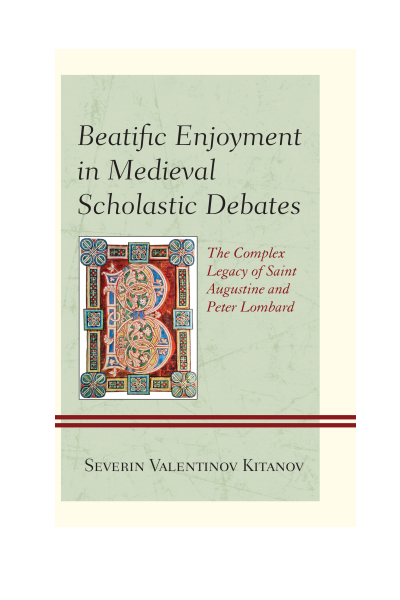
Beatific Enjoyment in Medieval Scholastic Debates
The Complex Legacy of Saint Augustine and Peter Lombard- Authors:
- Publisher:
- 2014
Summary
Beatific Enjoyment in Medieval Scholastic Debates examines the religious concept of enjoyment as discussed by scholastic theologians in the Latin Middle Ages. Severin Kitanov argues that central to the concept of beatific enjoyment (fruitio beatifica) is the distinction between the terms enjoyment and use (frui et uti) found in Saint Augustine’s treatise On Christian Learning. Peter Lombard, a twelfth-century Italian theologian, chose the enjoyment of God to serve as an opening topic of his Sentences and thereby set in motion an enduring scholastic discourse. Kitanov examines the nature of volition and the relationship between volition and cognition. He also explores theological debates on the definition of enjoyment: whether there are different kinds and degrees of enjoyment, whether natural reason unassisted by divine revelation can demonstrate that beatific enjoyment is possible, whether beatific enjoyment is the same as pleasure, whether it has an intrinsic cognitive character, and whether the enjoyment of God in heaven is a free or un-free act.
Even though the concept of beatific enjoyment is essentially religious and theological, medieval scholastic authors discussed this concept by means of Aristotle’s logical and scientific apparatus and through the lens of metaphysics, physics, psychology, and virtue ethics. Bringing together Christian theological and Aristotelian scientific and philosophical approaches to enjoyment, Kitanov exposes the intricacy of the discourse and makes it intelligible for both students and scholars.
Keywords
Search publication
Bibliographic data
- Edition
- 1/2014
- Copyright Year
- 2014
- ISBN-Print
- 978-0-7391-7415-9
- ISBN-Online
- 978-0-7391-7416-6
- Publisher
- Lexington, Lanham
- Language
- English
- Pages
- 285
- Product Type
- Monograph
Table of contents
- Contents No access
- Abbreviations of English and Latin Words No access
- Acknowledgments No access
- Notes No access
- St Augustine on Things to Enjoy and Things to Use No access
- St Augustine on the Passions, Will, and Enjoyment No access
- The Importance of Peter Lombard No access
- Lombard on Enjoyment and Use No access
- Conclusion No access
- Notes No access
- The Object of Enjoyment No access
- Alexander of Hales No access
- Albert the Great No access
- St Bonaventure No access
- St Thomas Aquinas No access
- Peter of Tarantaise No access
- Robert Kilwardby No access
- Richard of Middleton No access
- The Eternal Res of Enjoyment No access
- The Proper Faculty of Enjoyment No access
- Alexander of Hales No access
- Albert the Great No access
- St Bonaventure No access
- St Thomas Aquinas No access
- Peter of Tarantaise No access
- Robert Kilwardby No access
- William de la Mare No access
- Giles of Rome No access
- Richard of Middleton No access
- Enjoyment and Volitional Quiescence No access
- The Enjoyment of Animals No access
- Conclusion No access
- Notes No access
- Voluntarist Psychology and the Condemnation of 1277 No access
- Duns Scotus on Enjoyment and Use No access
- The Liber propugnatorius of Thomas Anglicus—an Early Thomistic Critique of Scotus No access
- Peter Auriol on Enjoyment and Use No access
- Francis of Marchia on the Different Acts and Passions of the Will No access
- William of Ockham on Enjoyment and Use No access
- Walter Chatton on Enjoyment and the Love of God No access
- Robert Holcot on Enjoyment and Use No access
- Adam Wodeham on Enjoyment, Cognition and Volition No access
- Beatific Enjoyment in the Sentences Commentaries of Some Less-Known Fourteenth-Century Theologians: Robert Graystones O.S.B. and the Secular Richard FitzRalph at Oxford, and John Baconthorpe O. Carm. & Gerard of Siena O.E.S.A. at Paris No access
- Enjoyment and Pleasure No access
- Durandus of Saint Pourçain on the Object of Beatific Enjoyment No access
- Conclusion No access
- Notes No access
- The Trinity, Logic and the Limits of Theological Explanation No access
- Duns Scotus’s Exploration of Diverse Enjoyment Standpoints No access
- Peter Auriol on Enjoying the Trinity as a Numerically Indistinguishable and Complete Unity No access
- Gerard of Siena on the Objective Unity of Beatific Enjoyment No access
- John Baconthorpe on Essential and Notional Acts of Cognition and the Challenge of Differentiated Enjoyments No access
- William of Ockham’s Ars obligatoria Elimination Strategy No access
- Walter Chatton’s Way with Trinitarian Syllogisms No access
- Richard FitzRalph on the Possibility of Differentiated Enjoyments in this Life and the Life to Come No access
- Robert Holcot’s Logic of Faith No access
- Adam Wodeham on Possible and Impossible Enjoyments No access
- Conclusion No access
- Notes No access
- Contingency, Obligation, Covenant and Divine Power No access
- Duns Scotus on the Contingency of Enjoying the Ultimate End in via and in patria, with and without Charity’s Assistance No access
- The Liber propugnatorius on Scotus’s Destruction of Moral Philosophy No access
- Peter Auriol on the Psychological Irresistibility of the Ultimate End and the Voluntariness of Beatific Enjoyment No access
- Francis of Marchia on Kinds of Freedom, Volitional Suspension, Kinds of Volitional Necessitation and the Contingency of Beatific Enjoyment No access
- William of Ockham on Volitional Indifference, Rejecting Beatitude and the Passivity of the Will of the Blessed No access
- Walter Chatton on Vision-Based and Abstraction-Based Enjoyment, and on Hating God and Beatitude No access
- Richard FitzRalph on Freedom per se, Freedom per accidens and the Security of the Blessed No access
- Robert Holcot on the Contingency, Causation and Security of Enjoyment, and on Volitional Suspension and Necessitation No access
- Adam Wodeham on Apprehension-Based and Deliberation-Based Beatific Enjoyment No access
- Robert Graystones on the Compatibility of Freedom and Necessity and the Contingency of Enjoyment through Personal Experience No access
- Conclusion No access
- Notes No access
- Notes No access
- Primary sources No access
- Secondary Sources No access
- Index No access Pages 279 - 285