, to see if you have full access to this publication.
Monograph No access
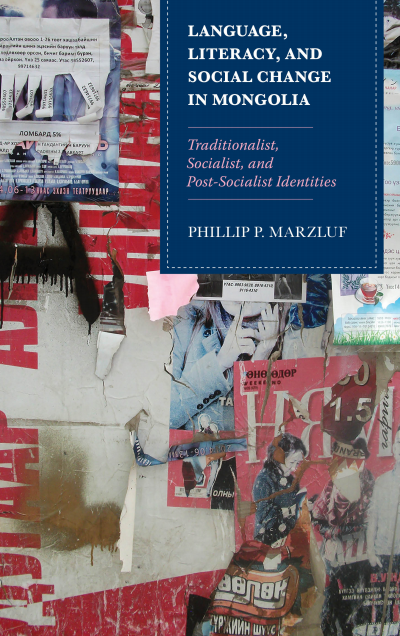
Language, Literacy, and Social Change in Mongolia
Traditionalist, Socialist, and Post-Socialist Identities
Authors:
Publisher:
2017
Summary
Language, Literacy, and Social Change in Mongolia is the first full-length treatment of literacy in Mongolian. Challenging readers’ assumptions about Central Asia and Mongolia, this book focuses on Mongolians’ experiences with reading and writing throughout the past 100 years. Literacy, as a powerful historical and social variable, shows readers how reading and writing have shaped the lives of Mongolians and, at the same time, how reading and writing have been transformed by historical, political, economic, and other social forces.
Mongolian literacy serves as an especially rich area of inquiry because of the dramatic political, economic, and social changes that occurred in the twentieth and twenty-first centuries. For the seventy years during which Mongolia was a part of the communist Soviet world, literacy played an important role in how Mongolians identified themselves, conceived of the past, and created a new social order. Literacy was also a part of the story of authoritarianism and state violence. It was used to express the authority of the communist Mongolian People’s Revolutionary Party, control the pastoral population, and suppress non-socialist beliefs and practices. Mongolians’ reading and writing opportunities and resources were tightly controlled, and the language policy of replacing the traditional Mongolian script with the Cyrillic alphabet immediately followed the violent repression of Buddhist leaders, government officials, and intellectuals.
Beginning with the 1990 Democratic Revolution, Mongolians have been thrust into free-market capitalism, privatization, globalization, and neoliberalism. In post-socialist Mongolia, literacy no longer serves as the center for Mongolian identity. Government subsidies to pastoral literacy resources have been slashed, and administrators now find themselves competing with other “developing countries” for educational funding. Due to the pressures caused by globalization, Mongolians have begun to talk about literacy and language in terms of crisis and anxiety. As global flows of English compete with new symbols from the distant past, Mongolians worry about the perceived lowering standards of Mongolian linguistic usage amid rapid economic changes. These worries also reveal themselves in official language policies and manifest themselves in the multiple languages and scripts that appear in the capital of Ulaanbaatar and other urban areas.
Keywords
Search publication
Bibliographic data
Edition
1/2017
Copyright Year
2017
ISBN-Print
978-1-4985-3485-7
ISBN-Online
978-1-4985-3486-4
Publisher
Lexington, Lanham
Language
English
Pages
224
Product Type
Monograph
Table of contents
ChapterPages
Contents No access
Acknowledgments No access
Note on Transliteration No access
Chapter One. Introduction No access Pages 1 - 28
Chapter Two. The Pastoral Home School: Rural, Vernacular, and Grassroots Literacies in Early Socialist Mongolia No access Pages 29 - 48
Chapter Three. How to Think Like a Socialist: Official Representations of Literacy in Socialist Mongolia No access Pages 49 - 78
Chapter Four. Literacy under Authority: The Young Pioneers and the Cultural Campaigns No access Pages 79 - 106
Chapter Five. Sponsorship and the Official Center of Post-Socialist Literacy No access Pages 107 - 134
Chapter Six. Post-Socialist English and National Language Ideologies No access Pages 135 - 160
Chapter Seven. Urban Linguistic Landscapes and Post-Socialist Public Audiences No access Pages 161 - 192