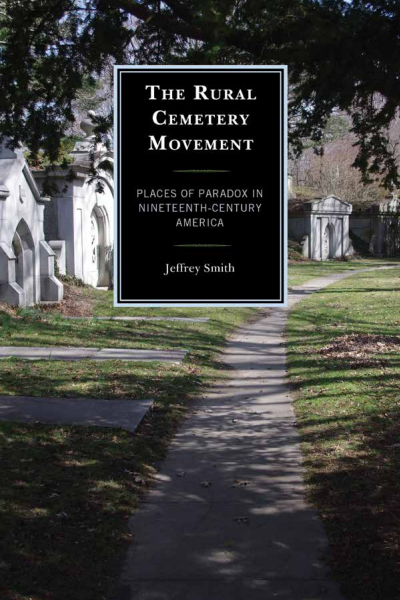
The Rural Cemetery Movement
Places of Paradox in Nineteenth-Century America- Authors:
- Publisher:
- 2017
Summary
When Mount Auburn opened as the first “rural” cemetery in the United States in 1831, it represented a new way for Americans to think about burial sites. It broke with conventional notions about graveyards as places to bury and commemorate the dead. Rather, the founders of Mount Auburn and the spate of similar cemeteries that followed over the next three decades before the Civil War created institutions that they envisioned being used by the living in new ways. Cemeteries became places for leisure, communing with nature, and creating a version of collective memory. In fact, these cemeteries reflected changing values and attitudes of Americans spanning much of the nineteenth century. In the process, they became paradoxical: they were “rural” yet urban, natural yet designed, artistic yet industrial, commemorating the dead yet used by the living.
The Rural Cemetery Movement: Places of Paradox in Nineteenth-Century America breaks new ground in the history of cemeteries in the nineteenth century. This book examines these “rural” cemeteries modeled after Mount Auburn that were founded between the 1830s and 1850s. As such, it provides a new way of thinking about these spaces and new paradigm for seeing and visiting them. While they fulfilled the sacred function of burial, they were first and foremost businesses. The landscape and design, regulation of gravestones, appearance, and rhetoric furthered their role as a business that provided necessary services in cities that went well beyond merely burying bodies. They provided urban green spaces and respites from urban life, established institutions where people could craft their roles in collective memory, and served as prototypes for both urban planning and city parks.
These cemeteries grew and thrived in the second half of the nineteenth century; for most, the majority of their burials came before 1910. This expansion of cemeteries coincided with profound urban growth in the United States. Unlike their predecessors, founders of these burial grounds intended them to be used in many ways that reflected their views and values about nature, life and death, and relationships. Emphasis on worldly accomplishments increased with industrialization and growth in the United States, which was reflected in changing ways people commemorated their dead during the period under this study. Thus, these cemeteries are a prism through which to understand the values, attitudes, and culture of urban America from mid-century through the Progressive Era.
Keywords
Search publication
Bibliographic data
- Edition
- 1/2017
- Copyright Year
- 2017
- ISBN-Print
- 978-1-4985-2900-6
- ISBN-Online
- 978-1-4985-2901-3
- Publisher
- Lexington, Lanham
- Language
- English
- Pages
- 166
- Product Type
- Monograph
Table of contents
- Contents No access
- Acknowledgments No access
- NOTE No access
- LOCATION, LOCATION, LOCATION No access
- REPLACING CHURCH GRAVEYARDS No access
- “THOSE WHO GAVE THE LAST FULL MEASURE” No access
- HEALTH CONCERNS No access
- NOTES No access
- NATURE BY DESIGN No access
- APPLYING THE RHETORIC OF “NATURE” TO CEMETERIES No access
- GOVERNING THE CITY OF THE DEAD No access
- NOTES No access
- URBAN GREEN SPACES No access
- THE EVOLUTION OF OPEN GREEN SPACE IN CEMETERIES No access
- REGULATING THE CEMETERY BUSINESS No access
- BUILDINGS AND AMENITIES No access
- NOTES No access
- CREATING A NEW KIND OF BUSINESS No access
- FINANCING CEMETERIES No access
- MARKETING CEMETERIES No access
- FAMILY LOTS AND REVENUE STREAMS No access
- THE EMERGENCE OF INDUSTRY STANDARDS No access
- PROFESSIONALIZATION OF CEMETERY MANAGEMENT No access
- NOTES No access
- CLASS DIVISION BY DESIGN No access
- CLASS AND VISITATION No access
- ORGANIZATIONAL LOTS AND SOCIAL CLASS No access
- NOTES No access
- VISITATION AND COLLECTIVE MEMORY No access
- TOURING THE REMEMBERED AND COLLECTIVE MEMORY No access
- REGULATING CEMETERIES’ COMMEMORATIONS No access
- MANUFACTURING GRIEF No access
- IMMORTALITY CARVED IN STONE No access
- NOTES No access
- Conclusion No access Pages 141 - 142
- Bibliography No access Pages 143 - 160
- Index No access Pages 161 - 164
- About the Author No access Pages 165 - 166