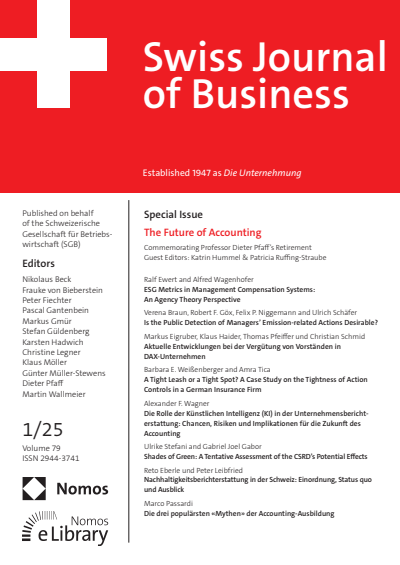
Founded in 1947 as Die Unternehmung: Zeitschrift für Betriebswirtschaft und Organisation, the Swiss Journal of Business (SJB) is a peer-reviewed (double-blind), open access business journal. With its concept of combining theoretical standards and practical relevance in high-quality scientific articles, it is one of the leading European journals in the field of business administration. The scope of the journal covers all disciplines of business administration as well as interdisciplinary topics that broaden the horizon of business research and practice. The SJB aims to disseminate new findings in business research, to draw attention to important problems in society, research and business practice, to set research agendas, to present scientifically sound solutions and generally to promote the exchange between science and practice.
With growing public and policy-makers’ attention to environmental, social, and governance (ESG) disclosures, a natural question is how management compensation systems should include ESG metrics. This paper selectively reviews and discusses...
We consider the contracting problem between a firm and a manager. The manager provides productive efforts to increase the firm’s financial performance and to reduce its carbon emissions. The outcome of these efforts depends on the manager’s...
This article provides insights into current trends and developments in executive compensation at German DAX companies. We discuss the implementation of sustainable ESG remuneration components, malus and clawback provisions, say-on-pay, and relative...
The objective of this paper is to theoretically expand the understanding of tight management control with respect to action controls. An empirical conceptualization of tight control has so far only been available for budgeting (Van der Stede 2001)....
This article examines the growing importance of artificial intelligence (AI) in the field of corporate reporting and analysis. It highlights how AI methods can be used to interpret traditional textual and visual disclosures and points out the...
The introduction of the CSRD represents the largest regulatory intervention in external reporting in decades. Sustainability statements now have to be issued in accordance with the ESRS, which include numerous Disclosure Requirements and datapoints,...
While business indicators have been enriching financial reporting for quite a while, these indicators increasingly focus on sustainability issues. In spite of the fact that various international standards having been developed therefore, and are...
Certain didactic approaches to education and training in the field of accounting have become firmly established in everyday education at university level. This can lead to learning environments not being critically reflected upon and adaptation to...