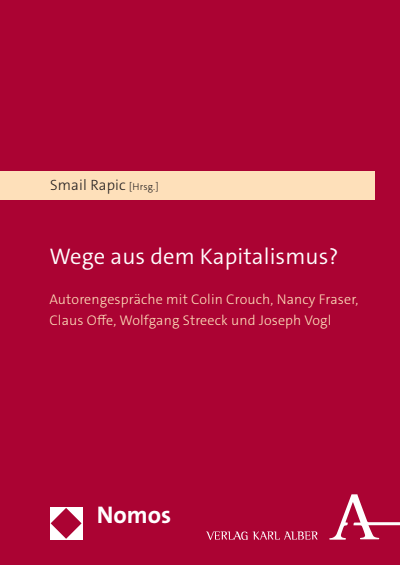
Wege aus dem Kapitalismus?
Autorengespräche mit Colin Crouch, Nancy Fraser, Claus Offe, Wolfgang Streeck und Joseph Vogl- Editors:
- Publisher:
- 2023
Summary
The conviction that has prevailed in the West for decades, that capitalism is the most efficient economic system and at the same time a natural ally of democracy, has been increasingly called into question since the global financial crisis erupted in 2008. The symptoms of secular stagnation and the worsening of social inequality are leading to growing distrust of the crisis management of established politics and giving a boost to populist movements. This is eroding the basis of consensus to which Western post-war societies owe their stability. Can the prevailing capitalism be democratically reformed? Are alternative economic systems conceivable that do not revert to authoritarian state socialism or corporatism? With contributions byJens Beckert | Maria Behrens | Colin Crouch | Christoph Deutschmann | Nancy Fraser | Peter Imbusch | Tobias Nikolaus Klass | Regina Kreide | David Löw Beer | Georg Lohmann | Jo Moran-Ellis | Patrizia Nanz | Frank Nullmeier | Claus Offe | William Outhwaite | Reinhard Pfriem | Smail Rapic | Anne Reichold | Darrow Schecter | David Strecker | Wolfgang Streeck | Joseph Vogl | Lutz Wingert
Keywords
Search publication
Bibliographic data
- Copyright Year
- 2023
- ISBN-Print
- 978-3-495-48987-1
- ISBN-Online
- 978-3-495-99571-6
- Publisher
- Karl Alber, Baden-Baden
- Language
- German
- Pages
- 610
- Product Type
- Edited Book
Table of contents
- Titelei/Inhaltsverzeichnis No access Pages 1 - 10
- Authors:
- I. Die Ursachen der Weltfinanzkrise von 2008 No access
- II. Das Verhältnis von Kapitalismus und Demokratie No access
- III. Der theoretische Rahmen für die konkreten Analysen der kapitalistischen Systemkrise No access
- IV. Die Zukunftsaussichten des Kapitalismus No access
- 2. Das Autorengespräch mit Nancy Fraser über die Krise des Kapitalismus No access
- 3. Das Autorengespräch mit Joseph Vogl über das Finanzregime No access
- 4. Das Autorengespräch mit Colin Crouch über Demokratie und Kapitalismus No access
- 5. Das Autorengespräch mit Claus Offe über Strukturprobleme des kapitalistischen Staates heute No access Pages 49 - 56Authors:
- 6. Das Autorengespräch mit Wolfgang Streeck über Staatensysteme und die Regierbarkeit des ausgehenden Neoliberalismus No access
- Authors:
- I. Fictitious commodification or falling rate of profit? On the structural dimension of capitalist crisis No access
- II. Double movement or class struggle? On the social action dimension of capitalist crisis No access
- Nancy Fraser’s Critical Re-Reading of Marx’s Capital and Historical Materialism No access Pages 64 - 73Authors:
- Authors:
- 1. A »common grammar of crisis« No access
- 2.1. Diagnostic level of normativity No access
- 2.2 Evaluative level of normativity No access
- 2.3 Transformative level of normativity No access
- Authors:
- 1. Introduction No access
- 2. »Human Equality« as the basis of the accumulation of capital. No access
- 3. Private and public law as the framework of Marx’s critique of capital. No access
- 4. »Between equal rights, force decides« No access
- 5.1 No access
- 5.2 No access
- 5.3 No access
- 6. Between equal rights, the (constitutional) powers decide No access
- 7. The relationship between »expropriation« and »exploitation« (Fraser), revised. No access
- Authors:
- Introduction No access
- Why does social reproduction matter in the crisis of capitalism? No access
- The necessity of non-commodification in social reproduction No access
- Limits, boundaries, markets No access
- The Advert narrative No access
- IKEA at the boundary of the non-commodifiable No access
- Authors:
- Economic cleavage No access
- Political segregation No access
- Cultural invisibility No access
- Right wing populism and the loss of a future No access
- Communicative power No access
- Movement and Countermovement: Nancy Fraser and the Difficult Relationship between Enslavement and Liberation No access Pages 108 - 120Authors:
- Authors:
- Introduction No access
- 1. Marx, Engels, and me No access
- 2. Normativity, contradiction, and critique No access
- 3. Care, commodification, and corporate speech No access
- 4. Is capitalism necessarily racist? No access
- 5. Democratic crisis as capitalist crisis No access
- 6. Has solidarity been exhausted? No access
- Conclusion No access
- Authors:
- Eine Erinnerung No access
- Klarsicht und Prognostik No access
- Das Marktsubjekt No access
- Oikodizee No access
- Das Finanzregime No access
- Finanzialisierung No access
- Fünf Thesen No access
- Authors:
- Die Zukunft ist prinzipiell offen No access
- Die moderne Ökonomik ist säkularisierte Religion No access
- Die Unvernunft der ökonomischen Vernunft No access
- Ein unendliches Steigerungsspiel No access
- Dramatische Veränderungen des Kapitalismus – und neue Widersprüche No access
- Kritische Anmerkungen: Natur, Veränderungsmöglichkeiten und kulturelle Perspektiven No access
- Allegorien des Gespenstischen. Anmerkungen zur Idee einer Hantologie des Kapitals No access Pages 156 - 164Authors:
- Die Gespenster der Macht – Anmerkungen zu Joseph Vogl No access Pages 165 - 170Authors:
- Was tun? Negative Dialektik und das alltagspraktische Optimismus-Gebot No access Pages 171 - 177Authors:
- The Fourth Power? No access Pages 178 - 243Authors:
- Authors:
- 1. Der historische Ursprung der kapitalistischen Postdemokratie No access
- 2. Der grundbegriffliche Rahmen von Vogls Souveränitätseffekt No access
- a) Die Verschränkung von Sicherheitsdispositiven und Disziplinen in der Gouvernementalität No access
- b) Merkantilismus und klassischer Liberalismus No access
- c) Das Spannungsverhältnis von »Krieg« und »Politik« in Foucaults Machtbegriff No access
- d) Der Marktkampf als Basis der liberalen Gouvernementalität No access
- e) Foucaults Kritik am Begriff der Souveränität No access
- a) Die »ursprüngliche Akkumulation« von privater Kapitalmacht und staatlichen Machtkapitalien No access
- b) Die Zentralbanken als »vierte Gewalt« No access
- c) Vogls Umakzentuierung von Foucaults Analyse des Ursprungs des Liberalkapitalismus No access
- d) Der Ordoliberalismus No access
- e) Die Etablierung des Finanzkapitalismus No access
- f) Die Weltfinanzkrise No access
- g) Das neoliberale Finanzregime No access
- h) Vogls und Streecks Interpretationen des Finanzkapitalismus No access
- 5. Die Dialektik von Ökonomie und Politik bei Marx und Engels No access
- Authors:
- I. No access
- II. No access
- Introductory Statement No access Pages 262 - 273Authors:
- Authors:
- Democracy preempted No access
- The »populist« turn No access
- In defense of the nation-state No access
- A nation-centered international order? No access
- By way of conclusion No access
- Response to Wolfgang Streeck No access Pages 277 - 288Authors:
- Authors:
- I No access
- II No access
- Response to Darrow Schecter No access Pages 292 - 297Authors:
- ›The Corruption of Markets, Knowledge, Politics etc.‹ No access Pages 298 - 300Authors:
- Response to William Outhwaite No access Pages 301 - 310Authors:
- Authors:
- I. In bed with neoliberalism No access
- II. Optimism and trust No access
- III. Democracy and xenophobia No access
- IV. Democratic socialism No access
- V. Eco-socialism No access
- VI. Anti-racist socialism No access
- VIII. Who narrates? No access
- Response to Regina Kreide No access Pages 312 - 326Authors:
- Authors:
- 1. Crouch’s interpretation of the collapse of the Soviet Union No access
- 2. Marx and Engels on socialism No access
- 3. Engels’ prediction of a transition from liberal to state capitalism No access
- 4. Research positions on the collapse of the Soviet Union No access
- 5. Contemporary China – a hybrid of capitalism and socialism? No access
- 6. A transition from the state capitalist trait of »actually existing neoliberalism« to socialism? No access
- Response to Smail Rapic No access Pages 331 - 343Authors:
- Authors:
- 1. Einleitung: Spätkapitalismus als gesellschaftliche Integration mittels des politischen Managements ökonomischer Krisen No access
- 2. Spätkapitalismus 1.0: Keynesianismus, der kapitalistische Staat und Legitimationskrisen No access
- 3. Spätkapitalismus 1.1: Keynesianismus und die Kolonialisierung der Lebenswelt No access
- 4. Spätkapitalismus 2.0: Der neoliberale Spätkapitalismus als die monetaristische Variante des politischen Managements ökonomischer Krisen No access
- Authors:
- I. No access
- II. No access
- III. No access
- IV. No access
- V. No access
- Authors:
- 1 No access
- 2 No access
- 3 No access
- Authors:
- 1. Einleitung. Strukturprobleme des Sozialstaats No access
- 2. Was sind Menschenrechte heute? No access
- 3. Soziale Menschenrechte als (internationaler) rechtlicher Rahmen für sozialstaatliche Leistungen, z.B. in der BRD No access
- 4. Entgrenzung des Sozialstaates: Interner und externer Universalismus der sozialen Menschenrechte No access
- Authors:
- 1. Funktionale Differenzierung und die Option auf Optionsbegrenzung No access
- 2. Grenzdebatten No access
- 3.1. Die Unbegrenztheit der Wünsche No access
- 3.2. Möglichkeiten einer Demokratisierung der Ökonomie No access
- 3.3. Anerkennungsdynamiken: Sozialkomparative Präferenzen und die immer neue Auslösung von Steigerungslogiken No access
- 4. Schluss No access
- Authors:
- Einleitung: Eine theoretische Annäherung an die Strukturprobleme des kapitalistischen Staates aus der Perspektive der Internationalen Beziehungen No access
- 1. Phase I: Der nationale Wettbewerbsstaat (Fordismus) No access
- 2. Phase II: Die Internationalisierung des Staates als multilaterale Strategie No access
- 3.1. Bilaterale Außenhandelsstrategie No access
- 3.2. Bilaterale Investitionsabkommen No access
- Theoretische Reflexion No access
- Authors: |
- Einleitung No access
- I. Was heißt »Kapitalismus«? No access
- II. Was heißt »Reformen aus einer linken Sicht«? No access
- 1. Ungleichheiten No access
- (1) Negative Externalitäten in Form von Umweltschäden No access
- (2) Negative Externalitäten in Form von Mitweltschäden No access
- (3) Negative Externalitäten in Form der Abwälzung von eingetretenen Risiken No access
- 1. Umfassende Kreislaufwirtschaft No access
- 2. Drastisch verlängerte Garantiezeiten für Güter No access
- 3. Beschränkungen des Marktzuganges No access
- 4. Unbedingtes Grundeinkommen No access
- 5. Investitionsschutz für Arbeitnehmerinnen No access
- 6. Einklagbare unternehmerische Verantwortung No access
- 1. Eine Reform sollte wie ein Keim wirken No access
- 2. Eine Reform sollte einen Verstärkereffekt haben No access
- 3. Eine Reform sollte sachlich anschlussfähig sein No access
- 4. Eine Reform muss sozial anschlussfähig sein No access
- 5. Eine Reform sollte eine Drift erzeugen No access
- 6. Das Ziel einer Reform sollte nicht zu mehrdeutig sein No access
- 7. Eine Reform sollte die Zweitschlagkapazität des Kapitals mindern No access
- V. Schluss No access
- Authors:
- Einleitung No access
- Expert*innenkommissionen im Spannungsverhältnis von Legitimität und Effektivität No access
- Kommission Wachstum, Strukturwandel und Beschäftigung: Lösungsvorschläge mit großen Legitimitätsproblemen No access
- Deliberative Qualität No access
- Gemeinwohlorientierung No access
- Zukunftsfonds zur gerechten Finanzierung der Transformation No access
- Zukunftsrat als Beratungsgremium von Bürger*innen für langfristige Entscheidungen No access
- Diskussion und Schlussfolgerungen No access
- Authors:
- Strecker No access
- Streeck No access
- Rapic No access
- Lohmann No access
- Nullmeier No access
- Behrens No access
- Wingert No access
- Löw Beer und Nanz No access
- Authors:
- Kapitalismus No access
- Staat No access
- Und Europa? No access
- Authors:
- Streecks Anknüpfung an den Historischen Materialismus No access
- Die Ursachen und Auswirkungen der Weltfinanzkrise von 2008 No access
- Die Rolle des Westens im Ukraine-Krieg als Symptom der kapitalistischen Systemkrise No access
- Authors:
- Die Gefahren der Globalisierung No access
- Ist eine Deglobalisierung möglich? No access
- Authors:
- 1. Die Kontroverse um die Zukunft der Demokratie No access
- 2. Streeck und Fukuyama No access
- 3. Kritik der Streeck’schen Position No access
- Authors:
- 1. Demokratie als Regierung für das Volk, durch das Volk, über das Volk No access
- 2. Zum Begriff der Größe respektive Komplexität No access
- 3. Zum Begriff der Grenze No access
- II. Die Zerlegung von Komplexität No access
- 1. Zerlegung von komplexen Zusammenhängen als Abbau von Komplexität No access
- 2. Zerlegung komplexer Systeme als Abbau und Aufbau von Komplexität im polyzentrisches Staatensystem No access
- Authors:
- 1. No access
- 2.1 Die kapitalistische Wirtschaft No access
- 2.2 Der Staat No access
- 2.3 Das Staatsvolk No access
- 3. Konsequenzen No access
- 4. Ansatzpunkte No access
- 5. Schluss No access
- Authors:
- 1. Zur ökologischen Erweiterung No access
- 2. Zur kulturalistischen Erweiterung No access
- 3. Zur evolutionstheoretischen Erweiterung No access
- Fazit No access
- Krisen und das »Ende des Kapitalismus« No access
- Globalisierung, Entglobalisierung No access
- Komplexität, Zentralisierung, Dezentralisierung No access
- Was bleibt zu tun, wenn man vielleicht doch etwas tun könnte? No access
- Sachregister No access