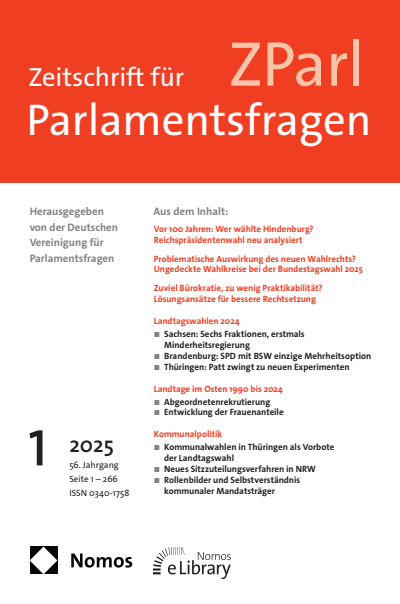
Zeitschrift für Parlamentsfragen contains articles on political issues dealing with representation and legitimation of the political system. The articles provide a broad overview of the functioning of national and regional parliaments as well as a forum for comparative analysis of international parliaments. One stress is on the parliamentary development of different countries. Indices are provided in every issue which makes the ZParl an outstanding reference book for institutional and comparative political studies. Website: www.zparl.nomos.de
This article examines the effects of the new electoral law for the 2025 federal election, in particular the problem of “uncovered constituencies”. The new second-vote coverage procedure means that direct candidates only receive a mandate if...
The recruitment of politicians is a central task of political parties in democracies. In order to understand who enters politics and how the political mandate is obtained, we must first ask under which criteria the parties nominate their potential...
The eighth state election in the Saxon Free State – 35 years after the peaceful revolution – was particularly eagerly awaited because of the following question: Will the AfD, which clearly became the strongest party in the state in both the 2021...
The Thuringian state parliament election on September 1, 2024 was a vote on the red-red-green minority government of the last election period. The voters' verdict was very clear, the governing parties suffered a dramatic defeat; the Greens even...
The combined local elections in Thuringia on May 26 and June 9, 2024 were seen as a precursor to the state elections on September 1, 2024. After the AfD won its first county executive (Landrat) post and emerged as the strongest party in the state...
The final phase of the election campaign was dominated by the struggle between the SPD and the AfD to become the largest party. The polarization and mobilization resulted in the historically highest turnout of 72,9 percent. The SPD won the election...
Despite legal equality, women remain a minority on all levels of political offices, mainly due to unequal access to political power. This article therefore examines structural disadvantages that women experience in the context of internal party...
On July 4, 2024, the North Rhine-Westphalian state parliament adopted a law amending the municipal election act. By this law, the apportionment method of Sainte-Laguë (Webster's method) applied so far in North Rhine-Westphalia is replaced by a...
Local politicians act as key players in municipal self-governance, navigating the tension between rising expectations and limited room for maneuver while maintaining direct contact with citizens. Based on 38 interviews, this study examines how...
Why does the business community in Germany now see excessive bureaucracy as the biggest competitive disadvantage, even more so than the shortage of skilled workers and energy costs? Why are complaints from the public about incomprehensible and...
Lawmaking requires specific skills that must be learned and taught – no one is born a policy maker and legal drafter. The state acts in central areas through lawmaking, and every technical flaw causes enormous socio-economic costs. In order to...
The year 2025 marks the 100th anniversary of the historically momentous presidential election of 1925, in which Paul von Hindenburg was elected Reich President. With 48.3 percent, Hindenburg only narrowly beat the candidate of the Centre Party, SPD...