, to see if you have full access to this publication.
Monograph No access
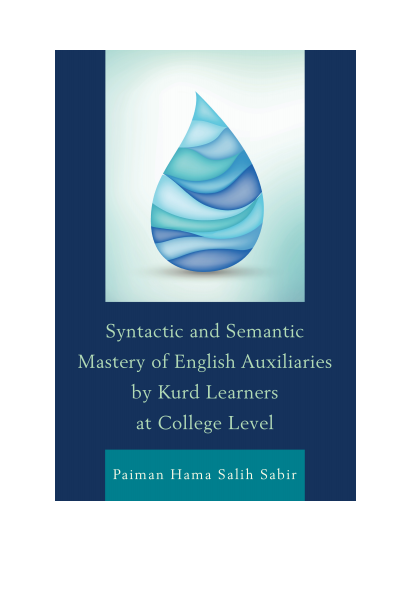
Syntactic and Semantic Mastery of English Auxiliaries by Kurd Learners at College Level
Authors:
Publisher:
2016
Summary
The Syntax and Semantics of English Auxiliaries by Kurd Learners at College Level is concerned with the syntactic and semantic aspects of English auxiliary verbs (which comprise the primary and the modals) as a problematic area for English foreign language learners.
The study aims at investigating Kurd EFL learners’ ability in recognizing and producing the various forms and meanings of English auxiliary verbs, clarifying the problems that Kurd EFL learners encounter in learning the auxiliary verbs and identifies the sources behind them, and trying to put suitable suggestions to overcome these problems.
Its use of error analysis methodology makes this study unique as there are no other studies within its field to deal with topic in such a systematic and analytical method.
Keywords
Search publication
Bibliographic data
Edition
1/2016
Copyright Year
2016
ISBN-Print
978-0-7618-6655-8
ISBN-Online
978-0-7618-6654-1
Publisher
University Press, Lanham
Language
English
Pages
115
Product Type
Monograph
Table of contents
ChapterPages
Contents No access
List of Figures No access
List of Tables No access
Acknowledgments No access
Abbreviations No access
Kurdish Phonemic System No access
1.1 The Problem No access
1.2 Aims of the Study No access
1.3 Hypotheses of the Study No access
1.4 The Procedures No access
1.5 Delimitation No access
1.6 Value of the Study No access
2.1 Foreign Language and Second Language No access
2.2 Acquisition No access
2.3 Language Learning No access
2.4 Hypotheses Explaining L1 and L2 Similarities/Differences No access
2.5 Error Analysis No access
2.6 Errors and Mistakes No access
2.7 Transfer No access
2.8 Interlanguage No access
2.9 Factors on Second Language Acquisition (SLA) No access
2.10 The Role of Social Context in Language Learning No access
2.11 Learning Strategies No access
2.12 The Role of Output in SLA No access
2.13 Formal Instruction No access
Notes No access
3.1 The Structure of the English Verb Phrase No access
3.2 Auxiliary Verbs No access
3.3 Functional Criteria for the Auxiliary verbs No access
3.4 Syntactic Properties of Primary Aux. (Be, Do and Have) No access
3.5 Modal Auxiliaries or the Modals No access
3.6 Syntactic Features of Modal Auxiliaries No access
3.7 Central Modal Auxiliaries No access
3.8 Marginal Modal Auxiliaries No access
3.9 Modal Idioms No access
3.10 Semi-Auxiliaries No access
3.11 Catenative-Verbs No access
3.12 Order of Auxiliary Verbs No access
3.13 Mood and Modality No access
3.14 The Tri-Dimensionality of the Modals No access
3.15 The Semantic Aspect of Auxiliary verbs No access
3.16 Tense, Time and the Modals No access
3.17 Two Different Treatments of Modal Meanings No access
3.18 Auxiliaries in Kurdish No access
3.19 Auxiliary Verbs in Kurdish: A Traditional Perspective No access