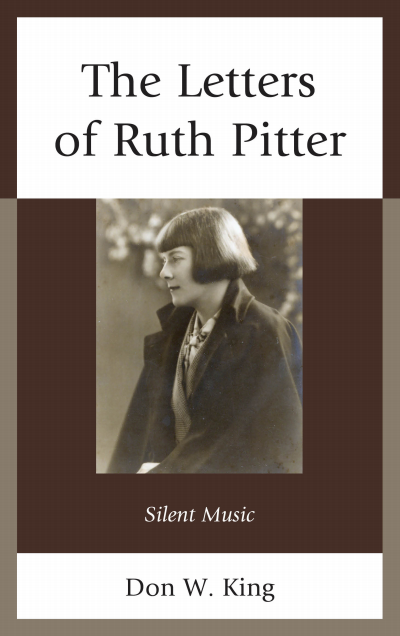
The Letters of Ruth Pitter
Silent Music- Authors:
- Publisher:
- 2014
Summary
Although Ruth Pitter (1897–1992) is not well known, her credentials as a poet are extensive, and in England from the mid-1930s to the mid-1970s she maintained a modest yet loyal readership. In total she produced eighteen volumes of new and collected verse. Her A Trophy of Arms (1936) won the Hawthornden Prize for Poetry in 1937, and in 1954 she was awarded the William E. Heinemann Award for The Ermine (1953). Most notably, perhaps, she became the first woman to receive the Queen’s Gold Medal for Poetry in 1955. Furthermore, from 1946 to 1972 she was often a guest on BBC radio and television programs, In 1974 The Royal Society of Literature elected her to its highest honor, a Companion of Literature, and in 1979 she received her last national award when she was appointed a Commander of the British Empire.
Pitter was a voluminous letter writer. Her friends and correspondents read like a “Who’s Who” of twentieth-century British literary luminaries, including AE (George Russell), A. R. Orage, Hiliare Belloc, Walter de la Mare, Julian Huxley, John Masefield, Phillip and Ottoline Morrell, George Orwell, Dylan Thomas, T. S. Eliot, C. S. Lewis, James Stephens, Dorothy L. Sayers, Siegfried Sassoon, Virginia Sackville-West, Dorothy Wellesley, Lord David Cecil,John Betjeman, Evelyn Waugh, John Wain, Kathleen Raine, and May Sarton. Stylistically Pitter’s letters are marked by crisp prose, precise imagery, and elegant simplicity reflecting a well-read and vigorous mind—lithe, curious, penetrating, analytical, and perceptive. Of her more than one thousand letters covering the years 1908–1988, published here is a generous selection. These selected letters go a long way toward illustrating Pitter’s desire to reach a public interested in her as both a poet and personal commentator. These letters offer an understanding of “the silent music, the dance in stillness, the hints and echoes and messages of which everything is full” reflected in her life and poetry. In total they provide an essential introduction to the work of this neglected twentieth-century poet.
Keywords
Search publication
Bibliographic data
- Edition
- 1/2014
- Copyright Year
- 2014
- ISBN-Print
- 978-1-61149-451-8
- ISBN-Online
- 978-1-61149-450-1
- Publisher
- Lexington, Lanham
- Language
- English
- Pages
- 548
- Product Type
- Monograph
Table of contents
- Contents No access
- Acknowledgments No access
- Editorial Principles No access
- Introduction No access
- Chronology of Ruth Pitter’s Life (1897–1992) No access
- Chapter 1. Apprentice Poet (1921–1934) No access Pages 1 - 36
- Chapter 2. Successful Poet (1935–1939) No access Pages 37 - 86
- Chapter 3. Surviving the Blitz (1940–1945) No access Pages 87 - 118
- Chapter 4. New Life (1946–1947) No access Pages 119 - 160
- Chapter 5. New Friends (1948–1949) No access Pages 161 - 196
- Chapter 6. Broadening Horizons (1950–1952) No access Pages 197 - 234
- Chapter 7. Leaving London (1953–1954) No access Pages 235 - 262
- Photospread No access Pages B - H
- Chapter 8. Royal Favor (1955–1956) No access Pages 263 - 298
- Chapter 9. BBC Personality (1957–1959) No access Pages 299 - 340
- Chapter 10. In Demand (1960–1961) No access Pages 341 - 364
- Chapter 11. Downward Pointing Muse (1962–1965) No access Pages 365 - 400
- Chapter 12. Renewed Muse (1966–1969) No access Pages 401 - 436
- Chapter 13. Soldiering On (1970–1974) No access Pages 437 - 474
- Chapter 14. Soft Glow (1975–1988) No access Pages 475 - 510
- Bibliography No access Pages 511 - 526
- Biographical Index No access Pages 527 - 534
- Index No access Pages 535 - 546
- About the Editor No access Pages 547 - 548