, to see if you have full access to this publication.
Monograph No access
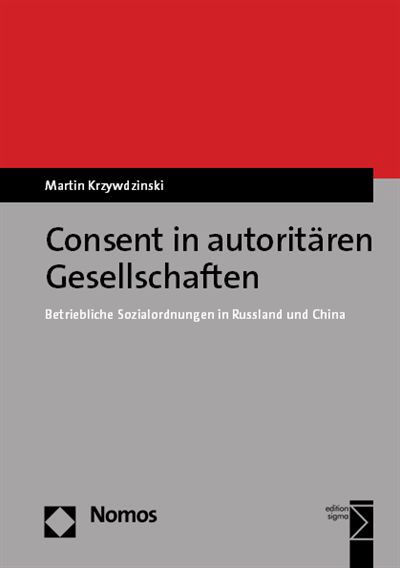
Consent in autoritären Gesellschaften
Betriebliche Sozialordnungen in Russland und China- Authors:
- Publisher:
- 2017
Search publication
Bibliographic data
- Edition
- 1/2017
- Copyright Year
- 2017
- ISBN-Print
- 978-3-8487-3065-0
- ISBN-Online
- 978-3-8452-7209-2
- Publisher
- Nomos, Baden-Baden
- Language
- German
- Pages
- 354
- Product Type
- Monograph
Table of contents
ChapterPages
- Titelei/Inhaltsverzeichnis No access Pages 1 - 15
- 1.1 Consent in autoritären Arbeitswelten No access
- 1.2 Varianten postkommunistischen Autoritarismus: China und Russland No access
- 1.3 Untersuchungsfeld No access
- 1.4 Methoden und Datenbasis No access
- 1.5 Inhaltsübersicht No access
- 2.1 Was ist Consent? No access
- 2.2 Consent und Paternalismus No access
- 2.3 Forschungsstand: Fabrikregime in China und Russland No access
- 2.4 Grundlagen von Consent: Sozialisation, Anreize und Interessenvertretung No access
- 2.5 Zusammenfassung No access
- 3.1 Einleitung No access
- China: Die Disziplinkultur No access
- Russland: Sind Standards nichts wert? No access
- Zusammenfassung No access
- China: Die Akzeptanzkultur No access
- Russland: Der Kampf um die Mehrleistung No access
- Zusammenfassung No access
- China: Der befriedete Shopfloor? No access
- Russland: Der trügerische Frieden? No access
- Zusammenfassung No access
- 3.5 Schlussfolgerungen No access
- 4.1 Theoretische und konzeptionelle Überlegungen No access
- China: Die Suche nach beeinflussbaren Charakteren No access
- Russland: Ein leergefegter Arbeitsmarkt No access
- Zusammenfassung No access
- China: Der Bruch mit der „eisernen Reisschüssel“ No access
- Russland: Kontinuität und Wandel No access
- Zusammenfassung No access
- China: Der zeremonielle Beginn eines neuen Lebensabschnitts No access
- Russland: Kurze und wenig feierliche Einweisung No access
- Zusammenfassung No access
- China: Ambivalenz des Paternalismus No access
- Russland: Gefahr der Korrumpierbarkeit No access
- Zusammenfassung No access
- China: Guanxi No access
- Russland: Blat No access
- Zusammenfassung No access
- China: Die Wettbewerbskultur No access
- Russland: Die Gemeinschaftskultur No access
- Zusammenfassung No access
- 4.8 Schlussfolgerungen No access
- 5.1 Theoretische und konzeptionelle Überlegungen No access
- Russland: Tradition arbeitsplatzbasierter Entgeltsysteme No access
- China: Vom Charakter zur Leistung No access
- Zusammenfassung No access
- Russland: Die Sehnsucht nach dem alten Sozialvertrag No access
- China: Die Hochlohnindustrie No access
- Zusammenfassung No access
- Russland: Die Bestrafungskultur No access
- China: „Bestrafung ist nicht das Ziel“ No access
- Zusammenfassung No access
- Russland: Das Team als Gemeinschaft No access
- China: Balance zwischen Integration und Wettbewerb No access
- Zusammenfassung No access
- 5.6 Schlussfolgerungen No access
- 6.1 Theoretische und konzeptionelle Überlegungen No access
- China: Beteiligung und soziale Kontrolle No access
- Russland: Kontrolle ohne Beteiligung No access
- Zusammenfassung No access
- China: Mobilisierung der Beschäftigten No access
- Russland: „Die Mitarbeiter sollten lieber nicht einbezogen werden.“ No access
- Zusammenfassung No access
- China: „Es ist schwierig, die Meinungen der Arbeiter herauszufinden“ No access
- Russland: Eine „weiche“ soziale Kontrolle No access
- Zusammenfassung No access
- China: „Bei uns findet das in Harmonie statt“ No access
- Russland: Soziale Partnerschaft oder militanter Konflikt? No access
- Zusammenfassung und Ausblick No access
- China: Der mühsame Weg der Konfliktlösung No access
- Russland: Streikrecht in einem korrumpierten Staat No access
- Zusammenfassung No access
- 6.7 Schlussfolgerungen No access
- 7.1 Betriebliche Sozialordnungen in autoritären Gesellschaften No access
- Politische Regulierung No access
- Kultur No access
- Organisationale Legacies No access
- 7.3 Ausblick: Consent und wirtschaftliche Entwicklung No access
- Literatur No access Pages 329 - 354
Bibliography (484 entries)
No match found. Try another term.
- Acemoglu, Daron/Robinson, James (2012), Why Nations Fail. The Origins of Power, Prosperity, and Poverty, New York: Crown Business Open Google Scholar DOI: 10.5771/9783845272092
- Ackroyd, Stephen/Thompson, Paul (1999), Organizational Misbehaviour, London: Sage Open Google Scholar DOI: 10.5771/9783845272092
- Adler, Paul (1992), Time-and-Motion Regained, in: Harvard Business Review 36(1): 97–108 Open Google Scholar DOI: 10.5771/9783845272092
- Adler, Paul/Borys, Bryan (1996), Two Types of Bureaucracy: Enabling and Coercive, in: Administrative Science Quarterly 41(1): 61–89 Open Google Scholar DOI: 10.5771/9783845272092
- Adler, Paul/Cole, Robert (1993), Designed for Learning: A Tale of Two Auto Plants, in: Sloan Management Review 34: 85–94 Open Google Scholar DOI: 10.5771/9783845272092
- Aglietta, Michel (1976), Régulation et crises du capitalisme: l’expérience des États-Unis, Paris: Calmann-Lévy Open Google Scholar DOI: 10.5771/9783845272092
- Akerlof, George (1982), Labor Contracts as Partial Gift Exchange, in: Quarterly Journal of Economics 97(4): 543–569 Open Google Scholar DOI: 10.5771/9783845272092
- Alewell, Dorothea/Hackert, Björn (1998), Betriebliche Personalpolitik im Lichte des Transaktionskostenansatzes – Überlegungen zum Erklärungspotential einer vertragsorientierten Perspektive, in: Martin, Albert/Nienhüser, Werner (Hg.), Personalpolitik. Wissenschaftliche Erklärung der Personalpraxis, München/Mering: Hampp, 31–52 Open Google Scholar DOI: 10.5771/9783845272092
- Alexander, Robin (2000), Culture and Pedagogy: International Comparisons in Primary Education, Oxford: Blackwell Open Google Scholar DOI: 10.5771/9783845272092
- Alford, William (1999), A Second Great Wall? China’s Post-Cultural Revolution Project of Legal Construction, in: Cultural Dynamics 11(2): 193–213 Open Google Scholar DOI: 10.5771/9783845272092
- Allen, Steven (1984), Trade Unions, Absenteeism, and Exit-Voice, in: Industrial and Labor Relations Review 37(3): 331–345 Open Google Scholar DOI: 10.5771/9783845272092
- Almond, Phil/Ferner, Anthony (Hg.) (2006), American Multinationals in Europe. Managing Employment Relations Across National Borders, Oxford: Oxford University Press Open Google Scholar DOI: 10.5771/9783845272092
- Ambrosio, Thomas (2009), Authoritarian Backlash: Russian Resistance to Democratization in the Former Soviet Union, Farnham: Ashgate Open Google Scholar DOI: 10.5771/9783845272092
- Anderson, Greg (2012), Designated Drivers. How China Plans to Dominate the Global Auto Industry, Singapore: John Wiley Open Google Scholar DOI: 10.5771/9783845272092
- Appelbaum, Eileen/Bailey, Thomas/Berg, Peter/Kalleberg, Arne (2000), Manufacturing Advantage: Why High-Performance Work Systems Pay Off, Ithaca: Cornell University Press Open Google Scholar DOI: 10.5771/9783845272092
- Argyris, Chris (1960), Understanding Organizational Behavior, Homewood: Dorsey Press Open Google Scholar DOI: 10.5771/9783845272092
- Ariely, Daniel (2009), Predictably Irrational, New York: Harper Open Google Scholar DOI: 10.5771/9783845272092
- Aryee, Samuel/Budhwar, Pawan/Chen Zhen Xiong (2002), Trust as a Mediator of the Relationship between Organizational Justice and Work Outcomes: Test of a Social Exchange Model, in: Journal of Organizational Behavior 23(3): 267–285 Open Google Scholar DOI: 10.5771/9783845272092
- Ashforth, Blake/Sluss, David/Harrison, Spencer (2007), Socialization in Organizational Contexts, in: International Review of Industrial and Organizational Psychology 22: 1–70 Open Google Scholar DOI: 10.5771/9783845272092
- Ashwin, Sarah (1999), Russian Workers. The Anatomy of Patience, Manchester: Manchester University Press Open Google Scholar DOI: 10.5771/9783845272092
- Ashwin, Sarah (Hg.) (2006), Adapting to Russia’s New Labour Market. Gender and Employment Behaviour, London/New York: Routledge Open Google Scholar DOI: 10.5771/9783845272092
- Ashwin, Sarah/Clarke, Simon (2003), Russian Trade Unions and Industrial Relations in Transition, Basingstoke: Palgrave Macmillan Open Google Scholar DOI: 10.5771/9783845272092
- Ashwin, Sarah/Kozina, Irina/Popova, Irina/Zhidkova, Elena (2006), Work Orientations and Employment Behaviour. Gender Differences?, in: Ashwin, Sarah (Hg.), Adapting to Russia’s New Labour Market. Gender and Employment Behaviour, London/New York: Routledge, 87–132 Open Google Scholar DOI: 10.5771/9783845272092
- Aycan, Zeynep (2010), Paternalism. Towards Conceptual Refinement and Operationalization, in: Kim, Uichol/Yang, Kuo-Shu/Hwang, Kwang-Kuo (Hg.), Indigenous and Cultural Psychology. Understanding People in Context, Berlin: Springer, 445–466 Open Google Scholar DOI: 10.5771/9783845272092
- Bachrach, Peter/Baratz, Morton (1962), Two Faces of Power, in: American Political Science Review 56(4): 947–952 Open Google Scholar DOI: 10.5771/9783845272092
- Bachrach, Peter/Baratz, Morton (1963), Decisions and Nondecisions: An Analytical Framework, in: American Political Science Review 57(3): 632–642 Open Google Scholar DOI: 10.5771/9783845272092
- Bai, Limin (2006), Graduate Unemployment: Dilemmas and Challenges in China’s Move to Mass Higher Education, in: The China Quarterly 185: 128–144 Open Google Scholar DOI: 10.5771/9783845272092
- Baker & McKenzie (2012), China Employment Law Update, October 2012, http://www.bakermckenzie.com/NLChinaEmploymentLawUpdateFeb12/ (letzter Zugriff: 3.11.2012) Open Google Scholar DOI: 10.5771/9783845272092
- Barabasch, Antje/Huang, Sui/Lawson, Robert (2009), Planned Policy Transfer: the Impact of the German Model on Chinese Vocational Education, in: Compare 39(1): 5–20 Open Google Scholar DOI: 10.5771/9783845272092
- Barros, Mauricio Rands (1999), Labour Relations and the New Unionism in Contemporary Brazil, Basingstoke: Macmillan Open Google Scholar DOI: 10.5771/9783845272092
- Barry, Michael/Wilkinson, Adrian (2016), Pro-Social or Pro-Management? A Critique of the Conception of Employee Voice as a Pro-Social Behaviour within Organizational Behaviour, in: British Journal of Industrial Relations 54(2): 261–284 Open Google Scholar DOI: 10.5771/9783845272092
- Batjargal, Bat (2003), Social Capital and Entrepreneurial Performance in Russia: A Longitudinal Study, in: Organization Studies 24(4): 535–556 Open Google Scholar DOI: 10.5771/9783845272092
- Batt, Rosemary/Colvin, Alexander/Keefe, Jeffrey (2002), Employee Voice, Human Resource Practices, and Quit Rates: Evidence from the Telecommunications Industry, in: Industrial and Labor Relations Review 55(4): 573–594 Open Google Scholar DOI: 10.5771/9783845272092
- Bell, Daniel (2010), China’s New Confucianism: Politics and Everyday Life in a Changing Society, Princeton: Princeton University Press Open Google Scholar DOI: 10.5771/9783845272092
- Belzer, Michael/Pan Shih Wie/Yu Nan (2008), Industrial Relations Experiments in China: Balancing Equity and Efficiency the Chinese Way, Paper presented at the Alfred P. Sloan Foundation Industry Studies Annual Conference, Boston, 2.5.2008 Open Google Scholar DOI: 10.5771/9783845272092
- Bendix, Reinhard (1963) [1956], Work and Authority in Industry, New York, Harper Bennett, Neil/Bloom, Dadvid/Ivanov, Serguey (1998), Demographic Implications of the Russian Mortality Crisis, in: World Development 26(11): 1921–1937 Open Google Scholar DOI: 10.5771/9783845272092
- Berger, Peter/Luckmann, Thomas (1966), Die gesellschaftliche Konstruktion der Wirklichkeit, Fankfurt am Main: Fischer Open Google Scholar DOI: 10.5771/9783845272092
- Bernardelli, Dina (2008), Russian Rule-Ette: Using Khodorkovsky’s Criminal Trial to Assess the State of Russia’s Judiciary, in: Boston College International & Comparative Law Review 31(1): 85–101 Open Google Scholar DOI: 10.5771/9783845272092
- Bian Yanjie (1997), Bringing Strong Ties Back in. Indirect Ties, Network Bridges, and Job Searches in China, in: American Sociological Review 62(3): 366–385 Open Google Scholar DOI: 10.5771/9783845272092
- Björkman, Ingmar/Fey, Carl/Park, Hyeon Jeong (2006), Institutional Theory and MNC Subsidiary HRM Practices: Evidence from a Three-Country Study, in: Journal of International Business Studies 38(3): 430–446 Open Google Scholar DOI: 10.5771/9783845272092
- Blau, Peter (1964), Exchange and Power in Social Life, New York: John Wiley Open Google Scholar DOI: 10.5771/9783845272092
- Böhle, Fritz/Bolte, Annegret/Huchler, Norbert/Neumer, Judith/Porschen-Hueck, Stephanie/Sauer, Stefan (2014), Vertrauen und Vertrauenswürdigkeit. Arbeitsgestaltung und Arbeitspolitik jenseits formeller Regulierung, Wiesbaden: Springer VS Open Google Scholar DOI: 10.5771/9783845272092
- Boldrin, Michele; Levine, David; Modica, Salvatore (2012), A Review of Acemoglu and Robinson’s Why Nations Fail [Online-Publikation], URL: http://levine.sscnet.ucla.edu/general/aandrreview.pdf (letzter Zugriff: 16.9.2016) Open Google Scholar DOI: 10.5771/9783845272092
- Boswell, Wendy/Boudreau, John (2000), Employee Satisfaction with Performance Appraisals and Appraisers: The Role of Perceived Appraisal Use, in: Human Resource Development Quarterly 11(3): 283–299 Open Google Scholar DOI: 10.5771/9783845272092
- Bourdieu, Pierre (2000), Pascalian Meditations, Stanford: Stanford University Press Open Google Scholar DOI: 10.5771/9783845272092
- Boxall, Peter/Macky, Keith (2009), Research and Theory on High-Performance Work Systems: Progressing the High-Involvement Stream, in: Human Resource Management Journal 19(1): 3–23 Open Google Scholar DOI: 10.5771/9783845272092
- Bradley, Steve/Green, Colin/Leeves, Gareth (2014), Employment Protection, Threat and Incentive Effects on Worker Absence, in: British Journal of Industrial Relations 52(2): 333–358 Open Google Scholar DOI: 10.5771/9783845272092
- Brandt, Loren/Thun, Eric (2010), The Fight for the Middle: Upgrading, Competition, and Industrial Development in China, in: World Development 38(11): 1555–1574 Open Google Scholar DOI: 10.5771/9783845272092
- Brandt, Loren/Thun, Eric (2011), Going Mobile in China: Shifting Value Chains and Upgrading in the Mobile Telecom Sector, in: International Journal of Technological Learning, Innovation and Development 4(1): 148–180 Open Google Scholar DOI: 10.5771/9783845272092
- Breslauer, George (1984), On the Adaptability of Soviet Welfare-State Authoritarianism, in: Hoffmann, Erik/Laird, Robbin (Hg.), The Soviet Policy in the Modern Era, New York: Aldine, 3–25 Open Google Scholar DOI: 10.5771/9783845272092
- Brockner, Joel/Ackerman, Grant/Greenberg, Jerald/Gelfand, Michele J./Francesco, Anne Marie/Chen, Zhen Xiong/Leung, Kwok/Bierbrauer, Gunter/Gomez, Carolina/Kirkman, Bradley/Shapiro, Debra (2001), Culture and Procedural Justice: The Moderating Influence of Power Distance on Reactions to Voice, in: Journal of Experimental Social Psychology 37(4): 300–315 Open Google Scholar DOI: 10.5771/9783845272092
- Buck, Trevor/Filatotchev, Igor/Nolan, Peter/Wright, Mike (2001), Different Paths to Economic Reform in Russia and China: Causes and Consequences, in: Journal of World Business 35(4): 379–400. Open Google Scholar DOI: 10.5771/9783845272092
- Burawoy, Michael (1979), Manufacturing Consent. Changes in the Labor Process under Monopoly Capitalism, Chicago: University of Chicago Press Open Google Scholar DOI: 10.5771/9783845272092
- Burawoy, Michael (1985), Politics of Production. Factory Regimes under Capitalism and Socialism, London: Verso Open Google Scholar DOI: 10.5771/9783845272092
- Burawoy, Michael (1996), The State and Economic Involution: Russia through a China Lens, in: World Development 24(6): 1105–1117 Open Google Scholar DOI: 10.5771/9783845272092
- Burawoy, Michael (2012), The Roots of Domination: Beyond Bourdieu and Gramsci, in: Sociology 46(2): 187–206 Open Google Scholar DOI: 10.5771/9783845272092
- Buunk, Bram/Doosje, Bert/Jans, Liesbeth/Hopstaken, Liliane (1993), Perceived Reciprocity, Social Support, and Stress at Work: The Role of Exchange and Communal Orientation, in: Journal of Personality and Social Psychology 65(4): 801–811 Open Google Scholar DOI: 10.5771/9783845272092
- Byrne, Zinta/Pitts, Virginia/Wilson, Carolyn/Steiner, Zachary (2012), Trusting the Fair Supervisor: The Role of Supervisory Support in Performance Appraisals, in: Human Resource Management Journal 22(2): 129–147 Open Google Scholar DOI: 10.5771/9783845272092
- Cappelli, Peter/Rogovsky, Nikolai (1998), Employee Involvement and Organizational Citizenship: Implications for Labor Law Reform and Lean Production, in: Industrial & Labor Relations Review 51(4): 633–653 Open Google Scholar DOI: 10.5771/9783845272092
- Cerami, Alfio (2009), Welfare State Developments in the Russian Federation: Oil-Led Social Policy and the „Russian Miracle“, in: Social Policy & Administration 43(2): 105–120 Open Google Scholar DOI: 10.5771/9783845272092
- Chan, Anita (1995), The Emerging Patterns of Industrial Relations in China and the Rise of Two New Labor Movements, in: China Information 9(4): 36–59 Open Google Scholar DOI: 10.5771/9783845272092
- Chan, Anita (2001), China’s Workers under Assault. The Exploitation of Labor in a Globalizing Economy, Armonk/London: M.E. Sharpe Open Google Scholar DOI: 10.5771/9783845272092
- Chan, Anita (2009), Challenges and Possibilities for Democratic Grassroots Union Elections in China: A Case Study of Two Factory-Level Elections and Their Aftermath, in: Labor Studies Journal 34(3): 293–317 Open Google Scholar DOI: 10.5771/9783845272092
- Chan, Chris King-Chi (2010a), The Challenge of Labour in China. Strikes and the Changing Labour Regime in Global Factories, London/New York: Routledge Open Google Scholar DOI: 10.5771/9783845272092
- Chan, Chris King-Chi/Ngai, Pun (2009), The Making of a New Working Class? A Study of Collective Actions of Migrant Workers in South China, in: The China Quarterly 198(1): 287–303 Open Google Scholar DOI: 10.5771/9783845272092
- Chan, Kam Wing (2010b), The Household Registration System and Migrant Labor in China: Notes on a Debate, in: Population and Development Review 36(2): 357–364 Open Google Scholar DOI: 10.5771/9783845272092
- Charmaz, Kathy (2006), Constructing Grounded Theory, Los Angeles: Sage Open Google Scholar DOI: 10.5771/9783845272092
- Chell, Elizabeth (2004), Critical Incident Technique, in: Cassell, Cathrine/Symon, Gillian (Hg.), Essential Guide to Qualitative Methods in Organizational Research, London: Sage, 45–60 Open Google Scholar DOI: 10.5771/9783845272092
- Chen Chao/Chen Ya-Ru/Xin, Katherine (2004), Guanxi Practices and Trust in Management: A Procedural Justice Perspective, in: Organization Science 15(2): 200–209 Open Google Scholar DOI: 10.5771/9783845272092
- Chen Feng (2003), Between the State and Labour: The Conflict of Chinese Trade Unions’ Double Identity in Market Reform, in: The China Quarterly 176(3): 1006–1028 Open Google Scholar DOI: 10.5771/9783845272092
- Chen Jie/Eldridge, Derek (2010), Are “Standardized Performance Appraisal Practices” Really Preferred? A Case Study in China, in: Chinese Management Studies 4(3): 244-257 Open Google Scholar DOI: 10.5771/9783845272092
- Chen Jin/Lee Chunli/Fujimoto, Takahiro (1997), Adaptation of Lean Production in China: The Impact of Japanese Management Practices, IMVP Discussion Paper, Cambridge/MA: MIT Open Google Scholar DOI: 10.5771/9783845272092
- Chen Ying/Friedman, Ray/Yu Enhai/Fang Weihua/Lu Xinping (2009), Supervisor-Subordinate Guanxi: Developing a Three-Dimensional Model and Scale, in: Management and Organization Review 5(3): 375–399 Open Google Scholar DOI: 10.5771/9783845272092
- Chen, Clavin/Sil, Rudra (2006), Communist Legacies, Postcommunist Transformations, and the Fate of Organized Labor in Russia and China, in: Studies in Comparative International Development 41(2): 62–87 Open Google Scholar DOI: 10.5771/9783845272092
- Cheng Tiejun/Selden, Mark (1994), The Origins and Social Consequences of China’s Hukou System, in: The China Quarterly 138: 644–668 Open Google Scholar DOI: 10.5771/9783845272092
- Chin, Gregory (2003), Building „Capitalism with China’s Characteristics“: The Political Economy of Model Joint Ventures in the Automotive Industry, North York: York University Open Google Scholar DOI: 10.5771/9783845272092
- Chin, Gregory (2010), China’s Automotive Modernization. The Party-State and Multinational Corporations, New York: Palgrave Macmillan Open Google Scholar DOI: 10.5771/9783845272092
- Clarke, Simon (2007), The Development of Capitalism in Russia, London: Routledge Open Google Scholar DOI: 10.5771/9783845272092
- Clarke, Simon (Hg.) (1995), Management and industry in Russia: Formal and Informal Relations in the Period of Transition, Cheltenham: Edward Elgar Open Google Scholar DOI: 10.5771/9783845272092
- Clarke, Simon/Pringle, Tim (2009), Can Party-Led Trade Unions Represent Their Members?, in: Post-Communist Economies 21(1): 85–101 Open Google Scholar DOI: 10.5771/9783845272092
- CLB China Labour Bulletin (2007), Speaking Out. The Workers’ Movement in China (2005-2006), CLB Research Report No. 5, Hongkong: CLB Open Google Scholar DOI: 10.5771/9783845272092
- CLB China Labour Bulletin (2009), Protecting Workers’ Rights or Serving the Party: The Way Forward for China’s Trade Unions, Hongkong: CLB Open Google Scholar DOI: 10.5771/9783845272092
- CLB China Labour Bulletin (2011), Unity is Strength. The Workers’ Movement in China 2009-2011, CLB Research Report, Hongkong: CLB Open Google Scholar DOI: 10.5771/9783845272092
- Coens, Tom/Jenkins, Mary (2000), Abolishing Performance Appraisals. Why They Backfire and What To Do Instead, San Francisco: Berret-Koehler Open Google Scholar DOI: 10.5771/9783845272092
- Colquitt, Jason/Noe, Raymond/Jackson, Christine (2002), Justice in Teams: Antecedents and Consequences of Procedural Justice Climate, in: Personnel Psychology 55(1): 83–109 Open Google Scholar DOI: 10.5771/9783845272092
- Connor, Walter (1988), Socialism’s Dilemmas: State and Society in the Soviet Bloc, New York: Columbia University Press Open Google Scholar DOI: 10.5771/9783845272092
- Cooke, Fang Lee (2005a), HRM, Work and Employment in China, Milton Park: Routledge Open Google Scholar DOI: 10.5771/9783845272092
- Cooke, Fang Lee (2005b), Vocational and Enterprise Training in China: Policy, Practice and Prospect, in: Journal of the Asia Pacific Economy 10(1): 26–55 Open Google Scholar DOI: 10.5771/9783845272092
- Cooke, Fang Lee (2008), Enterprise Culture Management in China: Insiders’ Perspective, in: Management and Organization Review 4(2): 291–314 Open Google Scholar DOI: 10.5771/9783845272092
- Cooke, Fang Lee/Huang Kun (2011), Postacquisition Evolution of the Appraisal and Reward Systems: A Study of Chinese IT Firms Acquired by US Firms, in: Human Resource Management 50(6): 839–858 Open Google Scholar DOI: 10.5771/9783845272092
- Cooney Sean (2007), Making Chinese Labor Law Work: The Prospects for Regulatory Innovation in the People’s Republic of China, in: Fordham International Law Journal 30: 1050–1097 Open Google Scholar DOI: 10.5771/9783845272092
- Cox, Annette/Zagelmeyer, Stefan/Marchington, Mick (2003), The Embeddedness of Employee Involvement and Participation and its Impact on Employee Outcomes: An Analysis of WERS 1998; Paper presented at the 19th Colloquium of the European Group for Organizational Studies (EGOS) Conference, Kopenhagen, 6.–8.7.2003 Open Google Scholar DOI: 10.5771/9783845272092
- Coyle-Shapiro, Jacqueline/Kessler, Ian (2002), Exploring Reciprocity Through the Lens of the Psychological Contract: Employee and Employer Perspectives, in: Journal of Work and Organizational Psychology 11(1): 69–86 Open Google Scholar DOI: 10.5771/9783845272092
- Crawley, Stephen (2000), Labor Quiescence in Post-Communist Russia, Washington: NCEEER Open Google Scholar DOI: 10.5771/9783845272092
- Cropanzano, Russell/Mitchell, Marie (2005), Social Exchange Theory: An Interdisciplinary Review, in: Journal of Management 31(6): 874–900 Open Google Scholar DOI: 10.5771/9783845272092
- Danford, Andy/Zhao, Wei (2012), Confucian HRM or Unitarism with Chinese Characteristics? A Study of Worker Attitudes to Work Reform and Management in Three State-owned Enterprises, in: Work, Employment & Society 26(5): 839–856 Open Google Scholar DOI: 10.5771/9783845272092
- Dankbaar, Ben (1997), Lean Production: Denial, Confirmation or Extension of Sociotechnical Systems Design?, in: Human Relations 50(5): 567–583 Open Google Scholar DOI: 10.5771/9783845272092
- Den Hartog, Deanne (2003), Trusting Others in Organizations: Leaders, Management and Co-workers, in: Noteboom, Bart/Six, Frédérique (Hg.), The Trust Process in Organizations. Empirical Studies of the Determinants and the Process of Trust Development, Cheltenham: Edward Elgar, 125–146 Open Google Scholar DOI: 10.5771/9783845272092
- Deutschmann, Christoph (1987a), Der Betriebsclan, in: Soziale Welt 38(2): 133–147 Open Google Scholar DOI: 10.5771/9783845272092
- Deutschmann, Christoph (1987b), Arbeitszeit in Japan, Frankfurt/New York: Campus Open Google Scholar DOI: 10.5771/9783845272092
- Deutschmann, Christoph (2002), Postindustrielle Industriesoziologie, Weinheim/München: Juventa Open Google Scholar DOI: 10.5771/9783845272092
- Deyo, Frederic (1989), Beneath the Miracle. Labor Subordination in the New Asian Industrialism, Berkeley: University of California Press Open Google Scholar DOI: 10.5771/9783845272092
- Dickson, Bruce (2006), The Future of the Chinese Communist Party: Strategies for Survival and Prospects for Change, in: Jae Ho Chung (Hg.), Charting China’s Future: Political, Social, and Intemational Dimensions, Lanham: Roman & Littlefield, 21–49 Open Google Scholar DOI: 10.5771/9783845272092
- Dickson, Bruce (2008), Wealth into Power. The Communist Party’s Embrace of China’s Private Sector, Cambridge: Cambdrige University Press Open Google Scholar DOI: 10.5771/9783845272092
- DiMaggio, Paul/Powell, Walter (1983), The Iron Cage Revisited: Institutional Isomorphism and Collective Rationality in Organizational Fields, in: American Sociological Review 48(2): 147-160 Open Google Scholar DOI: 10.5771/9783845272092
- Dingjian Cai (1999), Development of the Chinese Legal System Since 1979 and its Current Crisis and Transformation, in: Cultural Dynamics 11(2): 135–166 Open Google Scholar DOI: 10.5771/9783845272092
- Dombrowski, Jörg (2002), Erziehung zur Selbstorganisation. Zum typischen Führungshandeln von Meistern bei Einführung moderner Gruppenarbeit, München/Mering: Hampp Open Google Scholar DOI: 10.5771/9783845272092
- Donova, Inna (1996), Wage Systems in Pioneers of Privatisation, in: Clarke, Simon (Hg.), Labour Relations in Transition, Cheltenham: Edward Elgar, 41–62 Open Google Scholar DOI: 10.5771/9783845272092
- Dore, Ronald (1973), British Factory, Japanese Factory. The Origins of National Diversity in Industrial Relations, Berkeley/Los Angeles: University of California Press Open Google Scholar DOI: 10.5771/9783845272092
- Doucouliagos, Chris (1995), Worker Participation and Productivity in Labor-Managed and Participatory Capitalist Firms: A Meta-Analysis, in: Industrial and Labor Relations Review 49(1): 58–77 Open Google Scholar DOI: 10.5771/9783845272092
- Eberl, Peter/Clement, Ute/Möller, Heidi (2012), Socialising Employees’ Trust in the Organisation: An Exploration of Apprentices’ Socialisation in Two Highly Trusted Companies, in: Human Resource Management Journal 22(4): 343–359 Open Google Scholar DOI: 10.5771/9783845272092
- Edwards, Paul (1986), Conflict at Work: A Materialist Analysis of Workplace Relations, Oxford: Basil Blackwell Open Google Scholar DOI: 10.5771/9783845272092
- Edwards, Paul (1990), The Politics of Conflict and Consent. How the Labor Contract Really Works, in: Journal of Economic Behavior and Organization 13(1): 41–61 Open Google Scholar DOI: 10.5771/9783845272092
- Edwards, Tony/Almond, Phil/Colling, Trevor (2011), Fleas on the Backs of Elephants: Researching the Multinational Company, in: Piekkari, Rebecca/Welch, Catherine (Hg.), Rethinking the Case Study in International Business and Management Research, Cheltenham: Edward Elgar, 411–430 Open Google Scholar DOI: 10.5771/9783845272092
- Eisenhardt, Kathleen (1989), Bulding Theories from Case Study Research, in: The Academy of Management Review 14(4): 532–550 Open Google Scholar DOI: 10.5771/9783845272092
- Ejova, Lubov/Olimpieva, Irina (2007), Professional Training and Retraining: Challenges of Transition (The Case of the Shipbuilding Industry in St Petersburg, Russia), in: Domsch, Michel/Lodokhover, Tatjana (Hg.), Human Resource Management in Russia, Aldershot: Ashgate, 209–225 Open Google Scholar DOI: 10.5771/9783845272092
- Elger, Tony/Smith, Chris (2005), Assembling Work. Remaking Factory Regimes in Japanese Multinationals in Britain, Oxford: Oxford University Press Open Google Scholar DOI: 10.5771/9783845272092
- Elliott, Julian (2009), Motivation and Behaviour in Russian Schools, in: Fleer, Marilyn/Hedegaard, Mariane/Tudge, Jonathan (Hg.), Childhood Studies and the Impact of Globalization. Policies and Practices at Global and Local Levels, World Yearbook of Education 2009, New York: Routledge, 233–253 Open Google Scholar DOI: 10.5771/9783845272092
- Elsey, Barry/Leung, Johnny Sai-Kwong (2004), Changing the Work Behaviour of Chinese Employees Using Organizational Learning, in: Journal of Workplace Learning 16(3): 167–178 Open Google Scholar DOI: 10.5771/9783845272092
- Emerson, Richard (1976), Social Exchange Theory, in: Annual Review of Sociology 2: 335–362 Open Google Scholar DOI: 10.5771/9783845272092
- Endo, Koshi (1994), Satei (Personal Assessment) and Interworker Competition in Japanese Firms, in: Industrial Relations 33(1): 70-82 Open Google Scholar DOI: 10.5771/9783845272092
- Endo, Koshi (1998), „Japanization“ of a Performance Appraisal System: A Historical Comparison of the American and Japanese Systems, in: Social Science Japan Journal 1(2): 247-262 Open Google Scholar DOI: 10.5771/9783845272092
- Esping-Andersen, Gøsta (1990), Three Worlds of Welfare Capitalism, Princeton: Princeton University Press Open Google Scholar DOI: 10.5771/9783845272092
- Etzioni, Amitai (1961), A Comparative Analysis of Complex Organizations, Glencoe: Free Press Open Google Scholar DOI: 10.5771/9783845272092
- Farh Jiing-Lih/Earley, Christopher/Lin Shu-Chi (1997), Impetus for Action: A cultural Analysis of Justice and Organizational Citizenship Behavior in Chinese Society, in: Administrative Science Quarterly 42(3): 421-444 Open Google Scholar DOI: 10.5771/9783845272092
- Fehr, Ernst/Falk, Armin (2002), Psychological Foundations of Incentives, in: European Economic Review 46: 687–724 Open Google Scholar DOI: 10.5771/9783845272092
- Fehr, Ernst/Fischbacher, Urs (2002), Why Social Preferences Matter – The Impact of Non-Selfish Motives on Competition, Cooperation and Incentives, in: Economic Journal 112(478): C1-C33 Open Google Scholar DOI: 10.5771/9783845272092
- Feldman, Daniel (1981), The Multiple Socialization of Organization Members, in: The Academy of Management Review 6(2): 309–318 Open Google Scholar DOI: 10.5771/9783845272092
- Feldman, Steven (2013), Trouble in the Middle. American-Chinese Business Relatinos, Culture, Conflict, and Ethics, New York: Routledge Open Google Scholar DOI: 10.5771/9783845272092
- Feng Xu (2009), The Emergence of Temporary Staffing Agencies in China, in: Comparative Labor Law and Policy Journal 30(2): 431–462 Open Google Scholar DOI: 10.5771/9783845272092
- Ferrin, Donald/Gillespie, Nicole (2010), Trust Differences across National-Societal Cultures: Much To Do, or Much Ado About Nothing?, in: Saunders, Mark/Skinner, Denise/Dietz, Graham/Gillespie, Nicole/Lewicki, Roy (Hg.), Organizational Trust. A Cultural Perspective, Cambridge: Cambridge University Press, 42–85 Open Google Scholar DOI: 10.5771/9783845272092
- Festing, Marion/Knappert, Lena/Dowling, Peter/Engle, Allen (2012), Global Performance Management in MNEs—Conceptualization and Profiles of Country–Specific Characteristics in China, Germany, and the United States, in: Thunderbird International Business Review 54(6): 82–-843 Open Google Scholar DOI: 10.5771/9783845272092
- Fey, Carl (2008), Involving Employees in Firms in Russia, in: Organizational Dynamics 37(3): 254–265 Open Google Scholar DOI: 10.5771/9783845272092
- Fey, Carl/Nordahl, Claes/Zatterstrom, Heike (1999), Organizational Culture in Russia: The Secret to Success, in: Business Horizons 42(6): 47–55 Open Google Scholar DOI: 10.5771/9783845272092
- Filtzer, Donald (1992), Soviet Workers and De-Stalinization, Cambridge: Cambridge University Press Open Google Scholar DOI: 10.5771/9783845272092
- Filtzer, Donald (1994), Soviet Workers and the Collapse of Perestroika, Cambridge: Cambridge University Press Open Google Scholar DOI: 10.5771/9783845272092
- Filtzer, Donald (2002), Soviet Workers and Late Stalinism. Labour and the Restoration of the Sta¬li¬nist System after World War II, Cambridge: Cambridge University Press Open Google Scholar DOI: 10.5771/9783845272092
- Fiorito, Jack (2001), Human Resource Management Practices and Worker Desires for Union Representation, in: Journal of Labor Research, 22(2): 335–354 Open Google Scholar DOI: 10.5771/9783845272092
- Fletcher, Clive/Perry, Elissa (2001), Performance Appraisal and Feedback: A Consideration of National Culture and a Review of Contemporary Research and Future Trends, in: Anderson, Neil/Ones, Deniz/Sinangil, Handan/Viswesvaran, Chockalingam (Hg.), Handbook of Industrial, Work and Organizational Psychology, Volume I (Personnel Psychology), London: SAGE, 127–144 Open Google Scholar DOI: 10.5771/9783845272092
- Flick, Uwe (2007), Managing Quality in Qualitative Research, Los Angeles: Sage Open Google Scholar DOI: 10.5771/9783845272092
- Fock, Henry/Hui, Michael/Au, Kevin/Bond, Michael (2012), Moderation Effects of Power Distance on the Relationship Between Types of Empowerment and Employee Satisfaction, in: Journal of Cross-Cultural Psychology 44(2): 281–298 Open Google Scholar DOI: 10.5771/9783845272092
- Fox, Alan (1974), Beyond Contract: Work, Power and Trust Relations, London: Faber & Faber Open Google Scholar DOI: 10.5771/9783845272092
- Francis, Corinna-Barbara (1996), Reproduction of Danwei Institutional Features in the Context of China’s Market Economy. The Case of Haidian Districts’ High-Tech Sector, in: The China Quarterly 147(3): 839–859 Open Google Scholar DOI: 10.5771/9783845272092
- Freedom House (2014), Freedom in the World 2014, Washington: Freedom House Open Google Scholar DOI: 10.5771/9783845272092
- Freeland, Robert (2001), Consent and Rational Choice, in: Contemporary Sociology 30(5): 446–448 Open Google Scholar DOI: 10.5771/9783845272092
- French, John (1992), The Brazilian Workers’ ABC. Class Conflict and Alliances in Modern Sao Paulo, Chapel Hill/London: University of North Carolina Press Open Google Scholar DOI: 10.5771/9783845272092
- Frenkel, Stephen/Kuruvilla, Sarosh (2002), Logics of Action, Globalization, and Changing Employment Relations in China, India, Malaysia, and the Philippines, in: Industrial and Labor Relations Review 55(3): 387–412 Open Google Scholar DOI: 10.5771/9783845272092
- Fucini, Joseph/Fucini, Suzy (1990), Working for the Japanese, New York: Free Press Open Google Scholar DOI: 10.5771/9783845272092
- Fürstenberg, Friedrich (2000), Berufsgesellschaft in der Krise. Auslaufmodell oder Zukunftspotential?, Berlin: edition sigma Open Google Scholar DOI: 10.5771/9783845272092
- Gallagher, Mary (2002), „Reform and Openness“: Why China’s Economic Reforms Have Delayed Democracy, in: World Politics 54(3): 338–372 Open Google Scholar DOI: 10.5771/9783845272092
- Gallagher, Mary (2005), Contagious Capitalism. Globalization and the Politics of Labor in China, Princeton: Princeton University Press Open Google Scholar DOI: 10.5771/9783845272092
- Gallagher, Mary/Giles, John/Park, Albert/Wang, Meijan (2015), China’s 2008 Labor Contract Law: Implementation and Implications for China’s Workers, in: Human Relations 68(2): 197-235 Open Google Scholar DOI: 10.5771/9783845272092
- Gamble, Jos (2006), Introducing Western-Style HRM Practices to China: Shopfloor Perceptions in a British Multinational, in: Journal of World Business 41(4): 328–343 Open Google Scholar DOI: 10.5771/9783845272092
- Gao, Qin (2011), Anti-Poverty Family Policies in China: A Critical Evaluation, Paper prepared for the United Nations Department of Economic and Social Affairs (DESA) Division for Social Policy and Development (DSPD) Expert Group Meeting on „Assessing Family Policies: Confronting Family Poverty and Social Exclusion & Ensuring Work Family Balance“, New York, 1-3.6.2011 Open Google Scholar DOI: 10.5771/9783845272092
- Geertz, Clifford (1973), The Interpretation of Cultures, New York: Basic Books Open Google Scholar DOI: 10.5771/9783845272092
- Gelman, Vladimir (2004), The Unrule of Law in the Making: The Politics of Informal Institution Building in Russia, in: Europe-Asia Studies 56(7): 1021–1040 Open Google Scholar DOI: 10.5771/9783845272092
- Gerber, Theodore/Hout, Michael (1998), More Shock than Therapy: Market Transition, Employment, and Income in Russia, 1991–1995, in: American Journal of Sociology 104(1): 1–50 Open Google Scholar DOI: 10.5771/9783845272092
- Gerring, John (2007), Case Study Research. Principles and Practices, Cambridge: Cambridge University Press Open Google Scholar DOI: 10.5771/9783845272092
- Gerst, Detlef (2006), Von der direkten Kontrolle zur indirekten Steuerung. Eine empirische Untersuchung der Arbeitsfolgen teilautonomer Gruppenarbeit, München/Mering: Hampp Open Google Scholar DOI: 10.5771/9783845272092
- Gilley, Bruce (2008), Legitimacy and Institutional Change: The Case of China, in: Comparative Political Studies 41(3): 259–284 Open Google Scholar DOI: 10.5771/9783845272092
- Gimpelson, Vladimir/Kapeliushnikow, Rostislav (2011), Labor Market Adjustment: Is Russia Different?, IZA Discussion Paper No. 5588, Bonn: IZA Open Google Scholar DOI: 10.5771/9783845272092
- Gimpelson, Vladimir/Kapeliushnikow, Rostislav/Lukiyanova, Anna (2009), Employment Protection Legislation in Russia: Regional Enforcement and Labour Market Outcomes, IZA Discussion Paper No. 4484, Bonn: IZA Open Google Scholar DOI: 10.5771/9783845272092
- Gore, Lance (2014), Labour Management as Development of the Integrated Developmental State in China, in: New Political Economy 19(2): 302–327 Open Google Scholar DOI: 10.5771/9783845272092
- Gorzka, Gabriele (2004), Wohin steuert Russland unter Putin?, in: Gorzka, Gabriele/Schulze, Peter (Hg.), Wohin steuert Russland unter Putin?, Frankfurt/New York: Campus, 7–16 Open Google Scholar DOI: 10.5771/9783845272092
- Gouldner, Alvin (1954), Patterns of Industrial Bureaucracy, New York: The Free Press Open Google Scholar DOI: 10.5771/9783845272092
- Gouldner, Alvin (1960), The Norm of Reciprocity: A Preliminary Statement, in: American Sociological Review 25(2): 161–178 Open Google Scholar DOI: 10.5771/9783845272092
- Gould-Williams, Julian (2003), The Importance of HR Practices and Workplace Trust in Achieving Superior Performance: A Study of Public-Sector Organizations, in: International Journal of Human Resource Management 14(1): 28–54 Open Google Scholar DOI: 10.5771/9783845272092
- Greenberg, Jerald/Colquitt, Jason (Hg.) (2013), Handbook of Organizational Justice, London: Psychology Press Open Google Scholar DOI: 10.5771/9783845272092
- Greif, Avner/Laitin, David (2004), A Theory of Endogenous Institutional Change, in: American Political Science Review 98(4): 633–652 Open Google Scholar DOI: 10.5771/9783845272092
- Groen, Bianca/Wouters, Marc/Wilderom, Celeste (2012), How is Employee Participation in Developing Performance Indicators Related to Employee Job Performance? Agency vs. Self-Determination Theory, Paper presented at the American Accounting Association Management Accounting Section Meeting, Brüssel, 12-14.12.2012 Open Google Scholar DOI: 10.5771/9783845272092
- Guest, David/Clinton, Michael (2011), Human Resource Management, the Psychological Contract and Trust, in: Searly, Rosalind/Skinner, Denise (Hg.), Trust and Human Resource Management, Cheltenham: Edward Elgar, 87–121 Open Google Scholar DOI: 10.5771/9783845272092
- Guo, Zhenyi/Lamb, Stephen (2010), International Comparisons of China’s Technical and Vocational Education and Training System, Dodrecht: Springer Science+Business Media Open Google Scholar DOI: 10.5771/9783845272092
- Gurkov, Igor/Settles, Alexander (2013), A Dominant Archetype of the HRM System in Russian Industrial Companies in Post-Recession Times, in: International Journal of Human Resource Management 24(19): 3630–3643 Open Google Scholar DOI: 10.5771/9783845272092
- Guthrie, Doug (1999), Dragon in a Three-Piece Suit. The Emergence of Capitalism in China, Princeton: Princeton University Press Open Google Scholar DOI: 10.5771/9783845272092
- Halper, Stefan (2010), The Beijing Consensus. How China’s Authoritarian Model Will Dominate the 21st Century, New York: Basic Books Open Google Scholar DOI: 10.5771/9783845272092
- Han Jing/Han Jian (2010), Network-Based Recruiting and Applicant Attraction in China: Insights from Both Organizational and Individual Perspectives, in: Warner, Malcolm (Hg.), Making Sense of Human Resource Management in China. Economy, Enterprises and Workers, London/New York: Routledge, 60–81 Open Google Scholar DOI: 10.5771/9783845272092
- Hansen, Stephen (2011), Plebiscitarian Patrimonialism in Putin’s Russia: Legitimating Authoritarianism in a Post-ideological Era, in: Annals of the American Academy of Political and Social Science 636(1): 32–48 Open Google Scholar DOI: 10.5771/9783845272092
- Harper Ho, Virginia (2003), Labor Dispute Resolution in China. Implication for Labor Rights and Legal Reform, Berkeley: University of California Open Google Scholar DOI: 10.5771/9783845272092
- Hauner, David (2008), Macroeconomic Effects of Pension Reform in Russia, IMF Working Paper WP/08/201, Washington: IMF Open Google Scholar DOI: 10.5771/9783845272092
- Hauslohner, Peter (1987), Gorbatchev’s Social Contract, in: Soviet Economy 3(1): 54–89 Open Google Scholar DOI: 10.5771/9783845272092
- Häußermann, Hartmut/Oswald, Ingrid (2001), Wohnungseigentum? Nicht geschenkt! Zur Wohnungsprivatisierung in Russland, in: Zeitschrift für Soziologie 30(1): 65–78 Open Google Scholar DOI: 10.5771/9783845272092
- Hedström, Peter/Swedberg, Richard (1998), Social mechanisms: An introductory essay, in: Hedström, Pater/Swedberg, Richard (Hg.), Social Mechanisms. An Analytical Approach to Social Theory, Cambridge: Cambridge University Press, 1–31 Open Google Scholar DOI: 10.5771/9783845272092
- Hendley, Kathryn (2001), Rewriting the Rules of the Game in Russia: The Neglected Issue of the Demand for Law, in: Brown, Archie (Hg.), Contemporary Russian Politics: A Reader, Oxford: Oxford University Press, 131–138 Open Google Scholar DOI: 10.5771/9783845272092
- Hendley, Kathryn (2007), Are Russian Judges Still Soviet?, in: Post-Soviet Affairs 23(3): 240–274 Open Google Scholar DOI: 10.5771/9783845272092
- Hendley, Kathryn (2009), „Telephone Law“and the „Rule of Law“: The Russian Case, in: Hague Journal on the Rule of Law 1(2): 241–262 Open Google Scholar DOI: 10.5771/9783845272092
- Herrigel, Gary (2010), Mutually Beneficial Upgrading? China’s Changing Relationship with Developed Country Manufacturing Multinationals, Paper presented at the Beijing Forum, 5-7.11.2010 Open Google Scholar DOI: 10.5771/9783845272092
- Herrigel, Gary/Wittke, Volker/Voskamp, Ulrich (2013), The Process of Chinese Manufacturing Upgrading: Transitioning from Unilateral to Recursive Mutual Learning Relations, in: Global Strategy Journal 3(1): 109–125 Open Google Scholar DOI: 10.5771/9783845272092
- Hewett, Ed (1988), Reforming the Soviet Economy: Equality Versus Efficiency, Washington: Brookings Institute Open Google Scholar DOI: 10.5771/9783845272092
- Hildebrandt, Eckart/Seltz, Rüdiger (1989), Wandel betrieblicher Sozialverfassung durch systemische Kontrolle? Die Einführung computergestützter Produktionsplanungs- und -steuerungssysteme im bundesdeutschen Maschinenbau, Berlin: edition sigma Open Google Scholar DOI: 10.5771/9783845272092
- Hintzen, Georg (1999), The Place of Law in the PRC’s Culture, in: Cultural Dynamics 11(2): 167–192 Open Google Scholar DOI: 10.5771/9783845272092
- Hirschmann, Albert (1970), Exit, Voice, and Loyalty. Responses to Decline in Firms, Organizations, and States, Cambridge: Harvard University Press Open Google Scholar DOI: 10.5771/9783845272092
- Hishida, Masaharu (2010), The Morphogenesis of the CPC: Organizational Issues, in: Hishida, Masaharu/Kojima, Kazuko/Ishii, Tomoaki/Qiao, Jian (Hg.), China’s Trade Unions: How Autonomous Are They?, London/New York: Routledge, 76–95 Open Google Scholar DOI: 10.5771/9783845272092
- Ho, David (1996), Filial Piety and Its Psychological Consequences, in: Bond, Michael (Hg.), The Handbook of Chinese Psychology, Oxford: Oxford University Press, 155–165 Open Google Scholar DOI: 10.5771/9783845272092
- Hodson, Randy (1991), Workplace Behaviors: Good Soldiers, Smooth Operators, and Saboteurs, in: Work and Occupations 18(3): 271–290 Open Google Scholar DOI: 10.5771/9783845272092
- Hodson, Randy (1995), Participation Effects on Workplace Attitudes, in: Management Research News 18(10/11): 1–12 Open Google Scholar DOI: 10.5771/9783845272092
- Hodson, Randy (1997), Individual Voice on the Shop Floor: The Role of Unions, in: Social Forces 75(4): 1183–1212 Open Google Scholar DOI: 10.5771/9783845272092
- Hodson, Randy (1999), Organizational Anomie and Worker Consent, in: Work and Occupations 26(3): 292–323 Open Google Scholar DOI: 10.5771/9783845272092
- Hoff, Karla/Stiglitz, Joseph (2004), After the Big Bang? Obstacles to the Emergence of the Rule of Law in Post-Communist Societies, in: American Economic Review 94(3): 753–763 Open Google Scholar DOI: 10.5771/9783845272092
- Hoffmann, Charles (1964), Work Incentive Policy in Communist China, in: The China Quarterly 17(1): 92–120 Open Google Scholar DOI: 10.5771/9783845272092
- Hofstede, Geert (1984), Culture’s Consequences: Comparing Values, Behaviors, Institutions, and Organizations Across Nations, Thousand Oaks: SAGE (2. Auflage 2001) Open Google Scholar DOI: 10.5771/9783845272092
- Hofstede, Geert (1997), Lokales Denken, globales Handeln. Kulturen, Zusammenarbeit und Management, München: Beck Open Google Scholar DOI: 10.5771/9783845272092
- Hofstede, Geert/Neuijen, Bram/Daval Ohayv, Denise/Sanders, Geert (1990), Measuring Organizational Cultures: A Qualitative and Quantitative Study Across Twenty Cases, in: Administrative Science Quarterly 35(2): 286–316 Open Google Scholar DOI: 10.5771/9783845272092
- Holden, Nigel/Cooper, Cary/Carr, Jennifer (1998), Management Cultures in Collision: Dealing with the New Russia, New York: Wiley Open Google Scholar DOI: 10.5771/9783845272092
- Holm, Kerstin (2006), Das korrupte Imperium, München: dtv Open Google Scholar DOI: 10.5771/9783845272092
- Holweg, Matthias (2007), The Genealogy of Lean Production, in: Journal of Operations Management 25(2): 420–437 Open Google Scholar DOI: 10.5771/9783845272092
- Hom, Peter/Tsui, Anne/Wu, Joshua/Lee, Thomas/Zhang, Ann Yan/Fu Ping Ping/Li Lan (2009), Explaining Employment Relationships With Social Exchange and Job Embeddedness, in: Journal of Applied Psychology 94(2): 277–297 Open Google Scholar DOI: 10.5771/9783845272092
- Hong Xue (2008), Local Strategies of Labor Control: A Case Study of Three Electronics Factories in China, in: International Labor and Working-Class History 73(3): 85–103 Open Google Scholar DOI: 10.5771/9783845272092
- Howe, Christopher (1973), Wage Patterns and Wage Policy in Modern China 1919–1972, Cambridge: Cambridge University Press Open Google Scholar DOI: 10.5771/9783845272092
- Huck, Steffen/Kübler, Dorothea/Weibull, Jörgen (2012), Social Norms and Economic Incentives in Firms, in: Journal of Economic Behavior & Organization 83(2): 173–185 Open Google Scholar DOI: 10.5771/9783845272092
- Huff, Lenard/Kelley, Lane (2003), Levels of Organizational Trust in Individualist versus Collectivist Societies: A Seven-Nation Study, in: Organization Science 14(1): 81–90 Open Google Scholar DOI: 10.5771/9783845272092
- Hui Sio Leng (2011), Understanding Labour Activism: The Honda Workers’ Strike, in: Scherrer, Christoph (Hg.), China’s Labor Question, München/Mering: Hampp, 133–151 Open Google Scholar DOI: 10.5771/9783845272092
- Hürtgen, Stefanie/Lüthje, Boy/Schumm, Wilhelm/Sproll, Martina (2009), Von Silicon Valley nach Shenzen. Globale Produktion und Arbeit in der IT-Industrie, Hamburg: VSA Open Google Scholar DOI: 10.5771/9783845272092
- Ichniowski, Casey/Shaw, Kathryn (1999), The Effects of Human Resource Management Systems on Economic Performance: An International Comparison of US and Japanese Plants, in: Management Science 45(5): 704–721 Open Google Scholar DOI: 10.5771/9783845272092
- Ihara, Ryoji (2007), Toyota’s Assembly Line: A View from the Factory Floor, Victoria: Trans Pacific Press Open Google Scholar DOI: 10.5771/9783845272092
- ILO Natlex (2001), Labor Code of the Russian Federation of 31 December 2001 [Website], URL: http://www.ilo.org/dyn/natlex/docs/WEBTEXT/60535/65252/E01RUS01.htm (letzter Zugriff: 16.9.2016) Open Google Scholar DOI: 10.5771/9783845272092
- ILO (2016), Laborsta, Genf: ILO, laborsta.ilo.org Open Google Scholar DOI: 10.5771/9783845272092
- Ilyina, Marina (1996), Foremen: An Ethnographic Investigation, in: Clarke, Simon (Hg.), Labour Relations in Transition, Cheltenham: Edward Elgar, 63–81 Open Google Scholar DOI: 10.5771/9783845272092
- ISSP (2013), International Social Survey Programme: Work Orientation III - ISSP 2005. GESIS Data Archive, Cologne. ZA4350 Data file Version 2.0.0 Open Google Scholar DOI: 10.5771/9783845272092
- ITUC International Trade Union Confederation (2014), ITUC Global Rights Index. The World’s Worst Countries for Workers, Brüssel: ITUC Open Google Scholar DOI: 10.5771/9783845272092
- ITUC International Trade Union Confederation (2016a), China – Survey of Violations of Trade Union Rights [Website], URL:http://survey.ituc-csi.org/China.html?lang=en#tabs-3 (letzter Zugriff: 16.9.2016) Open Google Scholar DOI: 10.5771/9783845272092
- ITUC International Trade Union Confederation (2016b), Russia – Survey of Violations of Trade Union Rights [Website], URL:http://survey.ituc-csi.org/Russian-Federation.html?lang=en#tabs-3 (letzter Zugriff: 16.9.2016) Open Google Scholar DOI: 10.5771/9783845272092
- Jackman, Mary (1994), The Velvet Glove: Paternalism and Conflict in Gender, Class, and Race Relations, California: University of California Press Open Google Scholar DOI: 10.5771/9783845272092
- Javeline, Debra (2003), Protest and the Politics of Blame. The Russian Response to Unpaid Wages, Ann Arbor: University of Michigan Press Open Google Scholar DOI: 10.5771/9783845272092
- Jiing-Lih Farh/Jian Liang/Li-Fang Chou/Bor-Shiuan Cheng (2008), Paternalistic Leadership in Chinese Organizations: Research Progress and Future Research Directions, in: Chao-Chuan Chen/Yueh-Ting Lee (Hg.), Leadership and Management in China, Cambridge: Cambridge University Press, 171–205 Open Google Scholar DOI: 10.5771/9783845272092
- Jürgens, Ulrich (1984), Die Entwicklung von Macht, Herrschaft und Kontrolle im Betrieb als politischer Prozess – Eine Problemskizze zur Arbeitspolitik, in: Jürgens, Ulrich/Naschold, Frieder (Hg.), Arbeitspolitik. Materialien zum Zusammenhang von politischer Macht, Kontrolle und betrieblicher Organisation der Arbeit, Opladen: Westdeutscher Verlag, 58–91 Open Google Scholar DOI: 10.5771/9783845272092
- Jürgens, Ulrich (2007), Warum Toyota so lange so stark ist, Stuttgart: IG Metall Open Google Scholar DOI: 10.5771/9783845272092
- Jürgens, Ulrich (2013), Lean Production/Toyotismus, in: Hartmut Hirsch-Kreinsen/Minssen, Heiner (Hg.): Lexikon der Arbeits- und Industriesoziologie, Berlin: edition sigma, 312–317 Open Google Scholar DOI: 10.5771/9783845272092
- Jürgens, Ulrich/Krzywdzinski, Martin (2012), Personal- und Produktionssysteme in den BRIC-Ländern. Fallstudien und Interviews, Version 1.0.0, Berlin: Wissenschaftszentrum Berlin für Sozialforschung (WZB), unveröffentlichter Datensatz Open Google Scholar DOI: 10.5771/9783845272092
- Jürgens, Ulrich/Krzywdzinski, Martin (2015), Competence Development on the Shop Floor and Industrial Upgrading. Case Studies of Auto Makers in China, in: The International Journal of Human Resource Management 26(9): 1204–1225 Open Google Scholar DOI: 10.5771/9783845272092
- Jürgens, Ulrich/Krzywdzinski, Martin (2016a), New Worlds of Work. Varieties of Work in Car Factories in the BRIC Countries, Oxford: Oxford University Press Open Google Scholar DOI: 10.5771/9783845272092
- Jürgens, Ulrich/Krzywdzinski, Martin (2016b), Neue Arbeitswelten. Wie sich die Arbeitsrealität in den Automobilwerken der BRIC-Länder verändert, Frankfurt/New York: Campus Open Google Scholar DOI: 10.5771/9783845272092
- Jürgens, Ulrich/Malsch, Thomas/Dohse, Knuth (1993), Breaking from Taylorism: Changing Forms of Work in the Automobile Industry. Cambridge: Cambridge University Press Open Google Scholar DOI: 10.5771/9783845272092
- Kahnemann, Daniel (2003), Maps of Bounded Rationality: Psychology for Behavioral Economics, in: American Economic Review 93(5): 1449–1475 Open Google Scholar DOI: 10.5771/9783845272092
- Kai Chang/Brown, William (2013), The Transition from Individual to Collective Labour Relations in China, in: Industrial Relations Journal 44(2): 102–131 Open Google Scholar DOI: 10.5771/9783845272092
- Kato, Tetsuro/Steven, Rob (1995), Is Japanese Capitalism Post-Fordist?, in: Sugimoto, Joshio/Arnason, Johann (Hg.), Japanese Encounters with Postmodernity, London: Kegan Paul, 65–94 Open Google Scholar DOI: 10.5771/9783845272092
- Katz, Harry/Lipsky, David (1998), The Collective Bargaining System in the United States: The Legacy and the Lessons, in: Neufeld, Maurice/McKelvey, Jean (Hg.), Industrial Relations at the Sawn of the New Millennium, Ithaca: ILR Press, 144–161 Open Google Scholar DOI: 10.5771/9783845272092
- Kaufman, Bruce (2003), High-Level Employee Involvement at Delta Air Lines, in: Human Resource Management 42(2): 175–190 Open Google Scholar DOI: 10.5771/9783845272092
- Keller, Monika (2007), Moralentwicklung und moralische Sozialisation, in: Horster, Detlef (Hg.), Moralentwicklung von Kindern und Jugendlichen, Wiesbaden: VS Verlag, 17–49 Open Google Scholar DOI: 10.5771/9783845272092
- Keller, Monika/Edelstein, Wolfgang/Krettenauer, Tobias/Fang Fu-Xi/Fang Ge (2005), Reasoning About Moral Obligations and Interpersonal Responsibilities in Different Cultural Contexts, in: Edelstein, Wolfgang/Nunner-Winkler, Gertrud (Hg.), Morality in Context, Amsterdam: Elsevier, 317–337 Open Google Scholar DOI: 10.5771/9783845272092
- Kim, Jaesok (2013), Chinese Labor in a Korean Factory, Stanford: Stanford University Press Open Google Scholar DOI: 10.5771/9783845272092
- Kim, Jaewon/MacDuffie, John Paul/Pil, Frits (2010), Employee Voice and Organizational Performance: Team versus Representative Influence, in: Human Relations 63(3): 371–394 Open Google Scholar DOI: 10.5771/9783845272092
- King, Lawrence (2002), Postcommunist Divergence: A Comparative Analysis of the Transition to Capitalism in Poland and Russia, in: Studies in Comparative International Development 37(3): 3–34 Open Google Scholar DOI: 10.5771/9783845272092
- King, Lawrence (2003), Shock Privatization: The Effects of Rapid Large-Scale Privatization on Enterprise Restructuring, in: Politics & Society 31(1): 3–30 Open Google Scholar DOI: 10.5771/9783845272092
- Knies, Eva/Leisink, Peter (2013), Linking People Management and Extra-Role Behavior: Results of a Longitudinal Study, in: Human Resource Management Journal 24(1): 57–76 Open Google Scholar DOI: 10.5771/9783845272092
- Knight, John/Xue, Jinjun (2006), How High is Urban Unemployment in China?, in: Journal of Chinese Economic and Business Studies 4(2): 91–107 Open Google Scholar DOI: 10.5771/9783845272092
- Knox, Zoe (2005), Russian Society and the Orthodox Church, Milton Park: RoutledgeCurzon Open Google Scholar DOI: 10.5771/9783845272092
- Kojima, Kazuko (2010), Direction of Trade Union Reforms and Corporatism in PRC: Based on a Survey of Primary Trade Union Chairmen (2004–06), in: Hishida, Masaharu/Kojima, Kazuko/Ishii, Tomoaki/Qiao, Jian (Hg.), China’s Trade Unions: How Autonomous Are They?, London/New York: Routledge, 25–51 Open Google Scholar DOI: 10.5771/9783845272092
- Komarovskii, Viktor (2007), Social Dialogue in Russia, in: Sociological Research 46(3): 48–70 Open Google Scholar DOI: 10.5771/9783845272092
- Konovsky, Mary/Pugh, Douglas (1994), Citizenship Behavior and Social Exchange, in: The Academy of Management Journal 37(3): 656–669 Open Google Scholar DOI: 10.5771/9783845272092
- Kornai, Janós (1992), The Socialist System. The Political Economy of Communism, Princeton: Princeton University Press Open Google Scholar DOI: 10.5771/9783845272092
- Korte, Russell (2009), How Newcomers Learn the Social Norms of an Organization: A Case Study of the Socialization of Newly Hired Engineers, in: Human Resource Development Quarterly 20(3): 285–306 Open Google Scholar DOI: 10.5771/9783845272092
- Kotthoff, Hermann (1981), Betriebsräte und betriebliche Herrschaft, Frankfurt/New York: Campus Open Google Scholar DOI: 10.5771/9783845272092
- Kotthoff, Hermann (1994), Betriebsräte und Bürgerstatus, München/Mering: Hampp Open Google Scholar DOI: 10.5771/9783845272092
- Kozina, Irina (2010), Transnational Corporations, Labour Relations and Trade Unions – the Case of Russia, in: Journal for Labour and Social Affairs in Eastern Europe 13(1): 69–88 Open Google Scholar DOI: 10.5771/9783845272092
- Krumm, Reinhard (2010), Der Medwedew-Faktor. Russlands gewünschte Modernisierung, Berlin: Friedrich-Ebert-Stiftung Open Google Scholar DOI: 10.5771/9783845272092
- Kryshtanovskaya, Olga/White, Stephen (1996), From Soviet Nomenklatura to Russian Elite, in: Europe-Asia Studies 48(5): 711–733 Open Google Scholar DOI: 10.5771/9783845272092
- Kryshtanovskaya, Olga/White, Stephen (2005), Inside the Putin Court: A Research Note, in: Europe-Asia Studies 57(7): 1065–1075 Open Google Scholar DOI: 10.5771/9783845272092
- Kryshtanovskaya, Olga/White, Stephen (2009), The Sovietization of Russian Politics, in: Post-Soviet Affairs 25(4): 283–309 Open Google Scholar DOI: 10.5771/9783845272092
- Krzywdzinski, Martin (2011), Neuordnung der Macht. Die industriellen Beziehungen in Russlands Automobilindustrie wandeln sich, in: WZB-Mitteilungen 133: 29–33 Open Google Scholar DOI: 10.5771/9783845272092
- Krzywdzinski, Martin (2016), Multinationale Unternehmen, in: Liebig, Stefan/Matiaske, Wenzel/Rosenbohm, Sophie (Hg.), Handbuch Empirische Organisationsforschung, Berlin: Springer, 1–23 Open Google Scholar DOI: 10.5771/9783845272092
- Krzywdzinski, Martin; Mählmeyer, Valentina (2015), Leistungspolitik und Karrieresysteme im internationalen Vergleich. Fallstudien und Interviews, Version 1.0.0, Berlin: Wissenschaftszentrum Berlin für Sozialforschung (WZB), unveröffentlichter Datensatz Open Google Scholar DOI: 10.5771/9783845272092
- Krzywdzinski, Martin/Mählmeyer, Valentina/Lechowski, Grzegorz (im Erscheinen), Gender and Consent on the Shop Floor. The Case of a Lean Automobile Factory in Russia Open Google Scholar DOI: 10.5771/9783845272092
- Kuhlmann, Martin/Sperling, Hans Joachim/Balzert, Sonja (2004), Konzepte innovativer Arbeitspolitik: Good-practice-Beispiele aus dem Maschinenbau, der Automobil-, Elektro- und Chemischen Industrie, Berlin: edition sigma Open Google Scholar DOI: 10.5771/9783845272092
- Lam, Simon/Schaubroeck, John/Aryee, Samuel (2002), Relationship Between Organizational Justice and Employee Work Outcomes: A Cross-National Study, in: Journal of Organizational Behavior 23(1): 1–18 Open Google Scholar DOI: 10.5771/9783845272092
- Lamond, David/Zheng, Connie (2010), HRM Research in China: Looking Back and Looking Forward, in: Journal of Chinese Human Resource Management 1(1): 6–16 Open Google Scholar DOI: 10.5771/9783845272092
- Lauffs, Andreas (2008), Employment Law & Practice in China, Hongkong: Thomson Open Google Scholar DOI: 10.5771/9783845272092
- Lawler, Edward (1993), From Job-Based to Competency-Based Organizations, Los Angeles: University of Southern California, Center for Effective Organizations Open Google Scholar DOI: 10.5771/9783845272092
- Lazear, Edward/Gibbs, Michael (2009): Personnel Economics in Practice, Hoboken: John Wiley & Sons (2. Auflage) Open Google Scholar DOI: 10.5771/9783845272092
- Lazear, Edward/Shaw, Kathryn (2007), Personnel Economics: The Economists View of Human Resources, NBER Working Paper Series No.13653, Cambridge/MA: National Bureau of Economic Research Open Google Scholar DOI: 10.5771/9783845272092
- Ledeneva, Alena (1998), Russia’s Economy of Favours. Blat, Networking and Informal Exchange, Cambridge: Cambridge University Press Open Google Scholar DOI: 10.5771/9783845272092
- Ledeneva, Alena (2008a), Blat and Guanxi: Informal Practices in Russia and China, in: Comparative Studies in Society and History 50(1): 118–144 Open Google Scholar DOI: 10.5771/9783845272092
- Ledeneva, Alena (2008b), Telephone Justice in Russia, in: Post-Soviet Affairs 24(4): 324–350 Open Google Scholar DOI: 10.5771/9783845272092
- Ledeneva, Alena (2009), From Russia with Blat: Can Informal Networks Help Modernize Russia?, in: Social Research 76(1): 257–288 Open Google Scholar DOI: 10.5771/9783845272092
- Ledeneva, Alena (2013), Can Russia Modernize? Sistema, Power Networks and Informal Governance, Cambridge: Cambridge University Press Open Google Scholar DOI: 10.5771/9783845272092
- Lee Chunli/Fujimoto, Takahiro (2003), The Chinese Automobile Industry and the Strategic Alliances of China, Japan, the US’s Firms, IMVP Discussion Paper, Cambridge/MA: MIT Open Google Scholar DOI: 10.5771/9783845272092
- Lee, Ching Kwan (1998), Gender and the South China Miracle, Berkeley: University of California Press Open Google Scholar DOI: 10.5771/9783845272092
- Lee, Ching Kwan (2007), Against the Law: Labor Protests in China’s Rustbelt and Sunbelt, Berkeley: University of California Press Open Google Scholar DOI: 10.5771/9783845272092
- Lee, Sangheon/McCann, Deidre/Messenger, Jon (2007), Working Time Around the World. Trends in Working Hours, Laws and Policies in a Global Comparative Perspective, London/New York: Routledge Open Google Scholar DOI: 10.5771/9783845272092
- Leidner, Robin (2001), „Manufacturing Consent“ Reexamined, in: Contemporary Sociology 30(5): 439–442 Open Google Scholar DOI: 10.5771/9783845272092
- Levine, David/Tyson, Laura (1990), Participation, Productivity, and the Firm’s Environment, in: Blinder, Alan (Hg.), Paying for Producitivity, Washington: Brookings Institution, 183–244 Open Google Scholar DOI: 10.5771/9783845272092
- Levitsky, Steven/Way, Lucan (2002), The Rise of Competitive Authoritarianism, in: Journal of Democracy 13(2): 51–65 Open Google Scholar DOI: 10.5771/9783845272092
- Levitsky, Steven/Way, Lucan (2010), Competitive Authoritarianism: Hybrid Regimes after the Cold War, Cambridge: Cambridge University Press Open Google Scholar DOI: 10.5771/9783845272092
- Lewinbuk, Katerina (2008), Russia’s Labor Pains: The Slow Creation of a Culture of Enforcement, in: Fordham International Law Journal 32(3): 846–887 Open Google Scholar DOI: 10.5771/9783845272092
- Li Cheng (2007), China in the Year 2020: Three Political Scenarios, in: Asia Policy 4(1): 17–29 Open Google Scholar DOI: 10.5771/9783845272092
- Li Cheng (2012), The End of the CCP’s Resilient Authoritarianism? A Tripartite Assessment of Shifting Power in China, in: The China Quarterly 211: 595–623 Open Google Scholar DOI: 10.5771/9783845272092
- Li Xianjun/Xie Nanxiang (2010), Measurement of R&D Capabilities in Chinese Self-Brand Firms, in: International Journal of Automotive Technology and Management 10(4): 414–429 Open Google Scholar DOI: 10.5771/9783845272092
- Li, Stella/Nesbitt, Paul (2013), An Exploration of the HRM Values of Chinese Managers Working in Western Multinational Enterprises in China: Implications for HR Practice, in: International Journal of Human Resource Management 25(11): 1529–1546 Open Google Scholar DOI: 10.5771/9783845272092
- Licht, Amir/Goldschmidt, Chanan/Schwartz, Shalom (2007), Culture Rules: The Foundations of the Rule of Law and Other Norms of Governance, in: Journal of Comparative Economics 35(4): 659–688 Open Google Scholar DOI: 10.5771/9783845272092
- Liker, Jeffrey/Hoseus, Michael (2008), Toyota Culture, New York: McGraw Hill Open Google Scholar DOI: 10.5771/9783845272092
- Lincoln, James/Kalleberg, Arne (1990), Culture, Control and Commitment. A Study of Work Organization and Work Attitudes in the United States and Japan, Cambridge: Cambridge University Press Open Google Scholar DOI: 10.5771/9783845272092
- Liu, Ming-Dong (1997), Rekrutierung und Qualifizierung von Fachkräften für die direkten und indirekten Prozessbereiche im Rahmen von Technologie-Transfer-Projekten im Automobilsektor in der VR China, ITB-Arbeitspapiere 21, Institut Technik und Bildung, Universität Bremen Open Google Scholar DOI: 10.5771/9783845272092
- Logan, John (2002), Consultants, Lawyers, and the „Union Free“ Movement in the USA since the 1970s, in: Industrial Relations Journal 33(3): 197–214 Open Google Scholar DOI: 10.5771/9783845272092
- Logan, John (2006), The Union Avoidance Industry in the United States, in: British Journal of Industrial Relations 44(4): 651–675 Open Google Scholar DOI: 10.5771/9783845272092
- Luchak, Andrew (2003), What Kind of Voice Do Loyal Employees Use?, in: British Journal of Industrial Relations 41(1): 115–135 Open Google Scholar DOI: 10.5771/9783845272092
- Lüthje, Boy (2010), „Sag mir, wo Du stehst“. Lehren aus den Streiks bei Autozulieferern in Südchina, in: Express. Zeitung für sozialistische Betriebs- und Gewerkschaftsarbeit 14(12), http://labournet.de/internationales/cn/luethje3.html Open Google Scholar DOI: 10.5771/9783845272092
- Lüthje, Boy/Hürttgen, Stefanie/Pawlicki, Peter/Sproll, Martina (2013a), From Silicon Valley to Shenzhen: Global Production and Work in the IT Industry, New York: Rowman & Littlefield Open Google Scholar DOI: 10.5771/9783845272092
- Lüthje, Boy/Luo Siqi/Zhang Hao (2013b), Beyond the Iron Rice Bowl. Regimes of Production and Industrial Relations in China, Frankurt/New York: Campus Open Google Scholar DOI: 10.5771/9783845272092
- Mahoney, James (2003), Strategies of Causal Assessment in Comparative Historical Analysis, in: Mahoney, James/Rueschemeyer, Dietrich (Hg.), Comparative Historical Analysis in the Social Sciences, Cambridge: Cambridge University Press, 337–372 Open Google Scholar DOI: 10.5771/9783845272092
- Mandel, David (2004), Labour After Communism. Auto Workers and Their Unions in Russia, Ukraine, and Belarus, Montréal: Black Rose Books Open Google Scholar DOI: 10.5771/9783845272092
- March, James/Simon, Herbert (1958), Organizations, New York: John Wiley Open Google Scholar DOI: 10.5771/9783845272092
- Marchington, Mick (2007), Employee Voice Systems, in: Boxall, Peter/Purcell, John/Wright, Patrick (Hg.), The Oxford Handbook of Human Resource Management, Oxford: Oxford University Press, 231–250 Open Google Scholar DOI: 10.5771/9783845272092
- Marsden, David (1986), The End of Economic Man?, Brighton: Wheatsheaf Open Google Scholar DOI: 10.5771/9783845272092
- Marsden, David (1999), A Theory of Employment Systems: Micro-Foundations of Societal Diversity, Oxford: Oxford University Press Open Google Scholar DOI: 10.5771/9783845272092
- Marsden, David (2004), The Role of Performance-Related Pay in Renegotiating the „Effort Bargain“: the Case of the British Public Service, in: Industrial and Labor Relations Review 57(3): 350–370 Open Google Scholar DOI: 10.5771/9783845272092
- Marsden, David (2007), Individual Employee Voice: Renegotiation and Performance Management in Public Services, in: International Journal of Human Resource Management 18(7): 1263–1278 Open Google Scholar DOI: 10.5771/9783845272092
- Masterson, Suzanne/Lewis, Kyle/Goldman, Barry/Taylor, Susan (2000), Integrating Justice and Social Exchange: The Differing Effects of Fair Procedures and Treatment on Work Relationships, in: The Academy of Management Journal 43(4): 738–748 Open Google Scholar DOI: 10.5771/9783845272092
- Maurice, Marc/Sellier, François/Silvestre, Jean-Jacques (1982), The Social Foundations of Industrial Power. A Comparison of France and Germany, Cambridge: MIT Press Open Google Scholar DOI: 10.5771/9783845272092
- Maxwell, Joseph (2004), Qualitative Research Design: An Interactive Approach, Los Angeles: Sage Open Google Scholar DOI: 10.5771/9783845272092
- May, Ruth/Ledgerwood, Donna (2007), One Step Forward, Two Steps Back: Negative Consequences of National Policy on Human Resource Management Practices in Russia, in: Domsch, Michael/Lodokhover, Tatjana (Hg.), Human Resource Management in Russia, Aldershot: Ashgate, 25–42 Open Google Scholar DOI: 10.5771/9783845272092
- McGregor, Richard (2010), The Party. The Secret World of China’s Communist Rulers, New York: HarperCollins Open Google Scholar DOI: 10.5771/9783845272092
- McSweeney, Brendan (2008), Cultural Diversity within Nations, in: Smith, Chris/McSweeney, Brendan/Fitzgerald, Robert (Hg.), Remaking Management. Between Global and Local, Cambridge: Cambridge University Press, 61–89. Open Google Scholar DOI: 10.5771/9783845272092
- Meeker, Barbara (1971), Decisions and Exchange, in: American Sociological Review 36: 485–495 Open Google Scholar DOI: 10.5771/9783845272092
- Mendras, Marie (2012), Russian Politics. The Paradox of a Weak State, London: Hurst & Company Open Google Scholar DOI: 10.5771/9783845272092
- Merton, Robert (1967), Social Theory and Social Structure, New York: The Free Press Open Google Scholar DOI: 10.5771/9783845272092
- Michailova, Snejina/Worm, Verner (2003), Personal Networking in Russia and China: Blat and Guanxi, in: European Management Journal 21(4): 509–519 Open Google Scholar DOI: 10.5771/9783845272092
- Michelson, Ethan (2006), The Practice of Law as an Obstacle to Justice: Chinese Lawyers at Work, in: Law and Society Review 40(1): 1–38 Open Google Scholar DOI: 10.5771/9783845272092
- Mishra, Vinod/Smyth, Russell (2012), Work Hours in Chinese Enterprises: Evidence From Matched Employer-Employee Data, Department of Economics Discussion Paper No. 10/12, Melbourne: Monash University Open Google Scholar DOI: 10.5771/9783845272092
- Moiseeva, Nina/Smirnova, Janna/Infante, Davide (2014), Russian High–Tech Business Incubators: Functional–and–Value Analysis Approach, in: International Journal of Economics and Business Research 8(2): 193–204 Open Google Scholar DOI: 10.5771/9783845272092
- Moldaschl, Manfred (1994), „Die werden zur Hyäne“. Erfahrungen und Belastungen in neuen Arbeitsformen, in: Moldaschl, Manfred/Schultz-Wild, Rainer (Hg.), Arbeitsorientierte Rationalisierung. Fertigungsinseln und Gruppenarbeit im Maschinenbau, Frankfurt/New York: Campus, 105–150 Open Google Scholar DOI: 10.5771/9783845272092
- Mommsen, Margareta/Nußberger, Angelika (2007), Das System Putin, München: C.H. Beck Open Google Scholar DOI: 10.5771/9783845272092
- Monousova, Galina/Guskova, Natalya (1996), Internal Mobility and the Reestructuring of Labour, in: Clarke, Simon (Hg.), Labour Relations in Transition. Wages, Employment and Industrial Conflict in Russia, Cheltenham: Edward Elgar, 82–98 Open Google Scholar DOI: 10.5771/9783845272092
- Moorman, Robert (1991), Relationship Between Organizational Justice and Organizational Citizenship Behaviors: Do Fairness Perceptions Influence Employee Citizenship?, in: Journal of Applied Psychology 76(6): 845–855 Open Google Scholar DOI: 10.5771/9783845272092
- Morrison, Claudio (2007), A Russian Factory Enters the Market Economy, London: Routledge Open Google Scholar DOI: 10.5771/9783845272092
- Mrowczynski, Rafael (2009), Im Netz der Hierarchien: Russlands sozialistische und postsozialistische Mittelschichten, Wiesbaden: VS Verlag Open Google Scholar DOI: 10.5771/9783845272092
- Murrell, Peter (1993), What Is Shock Therapy? What Did It Do in Poland and Russia?, in: Post-Soviet Affairs 9(2): 111–140 Open Google Scholar DOI: 10.5771/9783845272092
- Nathan, Andrew (2003), Authoritarian Resilience, in: Journal of Democracy 14(1): 6–17 Open Google Scholar DOI: 10.5771/9783845272092
- National Bureau of Statistics/Ministry of Human Resources and Social Security (1998), China Labour Statistical Yearbook 1998, Peking: China Statistics Press Open Google Scholar DOI: 10.5771/9783845272092
- National Bureau of Statistics/Ministry of Human Resources and Social Security (2006), China Labour Statistical Yearbook 2006, Peking: China Statistics Press Open Google Scholar DOI: 10.5771/9783845272092
- National Bureau of Statistics/Ministry of Human Resources and Social Security (2010), China Labour Statistical Yearbook 2010, Peking: China Statistics Press Open Google Scholar DOI: 10.5771/9783845272092
- National Bureau of Statistics/Ministry of Human Resources and Social Security (2012), China Labour Statistical Yearbook 2012, Peking: China Statistics Press Open Google Scholar DOI: 10.5771/9783845272092
- Naughton, Barry (1996), Growing Out of the Plan: Chinese Economic Reform, 1978–1993, Cambridge: Cambridge University Press Open Google Scholar DOI: 10.5771/9783845272092
- Naughton, Barry (2007), The Chinese Economy: Transitions and Growth, Cambridge: MIT Press Open Google Scholar DOI: 10.5771/9783845272092
- Naumann, Stefanie/Benett, Nathan (2000), A Case for Procedural Justice Climate: Development and Test of a Multilevel Model, in: Academy of Management Journal 43(5): 881–889 Open Google Scholar DOI: 10.5771/9783845272092
- Nemtsov, Alexander (2002), Alcohol‐related Human Losses in Russia in the 1980s and 1990s, in: Addiction 97(11): 1413–1425 Open Google Scholar DOI: 10.5771/9783845272092
- Nichols, Theo/Cam, Surhan/Chou, Wen-Chi Grace/Chun, Soonok/Zhao, Wie/Feng, Tongqing (2004), Factory Regimes and the Dismantling of Established Labour in Asia: A Review of Cases from Large Manufacturing Plants in China, South Korea and Taiwan, in: Work, Employment and Society 18(4): 663–685 Open Google Scholar DOI: 10.5771/9783845272092
- Nicholson, Nigel/Johns, Gary (1985), The Absence Culture and the Psychological Contract – Who’s in Control of Absence? in: The Academy of Management Review 10(3): 397–407 Open Google Scholar DOI: 10.5771/9783845272092
- Niepcel, Willem/Molleman, Eric (1998), Work Design Issues in Lean Production from a Sociotechnical Systems Perspective: Neo-Taylorism or the Next Step in Sociotechnical Design?, in: Human Relations 51(3): 259–287 Open Google Scholar DOI: 10.5771/9783845272092
- Nomura, Masami/Jürgens, Ulrich (1995), Binnenstrukturen des japanischen Produktivitätserfolges, Berlin: edition sigma Open Google Scholar DOI: 10.5771/9783845272092
- O’Brian, Kevin/Li Lianjiang (2000), Accommodating „Democracy“ in a One-Party State: Introducing Village Elections in China, in: The China Quarterly 162: 465–489 Open Google Scholar DOI: 10.5771/9783845272092
- O’Reilly, Charles/Chatman, Jennifer (1996), Culture as Social Control: Corporations, Cults, and Commitment, in: Research in Organizational Behavior 18: 157–200 Open Google Scholar DOI: 10.5771/9783845272092
- OECD (2011), ISIC Rev. 3 Technology Intensity Definition, Paris: OECD Directorate for Science, Technology and Industry Open Google Scholar DOI: 10.5771/9783845272092
- OECD (2016), Incidence of Employment by Usual Weekly Hours Worked [Datenbank], URL: stats.oecd.org (letzter Zugriff: 16.9.2016) Open Google Scholar DOI: 10.5771/9783845272092
- OICA (2016), Production Statistics [Datenbank], URL: http://www.oica.net/category/production-statistics/ (letzter Zugriff: 16.9.2016) Open Google Scholar DOI: 10.5771/9783845272092
- Offe, Claus/Wiesenthal, Helmut (1980), Two Logics of Collective Action: Theoretical Notes on Social Class and Organizational Form, in: Political Power and Social Theory 1(1): 67–115 Open Google Scholar DOI: 10.5771/9783845272092
- Organ, Dennis (1988), Organizational Citizenship Behavior: The Good Soldier Syndrome, Lanham: Lexington Books/DC Heath and Com Open Google Scholar DOI: 10.5771/9783845272092
- Ost, David (2006), The Defeat of Solidarity. Anger and Politics in Postcommunist Europe, Ithaca: Cornell University Press Open Google Scholar DOI: 10.5771/9783845272092
- Ost, David (2010), Solidarity and the Politics of Anti-Politics: Opposition and Reform in Poland since 1968. Philadelphia: Temple University Press Open Google Scholar DOI: 10.5771/9783845272092
- Ouchi, William (1980), Markets, Bureaucracies, and Clans, in: Administrative Science Quarterly 25(1): 129–141 Open Google Scholar DOI: 10.5771/9783845272092
- Paauwe, Jaap/Wright, Patrick/Guest, David (2013), HRM and Performance. What Should We Know and Where Should We Go?, in: Paauwe, Jaap/Guest, David/Wright, Partick (Hg.), HRM and Performance. Achievements and Challenges, Chichester: Wiley, 1–15 Open Google Scholar DOI: 10.5771/9783845272092
- Padavic, Irene/Earnest, William (1994), Paternalism as a Component of Managerial Strategy, in: Social Science Journal 31(4): 389–405 Open Google Scholar DOI: 10.5771/9783845272092
- Pei Minxin (2009), From Reform to Revolution: The Demise of Communism in China and the Soviet Union, Cambridge: Harvard University Press Open Google Scholar DOI: 10.5771/9783845272092
- Pellegrini, Ekin/Scandura, Terri (2008), Paternalistic Leadership: A Review and Agenda for Future Research, in: Journal of Management 34(3): 566–593 Open Google Scholar DOI: 10.5771/9783845272092
- Perry, Elizabeth (2002), Moving the Masses: Emotion Work in the Chinese Revolution, in: Mobilization: An International Journal 7(2): 111–128 Open Google Scholar DOI: 10.5771/9783845272092
- Pil, Frits/MacDuffie, John Paul (1995), The Adoption of High-Involvement Work Practices, in: Industrial Relations: A Journal of Economy and Society 35(3): 423–455 Open Google Scholar DOI: 10.5771/9783845272092
- Podsakoff, Philip/Ahearne, Michael/MacKenzie, Scott (1997), Organizational Citizenship Behavior and the Quantity and Quality of Work Group Performance, in: Journal of Applied Psychology 82(2): 262–270 Open Google Scholar DOI: 10.5771/9783845272092
- Podsakoff, Philip/MacKenzie, Scott/Paine, Julie/Bachrach, Daniel (2000), Organizational Citizenship Behaviors: A Critical Review of the Theoretical and Empirical Literature and Suggestions for Future Research, in: Journal of Management 26(3): 513–563 Open Google Scholar DOI: 10.5771/9783845272092
- Polonsky, Gennady/Edwards, Vincent (1998), Transformation in Russia: Insights from the Russian Province, in: Leadership and Organization Development Journal 19(6): 332–339 Open Google Scholar DOI: 10.5771/9783845272092
- Popov, Vladimir (2000), Shock Therapy versus Gradualism: The End of the Debate (Explaining the Magnitude of Transformational Recession), in: Comparative Economic Studies 42(1): 1–58 Open Google Scholar DOI: 10.5771/9783845272092
- Posth, Martin (2006), 1000 Tage in Shanghai. Die abenteuerliche Gründung der ersten chinesisch-deutschen Automobilfabrik, München: Hanser Open Google Scholar DOI: 10.5771/9783845272092
- Pridemore, William (2002), Vodka and Violence: Alcohol Consumption and Homicide Rates in Russia, in: American Journal of Public Health 92(12): 1921–1930 Open Google Scholar DOI: 10.5771/9783845272092
- Pringle, Tim (2011), Trade Unions in China. The Challenge of Labour Unrest, London/New York: Routledge Open Google Scholar DOI: 10.5771/9783845272092
- Pringle, Tim/Clarke, Simon (2011), The Challenge of Transition. Trade Unions in Russia, China and Vietnam. Palgrave Macmillan Open Google Scholar DOI: 10.5771/9783845272092
- Purcell, John/Hutchinson, Sue (2007), Front-line Managers as Agents in the HRM-Performance Causal Chain: Theory, Analysis and Evidence, in: Human Resource Management Journal 17(1): 3–20 Open Google Scholar DOI: 10.5771/9783845272092
- REFA (1971), Methodenlehre des Arbeitsstudiums, Teil 2: Datenermittlung, München: Hanser (2. Auflage 1972) Open Google Scholar DOI: 10.5771/9783845272092
- Ripahn, Regina/Thalmaier, Anja (2001), Behavioral Effects of Probation Periods: An Analysis of Worker Absenteeism, in: Journal of Economics and Statistics 221(2): 179–201 Open Google Scholar DOI: 10.5771/9783845272092
- Risler, Matthias (1989), Berufsbildung in China. Rot und Experte, Hamburg: Mitteilungen des Instituts für Asienkunde Open Google Scholar DOI: 10.5771/9783845272092
- Robertson, Graeme (2007), Strikes and Labor Organization in Hybrid Regimes, in: American Political Science Review 101(4): 781–798 Open Google Scholar DOI: 10.5771/9783845272092
- Roethlisberger, Fritz/Dickson, William/Wright, Harold (1939), Management and the Worker. An Account of a Research Program Conducted by the Western Electric Company. Hawthorne Works, Chicago, Cambridge: Harvard University Press Open Google Scholar DOI: 10.5771/9783845272092
- Rosstat (1996), Российский статистический ежегодник, 1996r. (Statistisches Jahrbuch Russlands), Moskau: Rosstat Open Google Scholar DOI: 10.5771/9783845272092
- Rosstat (2004), Российский статистический ежегодник, 2004r. (Statistisches Jahrbuch Russlands), Moskau: Rosstat Open Google Scholar DOI: 10.5771/9783845272092
- Rosstat (2010), Жилищное хозяйство и бытовое обслуживание населения в России - 2010г (Wohnungswirtschaft und Lebensbedingungen der Bevölkerung Russlands 2010), Moskau: Rosstat Open Google Scholar DOI: 10.5771/9783845272092
- Rosstat (2012), Российский статистический ежегодник, 2012r. (Statistisches Jahrbuch Russlands), Moskau: Rosstat Open Google Scholar DOI: 10.5771/9783845272092
- Rosstat (2013), Труд и занятость в России (Arbeit und Beschäftigung in Russland), Moskau: Rosstat Open Google Scholar DOI: 10.5771/9783845272092
- Rothstein, Bo (2015), The Chinese Paradox of High Growth and Low Quality of Government: The Cadre Organization Meets Max Weber, in: Governance: An International Journal of Policy, Administration, and Institutions 28(4): 533-548 Open Google Scholar DOI: 10.5771/9783845272092
- Rousseau, Denise (1995), Psychological Contracts in Organizations. Understanding Written and Unwritten Agreements, Thousand Oaks: SAGE Open Google Scholar DOI: 10.5771/9783845272092
- Rueschemeyer, Dietrich (2003), Can One or a Few Cases Yield Theoretical Gains?, in: Mahoney, James/Rueschemeyer, Dietrich (Hg.), Comparative Historical Analysis in the Social Sciences, Cambridge: Cambridge University Press, 305–336 Open Google Scholar DOI: 10.5771/9783845272092
- Ryan, Michael (1995), Alcoholism and Rising Mortality in the Russian Federation, in: British Medical Journal 310(6980): 646–648 Open Google Scholar DOI: 10.5771/9783845272092
- Sargeson, Sally (1999), Reworking Chinas Proletariat, Basingstoke: Macmillan Open Google Scholar DOI: 10.5771/9783845272092
- Schaufeli, Wilmar/van Dierendonck, Dirk/van Gorp, Karin (1996), Burnout and Reciprocity: Towards a Dual-Level Social Exchange Model, in: Work & Stress 10(3): 225–237 Open Google Scholar DOI: 10.5771/9783845272092
- Schein, Edgar (1965), Organizational Psychology, Englewood Cliffs: Prentice-Hall Open Google Scholar DOI: 10.5771/9783845272092
- Schein, Edgar (1986), Organizational Culture and Leadership, San Francisco: Jossey-Bass Publishers Open Google Scholar DOI: 10.5771/9783845272092
- Schumann, Michael (2003), Metamorphosen von Industriearbeit und Arbeiterbewusstsein. Kritische Industriesoziologie zwischen Taylorismusanalyse und Mitgestaltung innovativer Arbeitspolitik, Hamburg: VSA Open Google Scholar DOI: 10.5771/9783845272092
- Schumann, Michael/Baethge-Kinsky, Volker/Kuhlmann, Martin/Kurz, Constanze/Neumann, Uwe (1994), Trendreport Rationalisierung. Automobilindustrie, Werkzeugmaschinenbau, Chemische Industrie, Berlin: edition sigma Open Google Scholar DOI: 10.5771/9783845272092
- Searle, Rosalind/Den Hartog, Deanne N./Weibel, Antoinette/Gillespie, Nicole/Six, Frederique/Hatzakis, Tally/Skinner, Denise (2011), Trust in the Employer: The Role of High-Involvement Work Practices and Procedural Justice in European Organizations, in: International Journal of Human Resource Management 22(5): 1069–1092 Open Google Scholar DOI: 10.5771/9783845272092
- Senghaas-Knobloch, Eva/Nagler, Brigitte/Dohms, Anette (1996), Industrielle Gruppenarbeit aus der Erlebnisperspektive. Herausforderungen an die beruflichen Selbstbilder, in: Arbeit 5(1): 80–100 Open Google Scholar DOI: 10.5771/9783845272092
- Settoon, Randall/Benett, Nathan/Liden, Robert (1996), Social Exchange in Organizations: Perceived Organizational Support, Leader-Member Exchange, and Employee Reciprocity, in: Journal of Applied Psychology 81(3): 219–227 Open Google Scholar DOI: 10.5771/9783845272092
- Shambaugh, David (2008), China’s Communist Party. Atropy and Adaptation, Berkeley: University of California Press Open Google Scholar DOI: 10.5771/9783845272092
- Shambaugh, David (2015), The Coming Chinese Crackup, in: The Wall Street Journal, 6.3.2015 Open Google Scholar DOI: 10.5771/9783845272092
- Shapiro, Debra/Brett, Jeanne (2005), What Is the Role of Control in Organizational Justice, in: Greenberg, Jerald/Colquitt, Jason (Hg.), Handbook of Organizational Justice, Mahwah/London: Lawrence Erlbaum Associates, 155–177 Open Google Scholar DOI: 10.5771/9783845272092
- Shen Jie/Benson, John (2008), Tripartite Consultation in China. A First Step Towards Collective Bargaining?, in: International Labour Review 147(2–3): 231–248 Open Google Scholar DOI: 10.5771/9783845272092
- Shi Li (2008), Rural Migrant Workers in China: Scenario, Challenges and Public Policy, Genf: ILO Open Google Scholar DOI: 10.5771/9783845272092
- Shkolnikov, Vladimir/Cornia, Giovanni/Leon, David/Meslé, France (1998), Causes of the Russian Mortality Crisis: Evidence and Interpretations, in: World Development 26(11): 1995–2011 Open Google Scholar DOI: 10.5771/9783845272092
- Shulzhenko, Elena (2012), Human Resource Management and Industrial Relations in Post-Transitional Russia, in: Jürgens, Ulrich (Hg.), Human Resource Management and Industrial Relations in the BRICs. A Review of the Research Literature, Berlin: Logos, 63–102 Open Google Scholar DOI: 10.5771/9783845272092
- Shulzhenko, Elena (2016), Reforming the Russian Industrial Workplace: International Management Standards Meet the Soviet Legacy, London: Routledge Open Google Scholar DOI: 10.5771/9783845272092
- Siegelbaum, Lewis (2008), Cars for Comrades. The Life of the Soviet Automobile, Ithaca: Cornell University Press Open Google Scholar DOI: 10.5771/9783845272092
- Siegrist, Johannes/Starke, Dagmar/Chandola, Tarani/Godin, Isabelle/Marmot, Michael/Niedhammer, Isabelle/Peter, Richard (2004), The Measurement of Effort-Reward Balance at Work: European Comparisons, in: Social Science and Medicine 58(8): 1483–1499 Open Google Scholar DOI: 10.5771/9783845272092
- Silver, Beverly (2003), Forces of Labor. Workers’ Movements and Globalization since 1870, Cambridge: Cambridge University Press Open Google Scholar DOI: 10.5771/9783845272092
- Silver, Beverly/Zhang Lu (2009), China as an Emerging Epicenter of World Labor Unrest, in: Ho-fung Hung (Hg.), China and the Transformation of Global Capitalism, Baltimore: John Hopkins University Press, 174–187 Open Google Scholar DOI: 10.5771/9783845272092
- Simon, Herbert (1959), Theories of Decision Making in Economics and Behavioural Science, in: American Economic Review 49(3): 253–283 Open Google Scholar DOI: 10.5771/9783845272092
- Six, Frédérique/Sorge, Arndt (2008), Creating a High-Trust Organization: An Exploration into Organizational Policies that Stimulate Interpersonal Trust Building, in: Journal of Management Studies 45(5): 857–884 Open Google Scholar DOI: 10.5771/9783845272092
- Slider, Darrell (1987), The Brigade System in Soviet Industry: An Effort to Restructure the Labour Force, in: Soviet Studies 39(3): 388–405 Open Google Scholar DOI: 10.5771/9783845272092
- Smelser, Neil (1992), Culture: Coherent or Incoherent, in: Münch, Richard/Smelser, Neil (Hg.), Theory of Culture, Berkeley: University of California Press, 3–28. Open Google Scholar DOI: 10.5771/9783845272092
- Smirnych, Larissa (2007), Russian Labour Market – Institutional Development and Economic Perspectives, Bremen: Institute for World Economics and International Management Open Google Scholar DOI: 10.5771/9783845272092
- Smith, Ann/Organ, Dennis/Near, Janet (1982), Organizational Citizenship Behavior: Its Nature and Antecedents, in: Journal of Applied Psychology 68(4): 653–663 Open Google Scholar DOI: 10.5771/9783845272092
- Smith, Chris/Liu, Mingwei (2016), In Search of the Labour Process Perspective in China, in: Liu, Mingwei/Smith, Chris (Hg.), China at Work. A Labour Process Perspective on the Transformation of Work and Employment in China, London: Palgrave Macmillan, 1–30 Open Google Scholar DOI: 10.5771/9783845272092
- Smith, Chris/Pun, Ngai (2006), The Dormitory Labour Regime in China as a Site for Control and Resistance, in: International Journal of Human Resource Management 17(8): 1456–1470 Open Google Scholar DOI: 10.5771/9783845272092
- Smither, James (2012), Performance Management, in: Kozlowski, Steve (Hg.), The Oxford Handbook of Organizational Psychology, Volume I, Oxford: Oxford University Press, 285–329 Open Google Scholar DOI: 10.5771/9783845272092
- Snape, Ed/Thompson, David/Yan, Fanny Ka-Ching/Redman, Tom (1998), Performance Appraisal and Culture: Practice and Attitudes in Hong Kong and Great Britain, in: International Journal of Human Resource Management 9(5): 841–861 Open Google Scholar DOI: 10.5771/9783845272092
- Solomon, Peter (2010), Authoritarian Legality and Informal Practices: Judges, Lawyers and the State in Russia and China, in: Communist and Post-Communist Studies 43(4): 351–362 Open Google Scholar DOI: 10.5771/9783845272092
- Sorge, Arndt (1996), Societal Effects in Cross-National Organization Studies, in: Whitley, Richard/Kristensen, Peer Hull (Hg.), The Changing European Firm. Limits to Convergence, London/New York: Routledge, 67–86 Open Google Scholar DOI: 10.5771/9783845272092
- Sorge, Arndt/Warner, Malcolm (1986), Comparative Factory Organisation: An Anglo-German Comparison of Manufacturing, Management, and Manpower, Aldershot: Gower Open Google Scholar DOI: 10.5771/9783845272092
- Spencer, Daniel (1986), Employee Voice and Employee Retention, in: The Academy of Management Journal 29(3): 488–502 Open Google Scholar DOI: 10.5771/9783845272092
- Stewart, Paul/Richardson, Mike/Danford, Andy/Murphy, Ken/Richardson, Tony/Wass, Vicky (2009), We Sell Our Time No More: Workers’ Struggles Against Lean Production in the British Car Industry, London: Pluto Press Open Google Scholar DOI: 10.5771/9783845272092
- Storey, John (1985), The Means of Management Control, in: Sociology 19(2): 193–211 Open Google Scholar DOI: 10.5771/9783845272092
- Stuckler, David/King, Lawrence/McKee, Martin (2009), Mass Privatisation and the Post-Communist Mortality Crisis: a Cross-National Analysis, in: The Lancet 373(9661): 399–407 Open Google Scholar DOI: 10.5771/9783845272092
- Stykow, Petra (2006), Staat und Wirtschaft in Russland: Interessenvermittlung zwischen Korruption und Konzertierung, Berlin: Springer Open Google Scholar DOI: 10.5771/9783845272092
- Sztompka, Piotr (1999), Trust. A Sociological Theory, Cambridge: Cambridge University Press Open Google Scholar DOI: 10.5771/9783845272092
- Tan, Hong/Savchenko, Yevgeniya/Gimpelson, Vladiir/Kapelyushnikov, Rostislav/Lukyanova, Anna (2007), Skills Shortages and Training in Russian Enterprises, IZA Discussion Paper No. 2751, Bonn: IZA Open Google Scholar DOI: 10.5771/9783845272092
- Tan, Hwee Hoon/Lim, Augustine (2009), Trust in Coworkers and Trust in Organizations, in: Journal of Psychology 143(1): 45–66 Open Google Scholar DOI: 10.5771/9783845272092
- Taormina, Robert/Gao, Jennifer (2009), Identifying Acceptable Performance Appraisal Criteria: An International Perspective, in: Asia Pacific Journal of Human Resources 47(1): 102–125 Open Google Scholar DOI: 10.5771/9783845272092
- Taras, Daphne/Kaufman, Bruce (2006), Non‐Union Employee Representation in North America: Diversity, Controversy and Uncertain Future, in: Industrial Relations Journal 37(5): 513–542 Open Google Scholar DOI: 10.5771/9783845272092
- Tatur, Melanie (1983), Taylorismus in der Sowjetunion, Frankfurt/New York: Campus Open Google Scholar DOI: 10.5771/9783845272092
- Taylor, Bill/Chang Kai/Li Qi (2003), Industrial Relations in China, Cheltenham: Edward Elgar Open Google Scholar DOI: 10.5771/9783845272092
- Taylor, Bill/Li Qi (2007), Is the ACFTU a Trade Union and Does It Matter?, in: Journal of Industrial Relations 49(5): 701–715 Open Google Scholar DOI: 10.5771/9783845272092
- Taylor, Frederick (1913), Die Grundsätze wissenschaftlicher Betriebsführung, Weinheim: Psychologie Verlagsunion (1995, Reprint der Ausgabe von 1913) Open Google Scholar DOI: 10.5771/9783845272092
- Ten Brink, Tobias (2013), Chinas Kapitalismus: Entstehung, Verlauf, Paradoxien, Frankfurt/New York: Campus Open Google Scholar DOI: 10.5771/9783845272092
- The Economist (2012), Still in Second Gear. When Will China Produce a Car Brand People Want to Drive, in: The Economist, 5.5.2012 Open Google Scholar DOI: 10.5771/9783845272092
- Thompson, Paul (1988), Playing at Being Skilled Men: Factory Culture and Pride in Work Skills among Coventry Car Workers, in: Social History 13(1): 45–69 Open Google Scholar DOI: 10.5771/9783845272092
- Thompson, Paul/Findlay, Patricia (1999), Changing the People: Social Engineering in the Contemporary Workplace, in: Culture and Economy after the Cultural Turn, London: Sage, 162–188 Open Google Scholar DOI: 10.5771/9783845272092
- Thompson, Paul/Harley, Bill (2007), HRM and the Worker: Labor Process Perspectives, in: Boxall, Peter/Purcell, John/Wright, Patrick (Hg.), The Oxford Handbook of Human Resource Management, Oxford: Oxford University Press, 147–165 Open Google Scholar DOI: 10.5771/9783845272092
- Thompson, Paul/McHugh, David (2009), Work Organisations. A Critical Approach, Basingstoke: Macmillan (4. Auflage) Open Google Scholar DOI: 10.5771/9783845272092
- Thompson, Paul/van den Broek, Diane (2010), Managerial Control and Workplace Regimes: An Introduction, in: Work, Employment & Society 24(3): 1–12 Open Google Scholar DOI: 10.5771/9783845272092
- Trost, Armin (2015), Unter den Erwartungen. Warum das jährliche Mitarbeitergespräch in modernen Arbeitswelten versagt, Weinheim: Wiley-VCH Open Google Scholar DOI: 10.5771/9783845272092
- Tsai, Kellee (2007), Capitalism Without Democracy. The Private Sector in Contemporary China, Ithaca: Cornell University Press Open Google Scholar DOI: 10.5771/9783845272092
- Tullius, Knut (2004), Vertrackte Kontrolle. Formwandel des betrieblichen Steuerungsregimes und die neue Rolle des Meisters, Berlin: edition sigma Open Google Scholar DOI: 10.5771/9783845272092
- Tung, Rosalie (1981), Patterns of Motivation in Chinese Industrial Enterprises, in: The Academy of Management Review 6(3): 481–489 Open Google Scholar DOI: 10.5771/9783845272092
- van Ess, Hans (2009), Der Konfuzianismus, München: C.H. Beck (2. Auflage) Open Google Scholar DOI: 10.5771/9783845272092
- Van Maanen, John/Schein, Edgar (1979), Toward a Theory of Organizational Socialization, in: Research in Organizational Behavior 1: 209–269 Open Google Scholar DOI: 10.5771/9783845272092
- VDA (1986), International Auto Statistics, Frankfurt/Main: VDA Open Google Scholar DOI: 10.5771/9783845272092
- VDA (1990), International Auto Statistics, Frankfurt/Main: VDA Open Google Scholar DOI: 10.5771/9783845272092
- VDA (1994), International Auto Statistics, Frankfurt/Main: VDA Open Google Scholar DOI: 10.5771/9783845272092
- VDA (1998), International Auto Statistics, Frankfurt/Main: VDA Open Google Scholar DOI: 10.5771/9783845272092
- Venter, Katharine (2003), Building on Formal Education: Employers’ Approaches to the Training and Development of New Recruits in the People’s Republic of China, in: International Journal of Training and Development 7(3): 186–202 Open Google Scholar DOI: 10.5771/9783845272092
- VKT/KTR (2010), Complaint to the ILO Committee on Freedom of Association about Violations of the Principles of Freedom of Association, Moscow, 20.1.2010 Open Google Scholar DOI: 10.5771/9783845272092
- Vodopivec, Milan/Hahn Tong, Minna (2008), China: Improving Unemployment Insurance, SP Discussion Paper No. 0820, Washington: World Bank Open Google Scholar DOI: 10.5771/9783845272092
- van den Broek, Diane (1997), Human Resource Management, Cultural Control and Union Avoidance: An Australian Case Study, in: Journal of Industrial Relations 39(3): 332–348 Open Google Scholar DOI: 10.5771/9783845272092
- Walder, Andrew (1986), Communist Neo-Traditionalism, Berkeley: University of California Press Open Google Scholar DOI: 10.5771/9783845272092
- Walder, Andrew (2004), The Party Elite and China’s Trajectory of Change, in: China: An International Journal 2(2): 189–209 Open Google Scholar DOI: 10.5771/9783845272092
- Walker, Charles (2006), Managing Vocational Education and the Youth Labour Market in Post-Soviet Russia, in: International Journal of Human Resource Management 17(8): 1426–1440 Open Google Scholar DOI: 10.5771/9783845272092
- Walker, Charles (2011), Learning to Labour in Post-Soviet Russia. Vocational Youth in Transition, London/New York: Routledge Open Google Scholar DOI: 10.5771/9783845272092
- Wang Hongying (2001), Weak State, Strong Networks. The Institutional Dynamics of Foreign Investment in China, Oxford: Oxford University Press Open Google Scholar DOI: 10.5771/9783845272092
- Wang Kan (2007a), A Changing Arena of Industrial Relations in China. What Is Happening after 1978, in: Employee relations 30(2): 190–216 Open Google Scholar DOI: 10.5771/9783845272092
- Wang Zhengxu (2007b), Postmodern Values in Seven Confucian Societies: Political Consequences of Changing World Views, in: Japanese Journal of Political Science 8(3): 341–359 Open Google Scholar DOI: 10.5771/9783845272092
- Warner, Malcolm (2008), Reassessing Human Resource Management „with Chinese Characteristics“: An Overview, in: International Journal of Human Resource Management 19(5): 771–801 Open Google Scholar DOI: 10.5771/9783845272092
- Warner, Malcolm (2010), In Search of Confucian HRM: Theory and Practice in Greater China and Beyond, in: International Journal of Human Resource Management 21(10–12): 2053–2078 Open Google Scholar DOI: 10.5771/9783845272092
- Warren, Richard (1999), Against Paternalism in Human Resource Management, in: Business Ethics: A European Review 8(1): 50–59 Open Google Scholar DOI: 10.5771/9783845272092
- Wayne, Sandy/Shore, Lynn/Bommer, William/Tertrick, Lois (2002), The Role of Fair Treatment and Rewards in Perceptions of Organizational Support and Leader-Member Exchange, in: Journal of Applied Psychology 87(3): 590–598 Open Google Scholar DOI: 10.5771/9783845272092
- Wayne, Sandy/Shore, Lynn/Liden, Robert (1997), Perceived Organizational Support and Leader-Member Exchange: A Social Exchange Perspective, in: The Academy of Management Journal 40(1): 82–111 Open Google Scholar DOI: 10.5771/9783845272092
- White, Gordon (1996), Chinese Trade Unions in the Transition from Socialism: Towards Corporatism or Civil Society?, in: British Journal of Industrial Relations 34(3): 433–457 Open Google Scholar DOI: 10.5771/9783845272092
- White, Lynn (1989), Policies of Chaos: The Organizational Causes of Violence in China’s Cultural Revolution, Princeton: Princeton University Press Open Google Scholar DOI: 10.5771/9783845272092
- Whyte, Martin/Parish, William (1984), Urban Life in Contemporary China, Chicago: University of Chicago Press Open Google Scholar DOI: 10.5771/9783845272092
- Wilkins, Alan/Ouchi, William (1983), Efficient Cultures: Exploring the Relationship Between Culture and Organizational Performance, in: Administrative Science Quarterly 28(3): 468–481 Open Google Scholar DOI: 10.5771/9783845272092
- Wilson, Scott (2009), Remade in China. Foreign Investors and Institutional Change in China, Oxford: Oxford University Press Open Google Scholar DOI: 10.5771/9783845272092
- Woetzel, Jonathan (2003), Capitalist China. Strategies for a Revolutionized Economy, Singapore: John Wiley & Sons Open Google Scholar DOI: 10.5771/9783845272092
- Womack, James/Jones, Daniel/Roos, Daniel (1990), The Machine That Changed the World, New York: Rawson Associates Open Google Scholar DOI: 10.5771/9783845272092
- Wong Meiling (2010), Guanxi Management in Lean Production System – An Empirical Study of Taiwan-Japanese Firms, in: American Journal of Economics and Sociology 69(3): 1079–1106 Open Google Scholar DOI: 10.5771/9783845272092
- Wong Yui-Tim/Wong Shiu-Ho/Wong Yui-Woon (2010), A Study of Subordinate-Supervisor Guanxi in Chinese Joint Ventures, in: International Journal of Human Resource Management 21(10–12): 2142–2155 Open Google Scholar DOI: 10.5771/9783845272092
- Wong, Daniel/Li Chang Ying/Song He Xue (2007), Rural Migrant Workers in Urban China: Living a Marginalised Life, in: International Journal of Social Welfare 16(1): 32–40 Open Google Scholar DOI: 10.5771/9783845272092
- World Values Survey Association (2009), World Values Survey 1981–2008 Official Aggregate v.20090901, 2009, Aggregate File Producer: ASEP/JDS, Madrid Open Google Scholar DOI: 10.5771/9783845272092
- World Bank (2016), World Development Indicators Database [Datenbank], URL: http://databank.worldbank.org/data/home.aspx (letzter Zugriff: 16.9.2016) Open Google Scholar DOI: 10.5771/9783845272092
- Wright, Teresa (2010), Accepting Authoritarianism. State-Society Relations in China’s Reform Era, Stanford: Stanford University Press Open Google Scholar DOI: 10.5771/9783845272092
- Wu, Paul/Chaturvedi, Sankalb (2009), The Role of Procedural Justice and Power Distance in the Relationship Between High Performance Work Systems and Employee Attitudes: A Multilevel Perspective, in: Journal of Management 35(5): 1228–1247 Open Google Scholar DOI: 10.5771/9783845272092
- Yan Hao (2009), Welfare Housing Programs in Urban China, EAI Background Brief No. 485, Singapore: East Asian Institute, National University of Singapore Open Google Scholar DOI: 10.5771/9783845272092
- Yan Hao (2012), The Reform and Modernization of Vocational Education and Training in China, WZB Discussion Paper SP III 2012-304, Berlin: WZB Open Google Scholar DOI: 10.5771/9783845272092
- Yang Baiyin (2012), Confucianism, Socialism, and Capitalism: A Comparison of Cultural Ideologies and Implied Managerial Philosophies and Practices in the P.R. China, in: Human Resource Management Review 22(1): 165–178 Open Google Scholar DOI: 10.5771/9783845272092
- Yu Nan (2012), All in Transition – Human Resource Management and Labour Relations in the Chinese Industrial Sector, WZB Discussion Paper SP III 2012-302, Berlin: WZB Open Google Scholar DOI: 10.5771/9783845272092
- Yu Xiaomin (2008), Workplace Democracy in China’s Foreign-Funded Enterprises: A Multi-Level Case Study of Employee Representation, in: Economic and Industrial Democracy 29(2): 274–300 Open Google Scholar DOI: 10.5771/9783845272092
- Zhang Lu (2008a), Lean Production and Labor Controls in the Chinese Automobile Industry in An Age of Globalization, in: International Labor and Working-Class History 73(1): 24–44 Open Google Scholar DOI: 10.5771/9783845272092
- Zhang Lu (2010), From Detroit to Shanghai? Globalization, Market Reform, and Dynamics of Labor Unrest in the Chinese Automobile Industry, Indiana University Research Center for Chinese Politics and Business Working Paper #3, Bloomington: Indiana University Open Google Scholar DOI: 10.5771/9783845272092
- Zhang Lu (2015), Inside China’s Automobile Factories. The Politics of Labor and Worker Resistance, Cambridge: Cambridge University Press Open Google Scholar DOI: 10.5771/9783845272092
- Zhang Xiaodan (2005), Bargain without Union: Paternalist Labor Relations in China’s Reform Era, New York: Columbia University Open Google Scholar DOI: 10.5771/9783845272092
- Zhang Xiaodan (2008b), Hidden Forms of Bargaining on China’s Shop Floor, in: International Labor and Working-Class History 73(1): 7–23 Open Google Scholar DOI: 10.5771/9783845272092
- Ziehm, Stefan (2000), Facharbeit als Leitidee der Berufsbildungszusammenarbeit zwischen der Bundesrepublik Deutschland und der Volksrepublik China, Dissertation an der Technischen Universität Darmstadt Open Google Scholar DOI: 10.5771/9783845272092
- Zou, Mimi/Lansbury, Russel (2009), Multinational Corporations and Employment Relations in the People’s Republic of China: The Case of Beijing Hyundai Motor Company, in: International Journal of Human Resource Management 20(11): 2349–2369 Open Google Scholar DOI: 10.5771/9783845272092