KNOWLEDGE ORGANIZATION is a forum for all those interested in the organization of knowledge on a universal or a domain-specific scale, using concept-analytical or concept-synthetical approaches, as well as quantitative and qualitative methodologies. KNOWLEDGE ORGANIZATION also addresses the intellectual and automatic compilation and use of classification systems and thesauri in all fields of knowledge, with special attention being given to the problems of terminology.KNOWLEDGE ORGANIZATION publishes original articles, reports on conferences and similar communications, as well as book reviews, letters to the editor, and an extensive annotated bibliography of recent classification and indexing literature.KNOWLEDGE ORGANIZATION should therefore be available at every university and research library of every country, at every information center, at colleges and schools of library and information science, in the hands of everybody interested in the fields mentioned above and thus also at every office for updating information on any topic related to the problems of order in our information-flooded times.
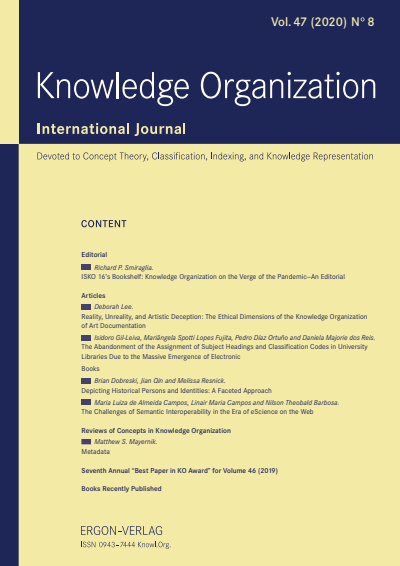
The Sixteenth International Conference on Knowledge Organization was to have been held in Aalborg, Denmark in July 2020. Cancelled due to COVID-19, the proceedings were published online on 4 December 2020 containing 48 full papers, 17 short papers...
The ethics of describing and indexing works which have an element of deception is an important topic within the arena of knowledge organization (KO). However, what happens if the unreal element is for artistic purposes and is part of the experience...
The massive and unstoppable emergence of electronic books in libraries has altered their organization. This disruptive technology has led to structural changes. Currently, an e-book exists only if its metadata exists. The objective of this article...
Archives are responsible for presenting historical materials to users while also placing them in context. Historical individuals and their identities pose specific challenges for the archive, including how to negotiate changing cultural perspectives...
This article is an exploratory study that intends to present semantic interoperability initiatives in the area of information science and computer science. It discusses these initiatives, focusing on open science and eScience, aiming at pointing out...
Metadata in various forms pervades our institutions, technologies, and daily lives. Metadata is a distinct focus of academic research and professional practice for many people within the library and information sciences (LIS). This article is an...