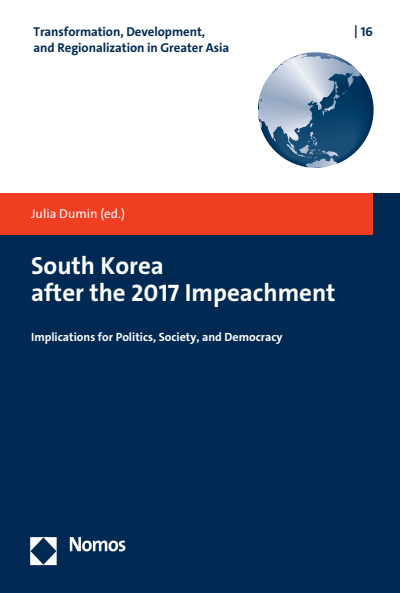
South Korea after the 2017 Impeachment
Implications for Politics, Society, and Democracy- Herausgeber:innen:
- Reihe:
- Transformation, Development, and Regionalization in Greater Asia, Band 16
- Verlag:
- 2022
Zusammenfassung
Das Impeachment gegen die südkoreanische Präsidentin Park Geunhye im Jahr 2017 sowie die vorangegangene Protestbewegung, die insbesondere aufgrund ihrer Länge, Größe und weitgehenden Gewaltfreiheit auch internationale Aufmerksamkeit hervorrief, gab Anlass zu einer neuen Betrachtung der südkoreanischen Demokratie.Mit der Analyse der traditionellen Interpretation des Präsidentenamtes, der Rolle der südkoreanischen Gerichtshöfe im Kontext des Impeachments, der Protestbewegung im Lichte bestehender sozio-ökonomischer Strukturen und der Motivationen der Protestierenden sowie mit einer Einordnung des Impeachments in den Kontext der Demokratisierungsforschung leistet der Sammelband einen Beitrag zu diesem Diskurs. Mit Beiträgen vonDr. Youngho Cho, Julia Dumin, Dr. Justine Guichard, Dr. Gabriel Jonsson, Prof. Dr. Hannes B. Mosler und Dr. Juliette Schwak.
Schlagworte
Publikation durchsuchen
Bibliographische Angaben
- Copyrightjahr
- 2022
- ISBN-Print
- 978-3-8487-8170-6
- ISBN-Online
- 978-3-7489-2630-6
- Verlag
- Nomos, Baden-Baden
- Reihe
- Transformation, Development, and Regionalization in Greater Asia
- Band
- 16
- Sprache
- Englisch
- Seiten
- 177
- Produkttyp
- Sammelband
Inhaltsverzeichnis
- Titelei/Inhaltsverzeichnis Kein Zugriff Seiten 1 - 8
- Introduction: Conceptualizing South Korea’s Impeachment Case in the Context of Democratization Theory Kein Zugriff Seiten 9 - 22Autor:innen:
- Autor:innen:
- Introduction Kein ZugriffAutor:innen:
- Autor:innen:
- Autor:innen:
- Schlesinger’s “Imperial Presidency” Kein ZugriffAutor:innen:
- Theorizing the Presidency for Practical Reasons Kein ZugriffAutor:innen:
- Autor:innen:
- Characteristics of Imperial Presidents Kein ZugriffAutor:innen:
- Causes of Imperial Presidencies Kein ZugriffAutor:innen:
- Consequences of Falling Into the Imperial President Trap Kein ZugriffAutor:innen:
- Operationalizing the Presidential Power Trap Kein ZugriffAutor:innen:
- Autor:innen:
- Autor:innen:
- Scale of Resources Kein ZugriffAutor:innen:
- Personnel Decisions and Activities Kein ZugriffAutor:innen:
- The Presidential Office’s Webpage’s Publicity Vortex Kein ZugriffAutor:innen:
- Autor:innen:
- Prime Minister Kein ZugriffAutor:innen:
- Members of Cabinet Kein ZugriffAutor:innen:
- Executive Ministries and Policy Decisions Kein ZugriffAutor:innen:
- Revolving Door to Para-Public Organization Posts Kein ZugriffAutor:innen:
- Autor:innen:
- The Legislature Kein ZugriffAutor:innen:
- The Judiciary Kein ZugriffAutor:innen:
- Conclusion Kein ZugriffAutor:innen:
- Autor:innen:
- Introduction Kein ZugriffAutor:innen:
- Autor:innen:
- 1.1 Constructing the Case’s Background and Removing the Candlelight Movement’s Influence Kein ZugriffAutor:innen:
- 1.2 Constructing the Impeachment Grounds and Ignoring the Candlelight Movement’s Demands Kein ZugriffAutor:innen:
- 1.3 Constructing Impeachment as an Apolitical Trial Kein ZugriffAutor:innen:
- Autor:innen:
- 2.1 Accounting for Collective Suffering: Citizens as Victims of the Sewol Ferry Sinking but Not of the President’s Violation of Her Duties Kein ZugriffAutor:innen:
- 2.2 Calling for Constitutional Reform: Citizens as Public Deliberators but Not Protesters Kein ZugriffAutor:innen:
- 2.3 A Hidden Discursive Commonality: Extinguishing Contentious Mass Politics Kein ZugriffAutor:innen:
- Autor:innen:
- 3.1 The Criminal Trial of Park Geun-hye: Chaebŏl as Both Victims of Corruption and Accomplices of Collusion Kein ZugriffAutor:innen:
- Autor:innen:
- 3.3 The Polity-Shaping Role of Courts: Comparing Ordinary and Constitutional Justice Kein ZugriffAutor:innen:
- Conclusion Kein ZugriffAutor:innen:
- Autor:innen:
- Introduction Kein ZugriffAutor:innen:
- 1. Theorizing Impeachment in a Global Context Kein ZugriffAutor:innen:
- 2. Methods Kein ZugriffAutor:innen:
- 3. State-Business Relationships in Contemporary Korea Kein ZugriffAutor:innen:
- 4. Park’s Impeachment: Class Conflict and Middle-Class Anxieties Kein ZugriffAutor:innen:
- Conclusion Kein ZugriffAutor:innen:
- Autor:innen:
- Introduction Kein ZugriffAutor:innen:
- 1. Background: Popular Protests and Korean Democracy Kein ZugriffAutor:innen:
- 2. The 2016-2017 Candlelight Protest and Survey Data Kein ZugriffAutor:innen:
- 3. Theories and Hypotheses Kein ZugriffAutor:innen:
- 4. Empirical Results Kein ZugriffAutor:innen:
- 5. Further Discussion Kein ZugriffAutor:innen:
- 6. Conclusion Kein ZugriffAutor:innen:
- Autor:innen:
- Perceived Salience of Politics (Composite Index) Kein ZugriffAutor:innen:
- Democratic Support Kein ZugriffAutor:innen:
- Demand for Direct Democracy Kein ZugriffAutor:innen:
- Perception of Redistribution and Inequality (Composite Index) Kein ZugriffAutor:innen:
- Appendix II. Descriptive Statistics (The Sogang Public Opinion Survey, SPOS) Kein ZugriffAutor:innen:
- Autor:innen:
- Introduction Kein ZugriffAutor:innen:
- 1. Theoretical Framework Kein ZugriffAutor:innen:
- 2. The Significance of the Impeachment of President Park Geun-hye Kein ZugriffAutor:innen:
- Conclusions Kein ZugriffAutor:innen:
- Contributors Kein Zugriff Seiten 177 - 177
Literaturverzeichnis (300 Einträge)
Es wurden keine Treffer gefunden. Versuchen Sie einen anderen Begriff.
- References Google Scholar öffnen doi.org/10.5771/9783748926306-9
- Baumgartner, J. C. (2003). Introduction: Comparative Presidential Impeachment. In Baumgartner, J. C. and Kada, N. (Eds.), Checking Executive Power: Presidential Impeachment in Comparative Perspective. Westport: Praeger Publishers, 1-20. Google Scholar öffnen doi.org/10.5771/9783748926306-9
- Beichelt, T. (2001). Demokratische Konsolidierung im postsozialistischen Europa: Die Rolle der politischen Institutionen. Wiesbaden: Springer Fachmedien. Google Scholar öffnen doi.org/10.5771/9783748926306-9
- Bertelsmann Stiftung (n.d.). BTI 2006-2022 Results, [online]. Available at: https://bti-project.org/en/index/political-transformation [Accessed February 23, 2022]. Google Scholar öffnen doi.org/10.5771/9783748926306-9
- Freedom House (n.d.). Freedom in the World: South Korea, [online]. Available at: https://freedomhouse.org/country/south-korea/freedom-world/2021 [Accessed February 21, 2022]. Google Scholar öffnen doi.org/10.5771/9783748926306-9
- Ginsburg, T., Huq, A., and Landau, D. (2021). The Comparative Constitutional Law of Presidential Impeachment. The University of Chicago Law Review, 88 (1), 81-164. Google Scholar öffnen doi.org/10.5771/9783748926306-9
- Huntington, S. (1991). The Third Wave: Democratization in the Late Twentieth Century. Norman and London: University of Oklahoma Press. Google Scholar öffnen doi.org/10.5771/9783748926306-9
- Kang, S.-G. (2019). Candlelight Demonstrations and the Presidential Impeachment in South Korea: An Evaluation of the 30 Years of Democracy. Asian Education and Development Studies, 8 (3), 256-267. Google Scholar öffnen doi.org/10.5771/9783748926306-9
- Kelly, R. (2017). South Korea’s Finest Hour: Lessons From the Impeachment. The Interpreter, April 11, 2017, [online]. Available at: https://www.lowyinstitute.org/the-interpreter/south-korea-s-finest-hour-lessons-impeachment [Accessed January 30, 2022]. Google Scholar öffnen doi.org/10.5771/9783748926306-9
- Kim, S.-C. (2017). South Korea’s Candlelight Protests. East Asia Forum, February 7, 2017, [online]. Available at: https://www.eastasiaforum.org/2017/02/07/south-koreas-candlelight-protests/ [Accessed January 31, 2022]. Google Scholar öffnen doi.org/10.5771/9783748926306-9
- Lauth, H.-J., Schlenkrich, O., and Lemm, L. (n.d.). Country Graph South Korea, [online]. Available at: https://www.democracymatrix.com/online-analysis/country#/South%20Korea/total_index_core [Accessed February 21, 2022]. Google Scholar öffnen doi.org/10.5771/9783748926306-9
- Lee, S. J. (2017). A Democratic Breakthrough in South Korea? Carnegie Endowment for International Peace, March 24, 2017, [online]. Available at: https://carnegieendowment.org/2017/03/24/democratic-breakthrough-in-south-korea-pub-68394 [Accessed January 30, 2022]. Google Scholar öffnen doi.org/10.5771/9783748926306-9
- Linz, J. J. and Stepan, A. (1996). Problems of Democratic Transition and Consolidation: Southern Europe, South America, and Post-Communist Europe. Baltimore and London: The John Hopkins University Press. Google Scholar öffnen doi.org/10.5771/9783748926306-9
- Merkel, W. (1996). Institutionalisierung und Konsolidierung der Demokratien in Ostmitteleuropa. In Merkel, W., Sandschneider, E., and Segert, D. (Eds.), Systemwechsel 2: Die Institutionalisierung der Demokratie. Opladen: Leske + Budrich, 73-112. Google Scholar öffnen doi.org/10.5771/9783748926306-9
- Merkel, W. (2010). Systemtransformation: Eine Einführung in die Theorie und Empirie der Transformationsforschung. Wiesbaden: VS Verlag für Sozialwissenschaften. Google Scholar öffnen doi.org/10.5771/9783748926306-9
- Mobrand, E. (2018). Democracy Is More Than a Political System: Lessons From South Korea’s Democratic Transformation. The Asan Forum, December 20, 2018, [online]. Available at: https://theasanforum.org/democracy-is-more-than-a-political-system-lessons-from-south-koreas-democratic-transformation/ [Accessed January 30, 2022]. Google Scholar öffnen doi.org/10.5771/9783748926306-9
- Mosler, H. B. (2017). The Institution of Presidential Impeachment in South Korea, 1992-2017. Verfassung und Recht in Übersee/Law and Politics in Africa, Asia and Latin America, 50 (2), 111-134. Google Scholar öffnen doi.org/10.5771/9783748926306-9
- Pickel, G. (2016). Transitorische Demokratietheorie. In Lembcke, O., Ritzi, C., and Schaal, G. S. (Eds.), Zeitgenössische Demokratietheorie: Empirische Demokratietheorien. Wiesbaden: Springer VS, 427-454. Google Scholar öffnen doi.org/10.5771/9783748926306-9
- Pridham, G. (1995). The International Context of Democratic Consolidation: Southern Europe in Comparative Perspective. In Gunther, R., Diamandouros, P. N., and Puhle, H.-J. (Eds.), The Politics of Democratic Consolidation: Southern Europe in Comparative Perspective. Baltimore and London: The John Hopkins University Press, 166-203. Google Scholar öffnen doi.org/10.5771/9783748926306-9
- Przeworski, A. (1991). Democracy and the Market: Political and Economic Reforms in Eastern Europe and Latin America. Cambridge: Cambridge University Press. Google Scholar öffnen doi.org/10.5771/9783748926306-9
- Rottinghaus, B. (2014). Surviving Scandal: The Institutional and Political Dynamics of National and State Executive Scandals. PS: Political Science & Politics, 47 (1), 131-140. Google Scholar öffnen doi.org/10.5771/9783748926306-9
- Schedler, A. (1998). How Should We Study Democratic Consolidation? Democratization, 5 (4), 1-19. Google Scholar öffnen doi.org/10.5771/9783748926306-9
- Shin, G.-W. and Moon, R. J. (2017). South Korea After Impeachment. Journal of Democracy, 28 (4), 117-131. Google Scholar öffnen doi.org/10.5771/9783748926306-9
- Valenzuela, J. S. (1992). Democratic Consolidation in Post-Transitional Settings: Notion, Process, and Facilitating Conditions. In Mainwaring, S., O’Donnell, G., and Valenzuela, J. S. (Eds.), Issues in Democratic Consolidation: The New South American Democracies in Comparative Perspective. Notre Dame: University of Notre Dame Press, 57-104. Google Scholar öffnen doi.org/10.5771/9783748926306-9
- References Google Scholar öffnen doi.org/10.5771/9783748926306-23
- Ch’ŏngwadae (2020). Kungminch’ŏngwŏn [Citizens’ Petition Board]. [Online]. Available at: https://www1.president.go.kr/petitions [Accessed February 11, 2020]. Google Scholar öffnen doi.org/10.5771/9783748926306-23
- Cho, S.-J. and Im, T.-B. (2010). Han’guk haengjŏngjojiknon [Korean Administration Theory]. Seoul: Bŏmmunsa. Google Scholar öffnen doi.org/10.5771/9783748926306-23
- Choi, J.-J. (2004). Minjuhwa ihu-ŭi minjujuŭi [Democracy after Democratization]. Seoul: Humanitas. Google Scholar öffnen doi.org/10.5771/9783748926306-23
- Chŏn, H.-G. (2019). Chwap’a tokchae yŏnggujipkwŏn sido seryrŏkŭrobut’ŏ chayudaehandmin’gukŭl chik’yŏnaegaessŭmnida [We Will Protect a Free Republic of Korea From the Forces That Attempt to Rule Permanently under the Leftist Dictatorship]. Naver, April 27, 2019. Available at: https://news.naver.com/main/read.naver?mode=LSD&mid=sec&sid1=123&oid=156&aid=0000025804 [Accessed April 30, 2019]. Google Scholar öffnen doi.org/10.5771/9783748926306-23
- Chŏng, C.-S. (2004). Hŏnbŏp Yŏn’gu [Constitutional Theory]. Seoul: Pakyŏngsa. Google Scholar öffnen doi.org/10.5771/9783748926306-23
- Chŏng, Ŭ.-H. (2019). Chŏngsi hwaktae ŏptadŏn kyoyukpu [The Ministry of Education That Were Against Expanding the CSAT]. TV Chosun, October 22, 2019. Available at: http://news.tvchosun.com/site/data/html_dir/2019/10/22/2019102290077.html [Accessed January 12, 2020]. Google Scholar öffnen doi.org/10.5771/9783748926306-23
- Chŏng, W.-S. (2018). T’ak Hyŏn-min-ŭi 1-yŏn, nollan-esŏ sat’oe-ggaji [One Year T’ak Hyŏn-min, From Controversy to Resignation]. The Hankyoreh, June 30, 2018. Available at: https://h2.khan.co.kr/201806301601001 [Accessed January 12, 2020]. Google Scholar öffnen doi.org/10.5771/9783748926306-23
- Chŏng, Y.-I. (2020). ‘Ch’ŏngwadae kyŏngnyŏk’ ch’ongsŏn pŭrimiŏm toeilgga? [Will the ‘Blue House Experience’ Become an Election Premium?]. Kyunghyang Weekly, January 10, 2020. Available at: https://weekly.khan.co.kr/khnm.html?mode=view&artid=202001101639211&code=113 [Accessed January 12, 2020]. Google Scholar öffnen doi.org/10.5771/9783748926306-23
- Chosun Ilbo (2019). Cho Kuk ttal t’ase tto ipsi pyŏn’gyŏng, 4-nyŏn-e 4-bŏn paggwindani [The Entrance Exam Changed Again, Changing Four Times in Four Years, Because of Cho Kuk’s Daughter], November 11, 2019. Available at: https://www.chosun.com/site/data/html_dir/2019/11/29/2019112903288.html [Accessed November 30, 2019]. Google Scholar öffnen doi.org/10.5771/9783748926306-23
- Chosun Ilbo (2019). Mun chŏnggwŏn munŭngŭi tto tarŭn p’ihaeja, ‘kyoyuk’-kwa ‘haksaeng hakpumo’ [Additional Other Victims of the Moon Regime’s Incompetence, ‘Education’ and ‘Students and Parents’], October 25, 2019. Available at: https://www.chosun.com/site/data/html_dir/2019/10/24/2019102403447.html [Accessed November 29, 2019]. Google Scholar öffnen doi.org/10.5771/9783748926306-23
- Chungang Ilbo (2018). Uri-nŭn mujŏk-ŭi nakhasan pudae [We Are the Parachute Unit Without Enemies], May 24, 2018. Available at: https://news.joins.com/Digitalspecial/297 [Accessed January 12, 2020]. Google Scholar öffnen doi.org/10.5771/9783748926306-23
- Constitution of the Republic of Korea. Available in English at: https://korea.assembly.go.kr:447/res/low_01_read.jsp?boardid=1000000035 [Accessed April 15, 2021]. Google Scholar öffnen doi.org/10.5771/9783748926306-23
- Constitution of the United States. Available at: https://www.senate.gov/civics/constitution_item/constitution.htm [Accessed April 15, 2021]. Google Scholar öffnen doi.org/10.5771/9783748926306-23
- Crouch, J., Rozell, M. J., and Sollenberger, M. A. (2017). The Law: The Unitary Executive Theory and President Donald J. Trump. Presidential Studies Quarterly, 47 (3), 561-573. Google Scholar öffnen doi.org/10.5771/9783748926306-23
- Democratic Party (2017). Nara-rŭl naradapke. 19-tae taet’ognyŏngsŏn’gŏ tŏburŏminjudang chŏngch’aekkungyakchip [Making the Country Country-Like. The Democratic Party’s 19th Presidential Election Manifesto]. Seoul: Democratic Party. Google Scholar öffnen doi.org/10.5771/9783748926306-23
- Dong-A Ilbo (1974). Chumokpannŭn miguk-ŭi tu chŏsŏ [Two US-American Books That Receive Attention], January 21, 1974, p. 5. Google Scholar öffnen doi.org/10.5771/9783748926306-23
- Dong-A Ilbo (2019). Kyoyukpo “chŏngsi 40% hwaktae,” kaljija kyoyukchŏngch’aek ŏnje tto paggwilji [Ministry of Education “Expansion of On-Time 40%,” When Will the Education Policy Change Again?], November 29, 2019. Available at: https://www.donga.com/news/Opinion/article/all/20191128/98587080/1 [Accessed November 29, 2019]. Google Scholar öffnen doi.org/10.5771/9783748926306-23
- Fitts, M. A. (1996). The Paradox of Power in the Modern State: Why a Unitary, Centralized Presidency May Not Exhibit Effective or Legitimate Leadership. University of Pennsylvania Law Review, 144 (3), 827-902. Google Scholar öffnen doi.org/10.5771/9783748926306-23
- Ham, S.-D. (1999). Taet’ongnyŏnghak [The Korean Presidency]. Seoul: Nanam. Google Scholar öffnen doi.org/10.5771/9783748926306-23
- Ham, S.-D. (2002). The Institutional Development of the Blue House in the Park Chung Hee Presidency. Asian Perspective, 26 (2), 101-130. Google Scholar öffnen doi.org/10.5771/9783748926306-23
- Ham, S.-D. (2003). Taet’ongyŏnghak [President Research]. Seoul: Nanamch’ulp’an. Google Scholar öffnen doi.org/10.5771/9783748926306-23
- Ham, S.-D. (2018). Chewangjŏk taet’ongyŏng-ŭi chongŏn [The End of the Imperial Presidency]. Koyang: Sŏmaensŏm. Google Scholar öffnen doi.org/10.5771/9783748926306-23
- Holloway, J. (2002). Change The World Without Taking Power. London: Pluto Press. Google Scholar öffnen doi.org/10.5771/9783748926306-23
- Hong, T.-P. (2002). Chewangjŏk taet’ongnyŏngnon: Kŭ t’ŭkching-kwa wŏnin-ŭl chungsim-ŭro [The Concept, Characteristics, and Causes of the Imperial President]. Kungminyulli Yŏn’gu, 50, 145-171. Google Scholar öffnen doi.org/10.5771/9783748926306-23
- Huntington, S. (1991). The Third Wave: Democratization in the Late Twentieth Century. Norman and London: University of Oklahoma Press. Google Scholar öffnen doi.org/10.5771/9783748926306-23
- Im, C.-H. and Yun, S.-M. (2019). T’ukhamyŏn ippŏp pasing [Very Often Legislation Is Bypassed]. Chungang Ilbo, November 4, 2019. Available at: https://news.joins.com/article/23623288 [Accessed January 10, 2020]. Google Scholar öffnen doi.org/10.5771/9783748926306-23
- Im, M.-H. (2019). Mun taet’ongnyŏng haengsagihoek chamunwiwŏn sinsŏl, T’ak Hyŏn-min wich’uk [President Moon Established Advisory Committee for Presidential Event Management, Makes T’ak Hyŏn-min Member]. MBC News, February 21, 2019. Available at: https://imnews.imbc.com/news/2019/politics/article/5174599_29092.html [Accessed January 12, 2020]. Google Scholar öffnen doi.org/10.5771/9783748926306-23
- Kelley, C. (2008). The Unitary, or Unilateral Executive? Presidential Power in the Bush Administration. The American Review of Politics, 29, 181-196. Google Scholar öffnen doi.org/10.5771/9783748926306-23
- Kim, C.-D. (2018). Kukhoebonhoeŭi Hoeŭirok 360(4) [Minutes of the Plenary Session 360(4)], Office of the National Assembly, May 24, 2018. Google Scholar öffnen doi.org/10.5771/9783748926306-23
- Kim, E.-B. and Lee, S.-E. (2020). Cho Kuk Indicted on 12 Charges, Blue House Slams ‘Narrow’ Results. Korea Joongang Daily, January 1, 2020. Available at: http://koreajoongangdaily.joins.com/news/article/article.aspx?aid=3072083 [Accessed January 12, 2020]. Google Scholar öffnen doi.org/10.5771/9783748926306-23
- Kim, H.-J. (1995). Han’gukchŏngch’ich’ejeron [The Political System of Korea]. Seoul: Pakyŏngsa. Google Scholar öffnen doi.org/10.5771/9783748926306-23
- Kim, H.-C. (2020). Yu Chae-su pwajunŭn kŏn ŏt’ŏk’ennŭnya [How About Turning a Blind Eye on Yu Chae-su?]. Kyunghyang Sinmun, January 20, 2020. Available at: http://news.khan.co.kr/kh_news/khan_art_view.html?art_id=202001201329001 [Accessed January 20, 2020]. Google Scholar öffnen doi.org/10.5771/9783748926306-23
- Kim, J.-Y. (2020). Political Culture and Behavior. In Moon, C.-I. and Moon, M. J. (Eds.), Routledge Handbook of Korean Politics and Public Administration. London: Routledge, 41-58. Google Scholar öffnen doi.org/10.5771/9783748926306-23
- Kim, K.-C. (2020). 4-15 ch’ongsŏn, ‘chŏnggwŏn simp’an’-boda ‘kukchŏng anjŏng’ [April 15 General Elections Rather Reflected ‘Government Stability’ Than ‘Judgment of Government’]. Issue Maker, April 24, 2020. Available at: http://www.issuemaker.kr/news/articleView.html?idxno=31607 [Accessed May 26, 2020]. Google Scholar öffnen doi.org/10.5771/9783748926306-23
- Kim, K.-Y. and Kim, T.-B. (2019). Mun K’aemk’odŏ insa Pak-poda mank’o MB-boda chŏkta [Moon’s Questionable Personnel Decisions More Than Park, Less Than Lee]. Nocutnews, April 10, 2019. Available at: https://www.nocutnews.co.kr/news/5132380 [Accessed January 12, 2020]. Google Scholar öffnen doi.org/10.5771/9783748926306-23
- Kim, N.-H. (2018). DMZ sich’al, Begun myŏndam … wangsiljang nollan hipsa’in Im Chong-sŏk [Inspection of the DMZ, Meeting With Begun … Im Chong-sŏk Is Embroiled in Royal Chief of Staff Controversy]. JTBC News, October 30, 2018. Available at: http://news.jtbc.joins.com/article/article.aspx?news_id=NB11719193 [Accessed January 12, 2020]. Google Scholar öffnen doi.org/10.5771/9783748926306-23
- Kim, S.-J. (2017). Han’guk changgwan chae’im kigan 1-yŏn 2-gaewŏl vs miguk changgwan 3-nyŏn pan [Korean Ministers’ 1 Year and 2 Months Office Term vs US-Ministers’ 3 Years]. YTN, June 25, 2017. Available at: https://www.ytn.co.kr/_ln/0101_201706250515367569 [Accessed October 23, 2019]. Google Scholar öffnen doi.org/10.5771/9783748926306-23
- Kim, S.-M., Lee, G.-Y., and Lee, S.-E. (2019). Cho Faces Questions in Ex-Busan Vice Mayor Probe. Korea Joongang Daily, December 17, 2019. Available at: http://koreajoongangdaily.joins.com/news/article/article.aspx?aid=3071547 [Accessed January 12, 2020]. Google Scholar öffnen doi.org/10.5771/9783748926306-23
- Kim, T.-H. (2018). Chaggu k’ŭnŭn Im Chong-sŏk [Im Chong-sŏk Is Continually Growing]. Chugan Chosŏn, March 25, 2018. Available at: http://news.chosun.com/site/data/html_dir/2018/03/23/2018032302132.html [Accessed January 12, 2020]. Google Scholar öffnen doi.org/10.5771/9783748926306-23
- Kim, U.-T. et al. (Eds.) (1999). Han’gukchŏngch’iron [Korean Politics]. Seoul: Pakyŏngsa. Google Scholar öffnen doi.org/10.5771/9783748926306-23
- Ko, M.-H. (2007). Chewangjŏk taet’ongnyŏngje-ŭi t’ŭkching-ŭrosŏ samyŏn’gwŏn haengsa-ŭi t’ongjebangan [A Proposal for Controlling the Presidential Pardoning Power as an Element of the Imperial Presidency]. Segyehŏnbŏp Yŏn’gu, 13 (2), 1-36. Google Scholar öffnen doi.org/10.5771/9783748926306-23
- Ko, T.-U. (2018). Pulbŏp sŏn’gŏ’undong T’ak Hyŏn-min 2-sim pŏlgŭm 70-manwŏn [Fine of KRW 700,000 for T’ak in the Second Instance]. Yonhapnews, November 2, 2018. Available at: https://www.yna.co.kr/view/AKR20181102049251004?input=1195m [Accessed January 12, 2020]. Google Scholar öffnen doi.org/10.5771/9783748926306-23
- Kruse, K. M. and Zelizer, J. E. (2019). Have We Had Enough of the Imperial Presidency Yet? The New York Times, January 9, 2019. Available at: https://www.nytimes.com/2019/01/09/opinion/president-trump-border-wall-weak.html [Accessed January 12, 2020]. Google Scholar öffnen doi.org/10.5771/9783748926306-23
- Kwŏn, H.-U. (2017). Sot’ong-ŭi ‘mun’-ŭl yŏlda - ch’ŏng: ‘kungminsot’ongp’ŭlaetŭp’om’ pongyŏk kadong [Opening the Door to Communication - Blue House: Full-Scale Operation of the Public Communication Platform]. CBS Nokŏt’ŭnyusŭ, August 17, 2017. Available at: http://www.nocutnews.co.kr/news/4832273 [Accessed July 20, 2018]. Google Scholar öffnen doi.org/10.5771/9783748926306-23
- Kwŏn, K.-S. (2018). Chikchŏp minjujuŭi vs yŏronmori agyong - ‘yangnar-ŭi k’al’ doen kungminch’ŏngwŏn [Abuse of Direct Democracy Versus Public Opinion - The National Petition Has Become a Double-Edged Sword]. Segye Ilbo, September 9, 2018. Available at: http://www.segye.com/newsView/20180909002693 [Accessed September 24, 2018]. Google Scholar öffnen doi.org/10.5771/9783748926306-23
- Lee, S.-J. (2016). Taet’ongnyŏng-ŭi sa’myŏn’gwŏn-e taehan pip’an-chŏk koch’al [A Critical Appraisal of the Presidential Amnesty Right]. Pŏphak Yŏn’gu (Yonsei), 26 (4), 1-38. Google Scholar öffnen doi.org/10.5771/9783748926306-23
- Lim, S. H. (1998). A Paradox of Korean Democracy: 50 Years’ of Experience of the Imperial Presidency and the Peripheral Legislature. Korea and World Affairs, 22 (4), 522-538. Google Scholar öffnen doi.org/10.5771/9783748926306-23
- Linz, J. J. (1994). Presidential or Parliamentary Democracy: Does It Make a Difference? In Linz, J. J. and Valenzuela, A. (Eds.), The Failure of Presidential Democracy: Comparative Perspectives, Vol. 1. Baltimore, MD: Johns Hopkins University Press, 3-87. Google Scholar öffnen doi.org/10.5771/9783748926306-23
- Linz, J. J. (1990). The Perils of Presidentialism. Journal of Democracy, 1 (1), 51-69. Google Scholar öffnen doi.org/10.5771/9783748926306-23
- MacKenzie, J. P. (2008). Absolute Power: How the Unitary Executive Theory Is Undermining the Constitution. New York: The Century Foundation Press. Google Scholar öffnen doi.org/10.5771/9783748926306-23
- Mainwaring, S. and Shugart, M. S. (1997). Juan Linz, Presidentialism, and Democracy: A Critical Appraisal. Comparative Politics, 29 (4), 449-471. Google Scholar öffnen doi.org/10.5771/9783748926306-23
- Ministry of Legislation (2020). Kongp’ohyŏnhwang [Current State of Promulgations]. Available at: https://www.moleg.go.kr/esusr/mpbStaSts/stastsList.es?mid=a10110020000&srch_csf_cd=120002 [Accessed February 12, 2020]. Google Scholar öffnen doi.org/10.5771/9783748926306-23
- Moon, J.-I. (2017). Mun Chae-in taet’ongnyŏng yŏnsŏlmunjip 2017-nyŏn 5-7-wŏl [Selected Speeches of President Moon Jae-in of the Republic of Korea, May-July 2017]. Seoul: Korean Culture and Information Service. Google Scholar öffnen doi.org/10.5771/9783748926306-23
- Mosler, H. B. (2015). The Deterioration of South Korean Democracy. In Howe, B. (Ed.), Democratic Governance in Northeast Asia: A Human-Centred Approach to Evaluating Democracy. London: Palgrave Macmillan, 25-50. Google Scholar öffnen doi.org/10.5771/9783748926306-23
- Mosler, H. B. (2017). The Institution of Presidential Impeachment in South Korea, 1992-2017. Verfassung und Recht in Übersee, 2, 111-134. Google Scholar öffnen doi.org/10.5771/9783748926306-23
- Mosler, H. B. et al. (Eds.) (2018). The Quality of Democracy in Korea. Three Decades after Democratization. Basingstoke: Palgrave Macmillan. Google Scholar öffnen doi.org/10.5771/9783748926306-23
- Mosler, H. B. (2020). Characteristics and Challenges of South Korea’s Presidential Government System. In Mosler, H. B. (Ed.), South Korea’s Democracy Challenge: Political System, Political Economy, and Political Society. Berlin: Peter Lang Academic Publishers, 25-66. Google Scholar öffnen doi.org/10.5771/9783748926306-23
- Mun, T.-Y. (2015). Kukhoe pŏpchesil, mobŏp-e ŏgŭnnan haengjŏng’ippŏp p’yŏngga sarye palgan [The National Assembly’s Legislation Office Publishes Administrative Legislation Evaluation Cases That Violate Upper Law]. Globalnewsagency, June 1, 2015. Available at: www.globalnewsagency.kr/news/articleView.html?idxno=37115 [Accessed October 23, 2019]. Google Scholar öffnen doi.org/10.5771/9783748926306-23
- Myŏng, J. J. (2007). Kungmuch’ongnije-ŭi hamni-chŏk unyong-ŭi han’gye-wa kaehŏn p’iryosŏng [The Operational Limits of the Prime Minister’s Power and the Necessity of Constitutional Revision]. Hŏnbŏp Yŏn’gu, 13 (1), 155-185. Google Scholar öffnen doi.org/10.5771/9783748926306-23
- National Assembly Legislation Office (2016). Che-19-dae kukhoe haengjŏngippŏp punsŏk-p’ŏngga sarye [19th National Assembly Administrative Legislative Analysis and Evaluation Cases]. Google Scholar öffnen doi.org/10.5771/9783748926306-23
- Obama, Barak [Barak Obama] (2014). “If Congress will not do their job, at least we can do ours.” - President Obama #ActOnReform [Tweet]. Twitter, June 30, 2014. Available at: https://twitter.com/barackobama/status/483692659236540416 [Accessed January 12, 2020]. Google Scholar öffnen doi.org/10.5771/9783748926306-23
- Pak, C.-J. (2015). Yŏktae chŏngbu taet’ongnyŏng sa’myŏn taehaebu [Analysis of Presidential Pardoning Under Previous Governments]. Hankook Weekly, May 9, 2015. Available at: http://daily.hankooki.com/lpage/politics/201505/dh20150509094918137430.htm [Accessed January 12, 2020]. Google Scholar öffnen doi.org/10.5771/9783748926306-23
- Pak, S.-H. (2017). Ch’ŏngwadae kungminch’ŏngwŏn-ŭn minju-jŏgilgga [Is the Blue House Public Petition Democratic?]. Dong-A Ilbo, December 19, 2017. Available at: http://news.donga.com/3/all/20171219/87808886/1 [Accessed May 18, 2018]. Google Scholar öffnen doi.org/10.5771/9783748926306-23
- Pak, S.-H. (2018). Ch’ŏngwadae chŏngbu [Blue House Government]. Seoul: Humanitas. Google Scholar öffnen doi.org/10.5771/9783748926306-23
- Pak, Y.-H. (2019). Mun chŏngbu nakhasan 500-myŏng nŏmŏ [Parachute Personnel Re-Shuffling Under the Moon Government Exceeds 500 Persons]. Kyunghyang Sinmun, October 13, 2019. Available at: http://news.khan.co.kr/kh_news/khan_art_view.html?art_id=201910131052001 [Accessed January 12, 2020]. Google Scholar öffnen doi.org/10.5771/9783748926306-23
- Pak, Y. S. (2016). Han’guk-ŭi chewangjŏk taet’ongnyŏng [The Imperial Presidency by Evasion of the Political Laws in Korea]. Han’gukchŏngch’i Yŏn’gu, 25 (2), 27-55. Google Scholar öffnen doi.org/10.5771/9783748926306-23
- Poguntke, T. and Webb, P. (2005). The Presidentialization of Politics: A Comparative Study of Modern Democracies. Oxford: Oxford University Press. Google Scholar öffnen doi.org/10.5771/9783748926306-23
- Rudalevige, A. (2005). The New Imperial Presidency. Renewing Presidential Power after Watergate. Ann Abor: University of Michigan Press. Google Scholar öffnen doi.org/10.5771/9783748926306-23
- Schlesinger, A. (1973). The Imperial Presidency. Boston: Houghton Mifflin. Google Scholar öffnen doi.org/10.5771/9783748926306-23
- Ser, M.-J. and Bae, J.-S. (2020). Im Jong-seok to Face Questioning on Power Abuse. Korea Joongang Daily, January 30, 2020. Available at: http://koreajoongangdaily.joins.com/news/article/article.aspx?aid=3073151 [Accessed February 12, 2020]. Google Scholar öffnen doi.org/10.5771/9783748926306-23
- Shin, G. H. (2016). Taet’ongnyŏng-ŭi sa’myŏn-gwŏn t’ongje-e kwanhan yŏn’gu [A Study on the Control of Presidential Pardoning Power]. Kach’ŏn Pŏphak, 9 (3), 124-148. Google Scholar öffnen doi.org/10.5771/9783748926306-23
- Shugart, M. S. and Carey, J. M. (1992). Presidents and Assemblies: Constitutional Design and Electoral Dynamics. Cambridge: Cambridge University Press. Google Scholar öffnen doi.org/10.5771/9783748926306-23
- Sim, K.-S. (2017). Kwŏllyŏkpullip-kwa taet’ongnyŏng-ŭi immyŏnggwŏn [Separation of Powers and the Appointment Power of President]. Hŏnbŏp Yŏn’gu, 23 (3), 295-332. Google Scholar öffnen doi.org/10.5771/9783748926306-23
- Song, C.-S. (2019). Sunŭng chŏngsi hwaktae-ro tae’ipchedo kaep’yŏn [Decision to Reform College Entrance System by Extending the CSAT Proportion]. Kyunghyang Sinmun, October 22, 2019. Available at: http://news.khan.co.kr/kh_news/khan_art_view.html?artid=201910221706001&code=940401 [Accessed January 10, 2020]. Google Scholar öffnen doi.org/10.5771/9783748926306-23
- Sŏk, H.-W. (2019). Nŭrŏnanŭn kukhoe p’aesing kwagŏ chŏngbu-nŭn ŏddaenna? [Increasing National Assembly Passing, How Was It under Former Governments?]. KBS News, June 17, 2019. Available at: http://news.kbs.co.kr/news/view.do?ncd=4284401 [Accessed October 25, 2019]. Google Scholar öffnen doi.org/10.5771/9783748926306-23
- Sŏng, T.-H. (2020). Cho Kuk ch’ŏngwadae-e 21-hoe pogo [Cho Kuk Reported 21 Times to the Blue House]. Yonhapnews, February 5, 2020. Available at: https://www.yna.co.kr/view/AKR20200205075600004?input=1195m [Accessed February 6, 2020]. Google Scholar öffnen doi.org/10.5771/9783748926306-23
- Sŏng, Y.-C. (2020). T’akhyŏnmin ch’ŏngwadae ŭijŏnbisŏgwan-ŭro pokkwi [T’ak Hyŏn-min Returns to the Blue House as Protocol Secretary]. The Hankyoreh, May 26, 2020. Available at: http://www.hani.co.kr/arti/politics/bluehouse/946553.html [Accessed May 26, 2020]. Google Scholar öffnen doi.org/10.5771/9783748926306-23
- The Economist (2020). Going South: South Korea’s President Curbs the Power of Prosecutors, January 16, 2020. Available at: https://www.economist.com/asia/2020/01/16/south-koreas-president-curbs-the-power-of-prosecutors [Accessed January 20, 2020]. Google Scholar öffnen doi.org/10.5771/9783748926306-23
- Dong-A Ilbo (1974). Chumokpannŭn miguk-ŭi tu chŏsŏ [Two US-American Books That Receive Attention], January 21, 1974, p. 5. Google Scholar öffnen doi.org/10.5771/9783748926306-23
- Waterman, R. W. (2009). The Administrative Presidency, Unilateral Power, and the Unitary Executive Theory. Presidential Studies Quarterly, 39 (1), 5-9. Google Scholar öffnen doi.org/10.5771/9783748926306-23
- Weko, T. J. (1995). The Politicizing Presidency. Lawrence: University of Kansas Press. Google Scholar öffnen doi.org/10.5771/9783748926306-23
- Yang, K. (2003). Irŭnba chewangjŏk taet’ongnyŏng nonŭi-e kwanhan sogo [A Study of the Debate on the Imperial Presidency]. Segyehŏnbŏp Yŏn’gu, 8, 113-124. Google Scholar öffnen doi.org/10.5771/9783748926306-23
- Yi, C.-H. (2008). Han’guktaet’ongyŏngje-ŭi wŏnsukhan unyŏngŭl wihan jeŏn [Suggestions for the Smooth Operation of the Korean Presidential System]. In Yang, K. et al. (Eds.), Saeroun hŏnbop p’iryohan’ga [Do We Need a New Constitution?]. Seoul: Taehwamunhwasa, 188-208. Google Scholar öffnen doi.org/10.5771/9783748926306-23
- Yi, C.-Y. (2019). Kungminch’ŏngwŏn haru p’yŏnggyun 851-kŏn [Citizens’ Petition Board Receives on Average 851 Petitions Per Day]. Seoul Sinmun, November 7, 2019. Available at: https://www.seoul.co.kr/news/newsView.php?id=20191107009010&wlog_tag3=naver [Accessed January 10, 2020]. Google Scholar öffnen doi.org/10.5771/9783748926306-23
- Yi, H.-S. (2019). Yu Ŭn-hye, tae’ipkaep’yŏn, chŏng.susi piyul chojŏng anin hakchong kongjŏngsŏng chego [Yu Ŭn-hye, Improving Equity of the Early Admission System Rather Than Adjusting the Standardized Modus]. Yonhapnews, September 4, 2019. Available at: https://www.yna.co.kr/view/AKR20190904107052004?input=1195m [January 10, 2020]. Google Scholar öffnen doi.org/10.5771/9783748926306-23
- Yi, K.-I. (2008). Chewangjŏk taet’ongyŏng-ŭi kiwŏn [The Origin of the Imperial Presidency]. Hwanghaemunhwa, 60, 117-138. Google Scholar öffnen doi.org/10.5771/9783748926306-23
- Yun, C.-W. (2020). Ch’ŏngch’ulsin yŏktaegŭp inwŏn-i ch’ongsŏn-e nasonŭn paegyŏng [Background on the Reasons Why So Many Former Blue House Staff Are Running for Public Offices]. Maeil Kyŏngje, January 20, 2020. Available at: http://m.raythep.com/AllNew/AllNew/View/21181 [Accessed February 4, 2020]. Google Scholar öffnen doi.org/10.5771/9783748926306-23
- References Google Scholar öffnen doi.org/10.5771/9783748926306-67
- Cho, J. (2004). The Politics of Constitution-Making During the 1987 Democratic Transition in South Korea. Korea Observer, 35 (2), 171-206. Google Scholar öffnen doi.org/10.5771/9783748926306-67
- Choe, S.-H. (2018). Former South Korean President Gets 15 Years in Prison for Corruption. The New York Times, October 5, 2018. Available at: https://www.nytimes.com/2018/10/05/world/asia/lee-myung-bak-south-korea-convicted.html [Accessed April 8, 2021]. Google Scholar öffnen doi.org/10.5771/9783748926306-67
- Choe, S.-H. (2020). Samsung Heir Apologizes for Corruption and Union-Busting Scandals. The New York Times, May 6, 2020. Available at: https://www.nytimes.com/2020/05/06/business/samsung-lee-apology.html [Accessed April 8, 2021]. Google Scholar öffnen doi.org/10.5771/9783748926306-67
- Choi, H., Kang, H., and Lee, C. (2018). What Constitutes ‘Too Big to Jail?’ Evidence from South Korea’s Family Business Groups. Asia-Pacific Journal of Financial Studies, 47 (6), 881-919. Google Scholar öffnen doi.org/10.5771/9783748926306-67
- Constitution of the Republic of Korea. Available in English at: https://korea.assembly.go.kr:447/res/low_01_read.jsp?boardid=1000000035 [Accessed April 15, 2021]. Google Scholar öffnen doi.org/10.5771/9783748926306-67
- Constitutional Court Act [of the Republic of Korea]. Downloadable in English from the website of the Constitutional Court: https://english.ccourt.go.kr/site/eng/main.do [Accessed April 15, 2021]. Google Scholar öffnen doi.org/10.5771/9783748926306-67
- Doucette, J. (2017). The Occult of Personality: Korea’s Candlelight Protests and the Impeachment of Park Geun-hye. Journal of Asian Studies, 76 (4), 851-860. Google Scholar öffnen doi.org/10.5771/9783748926306-67
- Guichard, J. (2016). Regime Transition and the Judicial Politics of Enmity: Democratic Inclusion and Exclusion in South Korean Constitutional Justice. New York: Palgrave Macmillan. Google Scholar öffnen doi.org/10.5771/9783748926306-67
- Harris, B. (2017). Timeline: Downfall of Park Geun-hye. The Financial Times, March 10, 2017. Available at: https://www.ft.com/content/9e5b361e-bde8-11e6-8b45-b8b81dd5d080 [Accessed April 8, 2021]. Google Scholar öffnen doi.org/10.5771/9783748926306-67
- Jackson, V. and Tushnet, M. (Eds.) (2017). Proportionality: New Frontiers, New Challenges. Cambridge: Cambridge University Press. Google Scholar öffnen doi.org/10.5771/9783748926306-67
- Kim, N. (2017). Candlelight and the Yellow Ribbon: Catalyzing Re-Democratization in South Korea. Asia-Pacific Journal: Japan Focus, 15 (14), no. 5, 1-17. Google Scholar öffnen doi.org/10.5771/9783748926306-67
- Kim, S. (2018). Candlelight for Our Country’s Right Name: A Confucian Interpretation of South Korea’s Candlelight Revolution. Religions, 9 (11), 330. Google Scholar öffnen doi.org/10.5771/9783748926306-67
- Kim, S. (2019). From Remonstrance to Impeachment: A Curious Case of Confucian Constitutionalism in South Korea. Law & Social Inquiry, 44 (3), 586-616. Google Scholar öffnen doi.org/10.5771/9783748926306-67
- Korea Herald (2018). Truth Committee: More than 9,000 Politically Active Artists Blacklisted under Ex-President Park, April 10, 2018. Available at: http://www.koreaherald.com/view.php?ud=20180410000663 [Accessed April 8, 2021]. Google Scholar öffnen doi.org/10.5771/9783748926306-67
- Kwaak, J. S. (2017). Samsung Is Under Scrutiny Again as South Korean Police Raid Offices. The New York Times, October 18, 2017. Available at: https://www.nytimes.com/2017/10/18/business/samsung-investigation-police-raid.html [Accessed April 8, 2021]. Google Scholar öffnen doi.org/10.5771/9783748926306-67
- Lee, Y. (2017). Key Issues in Trial of Samsung Heir Charged with Bribery. AP News, March 8, 2017. Available at: https://apnews.com/article/30d54176c03f461bb814a594759cbd74 [Accessed at April 8, 2021]. Google Scholar öffnen doi.org/10.5771/9783748926306-67
- Lee, Y. (2019). Articulating Inequality in the Candlelight Protests of 2016-2017. Korea Journal, 59 (1), 16-45. Google Scholar öffnen doi.org/10.5771/9783748926306-67
- Mobrand, E. (2015). The Politics of Regulating Elections in South Korea: The Persistence of Restrictive Campaign Laws. Pacific Affairs, 88 (4), 791-811. Google Scholar öffnen doi.org/10.5771/9783748926306-67
- Mosler, H. B. (2017). Decoding the ‘Free Democratic Basic Order’ for the Unification of Korea. Korea Journal, 57 (2), 5-34. Google Scholar öffnen doi.org/10.5771/9783748926306-67
- Park, S. (2016). Samsung Scion to Be Accused of Perjury. The Korea Times, January 12, 2016. https://www.koreatimes.co.kr/www/nation/2020/03/113_221978.html [Accessed April 8, 2021]. Google Scholar öffnen doi.org/10.5771/9783748926306-67
- The Economist (2019). South Korea’s Left-Wing President Loses His Zeal to Humble Big Business, June 22, 2019. Available at: https://www.economist.com/asia/2019/06/22/south-koreas-left-wing-president-loses-his-zeal-to-humble-big-business [Accessed April 8, 2021]. Google Scholar öffnen doi.org/10.5771/9783748926306-67
- Yonhap News Agency (2020). Appellate Court Slashes Prison Term of Ex-President Park to 20 Years in Retrial, July 10, 2020. Available at: https://en.yna.co.kr/view/AEN20200710009300315 [Accessed April 8, 2021]. Google Scholar öffnen doi.org/10.5771/9783748926306-67
- List of referenced cases Google Scholar öffnen doi.org/10.5771/9783748926306-67
- The following rulings are accessible in Korean language through the Constitutional Court of Korea’s case search engine under http://search.ccourt.go.kr/ths/pt/selectThsPt0101List.do [Last accessed July 10, 2020]; hyphens in the case numbers need to be omitted. noindent Google Scholar öffnen doi.org/10.5771/9783748926306-67
- Constitutional Court of Korea, 89Hun-Ka113, April 2, 1990. English summary available at http://search.ccourt.go.kr/xmlFile/0/010400/88/pdf/e89k113_1.pdf [Accessed July 11, 2020]. Google Scholar öffnen doi.org/10.5771/9783748926306-67
- Constitutional Court of Korea, 2004Hun-Na1, March 14, 2004. English translation available at http://search.ccourt.go.kr/xmlFile/0/010400/1/pdf/e2004n1_1.pdf [Accessed July 11, 2020]. Google Scholar öffnen doi.org/10.5771/9783748926306-67
- Constitutional Court of Korea, 2013Hun-Da1, December 19, 2014. English translation available at http://search.ccourt.go.kr/xmlFile/0/010400/2014//pdf/e2013d1_2.pdf [Accessed July 11, 2020]. Google Scholar öffnen doi.org/10.5771/9783748926306-67
- Constitutional Court of Korea, 2016Hun-Na1, March 10, 2017. English translation available at http://search.ccourt.go.kr/xmlFile/0/010400/2017/pdf/e2016n1_1.pdf [Accessed July 10, 2020]. Google Scholar öffnen doi.org/10.5771/9783748926306-67
- The following rulings are accessible in Korean language through the legal database https://casenote.kr [Last accessed April 16, 2021]. noindent Google Scholar öffnen doi.org/10.5771/9783748926306-67
- Seoul Central District Court, 2017Kohap364-1, April 6, 2018. Google Scholar öffnen doi.org/10.5771/9783748926306-67
- Seoul Central District Court, 2017Kohap194, August 25, 2017. Google Scholar öffnen doi.org/10.5771/9783748926306-67
- Seoul High Court, 2017No2556, February 5, 2018. Google Scholar öffnen doi.org/10.5771/9783748926306-67
- Seoul High Court, 2018No1087, August 24, 2018. Google Scholar öffnen doi.org/10.5771/9783748926306-67
- Supreme Court of Korea, 2018To14303, August 29, 2019. Google Scholar öffnen doi.org/10.5771/9783748926306-67
- Supreme Court of Korea, 2018To2738, August 29, 2019. Google Scholar öffnen doi.org/10.5771/9783748926306-67
- References Google Scholar öffnen doi.org/10.5771/9783748926306-97
- Algan, Y., Beasley, E., Cohen, D., Foucault, M. and Peron, M. (2019). Qui sont les Gilets jaunes et leurs soutiens? [Who Are the Yellow Vests and Their Supporters ?] Observatoire du Bien-etre du CEPREMAP et CEVIPOF. Available at: <https://www.sciencespo.fr/cevipof/sites/sciencespo.fr.cevipof/files/-Qui-sont-les-Gilets-jaunes-et-leurs-soutiens-1.pdf> [Accessed January 28, 2020]. Google Scholar öffnen doi.org/10.5771/9783748926306-97
- Amsden, A. (1989). Asia’s Next Giant: South Korea and Late Industrialisation. New York: Oxford University Press. Google Scholar öffnen doi.org/10.5771/9783748926306-97
- Bréchon P. (2019). Le mouvement des ‘gilets jaunes’ ou le retour des valeurs matérialistes? [The Yellow Vests Movement: Return of Materialist Values?]. Revue Politique et Parlementaire, 1090, 113-120. Available at: <https://www.revuepolitique.fr/le-mouvement-des-gilets-jaunes-ou-le-retour-des-valeurs-materialistes/> (Accessed January 28, 2020). Google Scholar öffnen doi.org/10.5771/9783748926306-97
- Bedeski, R. (2017). The Korean State and Candlelight Democracy: Paradigms and Evolution. Journal of Contemporary Eastern Asia, 16 (2), 82-92. Google Scholar öffnen doi.org/10.5771/9783748926306-97
- Black, C. L. Jr. <https://www.google.it/search?hl=it&tbo=p&tbm=bks&q=inauthor:%22Charles+L.+Black,+Jr.%22> (1998). Impeachment: A Handbook. New Haven: Yale University Press. Google Scholar öffnen doi.org/10.5771/9783748926306-97
- Carroll, T. (2014). Hong Kong’s Pro-Democracy Movement is about Inequality: The Elite Knows It. The Guardian, July 28, 2014, [online]. Available at: <https://www.theguardian.com/commentisfree/2014/jul/28/hong-kongs-pro-democracy-movement-is-about-inequality-the-elite-knows-it> [Accessed February 6, 2020]. Google Scholar öffnen doi.org/10.5771/9783748926306-97
- Cerny, P. G. (1997). Paradoxes of the Competition State: The Dynamics of Political Globalisation. Government and Opposition, 32 (2), 251-274. Google Scholar öffnen doi.org/10.5771/9783748926306-97
- Chang, H.-J. (2006). The East Asian Development Experience: The Miracle, the Crisis and the Future. Penang: Third World Network Google Scholar öffnen doi.org/10.5771/9783748926306-97
- Chang, K.-S. (2019). Developmental Liberalism in South Korea: Formation, Degeneration, and Transnationalization. Basingstoke: Palgrave Macmillan. Google Scholar öffnen doi.org/10.5771/9783748926306-97
- Chang, P. Y. (2018). Candlelight Protests in South Korea: The Legacies of Authoritarianism and Democratization. Ehwa Journal of Social Sciences, 34 (1), 5-18. Google Scholar öffnen doi.org/10.5771/9783748926306-97
- Choe, Y. (2018). Chaebol Affect: Emotional Capital and the Interiority of Wealth in Im Sang-soo’s ‘The Housemaid’ and ‘The Taste of Money’. Cinema Journal, 57 (4), 25-46. Google Scholar öffnen doi.org/10.5771/9783748926306-97
- Dent, C. M. (2018). East Asia’s New Developmentalism: State Capacity, Climate Change and Low-Carbon Development. Third World Quarterly, 39 (6), 1191-1210. Google Scholar öffnen doi.org/10.5771/9783748926306-97
- Diamond, L. (1999). Developing Democracy: Toward Consolidation. Baltimore: Johns Hopkins University Press. Google Scholar öffnen doi.org/10.5771/9783748926306-97
- Diamond, L., and Kim, B. K. (2000). Consolidating Democracy in South Korea. Boulder: Lynne Rienner. Google Scholar öffnen doi.org/10.5771/9783748926306-97
- Dostal, J. M. (2017). South Korean Presidential Politics Turns Liberal: Transformative Change or Business as Usual? The Political Quarterly, 88 (3), 480-491. Google Scholar öffnen doi.org/10.5771/9783748926306-97
- Doucette, J. (2017). The Occult of Personality: Korea’s Candlelight Protests and the Impeachment of Park Geun-hye. The Journal of Asian Studies, 76 (4), 851-860. Google Scholar öffnen doi.org/10.5771/9783748926306-97
- Gerhardt <https://www.google.it/search?hl=it&tbo=p&tbm=bks&q=inauthor:%22Michael+J.+Gerhardt%22>, M. J. (2019). The Federal Impeachment Process: A Constitutional and Historical Analysis. Chicago/London: University of Chicago Press. Google Scholar öffnen doi.org/10.5771/9783748926306-97
- Guichard, J. (2022). The Political Role of Courts in the Trials of South Korea’s 2016-2017 Impeachment Scandal. In Dumin, J. (Ed.), South Korea after the 2017 Impeachment: Implications for Politics, Society, and Democracy. Baden-Baden: Nomos, 67-96. Google Scholar öffnen doi.org/10.5771/9783748926306-97
- Guilluy, C. (2016). Le Crépuscule de la France d’en Haut [Twilight of the Elites: Prosperity, the Periphery, and the Future of France]. Paris: Flammarion. Google Scholar öffnen doi.org/10.5771/9783748926306-97
- Harriss‐White, B. and White G. (1996). Introduction: Liberalization and the New Corruption. IDS Bulletin, 27 (2), 1-5. Google Scholar öffnen doi.org/10.5771/9783748926306-97
- Harvey, D. (2001). Globalization and the “Spatial Fix”. Geographische revue, 2. Google Scholar öffnen doi.org/10.5771/9783748926306-97
- Hee, M. and Yun, S. (2018). Selective Exposure and Political Polarization of Public Opinion on the Presidential Impeachment in South Korea: Facebook vs KakaoTalk. Korea Observer, 49 (1), 137-159. Google Scholar öffnen doi.org/10.5771/9783748926306-97
- Hirst, P. and Thompson, G. (1995). Globalization and the Future of the Nation State. Economy and Society, 24, 409-442. Google Scholar öffnen doi.org/10.5771/9783748926306-97
- Hopkin, J. (2002). States, Markets and Corruption: A Review of Some Recent Literature. Review of International Political Economy, 9 (3), 574-590. Google Scholar öffnen doi.org/10.5771/9783748926306-97
- Hundt, D. (2005). A Legitimate Paradox: Neo-Liberal Reform and the Return of the State in Korea. Journal of Development Studies, 41 (2), 242-260. Google Scholar öffnen doi.org/10.5771/9783748926306-97
- Im, H. B. (2006). Korean Democracy in an Era of Polarization. In Co-sponsored conference of the Korean Political Science Association and Korean Sociological Association. Google Scholar öffnen doi.org/10.5771/9783748926306-97
- Im, H. B. (2018). Globalization, Democracy and Social Polarization in South Korea. In Kim, Y. (Ed.), Korea’s Quest for Economic Democratization. Basingstoke: Palgrave Mac Millan, 89-118. Google Scholar öffnen doi.org/10.5771/9783748926306-97
- Jellab, A. (2019). Gilet jaunes: les enjeux d’une mobilization. Les ‘gilets jaunes’ à l’épreuve de la démocratie et des injustices sociales [Gilets Jaunes: Issues Around a Mobilization. The ‘Gilets jaunes’ up against Social Injustice and the Democratic System]. Futuribles, 6 (433), 81-94. Google Scholar öffnen doi.org/10.5771/9783748926306-97
- Kada, N. (2003). The Role of Investigative Committees in the Presidential Impeachment Processes in Brazil and Colombia. Legislative Studies Quarterly, 28 (1), 29-54. Google Scholar öffnen doi.org/10.5771/9783748926306-97
- Kakakhel, M. N. (1978). The Theory of Impeachment in Islamic polity. Islamic Studies, 17 (2), 93-103. Google Scholar öffnen doi.org/10.5771/9783748926306-97
- Kalinowski, T. (2009). The Politics of Market Reforms: Korea’s Path from Chaebol Republic to Market Democracy and Back. Contemporary Politics, 15 (3), 287-304. Google Scholar öffnen doi.org/10.5771/9783748926306-97
- Kalinowski, T. (2016). Trends and Mechanism of Corruption in South Korea. The Pacific Review, 49 (4), 625-645. Google Scholar öffnen doi.org/10.5771/9783748926306-97
- Kalinowski, T. and Park, M. (2016). South Korean Development Co-operation in Africa: The Legacy of a Developmental State. Africa Spectrum, 51 (3), 61-75. Google Scholar öffnen doi.org/10.5771/9783748926306-97
- Kang, S. (2001). Globalization and Income Inequality in Korea: An Overview. Available at: <https://www.oecd.org/dev/2698445.pdf> [Accessed February 6, 2020]. Google Scholar öffnen doi.org/10.5771/9783748926306-97
- Kelly, R. (2016). South Korea’s Most Bizarre Corruption Scandal Yet. The Diplomat, November 4, 2016. Available at: https://thediplomat.com/2016/11/south-koreas-most-bizarre-corruption-scandal-yet/ [Accessed January 19, 2020]. Google Scholar öffnen doi.org/10.5771/9783748926306-97
- Kim, H. (2017). “Spoon Theory” and the Fall of a Populist Princess in Seoul. The Journal of Asian Studies, 76 (4), 839-849. Google Scholar öffnen doi.org/10.5771/9783748926306-97
- Kim, H.-A. (2018). Labor Polarization: Labor Aristocracy versus Irregular Workers in Post-developmental Korea. In Kim, Y. (Ed.), Korea’s Quest for Economic Democratization. Basingstoke: Palgrave Macmillan, 119-140. Google Scholar öffnen doi.org/10.5771/9783748926306-97
- Kim, S. (2019). From Remonstrance to Impeachment: A Curious Case of “Confucian Constitutionalism” in South Korea. Law and Social Inquiry, 44 (3), 586-616. Google Scholar öffnen doi.org/10.5771/9783748926306-97
- Kim, Y. (2008). Bureaucrats and Entrepreneurs: The State and the Chaebol in Korea. Seoul: Jimoondang. Google Scholar öffnen doi.org/10.5771/9783748926306-97
- Kim, Y. (2018). Hell Joseon: Polarization and Social Contention in a Neo-liberal Age. In Kim, Y. (Ed.), Korea’s Quest for Economic Democratization. Basingstoke: Palgrave Macmillan, 1-20. Google Scholar öffnen doi.org/10.5771/9783748926306-97
- Kim, Y. and Park, S. (2018). Emerging Cleavages in Korean Society: Region, Generation, Ideology and Class. In Kim, Y. (Ed.), Korea’s Quest for Economic Democratization. Basingstoke: Palgrave Macmillan, 63-88. Google Scholar öffnen doi.org/10.5771/9783748926306-97
- Kim, Y.-T. (1999). Neoliberalism and the Decline of the Developmental State. Journal of Contemporary Asia, 29 (4), 441-460. Google Scholar öffnen doi.org/10.5771/9783748926306-97
- Kim, Y.-Y., <https://www.tandfonline.com/author/Kim%2C+Yun-Young> Baek, S.-H. <https://www.tandfonline.com/author/Baek%2C+Seung-Ho>and Lee, S. S.-Y. (2018). Precarious Elderly Workers in Post-Industrial South Korea. Journal of Contemporary Asia, 48 (3), 465-484. Google Scholar öffnen doi.org/10.5771/9783748926306-97
- Koo, H. (2019). Rising Inequality and Shifting Class Boundaries in South Korea in the Neo-Liberal Era. Journal of Contemporary Asia, September 16, 2019, [online]. Available at: <https://www.tandfonline.com/doi/abs/10.1080/00472336.2019.1663242> [Accessed January 20, 2020]. Google Scholar öffnen doi.org/10.5771/9783748926306-97
- Korea Tourism Organization. Korea, Monthly Statistics of Tourism, [online]. Available at: https://kto.visitkorea.or.kr/eng/tourismStatics/keyFacts/KoreaMonthlyStatistics/eng/inout/inout.kto [Accessed June 20, 2020]. Google Scholar öffnen doi.org/10.5771/9783748926306-97
- Kornbluh <https://www.thenation.com/authors/peter-kornbluh/>, P. (2019). Why Chileans Are Protesting for a New Socioeconomic Order. The Nation, December 10, 2019, [online]. Available at: <https://www.thenation.com/article/archive/chile-protests-inequality-pinochet/> [Accessed February 6, 2020]. Google Scholar öffnen doi.org/10.5771/9783748926306-97
- Kwon <https://www.elgaronline.com/search?f_0=author&q_0=O.+Yul+Kwon>, O. Y. (2019). Social Trust and Economic Development: The Case of South Korea. Cheltenham: Edward Elgar Publishing. Google Scholar öffnen doi.org/10.5771/9783748926306-97
- Labovitz J. R. <https://www.google.it/search?hl=it&tbo=p&tbm=bks&q=inauthor:%22John+R.+Labovitz%22>and Labovitz, M. (1978). Presidential Impeachment. New Haven: Yale University Press. Google Scholar öffnen doi.org/10.5771/9783748926306-97
- Langman, J. (2019). From Model to Muddle: Chile’s Sad Slide Into Upheaval. Foreign Policy, November 23, 2019, [online]. Available at: <https://foreignpolicy.com/2019/11/23/chile-upheaval-protests-model-muddle-free-market/> [Accessed February 6, 2020]. Google Scholar öffnen doi.org/10.5771/9783748926306-97
- Lee, Y. (2015). The Birth of the Insecure Class in South Korea. Globalizations, 12 (2), 184-202. Google Scholar öffnen doi.org/10.5771/9783748926306-97
- Mosler, H. B. (2017). The Institution of Presidential Impeachment in South Korea, 1992-2017. Verfassung und Recht in Übersee, 50 (2), 111-134. Google Scholar öffnen doi.org/10.5771/9783748926306-97
- Na, E.Y. (2009). Oehwanwigi ihu kyech’ŭng-ŭi yanggŭkhwa: pyŏnhwadoen ilsang-gwa sobisaenghwal [The Gap between Social Stratification in the Aftermath of the 1997 Crisis: The Change of Living Conditions and Daily Life as a Consumer]. Chosa Yŏn’gu [Research Study], 10 (1), 1-32. Google Scholar öffnen doi.org/10.5771/9783748926306-97
- Nugent, C. (2020). From Chile to Hong Kong, the World Saw a Lot of Protests in 2019. Here’s Why That Trend Is Going to Continue. Time, January 16, 2020, [online]. Available at: <https://time.com/5766422/protests-unrest-2019-2020/> [Accessed February 6, 2020]. Google Scholar öffnen doi.org/10.5771/9783748926306-97
- Ohmae, K. (1995). The End of the Nation State: The Rise of Regional Economies. New York: Simon and Schuster. Google Scholar öffnen doi.org/10.5771/9783748926306-97
- Ortmann S. (2015). The Umbrella Movement in Hong Kong: From Economic Concerns to the Rejection of Materialism. Kyoto Review of Southeast Asia, 17. Google Scholar öffnen doi.org/10.5771/9783748926306-97
- Papuchon, A. and Duvoux, N. (2019). How to Measure Subjective Poverty in France - And What This Tells Us About the Anger of the Yellow Vests. EUROPP LSE Blog. Available at: <https://ssrn.com/abstract=3312298> or http://dx.doi.org/10.2139/ssrn.3312298 <https://dx.doi.org/10.2139/ssrn.3312298>[Accessed January 28, 2020]. Google Scholar öffnen doi.org/10.5771/9783748926306-97
- Park, S. (2018). The Politics of Impeaching Shamanism: Regulating Religions in the Korean Public Sphere. Journal of Church and State, 60 (4), 636-660. Google Scholar öffnen doi.org/10.5771/9783748926306-97
- Pérez-Liñán <https://www.cambridge.org/core/search?filters%5BauthorTerms%5D=Aníbal%20Pérez-Liñán&eventCode=SE-AU>, A. (2007). Presidential Impeachment and the New Political Instability in Latin America <https://www.cambridge.org/core/books/presidential-impeachment-and-the-new-political-instability-in-latin-america/00B01667C5803F3AF795E5B72939FFC2>. Cambridge: Cambridge University Press. Google Scholar öffnen doi.org/10.5771/9783748926306-97
- Pirie, I. (2007). The Korean Developmental State: From Dirigisme to Neoliberalism. London: Routledge. Google Scholar öffnen doi.org/10.5771/9783748926306-97
- Pirie, I. (2018). Korea and Taiwan: The Crisis of Investment-Led Growth and the End of the Developmental State. Journal of Contemporary Asia, 48 (1), 133-158. Google Scholar öffnen doi.org/10.5771/9783748926306-97
- Schwak, J. (2016a). Branding South Korea in a Competitive World Order: Discourses and Dispositives in Neoliberal Governmentality. Asian Studies Review, 40 (3), 426-443. Google Scholar öffnen doi.org/10.5771/9783748926306-97
- Schwak, J. (2016b). L’inquiétant taux de suicide des personnes âgées en Corée du Sud [The Worrying Suicide Rate of the Elderly in South Korea]. Korea Analysis, 9, 24-28. Google Scholar öffnen doi.org/10.5771/9783748926306-97
- Schwak, J. (2019a). Dangerous Liaisons? State-Chaebol Cooperation and the Global Privatisation of Development. Journal of Contemporary Asia, 49 (1), 104-126. Google Scholar öffnen doi.org/10.5771/9783748926306-97
- Schwak, J. (2019b). Nothing New under the Sun: Korea’s Developmental Promises and Neoliberal Illusions. Third World Quarterly, 41 (2), 302-320. Google Scholar öffnen doi.org/10.5771/9783748926306-97
- Shaw, M. (1997). The State of Globalization: Towards a Theory of State Transformation. Review of International Political Economy, 4 (3), 497-513. Google Scholar öffnen doi.org/10.5771/9783748926306-97
- Shifter, M. (2020). The Rebellion Against the Elites in Latin America. The New York Times, January 21, 2020, [online]. Available at: <https://www.nytimes.com/2020/01/21/opinion/international-world/latin-america-elites-protests.html> [Accessed February 6, 2020]. Google Scholar öffnen doi.org/10.5771/9783748926306-97
- Shin, G. and Moon, R. J. (2017). South Korea After Impeachment. Journal of Democracy, 28 (4), 117-131. Google Scholar öffnen doi.org/10.5771/9783748926306-97
- Shin G.-H. and Shin D.-G (2007). Sodŭkpunp’o yanggŭkhwa-ŭi t’ŭksŏng-gwa kyŏngje, sahoejŏk yŏnghyang [Income Polarization and Its Social and Economic Impact]. Han’gukkyŏngje-ŭi Punsŏk [Korean Economy Analysis], 13 (2), 63-123. Google Scholar öffnen doi.org/10.5771/9783748926306-97
- Shin, S. (2020). The Rise and Fall of Park Geun-hye: The Perils of South Korea’s Weak Party System. The Pacific Review, 33 (1), 153-183. Google Scholar öffnen doi.org/10.5771/9783748926306-97
- Starrs, S. (2013). American Economic Power Hasn’t Declined - It Globalized! Summoning the Data and Taking Globalization Seriously. International Studies Quarterly, 57 (4), 817-830. Google Scholar öffnen doi.org/10.5771/9783748926306-97
- Suh, D. (2018). Democracy Disenchanted and Autocracy Glamorized in Korea. In Kim, Y. (Ed.), Korea’s Quest for Economic Democratization. Basingstoke: Palgrave Macmillan, 41-62. Google Scholar öffnen doi.org/10.5771/9783748926306-97
- Sullivan, T. (1998). Impeachment Practice in the Era of Lethal Conflict. Congress & the Presidency, 25 (2), 117-128. Google Scholar öffnen doi.org/10.5771/9783748926306-97
- Theobald, R. (2002). Containing Corruption. New Political Economy, 7 (3), 435-449. Google Scholar öffnen doi.org/10.5771/9783748926306-97
- Thurbon, E. (2016). Developmental Mindset: Revival of Financial Activism in South Korea. Ithaca, NY: Cornell University Press. Google Scholar öffnen doi.org/10.5771/9783748926306-97
- Van Dijk, T. A. (2017). How Global Media Manipulated the Impeachment of Brazilian President Dilma Rousseff. Discourse and Communication, 11(2), 199-229. Google Scholar öffnen doi.org/10.5771/9783748926306-97
- Weiss, L. (1997). Globalization and the Myth of Powerless State. New Left Review, 225, 3-27. Google Scholar öffnen doi.org/10.5771/9783748926306-97
- Whitehead, L. (2002). Democratization: Theory and Experience. Oxford: Oxford University Press. Google Scholar öffnen doi.org/10.5771/9783748926306-97
- Woll, C. (2008). Firm Interests. Ithaca, NY: Cornell University Press. Google Scholar öffnen doi.org/10.5771/9783748926306-97
- Woo-Cumings, J.E. M. (1999). The Developmental State. Ithaca, NY: Cornell University Press. Google Scholar öffnen doi.org/10.5771/9783748926306-97
- Yang, M. (2018). From Miracle to Mirage: The Making and Unmaking of the Korean Middle Class, 1960-2015. Ithaca, NY: Cornell University Press. Google Scholar öffnen doi.org/10.5771/9783748926306-97
- Yeung, H. (2014). Governing the Market in a Globalising Era: Developmental states, Global Production Networks and Intra-Firm Dynamics in East Asia. Review of International Political Economy, 21 (1), 70-101. Google Scholar öffnen doi.org/10.5771/9783748926306-97
- You, J.-S. (2019). The Political Economy of Inequality and Capture in South Korea. In Park, C.-M. and Uslaner, E. M. (Eds.), Inequality and Democratic Politics in East Asia. Abingdon/New York, NY: Routledge. Google Scholar öffnen doi.org/10.5771/9783748926306-97
- References Google Scholar öffnen doi.org/10.5771/9783748926306-125
- Acemoglu, D. and Robinson, J. (2006). Economic Origins of Dictatorship and Democracy. New York: Cambridge University Press. Google Scholar öffnen doi.org/10.5771/9783748926306-125
- Acemoglu, D. and Robinson, J. (2013). Middle Class Rising? Whynationsfail.com, July 2, 2013, [online]. Available at: http://whynationsfail.com/blog/2013/7/2/middle-class-rising.html [Accessed April 3, 2021]. Google Scholar öffnen doi.org/10.5771/9783748926306-125
- Arce, M. (2010). Parties and Social Protest in Latin America’s Neoliberal Era. Party Politics, 16 (5), 669-686. Google Scholar öffnen doi.org/10.5771/9783748926306-125
- Aytaç, S. E., Schiumerini, L., and Stokes, S. (2017). Protests and Repression in New Democracies. Perspectives on Politics, 15 (1), 62-82. Google Scholar öffnen doi.org/10.5771/9783748926306-125
- Beissinger, M. (2013). The Semblance of Democratic Revolution. American Political Science Review, 107 (3), 574-592. Google Scholar öffnen doi.org/10.5771/9783748926306-125
- Beissinger, M., Jamal, A., and Mazur, K. (2015). Explaining Divergent Revolutionary Coalitions. Comparative Politics, 48 (1), 1-21. Google Scholar öffnen doi.org/10.5771/9783748926306-125
- Boix, C. (2003). Democracy and Redistribution. Cambridge: Cambridge University Press. Google Scholar öffnen doi.org/10.5771/9783748926306-125
- Brancati, D. (2016). Democracy Protests: Origins, Features and Significance. New York: Cambridge University Press. Google Scholar öffnen doi.org/10.5771/9783748926306-125
- Bunce, V. and Wolchik, S. (2011). Defeating Authoritarian Leaders in Postcommunist Countries. New York: Cambridge University Press. Google Scholar öffnen doi.org/10.5771/9783748926306-125
- Carothers, T. and Youngs, R. (2015). The Complexities of Global Protests. Washington, DC: Carnegie Endowment for International Peace. Google Scholar öffnen doi.org/10.5771/9783748926306-125
- Chang, H.-J. (2017). South Koreans Worked a Democratic Miracle. Can They Do It Again? The New York Times, September 14, 2017. Available at: https://www.nytimes.com/2017/09/14/opinion/south-korea-social-mobility.html [Accessed April 3, 2021]. Google Scholar öffnen doi.org/10.5771/9783748926306-125
- Chang, P. (2018). Candlelight Protests in South Korea. Ewha Journal of Social Science, 34 (1), 5-18. Google Scholar öffnen doi.org/10.5771/9783748926306-125
- Choe, S.-H. (2015). Legacy of a South Korean Ferry Sinking. The New York Times, April 11, 2015. Available at: https://www.nytimes.com/2015/04/12/world/asia/legacy-of-south-korea-sewol-ferry-sinking.html [Accessed April 3, 2021]. Google Scholar öffnen doi.org/10.5771/9783748926306-125
- Choe, S.-H. (2020). In South Korea Vote, Virus Delivers Landslide Win to Governing Party. The New York Times, April 15, 2020. Available at: https://www.nytimes.com/2020/04/15/world/asia/south-korea-election.html [Accessed April 3, 2021]. Google Scholar öffnen doi.org/10.5771/9783748926306-125
- Croissant, A. and Völkel, P. (2012). Party System Types and Party System Institutionalization. Party Politics, 18 (2), 235-265. Google Scholar öffnen doi.org/10.5771/9783748926306-125
- Dahl, R. (1998). On Democracy. New Haven: Yale University Press. Google Scholar öffnen doi.org/10.5771/9783748926306-125
- Dalton, R. (2014). Citizen Politics: Public Opinion and Political Parties in Advanced Industrial Democracies. Washington, DC: CQ Press. Google Scholar öffnen doi.org/10.5771/9783748926306-125
- Dasgupta, A. and Ziblatt, D. (2015). How Did Britain Democratize? Journal of Economic History, 75 (1), 1-29. Google Scholar öffnen doi.org/10.5771/9783748926306-125
- Fiori, A. and Kim, S. (2018). Civil Society and Democracy in South Korea. In Kim, Y. (Ed.), Korea’s Quest for Economic Democratization: Globalization, Polarization and Contention. New York: Palgrave Macmillan, 141-170. Google Scholar öffnen doi.org/10.5771/9783748926306-125
- Geddes, B. (2011). What Causes Democratization. In Goodin, R. (Ed.), Oxford Handbook of Political Science. New York: Oxford University Press, 594-615. Google Scholar öffnen doi.org/10.5771/9783748926306-125
- Goldstone, J. (2011). Understanding the Revolutions of 2011. Foreign Affairs, 90 (3), 8-16. Google Scholar öffnen doi.org/10.5771/9783748926306-125
- Hicken, A. and Kuhonta, E. (2015). Party System Institutionalization in Asia: Democracies, Autocracies, and the Shadows of the Past. New York: Cambridge University Press. Google Scholar öffnen doi.org/10.5771/9783748926306-125
- Huntington, S. (1991). The Third Wave: Democratization in the Late Twentieth Century. Norman and London: University of Oklahoma Press. Google Scholar öffnen doi.org/10.5771/9783748926306-125
- Inglehart, R. and Welzel, C. (2005). Modernization, Cultural Change, and Democracy: The Human Development Sequence. New York: Cambridge University Press. Google Scholar öffnen doi.org/10.5771/9783748926306-125
- Joo, H.-M. (2017). A Return of ‘The Strong Man’s Daughter’. Japanese Journal of Political Science, 18 (2), 360-382. Google Scholar öffnen doi.org/10.5771/9783748926306-125
- Kang, W. J. (2019). Determinants of Unaffiliated Citizen Protests. Korea Journal, 59 (1), 46-78. Google Scholar öffnen doi.org/10.5771/9783748926306-125
- Kim, C. (2017). Youth for Nation: Culture and Protest in Cold War South Korea. Manoa: University of Hawai’i Press. Google Scholar öffnen doi.org/10.5771/9783748926306-125
- Kim, H. M., Choi, J. Y., and Cho, J. (2008). Changing Cleavage Structure in New Democracies. Electoral Studies, 27 (1), 136-150. Google Scholar öffnen doi.org/10.5771/9783748926306-125
- Kim, S. (2016). Brexit, Trump Tide of Populism Swamps South Korea President Park. Bloomberg, December 8, 2016. Available at: https://www.bloomberg.com/news/articles/2016-12-08/brexit-trump-tide-of-populism-swamps-south-korea-president-park [Accessed April 3, 2021]. Google Scholar öffnen doi.org/10.5771/9783748926306-125
- Kim, S. (2000). The Politics of Democratization in Korea: The Role of Civil Society. Pittsburgh: University of Pittsburgh. Google Scholar öffnen doi.org/10.5771/9783748926306-125
- Kim, S. (2012). ‘Contentious Democacy’ in South Korea. Taiwan Journal of Democracy, 8 (2), 51-61. Google Scholar öffnen doi.org/10.5771/9783748926306-125
- Kim, S. (2018). Candlelight for Our Country’s Right Name. Religions, 9 (11), 330. Google Scholar öffnen doi.org/10.5771/9783748926306-125
- Kostelka, F. and Rovny, J. (2019). It’s Not the Left: Ideology and Protest Participation in Old and New Democracies. Comparative Political Studies, 52 (11), 1677-1712. Google Scholar öffnen doi.org/10.5771/9783748926306-125
- Krastev, I. (2014). From Politics to Protest. Journal of Democracy, 25 (4), 5-19. Google Scholar öffnen doi.org/10.5771/9783748926306-125
- Lee, H.-K. (2017). South Korea as a Beacon of Asian Democracy. East Asia Institute Column, September 21, 2017. Google Scholar öffnen doi.org/10.5771/9783748926306-125
- Lee, Y. (2009). Democracy Without Parties? Korea Observer, 40 (1), 27-52. Google Scholar öffnen doi.org/10.5771/9783748926306-125
- Lie, J. (2015). The Wreck of the Sewol. Georgetown Journal of International Affairs, 16 (2), 111-121. Google Scholar öffnen doi.org/10.5771/9783748926306-125
- Lipset, S. M. (1960). Political Man: The Social Bases of Politics. Garden City: Doubleday. Google Scholar öffnen doi.org/10.5771/9783748926306-125
- Mounk, Y. (2018). People vs. Democracy: Why Our Freedom Is in Danger and How to Save It. Cambridge: Harvard University Press. Google Scholar öffnen doi.org/10.5771/9783748926306-125
- Norris, P. (2011). Democratic Deficit: Critical Citizens Revisited. New York: Cambridge University Press. Google Scholar öffnen doi.org/10.5771/9783748926306-125
- Rosenfeld, B. (2017). Reevaluating the Middle-Class Protest Paradigm. American Political Science Review, 111 (4), 637-652. Google Scholar öffnen doi.org/10.5771/9783748926306-125
- Schattschneider, E. E. (1942). Party Government. New York: Farrar and Rinehart. Google Scholar öffnen doi.org/10.5771/9783748926306-125
- Shin, D. (2018). The Deconsolidation of Liberal Democracy in Korea: Exploring its Cultural Roots. Korea Observer, 49 (1), 107-136. Google Scholar öffnen doi.org/10.5771/9783748926306-125
- Shin, G.-W. and Moon, R. (2017). South Korea after Impeachment. Journal of Democracy, 28 (4), 117-131. Google Scholar öffnen doi.org/10.5771/9783748926306-125
- Su, Y.-P. (2015). Anti-Government Protests in Democracies. Comparative Politics, 47 (2), 149-167. Google Scholar öffnen doi.org/10.5771/9783748926306-125
- Teele, D. L. (2018). Forging the Franchise: The Political Origins of the Women’s Vote. New York: Princeton University Press. Google Scholar öffnen doi.org/10.5771/9783748926306-125
- Turner, M., Kwon, S.-H., and O’Donnell, M. (2018). Making Integrity Institutions Work in South Korea. Asian Survey, 58 (5), 898-919. Google Scholar öffnen doi.org/10.5771/9783748926306-125
- References Google Scholar öffnen doi.org/10.5771/9783748926306-157
- Bailey, D. (2010). Politics on the Peninsula: Democratic Consolidation and the Political Party System in South Korea. Graduate Journal of Asia-Pacific Studies, 7 (1) (2010), 32-48. Google Scholar öffnen doi.org/10.5771/9783748926306-157
- Ch’u, M.-A. (2017). Ch’uksa [Congratulation Address]. In T’anhaek soch’uan kagyŏl 1 chunyŏn t’oronhoe: Pak Kŭn-hye kukhoe t’anhaeg-ŭi chŏngchi’sajŏk ŭimi-wa Han’guk chŏngch’i-ŭi sidaejŏk kwaje [Debate Forum on the First Anniversary of the Approval of the Proposal for Impeachment: The Significance for the Political History of the Impeachment by the National Assembly of Pak Kŭn-hye and The Present Tasks for South Korean Politics]. n. p.: Tŏmirae yŏn’guso [Korea Institute for the Future], Tŏburŏminjudang [Democratic Party], Member of Parliament U Sang-ho, 4-5. Google Scholar öffnen doi.org/10.5771/9783748926306-157
- Chu, Y.-H., Diamond, L., and Shin, D. C. (2001). How People View Democracy: Halting Progress in Korea and Taiwan. Journal of Democracy, 12 (1), 122-136. Google Scholar öffnen doi.org/10.5771/9783748926306-157
- Croissant, A. (2002). Strong Presidents, Weak Democracy? Presidents, Parliaments and Political Parties in South Korea. Korea Observer, 33 (1), 1-45. Google Scholar öffnen doi.org/10.5771/9783748926306-157
- Diamond, L. and Shin, D. C. (2000). Introduction: Institutional Reform and Democratic Consolidation in Korea. In Diamond, L. and Shin, D. C. (Eds.), Institutional Reform and Democratic Consolidation in Korea. Stanford University, Stanford: Hoover Institution Press, 1-41. Google Scholar öffnen doi.org/10.5771/9783748926306-157
- Fell, D. (2012). Government and Politics in Taiwan. London and New York: Routledge. Google Scholar öffnen doi.org/10.5771/9783748926306-157
- Im, H. B. (2000). South Korean Democratic Consolidation in Comparative Perspective. In Diamond, L. and Kim, B.-K. (Eds.), Consolidating Democracy in South Korea. Boulder: Lynne Rienner Publishers, Inc., 21-52. Google Scholar öffnen doi.org/10.5771/9783748926306-157
- Im, H. B. (2004). Faltering Democratic Consolidation in South Korea: Democracy at the End of the ‘three Kims’ Era. Democratization, 11 (5), 579-597. Google Scholar öffnen doi.org/10.5771/9783748926306-157
- Jonsson, G. (2014). Consolidation of Democracy in South Korea? Stockholm: Stockholm University. Google Scholar öffnen doi.org/10.5771/9783748926306-157
- Kim, J. (2017). The Impeachment of South Korean President Park Geun-Hye: Constitution, Politics and Democracy. East Asia Foundation Policy Debates, 67, March 21, 2017. Google Scholar öffnen doi.org/10.5771/9783748926306-157
- Kim, S. (2017). Reforming South Korea’s ‘Imperial Presidency’. Policy Brief, 205, October 10, 2017. Stockholm: Institute for Security and Development Policy. Google Scholar öffnen doi.org/10.5771/9783748926306-157
- Kim, Y.-T. (2017). Simin hyŏngmyŏng-ŭi dilemma: 2016 nyŏn ch’oppul hyŏngmyŏng-ŭi yŏksajŏk ŭi ŭi-wa saeroun kwaje [The Dilemma of the Citizens’ Revolution: The Historical Significance of and New Tasks for the 2016 Candlelight Revolution]. In T’anhaek soch’uan kagyŏl 1 chunyŏn t’oronhoe: Pak Kŭn-hye kukhoe t’anhaeg-ŭi chŏngchi’sajŏk ŭimi-wa Han’guk chŏngch’i-ŭi sidaejŏk kwaje [Debate Forum on the First Anniversary of the Approval of the Proposal for Impeachment: The Significance for the Political History of the Impeachment by the National Assembly of Pak Kŭn-hye and The Present Tasks for South Korean Politics]. n. p.: Tŏmirae yŏn’guso [Korea Institute for the Future], Tŏburŏminjudang [Democratic Party], Member of Parliament U Sang-ho, 49-56. Google Scholar öffnen doi.org/10.5771/9783748926306-157
- Lee, J. (2017). Pak Kŭn-hye kukhoe t’anhaeg-ŭi yŏksajŏk ŭimi-wa Han’guk chŏngch’i-e kwanhan hamŭi [The Historical Significance of the National Assembly’s Impeachment of Pak Kŭn-hye and Its Implications for South Korean Politics]. In T’anhaek soch’uan kagyŏl 1 chunyŏn t’oronhoe: Pak Kŭn-hye kukhoe t’anhaeg-ŭi chŏngchi’sajŏk ŭimi-wa Han’guk chŏngch’i-ŭi sidaejŏk kwaje [Debate Forum on the First Anniversary of the Approval of the Proposal for Impeachment: The Significance for the Political History of the Impeachment by the National Assembly of Pak Kŭn-hye and The Present Tasks for South Korean Politics]. n. p.: Tŏmirae yŏn’guso [Korea Institute for the Future], Tŏburŏminjudang [Democratic Party], Member of Parliament U Sang-ho, 11-34. Google Scholar öffnen doi.org/10.5771/9783748926306-157
- Linz, J. J. and Stepan, A. (1996). Toward Consolidated Democracies. Journal of Democracy, 7 (2), 14-33. Google Scholar öffnen doi.org/10.5771/9783748926306-157
- Mobrand, E. (2018). Democracy Is More Than a Political System: Lessons from South Korea’s Democratic Transformation. The Asan Forum, 7 (4) (July-August), 1-19. Google Scholar öffnen doi.org/10.5771/9783748926306-157
- Pak, J. and Park, P. (2019). Liberal Democracy in South Korea. Policy Brief. Foreign Policy at Brookings, February 26, 2019. Google Scholar öffnen doi.org/10.5771/9783748926306-157
- Shin, D. C. (2017). President Park Geun-hye and the Deconsolidation of Liberal Democracy in South Korea: Exploring its Cultural Roots President Park Geun-hye and the Deconsolidation of Liberal Democracy in South Korea: Exploring its Cultural Roots. UC Irvine, Center for the Study of Democracy Working Paper, July 14, 2017. Available at: https://escholarship.org/uc/item/1t68c47v [Accessed April 7, 2021]. Google Scholar öffnen doi.org/10.5771/9783748926306-157
- Shin, S.-O. (2020). The Rise and Fall of Park Geun-hye: The Perils of South Korea’s Weak Party System. The Pacific Review, 33 (1), 153-183. Google Scholar öffnen doi.org/10.5771/9783748926306-157
- U, S.-H. (2017). Insamal [Greeting]. In T’anhaek soch’uan kagyŏl 1 chunyŏn t’oronhoe: Pak Kŭn-hye kukhoe t’anhaeg-ŭi chŏngchi’sajŏk ŭimi-wa Han’guk chŏngch’i-ŭi sidaejŏk kwaje [Debate Forum on the First Anniversary of the Approval of the Proposal for Impeachment: The Significance for the Political History of the Impeachment by the National Assembly of Pak Kŭn-hye and The Present Tasks for South Korean Politics]. n. p.: Tŏmirae yŏn’guso [Korea Institute for the Future], Tŏburŏminjudang [Democratic Party], Member of Parliament U Sang-ho, 8-9. Google Scholar öffnen doi.org/10.5771/9783748926306-157
- U, W.-S. (2017). Ch’uksa [Congratulation Address]. In T’anhaek soch’uan kagyŏl 1 chunyŏn t’oronhoe: Pak Kŭn-hye kukhoe t’anhaeg-ŭi chŏngchi’sajŏk ŭimi-wa Han’guk chŏngch’i-ŭi sidaejŏk kwaje. [Debate Forum on the First Anniversary of the Approval of the Proposal for Impeachment: The Significance for the Political History of the Impeachment by the National Assembly of Pak Kŭn-hye and The Present Tasks for South Korean Politics]. n. p.: Tŏmirae yŏn’guso [Korea Institute for the Future], Tŏburŏminjudang [Democratic Party], Member of Parliament U Sang-ho, 6-7. Google Scholar öffnen doi.org/10.5771/9783748926306-157